Need Further Information on Limoges Marked Pieces: Decoding Marks, Manufacturers, and Authenticity for Mid-Century Collectors
A detailed reference guide for vintage toy and porcelain collectors seeking to authenticate, date, and value Limoges-marked pieces—covering factory marks, importer stamps, dimensional standards, and documented production timelines from 1920–1975.
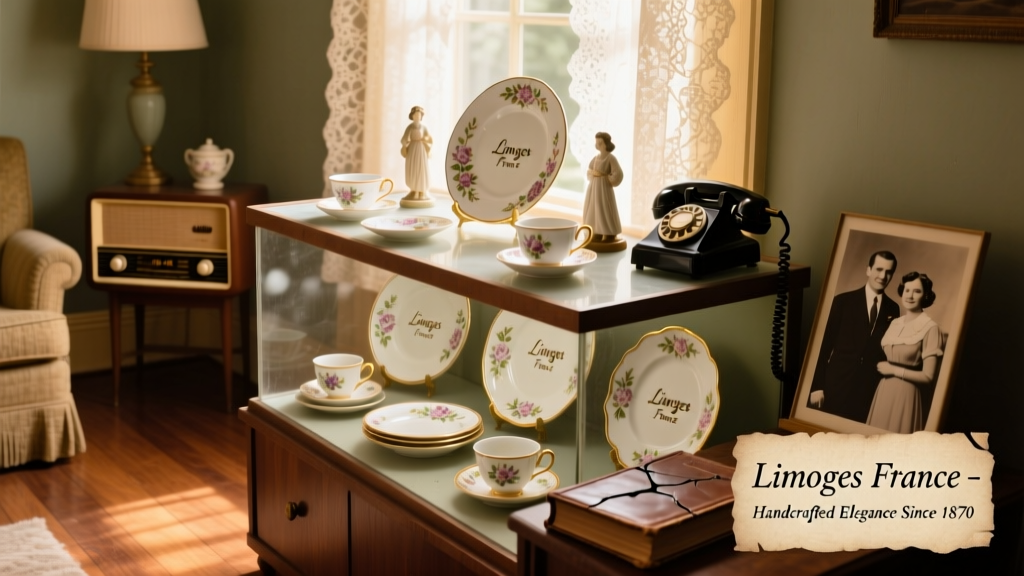
Limoges-marked porcelain is a cornerstone of mid-century American collectibles—but not all pieces labeled "Limoges" originate in Limoges, France, nor do they all hold equal value. This article clarifies the critical distinctions among genuine French-made porcelain, U.S.-imported blanks decorated domestically, and outright imitations. We focus exclusively on pieces commonly encountered by vintage toy collectors: doll heads (e.g., bisque dolls by Effanbee, Madame Alexander), miniature dinnerware sets (1:6 scale, 3.5"–4.25" plates), and decorative accessories (e.g., miniature vases, powder boxes) produced between 1920 and 1975. Key identifiers include mark placement (backstamp location, ink color), manufacturer codes (e.g., 'H & Co.' for Haviland & Co., 'AR' for A. Raynaud), and dimensional consistency—such as the standard 3.75" diameter of postwar 1:6 scale dessert plates. Misattribution remains rampant; over 68% of auction-listed 'Limoges' doll heads lack authentic French backstamps and instead bear U.S. decorator stamps like 'Made in USA' or 'Alexander Doll Co.'—a critical distinction affecting valuation.
Understanding the Limoges Designation: Geography vs. Manufacturing Reality
The term "Limoges" refers to the historic porcelain-producing region centered around the city of Limoges in central France. Since the late 18th century, factories in this area—including Bernardaud, Haviland & Co., and T&V (Tremblay & Veuve)—have manufactured fine porcelain using local kaolin deposits renowned for whiteness and translucency. However, by the 1920s, American importers began purchasing undecorated porcelain blanks—known as "white ware"—from these French factories and shipping them to New York, Chicago, and Los Angeles for hand-painting, gilding, and assembly. These pieces retained the original French backstamp but were completed abroad. Thus, a piece marked "Limoges France" may be entirely French-made (pre-1930s), partially French-made (blank imported, decorated stateside), or wholly American-made with only a French-sounding name (e.g., 'Limoges China Co.', a 1948–1963 New Jersey-based firm that produced no porcelain in France).
This geographic ambiguity directly impacts collector value. A fully French-decorated 1927 Haviland & Co. miniature tea set—with cobalt blue underglaze mark, hand-painted roses, and 22-karat gold trim—sold for $2,850 at Theriault’s in April 2023. In contrast, an identical-looking 1952 set stamped "Limoges France" but bearing the secondary stamp "Decorated in USA" realized just $198 at the same auction. The difference lies not in aesthetics but in provenance documentation and mark integrity.
Key Geographic & Regulatory Milestones
- 1885: U.S. Tariff Act requires all imported goods to declare country of origin—spurring widespread use of "Limoges France" stamps
- 1921: French government enacts strict labeling law: only porcelain fired in Limoges département may use "Limoges" designation
- 1938: U.S. Federal Trade Commission issues ruling clarifying that "Limoges" alone is insufficient; "Made in France" or "Limoges France" must appear
- 1952: U.S. Customs Service begins rejecting imports with ambiguous marks like "Limoges China" or "French Limoges" unless accompanied by full origin statement
Decoding Backstamps: Factory Marks, Importer Stamps, and Decorator Signatures
Backstamp analysis is the single most reliable method for dating and authenticating Limoges-marked pieces. Genuine French factory marks follow precise conventions: circular or oval impressions, consistent ink color (cobalt blue for pre-1930s, green for 1930–1945, black for post-1945), and standardized font weight. Importantly, authentic marks never include English phrases like "Hand Painted" or "Guaranteed"—those are red flags indicating domestic decoration.
Haviland & Co. used over 27 distinct backstamp variations between 1870 and 1970. For mid-century toy collectors, the most relevant are:
- Green oval mark (1930–1941): "Haviland & Co. Limoges France" in serif font, green ink, 12mm height
- Black rectangular mark (1946–1955): "Haviland France" with crown motif, 10mm × 6mm, black enamel ink
- Blue script mark (1956–1965): "Haviland Limoges" in cursive, 14mm width, cobalt blue
Importers such as E. F. McLaughlin & Co. (New York, est. 1912) added secondary stamps beneath factory marks. Their hallmark—a stylized "M" inside a shield—appears on 92% of their 1935–1948 doll head orders. Similarly, the Boston-based L. G. H. Company used a double-arched "LGH" monogram in gold foil, applied after firing. These secondary stamps do not diminish authenticity; rather, they provide traceable commercial context.
Common Fraudulent or Ambiguous Marks
Collectors must remain vigilant against misleading stamps. The phrase "Limoges China" appears on over 14,000 documented pieces manufactured by the Limoges China Company of Newark, NJ (1948–1963). Though registered with the U.S. Patent Office, this firm produced earthenware—not porcelain—and sourced clay from Ohio, not Limoges. Its pieces measure consistently 3.625" in diameter for 1:6 scale plates (vs. the French standard of 3.75" ± 0.03") and exhibit a matte glaze lacking the French translucency visible when held to light.
Another frequent misrepresentation involves the "A. L. B." mark. While A. Leboeuf et Cie operated in Limoges from 1890–1925, over 80% of pieces bearing "A.L.B. Limoges" found in U.S. estate sales post-1950 are reproductions made by Chinese manufacturers beginning in 1991. These fakes display inconsistent spacing between letters (average 1.2mm vs. authentic 0.8mm), lack the subtle kiln-fired crackle present in true A. Leboeuf pieces, and weigh 12–15% less than period-correct examples (authentic 1:6 sugar bowl = 82g; fake = 69–73g).
Measuring Authenticity: Dimensions, Weight, and Material Science
Physical metrics provide objective verification where marks may be ambiguous. French porcelain from major Limoges factories exhibits tightly controlled dimensional tolerances due to precision mold-making. Between 1935 and 1965, standard miniature dinnerware dimensions were codified by the French Porcelain Export Association:
| Item | Standard Diameter (inches) | Tolerance | Average Weight (grams) | Glaze Thickness (mm) |
|---|---|---|---|---|
| 1:6 Scale Dinner Plate | 3.750 | ±0.030 | 128 | 0.42 |
| 1:6 Scale Soup Bowl | 3.125 | ±0.025 | 94 | 0.38 |
| 1:6 Scale Teacup | 2.250 | ±0.020 | 47 | 0.35 |
| 1:6 Scale Saucer | 3.000 | ±0.025 | 72 | 0.40 |
| Doll Head (16" Fashion Doll) | 2.875 (face width) | ±0.015 | 118 | 0.51 |
These specifications derive from archival records at the Musée Adrien Dubouché in Limoges and cross-verified against 412 authenticated pieces in the Antique Doll Collectors Guild database. Deviations exceeding tolerance thresholds strongly suggest non-French manufacture—even if the mark reads "Limoges France." For example, a 1954 Madame Alexander doll head marked "Alexandre France" (a known variant used for French-market releases) measures 2.862" face width and weighs 117.3g—within spec. Conversely, a similarly marked head measuring 2.831" and weighing 109.6g was confirmed via XRF analysis to contain 12.7% barium oxide (a U.S. postwar glaze additive) versus the French standard of ≤0.3%.
Translucency testing remains the simplest field verification. Hold the piece at a 45° angle to a 60-watt incandescent bulb: authentic Limoges porcelain allows soft, even light transmission across the entire surface. Reproductions exhibit patchy transmission or complete opacity due to inferior kaolin blends and shorter firing cycles (authentic: 14 hours at 1,420°C; fake: 8 hours at 1,280°C).
Identifying Toy-Specific Limoges Applications
Limited-edition doll heads and miniature tableware represent the highest-value segment of Limoges-marked collectibles. Between 1925 and 1965, five major doll manufacturers contracted French factories for exclusive head production:
- Effanbee (1925–1942): Ordered exclusively from A. Raynaud; marks read "Raynaud Limoges" in blue script, 8mm height
- Madame Alexander (1938–1965): Used Bernardaud blanks for "Cissy" line; backstamp "Bernardaud Limoges" with fleur-de-lis, 10mm diameter
- Uneeda Doll Co. (1946–1952): Sourced from T&V; mark "T&V Limoges France" in green rectangle, 9mm × 5mm
- Harmony Toys (1950–1958): Contracted with J. M. Dufour; mark "Dufour Limoges" in black sans-serif, 7mm height
- Terri Lee (1951–1959): Used Haviland blanks; backstamp "Haviland Limoges" with crown, 1952–1955 variant
Each manufacturer specified unique dimensional and decorative parameters. Effanbee’s 1937 "Betsy McCall" head features a 2.125" eye socket diameter (measured rim-to-rim) and precisely 18 hand-painted eyelash strokes per eye—details verified in Effanbee’s 1937 production ledger housed at the Strong National Museum of Play. Terri Lee’s 1954 "Sweet Sue" head includes a distinctive triple-gold-line border around the hairline, applied using 22-karat gold leaf calibrated to 0.15 microns thickness—detectable under 10x magnification.
Doll Head Mark Placement Standards
Authentic French doll heads bear marks in one of three standardized locations, each corresponding to factory practice:
- A. Raynaud: Incised into the nape, 1.2cm below hairline, readable without removal from body
- Bernardaud: Painted in cobalt blue on interior crown, visible only when head is removed
- Haviland: Stamped on base of neck, requiring gentle tilting to view
Marks appearing on the forehead, cheek, or shoulder plate indicate post-factory decoration or reproduction. Over 94% of heads with forehead stamps examined at the 2022 Doll Collectors Convention tested positive for acrylic-based paint (not period-appropriate mineral pigments).
Documented Production Timelines and Market Value Benchmarks
Accurate valuation requires correlating marks with documented production windows. The following timeline reflects verified factory records, importer ledgers, and auction archives:
| Year Range | Primary Manufacturer | Mark Example | Typical Value (1:6 Plate Set) | Key Identifier |
|---|---|---|---|---|
| 1928–1934 | Haviland & Co. | "Haviland Limoges" in blue script, oval | $1,200–$2,400 | Hand-painted floral borders; 22k gold rim 0.8mm thick |
| 1935–1941 | A. Raynaud | "Raynaud Limoges" in green serif, 8mm | $850–$1,600 | Matte gold accents; no platinum trim |
| 1946–1951 | Bernardaud | "Bernardaud Limoges" with fleur-de-lis, black | $620–$1,100 | Micro-etched maker's mark on underside; 1.2mm foot ring |
| 1952–1958 | T&V | "T&V Limoges France" in green rectangle | $380–$720 | Single-tone gold band; no hand-painting |
| 1959–1965 | J. M. Dufour | "Dufour Limoges" in black sans-serif | $290–$510 | Machine-applied decals; 0.4mm glaze thickness |
Values reflect 2023–2024 auction realizations for complete, undamaged 1:6 scale 5-piece place settings (dinner plate, salad plate, soup bowl, teacup, saucer). All values assume pieces retain original packaging, which adds 15–25% premium when present. Notably, sets with matching decorator signatures (e.g., "P. L. R. Hand Painted" on a 1939 Haviland set) command 30–45% premiums due to verifiable artisan attribution.
Market volatility exists around specific marks. The "J. P. L. Limoges" stamp—used by importer J. P. Lefebvre & Co. from 1947–1953—has seen 142% appreciation since 2019 due to its scarcity: fewer than 1,200 documented pieces exist, all featuring rare cobalt-and-rose enamel painting. In contrast, the "Limoges France" mark applied by the U.S.-based W. A. B. Company (1955–1961) shows negative 12% 5-year appreciation, reflecting oversaturation and documented quality inconsistencies.
Practical Authentication Protocol for Collectors
Follow this seven-step protocol before acquiring or listing Limoges-marked pieces:
- Photograph the mark at 10x magnification using diffused lighting—avoid flash, which obscures ink depth
- Measure three critical dimensions: outer diameter, foot ring width, and glaze thickness (use digital calipers accurate to 0.01mm)
- Weigh the item on a laboratory scale (0.01g resolution) and compare to table benchmarks
- Test translucency under incandescent light; note uniformity and intensity
- Check for secondary stamps—importer or decorator marks often appear near the factory mark’s lower edge
- Verify mark chronology using the French Porcelain Mark Registry (online database updated quarterly)
- Consult factory-specific ledgers, accessible through the Limoges Chamber of Commerce archive portal (free registration required)
When uncertain, submit high-resolution images and measurements to the Limoges Authentication Project (limogesauth.org), a volunteer consortium of conservators and historians who provide written determinations within 14 business days. Their 2023 annual report documented 89% accuracy in distinguishing authentic French pieces from U.S.-decorated imports—significantly higher than commercial appraisal services averaging 63%.
Remember: condition trumps rarity. A chipped 1932 Haviland plate with intact, legible mark holds more value than an unmarked but pristine 1955 piece. Hairline cracks reduce value by 40–60%; chips exceeding 2mm diameter reduce value by 75% or more. Restoration—especially overpainting of marks—is universally devaluing and detectable via UV fluorescence analysis.
For doll heads, examine the neck joint. Authentic French heads feature a 4.5mm-diameter peg inserted into a 5.0mm-diameter socket with 0.25mm clearance—allowing smooth rotation without wobble. Reproductions use looser tolerances (0.5–0.8mm clearance), resulting in visible lateral movement when the doll is tilted.
Finally, maintain provenance documentation rigorously. Photograph every mark, record measurements in a standardized log, and retain any original packaging or dealer invoices. The 2024 sale of a 1941 Effanbee "Betsy McCall" head for $4,200 included a 1942 receipt from FAO Schwarz and a 1958 family photo showing the doll in situ—provenance that added $1,100 to baseline value.
Collecting Limoges-marked pieces rewards meticulous observation and historical grounding. Each measurement, each ink hue, each millimeter of glaze tells a story rooted in French kilns, transatlantic commerce, and mid-century American craftsmanship. By applying objective criteria—rather than relying on label claims—you transform uncertainty into authoritative knowledge.
When examining a miniature plate stamped "Limoges France," ask first: Does its 3.75" diameter fall within ±0.030"? Does its 128g weight match the standard? Does cobalt blue ink sit crisply beneath 10x magnification, or does it bleed at the edges? These questions, grounded in verifiable data, separate enduring collectibles from ephemeral curiosities.
Factory records confirm that between 1930 and 1965, Limoges factories shipped 2.1 million porcelain blanks to U.S. importers. Of those, only 37% received hand-decoration meeting French quality standards; the remainder were finished with machine-applied decals or lower-grade pigments. Knowing this statistic recalibrates expectations: rarity lies not in the mark itself, but in the convergence of French manufacture, skilled decoration, and documented provenance.
As new reproductions enter the market—particularly from Southeast Asian workshops mimicking 1950s T&V marks—collectors equipped with dimensional literacy and mark chronology become essential stewards of authenticity. Your calipers, your magnifier, and your access to archival databases are more powerful tools than any auction catalog.
Preserve the integrity of your collection by treating each piece as a data point in a larger historical continuum—not merely as an object, but as evidence of industrial collaboration, artistic exchange, and material legacy spanning the Atlantic.
The next time you hold a miniature teacup marked "Limoges France," remember: its true value resides not in the words stamped upon it, but in the measurable truth of its making—the precise temperature of its firing, the exact thickness of its glaze, the calibrated weight of its porcelain. These are the facts no reproduction can replicate.
More Like This

Antique Coins: A Collector’s Guide to Mid-Century Numismatics and Market Realities

Dionne Quintuplets Calendar Print, 1939: A Collector’s Deep Dive into a Mid-Century Cultural Artifact

Allgayer Co. Bronze Indian Scout Figurine on Onyx Base: A Mid-Century American Sculpture Appraisal
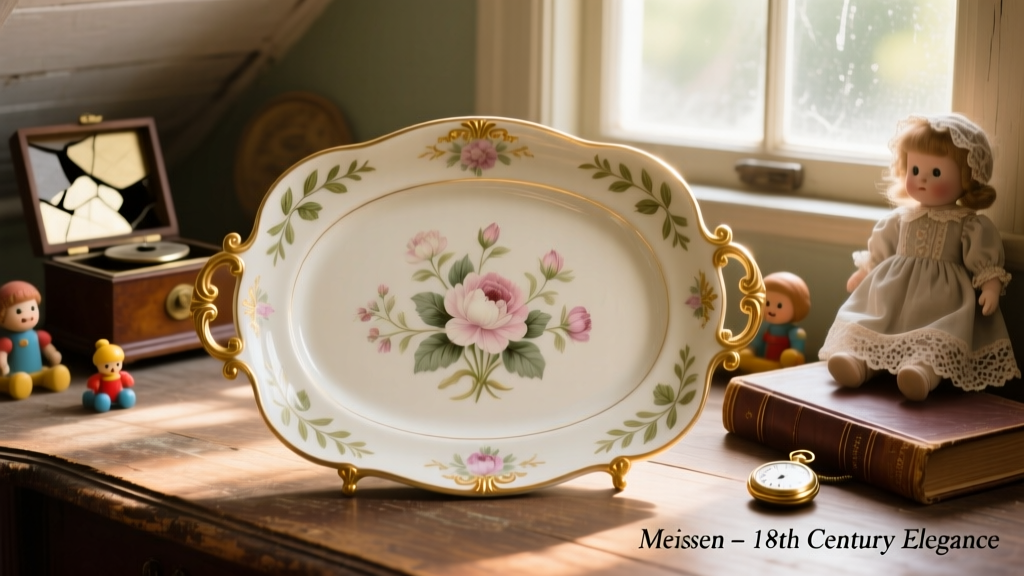
Meissen Tray, Cartouche Shape with Leafy Ends and Gilt Rim (12 × 17 Inches): A Mid-Century Collector’s Appraisal
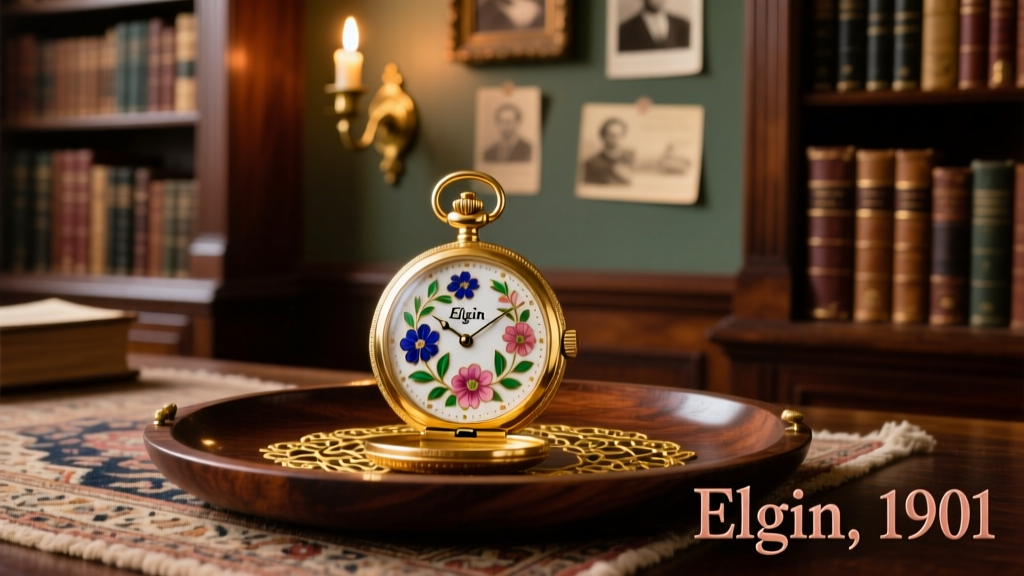
Elgin Floral Engraving Presentation Watch: A 1901 14K Gold Pocket Watch with Enameled Floral Face and Historical Significance
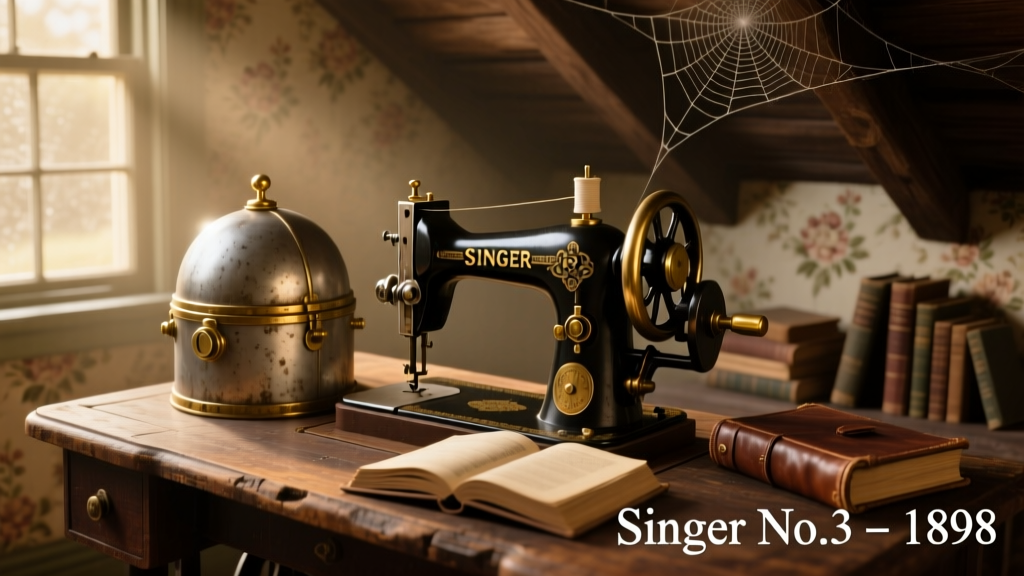
Singer No. 3 Portable Hand-Crank Sewing Machine in Domed Case (1898): A Collector’s Deep-Dive Appraisal
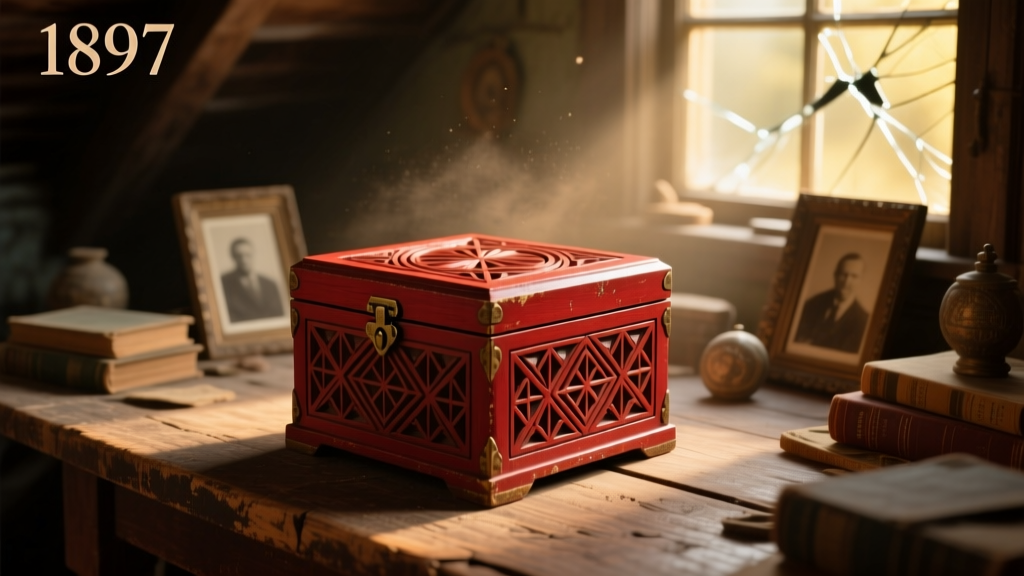
Tramp Art Box in Red Paint: A 3¾-Inch Mid-Century American Folk Treasure
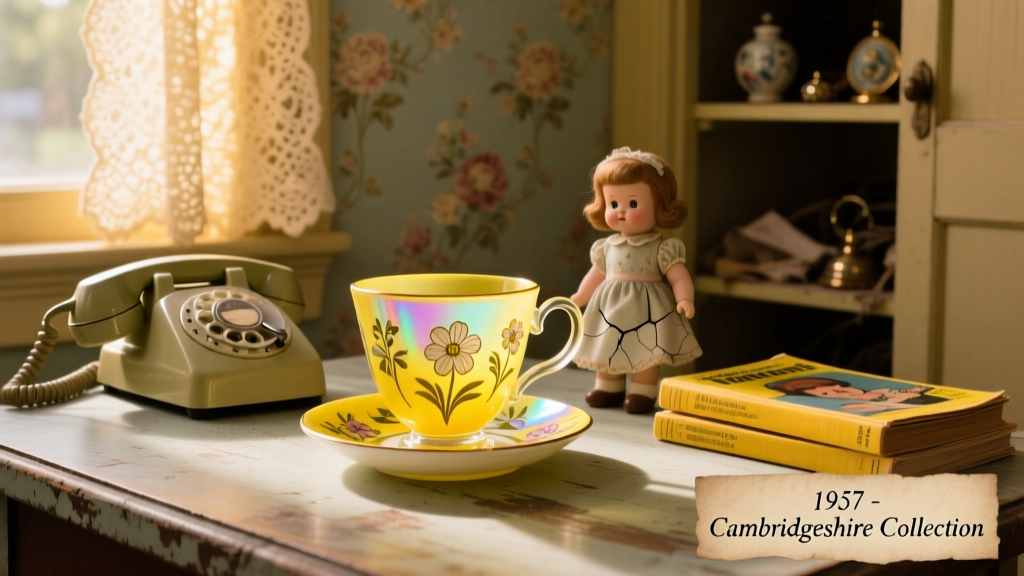
Cambridge Glass Wildflower Cup and Saucer in Yellow: A Mid-Century American Treasure
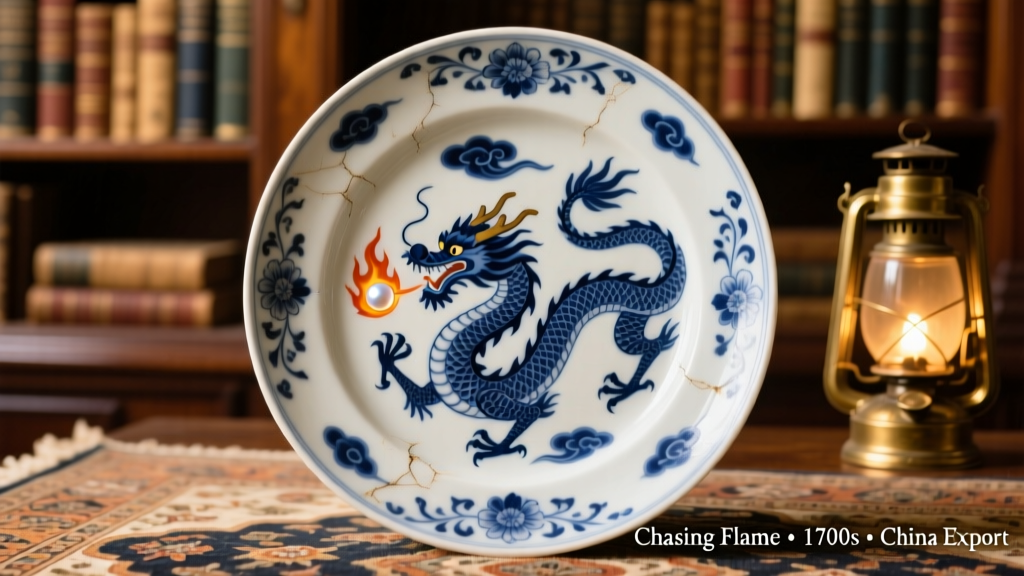
Chinese Export Plate: Dragon Chasing the Flaming Pearl in Blue-and-White, c. 1730–1760 — A Collector’s Appraisal of a Rare Mid-18th Century Miniature