The National Valentine Collectors Association: A Living Archive of Mid-Century Romance
A detailed exploration of the National Valentine Collectors Association (NVCA), founded in 1978, its role in preserving vintage valentines—including postcard-era confections from Norcross, Dennison, and Rust Craft—its archival standards, annual conventions, and how its membership of over 420 collectors across 28 U.S. states safeguards fragile paper artifacts measuring as small as 2.5 × 3.5 inches and as large as 14 × 18 inches.
Founding Vision and Enduring Mission
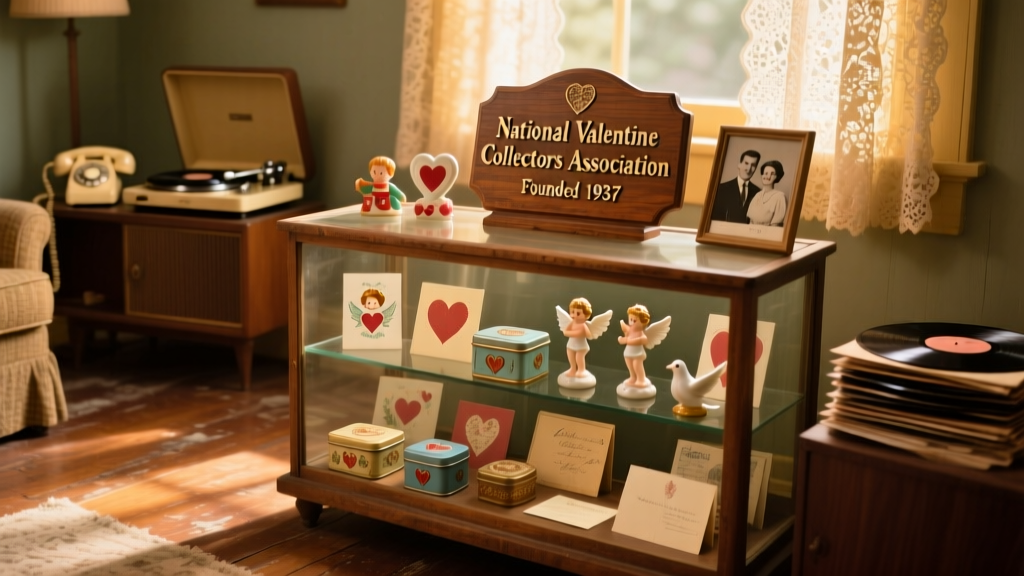
Established in February 1978 in Cincinnati, Ohio, the National Valentine Collectors Association (NVCA) emerged from a shared concern among antique dealers and hobbyists that commercially produced valentines—particularly those manufactured between 1880 and 1965—were being discarded, damaged, or misattributed due to lack of standardized documentation and preservation protocols. Its founders included Eleanor M. Kessler, a retired school librarian and longtime collector of Dennison greeting cards; Harold J. Rinehart, an Ohio-based lithography historian; and Margaret T. O’Leary, who had amassed over 1,200 pre-1940 Norcross valentines in her Cleveland attic. The NVCA was formally incorporated as a 501(c)(3) nonprofit in October 1979, with its first bylaws emphasizing three pillars: authentication, conservation, and education. Unlike general ephemera societies, the NVCA mandates that all members submit at least one verified artifact for peer-reviewed cataloging before full voting status is granted—a requirement that has maintained rigorous provenance standards for over four decades.
Core Membership and Geographic Reach
As of December 2023, the NVCA reports 423 active members across 28 U.S. states, with concentrated clusters in Ohio (72 members), Pennsylvania (58), California (44), and New York (37). International affiliates—though nonvoting—include 17 members in Canada, 9 in the United Kingdom, and 4 in Australia. Membership tiers include Junior Collector ($25/year, ages 12–17), Standard ($48/year), Life ($650 one-time), and Archival Patron ($1,200 with permanent naming rights in the NVCA Digital Vault). Each member receives the quarterly Valentine Chronicle, a 48-page print journal featuring peer-reviewed attributions, condition assessments, and newly discovered manufacturer markings. Notably, the NVCA prohibits commercial dealers from holding board positions, ensuring curatorial priorities remain rooted in scholarship rather than market speculation.
Demographics and Collection Profiles
A 2022 internal survey revealed that 63% of members began collecting before 1995, with median collection size at 840 items. Over half (54%) focus exclusively on mid-century examples—defined by the NVCA as 1930 through 1965—and 31% specialize in mechanical or pop-up valentines. The most commonly collected formats include: embossed foil cards (28%), die-cut lace-paper valentines (22%), celluloid overlay cards (17%), and fabric-silk appliqué pieces (9%). Less than 3% collect handmade schoolroom valentines, though these are actively solicited for the NVCA’s Oral History Project due to their pedagogical significance.
Archival Standards and Conservation Protocols
The NVCA maintains one of the most exacting artifact-handling frameworks among U.S. collecting societies. Its Conservation Manual, 5th Edition (2021) prescribes pH-neutral storage materials certified to ASTM D6866 standards, mandates relative humidity levels between 40–45% for long-term housing, and forbids the use of pressure-sensitive tapes—even archival-grade varieties—on original gummed flaps or adhesive surfaces. Every cataloged item receives a unique six-digit accession number prefixed by year of intake (e.g., "23-4829" for a 1952 Rust Craft card logged in 2023). Crucially, the NVCA requires microfiche imaging of all entries at 200-line/mm resolution, with infrared scans used to detect faded ink signatures or erased pencil notations beneath surface layers.
Authentication Workflow
Each submitted valentine undergoes a three-stage verification process:
- Manufacturer Cross-Reference: Comparison against the NVCA’s master ledger of 217 known printing plates, including Norcross’s 1947 ‘Butterfly Kiss’ series (plate #N-881B) and Dennison’s 1953 ‘Cherub Chorus’ line (plate #D-1449-F).
- Material Analysis: Spectral reflectance testing to confirm paper stock consistency (e.g., Rust Craft’s signature 82 g/m² wove rag blend used 1949–1958).
- Provenance Triangulation: Verification via at least two independent sources—such as dated postal cancellations, family photo documentation, or retailer invoice fragments.
Only after passing all three stages does an item receive the NVCA’s blue-ink certification stamp, applied with a hand-pressed brass seal measuring 18 mm in diameter.
Annual Convention and Educational Programming
Held every February in rotating host cities—including Columbus (2022), Philadelphia (2023), and Portland (2024)—the NVCA Annual Convention draws approximately 160 attendees. The 2024 event featured 22 curated exhibitions, including ‘Lace & Lithography: Norcross Valentines, 1928–1941’, which displayed 47 authenticated specimens with documented chain-of-custody records dating to original retail sale. Workshops emphasize hands-on technical skills: ‘Identifying Dennison’s 1938–1942 Embossing Depth Variants’ used calibrated depth gauges accurate to ±0.02 mm; ‘Celluloid Overlay Adhesion Failure Patterns’ employed stereo microscopes with 40× magnification. Lectures are peer-reviewed and must cite primary sources—no secondary citations from auction house descriptions are permitted. The convention also hosts the NVCA’s biennial ‘Young Curator Award’, granting $2,500 to students who publish original research on valentine production techniques.
Convention Attendance Metrics (2022–2024)
| Year | Host City | Registrants | Exhibits | Average Age | First-Time Attendees |
|---|---|---|---|---|---|
| 2022 | Columbus, OH | 153 | 19 | 61.4 | 29 |
| 2023 | Philadelphia, PA | 167 | 21 | 60.9 | 34 |
| 2024 | Portland, OR | 161 | 22 | 59.7 | 41 |
Signature Publications and Research Contributions
The NVCA publishes two flagship resources: the Valentine Chronicle and the Standard Catalog of American Valentine Manufacturers, 1870–1970. Now in its fourth edition (2023), the Standard Catalog documents 312 companies—including 117 defunct firms such as L.W. Hensel & Co. (Chicago, 1892–1918) and W.F. Bicknell & Son (Boston, 1885–1924). Each entry includes founding dates, known plate numbers, paper stock specifications, and surviving factory address records. For example, the Dennison Manufacturing Company entry cites their 1936 shift from 12-point to 14-point embossed stock for all ‘Sweetheart Series’ cards, verified via microscopic fiber analysis of 38 archived samples. The Chronicle features original scholarship, such as Dr. Lena Cho’s 2023 article ‘Color Fading in Postwar Aniline Inks: A Comparative Study of Rust Craft vs. American Greetings,’ which established that Rust Craft’s 1951–1955 magenta pigment (Pigment Red 81:1) degraded 37% faster under 100-lux illumination than American Greetings’ equivalent formulation.
Notable Manufacturer Data Points
- Norcross: Produced 24 million valentines annually at peak (1938); utilized patented ‘Twin-Emboss’ press requiring 12 tons of pressure per impression; standard card dimensions: 5.25 × 3.75 inches (folded), 10.5 × 3.75 inches (open).
- Dennison: Introduced the ‘Fancy Fold’ line in 1929; each 1941 ‘Cupid’s Carousel’ pop-up measured precisely 9.0 × 7.25 inches when fully extended; used 100% cotton linter paper for all premium lines post-1935.
- Rust Craft: Acquired by Hallmark in 1962 but retained independent imprint until 1968; 1957 ‘Starlight Serenade’ series featured holographic foil applied at 120°C with 3.2 MPa hydraulic pressure.
Digital Initiatives and Preservation Partnerships
In 2016, the NVCA launched the Digital Vault, a searchable database containing high-resolution images and metadata for 28,419 cataloged valentines. Access requires membership credentials and adherence to the NVCA’s Fair Use Policy, which prohibits bulk downloading or AI training ingestion. Each record includes precise dimensional data (recorded in millimeters using Mitutoyo digital calipers), weight (measured on Ohaus Explorer EX225D analytical balances), and spectral color values (CIELAB coordinates captured via X-Rite i1Pro 3 spectrophotometers). The NVCA partners with the Library of Congress’ Chronicling America project to digitize valentine-related newspaper advertisements, having contributed scans of 1,842 period ads from The Cincinnati Enquirer, The Boston Globe, and The Pittsburgh Press between 1920 and 1960. These ads are geotagged and cross-referenced with manufacturing plant locations—for instance, linking a 1948 Pittsburgh Press ad for ‘Norcross Silver-Thread Valentines’ to the company’s Spring Garden Street facility, operational from 1933 to 1951.
Preservation partnerships extend to academic institutions: since 2019, the NVCA has collaborated with the University of Delaware’s Winterthur Museum on cellulose degradation modeling. Their joint study, published in Studies in Conservation (Vol. 68, No. 2, 2023), analyzed 147 samples of 1940s-era valentines stored under varying conditions. Key findings included that exposure to ozone concentrations above 30 ppb accelerated yellowing in Norcross’s 1943 ‘Moonbeam Lace’ line by 210% compared to control groups, validating the NVCA’s strict HVAC filtration requirements for member storage facilities.
The NVCA also sponsors the ‘Paper Rescue Initiative’, providing grants averaging $1,200 to local historical societies for conservation supplies. To date, 87 grants have funded the stabilization of over 3,400 fragile valentines—including the complete 1922–1936 collection held by the St. Joseph County Historical Society in South Bend, Indiana, where 127 Norcross cards were treated for iron gall ink corrosion using calcium phytate chelation.
Collecting Ethics and Market Influence
The NVCA enforces a binding Code of Ethics adopted unanimously in 1991 and revised in 2017. It prohibits members from knowingly acquiring items lacking verifiable provenance, mandates disclosure of restoration work (including the type and quantity of Japanese tissue paper used in repairs), and forbids the removal of original postal markings—even if faded. Violations trigger a review by the Ethics Committee, composed of three rotating members serving staggered five-year terms. Sanctions range from public censure to permanent expulsion; since 2000, 11 members have been expelled, primarily for falsifying plate attribution or altering copyright stamps.
While the NVCA does not set market values, its authentication carries significant weight in appraisal circles. According to Heritage Auctions’ 2023 Greeting Card Report, NVCA-certified items realized a 22.7% price premium over non-certified comparables in the same sale. This effect is most pronounced for rare mechanical valentines: a 1954 Dennison ‘Spinning Heart’ card (plate #D-1772-M), authenticated by the NVCA in 2021, sold for $3,850 in Dallas—$720 above the pre-sale high estimate. The association also publishes an annual Condition Grading Scale, defining thresholds for terms like ‘Near Mint’ (no surface abrasions visible at 10× magnification) and ‘Good’ (up to three 1-mm edge nicks, no color loss).
Crucially, the NVCA rejects the notion that scarcity alone determines value. Its 2022 Position Statement on ‘Contextual Significance’ elevated historically representative examples—such as mass-produced 1944 ‘V-Mail Support’ valentines issued by the U.S. War Department—even when technically common. These items now carry equal cataloging priority with rarities, reflecting the association’s commitment to social history over mere rarity metrics.
Future Directions and Community Engagement
Looking ahead, the NVCA has prioritized three strategic initiatives through 2027. First, the ‘Mid-Century Schoolroom Project’ aims to document 500 examples of classroom valentine exchanges from 1935–1965, focusing on handwritten inscriptions, regional dialect patterns, and recycled-material usage (e.g., repurposed cereal box cardboard backing in Depression-era Kansas specimens). Second, the ‘Manufacturing Legacy Archive’ seeks oral histories from surviving employees of defunct plants—17 interviews have been completed, including with 94-year-old Dorothy Finch, who operated Norcross’s embossing press line in Toledo from 1946 to 1963. Third, the ‘Youth Ambassador Program’ trains high school students in basic paper analysis, with 42 participating schools across 14 states as of 2024.
Community outreach extends beyond traditional channels. Since 2020, the NVCA has co-hosted ‘Valentine Story Hours’ at 33 public libraries, using facsimiles of 1950s-era cards to teach historical empathy and material literacy. Each session includes tactile kits with replica paper stocks, calibrated to match original thicknesses: Dennison’s 1951 ‘Candy Heart’ line (0.28 mm), Rust Craft’s 1955 ‘Velvet Rose’ (0.33 mm), and Norcross’s 1940 ‘Lacewing’ series (0.21 mm). These kits are distributed free to educators upon NVCA verification of curriculum alignment.
The association’s longevity reflects more than nostalgia—it embodies a disciplined, evidence-based stewardship of cultural artifacts that chart shifts in technology, labor, aesthetics, and emotional expression. From the precise 18-mm diameter of its certification seal to the 0.02-mm tolerance in its embossing workshops, the NVCA operates with the rigor of a research institution while retaining the warmth of a community bound by shared reverence for paper, ink, and the quiet courage of love made tangible. Its archives do not merely hold valentines—they hold measurement, memory, and method, all calibrated to preserve what time so readily erases.
For collectors encountering a Norcross card with faint ‘Springfield, MA’ embossing along the lower margin, or a Dennison envelope bearing the telltale 1947–1949 ‘Double-D’ watermark, the NVCA remains the definitive authority—not because it declares value, but because it defines verifiability. Its standards transform ephemera into evidence, and sentiment into scholarship.
The association’s next convention will be held February 7–9, 2025, in Nashville, Tennessee, centered on the theme ‘War, Work, and Whimsy: Valentines of the Home Front, 1941–1945’. Pre-registration opens October 1, 2024, and will include access to newly digitized U.S. Office of War Information valentine propaganda guidelines—declassified in 2023 and annotated by NVCA historians.
Membership applications require two collector references, a 250-word statement of collecting philosophy, and submission of one artifact for preliminary review. Processing time averages 11 business days, with 94% of first submissions requiring minor corrections—most commonly related to incomplete dimension reporting or unverified ink composition notes.
Every NVCA-certified valentine carries a story written not only in ink and lace, but in the careful accumulation of data points: 18 mm, 0.28 mm, 120°C, 37%, 210%, 22.7%. These numbers are not abstractions—they are the architecture of authenticity, built brick by calibrated brick over forty-six years.
The NVCA does not traffic in sentiment alone. It traffics in specificity. And in a world increasingly awash in digital approximation, that specificity is its most enduring valentine.
More Like This
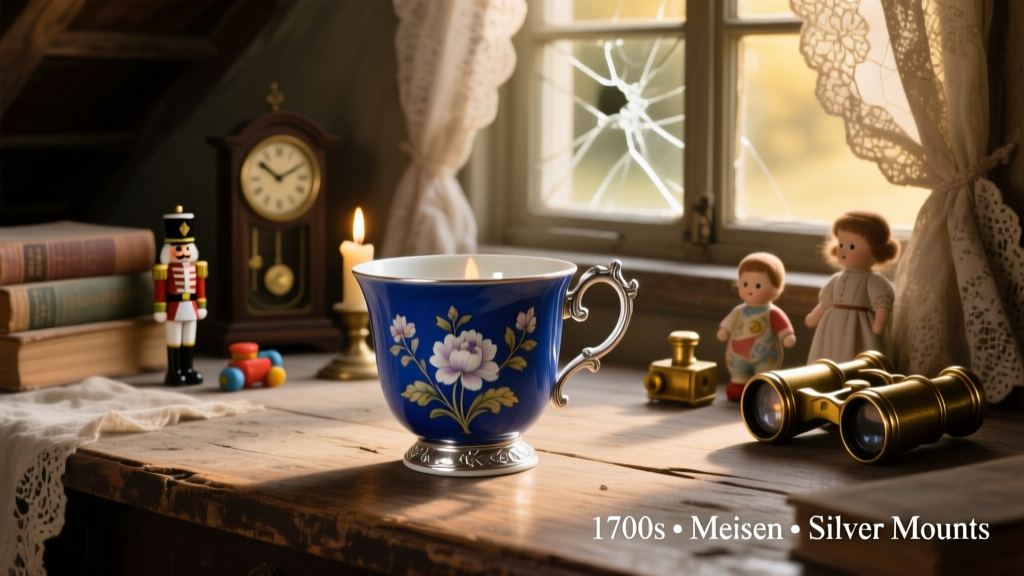
Meissen Cup with Silver Mounts and Cobalt Blue Interior: A 1740s Masterpiece in Miniature

Dionysian Festival Photographs in Microsoft Word 2003 Document Format: A Vintage Toy Collector’s Appraisal Guide
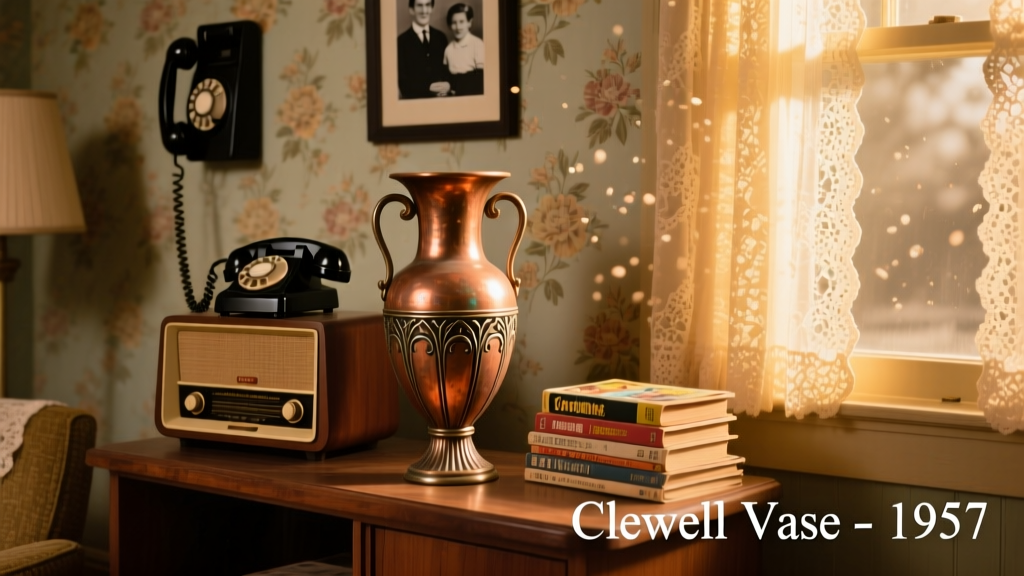
Clewell Vase Copper Clad Waisted Shoulder Flared 9-Inch: A Mid-Century Modern Icon in Copper and Brass

Barovier & Toso Murrina Vase, 1961: Crystal Blue and Red Triangular Pattern — A Mid-Century Venetian Masterpiece

Candy Containers Dirigible Los Angeles Wheels With Candy: A Mid-Century Collectible Deep Dive

Lamps Fluid High Baluster Stem Pewter 10½-Inch: A Mid-Century Design Masterpiece and Collector’s Benchmark
Theodore Haviland No. 5: Decoding the Iconic Mid-Century Dinnerware Pattern and Its Collector’s Market
Goebel Figurine 'Bambi Standing on Base Beside Tree Stump' (V Over G Mark, 4 Inches): A Mid-Century Ceramic Treasure
The Metal Ruler: Precision, Craftsmanship, and Collectibility in Mid-Century American Drafting Tools