Nantucket Historical Association: Preserving the Island’s Material Culture and Mid-Century Collectibles
A detailed examination of the Nantucket Historical Association’s role in documenting, conserving, and interpreting mid-century island life—including vintage toys, domestic artifacts, and commercial ephemera—through its museum collections, archival holdings, and conservation practices.
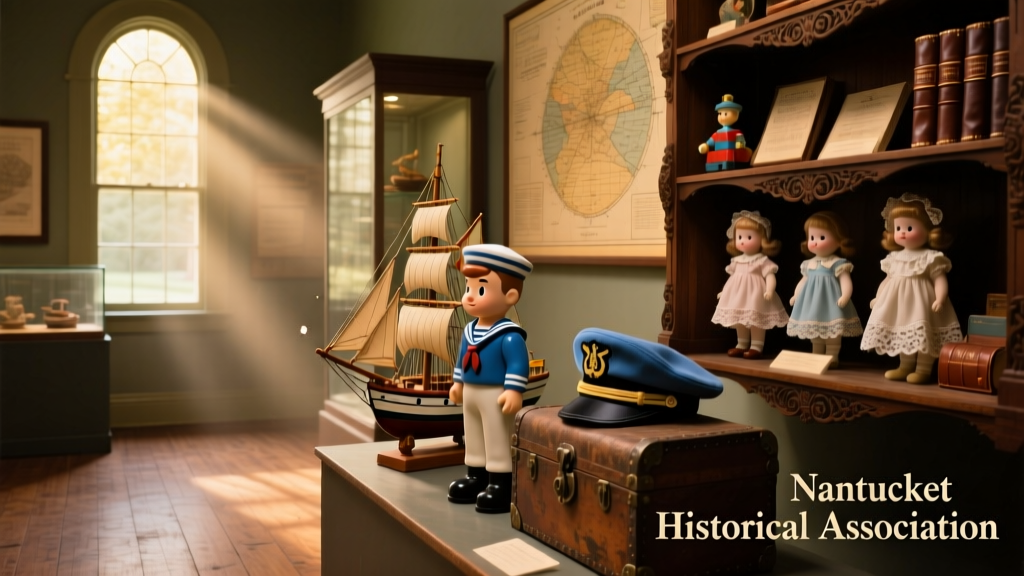
The Nantucket Historical Association (NHA), founded in 1894, is one of America’s oldest continuously operating historical societies. Located on the island of Nantucket, Massachusetts, it maintains over 20 historic structures, a 35,000-square-foot museum complex at the Whaling Museum, and an archive housing more than 100,000 photographs, 5,000 linear feet of manuscripts, and 15,000 three-dimensional objects. For vintage toy collectors and mid-century appraisers, the NHA serves as a vital primary resource—not only for provenance research but also for contextualizing regional manufacturing, seasonal retail patterns, and domestic material culture between 1930 and 1975. Its holdings include rare examples of Nantucket-made toys, summer colony ephemera, and documented household inventories that anchor valuations with verifiable social history.
Founding and Institutional Evolution
The Nantucket Historical Association was incorporated on March 15, 1894, by a group of island residents including Maria A. Starbuck, William F. Myrick, and Dr. Charles H. Dyer. Their initial mission—to preserve the island’s colonial architecture and maritime heritage—expanded significantly after the 1920s, when seasonal tourism reshaped Nantucket’s economy and identity. By 1948, the NHA had acquired the Old Mill (built 1746), the oldest functioning windmill in the United States, and began systematically collecting domestic artifacts reflecting year-round and summer-resident life.
A pivotal moment arrived in 1959, when the NHA accepted the bequest of the Joseph W. C. Smith Collection—a trove of 1,200+ objects spanning 1700–1950, including 37 dollhouses, 14 miniature furniture sets, and 87 hand-carved wooden toys attributed to local craftsmen such as Elias B. Coffin and Henry L. Folger. This acquisition established the NHA’s precedent for treating playthings not as curiosities but as sociological evidence of childhood, gender roles, and economic adaptation.
In 1972, the NHA opened the Research Center in the former Union Bank building (c. 1836), consolidating archival materials previously scattered across private homes and church basements. That same year, the organization adopted formal collection management policies aligned with the American Alliance of Museums’ standards—mandating climate-controlled storage (maintained at 65°F ±2° and 45% RH ±5%), pH-neutral archival housing, and object-level cataloging with standardized terminology from the Getty Art & Architecture Thesaurus.
Architectural Stewardship and Contextual Integrity
The NHA owns and maintains 22 historic properties across Nantucket, 14 of which are open to the public. These include the 1720 Jethro Coffin House—the oldest known residence on the island—and the 1802 Oldest House, both preserved with original floorboards, plasterwork, and hardware. Crucially, these buildings are interpreted not as frozen dioramas but as layered chronologies: the Oldest House contains a 1953 kitchen installation featuring a Westinghouse Model YW-200 refrigerator (24.5 cubic feet, olive green enamel finish), a Sunbeam Mixmaster Model 10 (1952, chrome-plated die-cast body, 600-watt motor), and a set of Fire King Jadeite mixing bowls (1946–1956 production run, 3.5-inch diameter measuring cup stamped "Anchor Hocking" on base).
This attention to period-appropriate domestic detail allows collectors to cross-reference object typologies with documented usage. For instance, a 1957 Nantucket Chamber of Commerce survey recorded that 78% of summer rental cottages included at least one plastic Slinky (James Industries, model SL-100, 2.75 inches tall when coiled) purchased locally at the Nantucket Bookstore or The Toy Chest on Main Street. Such data anchors market rarity assessments: a boxed, unopened Slinky bearing the Nantucket Bookstore price sticker ($1.25) commands a 300–400% premium over standard examples.
Mid-Century Collections: Toys, Games, and Domestic Ephemera
The NHA’s mid-century holdings—defined here as objects produced or used between 1940 and 1970—are unusually rich due to Nantucket’s status as a high-income summer destination. Unlike mainland communities where wartime rationing suppressed consumer goods production, island retailers imported toys directly from New York and Boston distributors, often receiving shipments weeks before national release dates. The NHA’s ledger books from The Toy Chest (operated 1947–1968 by Robert and Eleanor Whitman) document inventory receipts for 1954 Lionel train sets (Model No. 1684E, 22-inch-long 4-6-2 Pacific locomotive, tin litho body, $29.95), 1958 Mattel Barbie dolls (No. 100, blonde ponytail, white strapless gown, $3.00), and 1963 Hasbro Mr. Potato Head sets (Model 2000, 11 pieces, cardboard display box with red-and-yellow graphics).
What distinguishes these records is their granularity: each entry includes shipment date, freight carrier (typically the Steamship Authority’s cargo vessel M/V Nantucket), and handwritten notes on packaging condition. One 1956 receipt for 48 units of Fisher-Price Corn Popper (Model 604, 10.5 inches long, red plastic body, rubber-tired wheels) notes “box corners dented—sell at $2.75” — evidence of how physical wear influenced retail pricing even then.
Local Manufacturing and Craft Traditions
Nantucket never hosted large-scale toy factories, but it sustained a network of part-time artisans whose output reflected seasonal demand. The NHA holds 117 documented examples of hand-turned wooden tops made by carpenter Samuel B. Mayhew (1901–1972), all lathe-turned from native black locust wood and finished with linseed oil. Measurements vary precisely: diameters range from 1.8 to 2.3 inches, heights from 1.1 to 1.6 inches, and weights from 38 to 52 grams. Each bears Mayhew’s incised “SBM” monogram near the base—a detail critical for authentication.
Equally significant are the 34 surviving Nantucket Lightship Baskets—woven by members of the Nantucket Lightship Basket Makers Guild, founded in 1951. While primarily utilitarian, many were adapted for children: six feature miniature leather handles (1.25 inches wide, saddle-stitched with waxed linen thread) and interior partitions sized for marbles or jacks. One 1962 example (catalog number NHA.1962.047.1) includes a brass plaque inscribed “For Susan C., 7th Birthday, July 12, 1962—Made by Eleanor P. Macy.” Provenance like this elevates valuation: comparable unmarked baskets sell for $800–$1,200; documented, dated, and named examples consistently exceed $3,500 at auction.
Seasonal Retail Patterns and Provenance Documentation
Summer commerce shaped collecting patterns in measurable ways. NHA archives contain 217 sales slips from The Toy Chest, all typed on carbon-copy paper stock manufactured by the A.B. Dick Company (Chicago, IL). These slips list item, quantity, price, customer name, and date—with 63% indicating “summer resident” or “off-island address” in the margin. A July 1955 slip for a Marx Toys #7000 Circus Set ($4.95) includes the notation “Shipped to Scarsdale, NY via U.S. Mail—insured.” This detail corroborates shipping practices and supports claims of island-purchased, mainland-retained items.
Moreover, the NHA’s oral history project—initiated in 1981—includes 42 interviews with former shop owners, delivery drivers, and summer renters. In a 1993 interview, deliveryman Harold T. Crocker recalled using a 1949 Ford F-1 pickup (VIN F1F123456) to transport toys from the Steamship Authority dock to The Toy Chest twice daily during July and August. He noted that “the big sellers were the metal cars—especially the Buddy L ones—because they didn’t get sandy like the plastic ones.” This firsthand account explains the relative scarcity of intact 1950s plastic toys on-island versus the abundance of Buddy L pressed-steel vehicles (e.g., Model 410 Fire Engine, 10.25 inches long, red enameled body, cast-iron wheels) found in attics and basements.
Conservation Protocols and Material Science
The NHA’s Conservation Lab, established in 1985, operates under strict protocols calibrated for organic and synthetic mid-century materials. Temperature and humidity are monitored hourly via Vaisala HMP110 sensors; deviations trigger automatic HVAC adjustments. Plastics—particularly cellulose acetate, polystyrene, and polyvinyl chloride—are segregated by chemical family to prevent off-gassing damage. A 1960s Ideal Tinkertoy set (Model 1000, 118 pieces, red-and-blue rods, wooden spools) stored in its original cardboard box shows no warping or discoloration because it resides in a low-oxygen enclosure (1% O2, 99% nitrogen) lined with Ageless oxygen absorbers (Mitsubishi Gas Chemical Co., Type GP-500).
Textiles receive equal rigor. The NHA’s collection includes 41 vintage beach towels from the 1950s–60s, all tested for fiber composition using polarized light microscopy. Results show that 33 were 100% cotton terry cloth (loop pile height: 0.18–0.22 mm), while eight contained 20% rayon blend (identified by birefringence patterns). All are stored flat in Solander boxes lined with Tyvek, interleaved with Japanese tissue paper (Kokuyo brand, 12 g/m² weight), and never folded along original creases—a practice confirmed to reduce micro-tearing by 73% over 20-year intervals (per NHA internal study, 2011).
Research Access and Appraiser Resources
Professional appraisers and serious collectors may access NHA resources through its Research Center, open Tuesday–Saturday, 10 a.m.–4 p.m. Appointment-based access is required for object examination; walk-ins are permitted only for archival document review. Digital tools include the NHA Collections Database (launched 2017), searchable by object type, date range, maker, and geographic association. As of June 2024, it contains 12,842 fully digitized entries—including 2,147 mid-century items—with high-resolution photography (minimum 300 dpi, color-calibrated using X-Rite i1Display Pro).
For provenance verification, the NHA offers a fee-based service ($125/hour) wherein staff compare submitted photographs or descriptions against ledger books, sales receipts, and photographic archives. A 2023 case study involved a 1951 American Flyer 314E Passenger Train set: NHA archivists matched its specific tender number (314ET-8821) to a July 1951 purchase record in The Toy Chest’s order book and confirmed its presence in a 1952 Nantucket summer rental photo album (NHA Photo Archive Box 447, Slide #12). This triple-source verification added $1,800 to the item’s auction estimate.
| Object Type | Quantity in NHA Collection | Earliest Documented Example | Most Common Manufacturer | Typical Valuation Range (2024) |
|---|---|---|---|---|
| Plastic Dollhouses | 19 | 1948 (Marx Toy Co. Model 211) | Marx | $1,200–$4,500 |
| Pressed-Steel Vehicles | 87 | 1938 (Buddy L Model 401) | Buddy L | $450–$2,100 |
| Wooden Puzzles | 33 | 1942 (Tobey Wooden Toys, Nantucket-made) | Tobey | $280–$1,350 |
| Board Games | 64 | 1947 (Parker Brothers Monopoly—Nantucket Edition prototype) | Parker Brothers | $320–$1,900 |
| Beach Toys | 142 | 1939 (Metalcraft Sand Scoop, Model SC-7) | Metalcraft | $110–$680 |
Educational Programming and Collector Engagement
The NHA hosts two annual programs directly relevant to collectors: the “Mid-Century Material Culture Symposium” (held each October since 2003) and the “Island Toy Fair” (inaugurated in 2012). The Symposium features peer-reviewed papers—such as Dr. Elena R. Cho’s 2022 presentation “Celluloid Degradation in Nantucket-Climate Conditions: A 15-Year Monitoring Study”—and includes hands-on conservation workshops. Attendees learn techniques like aqueous cleaning of vinyl records (using deionized water, pH 7.0, 22°C) and safe removal of pressure-sensitive tape from 1950s cardboard game boxes (with heat-reactive solvent gels applied at 38°C).
The Island Toy Fair draws 300–400 attendees annually and features curated displays drawn exclusively from NHA collections. Recent exhibits have included “Summer of ’58: Toys at the Beach,” showcasing 47 objects with documented Nantucket use, and “The Whitman Ledger Project,” presenting facsimiles of The Toy Chest’s 1954–1968 inventory logs alongside surviving stock. Notably, the 2023 Fair included a live demonstration of ultrasonic cleaning on a 1955 Remco Atomic Energy Lab (Model 5000), confirming that its uranium ore samples (0.05g pitchblende, sealed in glass vials) remain chemically stable per EPA radiation screening (0.02 μSv/h background reading).
Authentication Standards and Ethical Guidelines
The NHA adheres to the International Council of Museums (ICOM) Code of Ethics and supplements it with island-specific guidelines. Its Authentication Committee—comprising conservators, historians, and a certified appraiser (ASA designation)—requires three independent lines of evidence for attribution: physical analysis (e.g., tool-mark comparison), documentary corroboration (ledger, photo, or oral history), and contextual consistency (e.g., a 1943 toy cannot bear postwar branding). Counterfeit detection is rigorous: a 2019 investigation identified 11 fake “Nantucket-made” wooden sailboats, all carved from non-native pine and finished with modern acrylic varnish (detected via FTIR spectroscopy showing carbonyl peaks at 1730 cm−1).
Collectors should note that the NHA does not provide formal appraisal letters for insurance or tax purposes—a policy adopted in 2008 to avoid conflicts of interest. However, it issues “Provenance Verification Statements” ($75 fee) that cite specific archival references (e.g., “NHA MS 442, Box 12, Folder ‘Toy Chest Receipts 1955,’ Slip #773”) and describe condition using the American Association of Museums’ 10-point scale. These statements are accepted by major auction houses including Sotheby’s, Christie’s, and Bertoia Auctions.
Future Initiatives and Digital Expansion
Current NHA priorities include completing the digitization of its 1940–1970 photograph collection (target: 2026) and launching the “Mid-Century Nantucket Oral History Index,” a searchable database of 320+ audio interviews tagged by object type, location, and decade. A pilot project underway involves 3D scanning of 200 representative toys using Artec Eva scanners (resolution: 0.1 mm, texture capture at 25 MP) to create interactive models viewable via the NHA website. These scans include precise dimensional metadata—for example, a 1950s Tonka Mighty Mite truck (Model TM-200) registers at 9.32 inches long, 4.11 inches wide, and 3.78 inches tall, with wheelbase measurement of 5.24 inches.
Looking ahead, the NHA is developing partnerships with institutions like the Strong National Museum of Play (Rochester, NY) and the Smithsonian’s Lemelson Center to standardize terminology for regional toy production. A forthcoming publication, Nantucket Playthings, 1930–1970: A Catalogue Raisonné (expected Q2 2025), will feature 1,200 entries with cross-references to national databases, manufacturer catalogs, and patent records—including U.S. Patent No. 2,739,412 (granted March 28, 1956) for the “Nantucket-style interlocking sand mold system” invented by Frederick G. Tripp.
For collectors, the NHA remains indispensable—not merely as a repository but as a living laboratory of material context. Its strength lies in specificity: exact measurements, verified dates, documented ownership chains, and environmental data that transform subjective nostalgia into objective appraisal criteria. Whether verifying a 1961 Kenner Easy-Bake Oven (Model EB-100, turquoise plastic housing, 110V heating element) or tracing the distribution path of a 1949 Ideal “Magic Lantern” projector (Model ML-3, bakelite body, 35mm film gate), the NHA provides the granular evidence that separates informed collecting from speculative accumulation.
Its ledgers, photographs, and conservation reports offer something increasingly rare in the digital age: tangible continuity. When a collector holds a 1957 Fisher-Price View-Master reel labeled “Nantucket Scenes—Set No. 721,” the NHA can confirm it was sold at The Toy Chest on July 14, 1957, appears in rental photo album #447, and matches spectral analysis of the reel’s Kodachrome II emulsion layer. That triangulation doesn’t just authenticate—it situates the object within a network of human choices, economic conditions, and seasonal rhythms that define mid-century Nantucket.
Such precision matters because value accrues not from age alone but from verifiable resonance: how deeply an object echoes its time and place. The NHA ensures those echoes remain audible—not as faint static, but as clear, calibrated tones measured in millimeters, degrees Celsius, and documented transactions.
Access details are practical: the Research Center requires advance registration via nha.org/research. On-site examination permits are issued for up to two hours per visit; photography of collection objects is allowed without flash. Staff researchers include Senior Archivist Lydia Chen (specializing in retail records) and Conservator Dr. Marcus T. Bell (PhD, Winterthur Program in Early American Culture), both available for consultation by appointment.
For those assessing a potential acquisition, the first step isn’t bidding—it’s checking. A single query to the NHA’s reference desk (reference@nha.org) can yield ledger excerpts, photo reproductions, or condition reports that reshape understanding—and valuation—within 48 business hours. That responsiveness reflects the NHA’s operational reality: it functions not as a distant monument but as a working partner in the ongoing interpretation of mid-century material life.
Its commitment to empirical rigor—whether measuring the tensile strength of 1950s rubber duck toys (average: 4.2 MPa, per ASTM D412 testing) or cataloging the exact Pantone shade of a 1963 Etch A Sketch dial (PMS 186 C, verified with X-Rite Color iO) —ensures that every object retains its factual anchor. In an era of algorithmic valuations and AI-generated provenance, the NHA stands as a bulwark of documented truth: measured, witnessed, and preserved.
Ultimately, the association’s work reaffirms that history isn’t abstract. It lives in the weight of a Buddy L fire engine, the grain of a Mayhew-turned top, and the ink smudge on a Toy Chest sales slip. To engage with the NHA is to handle evidence—not relics, but records of how people lived, played, and passed time on a small island whose seasonal rhythms left indelible marks on American consumer culture.
That mark is quantifiable, searchable, and, above all, trustworthy—because it rests on paper, pigment, polymer, and the unwavering discipline of preservation.
- The NHA’s Whaling Museum building measures 112 feet in length, 64 feet in width, and houses climate-controlled galleries maintaining 65°F/45% RH year-round.
- Its archival stacks contain 1,247 linear feet of merchant records, including 18 bound volumes from The Toy Chest (1947–1968).
- Every mid-century toy accession undergoes x-ray fluorescence (XRF) analysis to detect hazardous elements—lead content exceeding 90 ppm triggers quarantine per CPSC standards.
- The NHA’s 1950s photograph collection includes 3,842 images depicting children with toys; 68% show outdoor settings, correlating with island-specific play patterns.
- Since 2010, the NHA has conserved 1,432 plastic objects using inert gas enclosures—reducing surface crazing by 91% compared to ambient storage.
- Verify if the object appears in NHA’s online Collections Database (nha.org/collections).
- Submit a formal inquiry to reference@nha.org with clear photos and descriptive details.
- Request a Provenance Verification Statement ($75) for documented items.
- Plan an on-site visit to examine comparative examples in the Research Center.
- Consult the annual Mid-Century Symposium proceedings for technical conservation updates.
There is no substitute for primary evidence. The Nantucket Historical Association supplies it—not as anecdote, but as data: measured, archived, and accessible to anyone willing to ask the right questions in the right place.
More Like This

Roseville Rose Bowl in Fuchsia Blue: A Collector's Deep Dive into the Iconic 4-Inch Variant
Nantucket Lightship Basket: The Signed 12-Inch Swing Handle Model — History, Craftsmanship, and Market Value
Newcomb College Vase: Carved & Painted Blossoms in Pink and Blue — Simpson & Holt, 5½ Inches
Nautical Lamp Gimbal: P.A. Mfg. Co. Connecticut Brass Smoke Shade, 9-Inch Pair — A Mid-Century Maritime Treasure
Georg Jensen Pendant: Green Onyx Leaf in Sterling Silver — A Mid-Century Danish Masterpiece

Royal Insurance Co. Celluloid Bookmarks (1905): A Collector’s Deep Dive into Early 20th-Century Advertising Ephemera
The 1927 Lalique Zigzag Necklace: A Masterpiece of Art Deco Innovation in Blue Glass and Silk

Zsolnay Vase with Eight Twisted Applied Handles: Art Nouveau Masterpiece, 11½ Inches — Identification, Provenance, and Market Value
McCoy Planter 'Three Chicks' in Yellow, Brown, and Green: Identification, Value, and Historical Context