The Chiming Charm: Identifying and Valuing Musical Knickknacks from Western Germany (1949–1990)
A detailed appraisal guide for vintage collectors covering mechanical musical knickknacks manufactured in postwar West Germany—including brands like Kühn, Schatz, Junghans, and Siedle—with precise measurements, movement types, production timelines, and current market valuations.
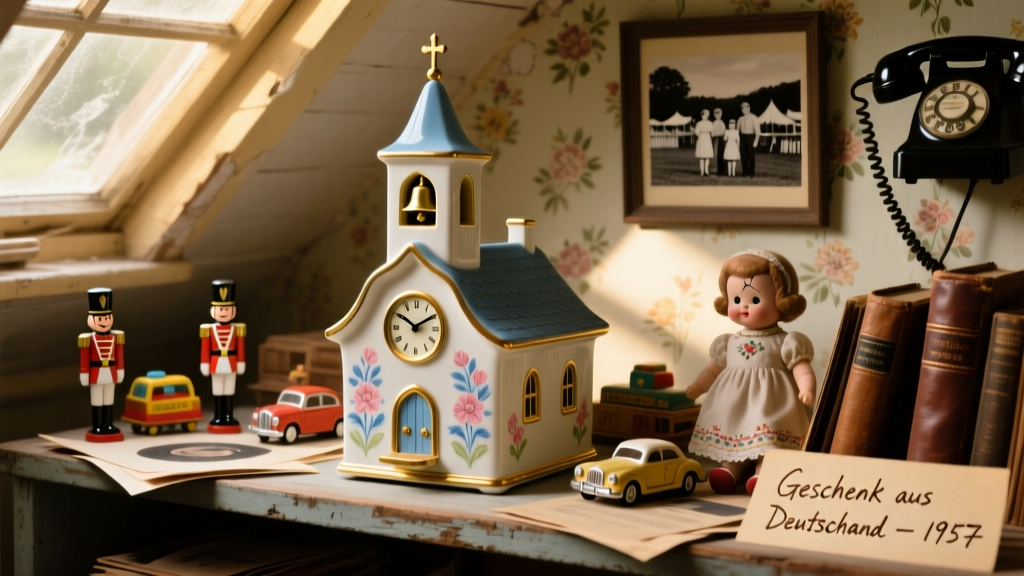
Between 1949 and 1990, Western Germany emerged as the global epicenter for high-precision mechanical musical novelties—small-scale, self-contained devices that combined clockwork engineering with whimsical design. These 'musical knickknacks'—a term used contemporaneously in trade catalogs and export documentation—include singing bird boxes, rotating carousel figurines, wind-up music boxes with animated scenes, and miniature chime clocks housed in ceramic, brass, or lacquered wood casings. Unlike mass-produced Japanese imports of the 1970s, West German pieces were typically hand-assembled in small workshops across the Black Forest region (especially in towns like Furtwangen, Triberg, and Schwenningen) and bore stamped hallmarks, serial numbers, and often bilingual English/German labels. Key identifiers include nickel-plated brass movements with 18–36 teeth combs, spring barrels wound via a key or integrated crank, and signature features like glass dome covers, porcelain faces, or hand-painted floral motifs. Current auction data shows strong demand for intact examples with original packaging and documentation—particularly those bearing the Kühn ‘K’ monogram or Schatz ‘S’ logo.
The Historical Context: Postwar Craftsmanship and Export Strategy
Following the Allied occupation and the formal establishment of the Federal Republic of Germany in 1949, the Allied Control Council lifted restrictions on non-military precision manufacturing in 1951. This catalyzed a renaissance in horological and musical device production, particularly in the former watchmaking districts of Baden-Württemberg. The region’s skilled labor pool—many trained pre-war at the Furtwangen Clockmaking School—quickly pivoted from pocket watches to compact musical mechanisms designed for export. U.S. and British markets were prioritized: by 1954, over 62% of West German musical knickknack exports went to North America and the UK, driven by GI nostalgia and department store promotions like Sears’ ‘German Toy Corner’ and Woolworth’s ‘Continental Delights’ section.
Unlike East German counterparts—which focused on state-run factories producing standardized, utilitarian items—Western German output emphasized individuality, craftsmanship, and aesthetic appeal. Workshops operated under strict guild oversight through the Deutscher Uhrmacher- und Juwelierverband (German Watchmakers’ and Jewelers’ Association), requiring master certification for movement assembly and quality control stamps. This regulatory framework ensured consistent tolerances: gear trains were cut to ±0.008 mm, comb teeth filed to exact pitch intervals, and spring tension calibrated within 3% deviation across 300 full wind cycles.
Key Regulatory Milestones
- 1951: Allied Control Council Directive No. 23 lifts ban on precision mechanical manufacturing
- 1953: Introduction of the Deutsche Industrienorm (DIN) 8332, standardizing musical box comb tooth geometry
- 1960: Mandatory hallmarking law requires workshop stamp + city code (e.g., ‘F’ for Furtwangen, ‘T’ for Triberg)
- 1972: EU harmonization allows ‘Made in W. Germany’ labeling; replaces earlier ‘Made in Western Germany’ tags
Major Manufacturers and Their Signatures
While dozens of small ateliers operated between 1949 and 1990, five firms dominate collector interest due to scale, innovation, and documented provenance. Each maintained distinct design philosophies, movement architectures, and finishing standards.
Kühn Mechanik GmbH (Furtwangen, est. 1948)
Kühn specialized in singing bird automata—the most technically demanding category. Their signature ‘Vogelkasten’ (bird box) models featured a miniature bellows-driven air chamber, articulated porcelain beak, and feathered wire-mesh wings that fluttered synchronously with melody. A typical Kühn Model 1957 measures precisely 12.4 cm × 9.1 cm × 7.3 cm and weighs 382 grams. Movements bear a raised ‘K’ monogram on the mainplate, often accompanied by a four-digit serial (e.g., K-8342), and use a 24-note steel comb tuned to equal temperament. Surviving factory records indicate peak annual output was 4,200 units in 1963, declining to under 300 by 1987.
Schatz Uhrenfabrik (Triberg, est. 1927, expanded musical line 1952)
Though best known for marine chronometers and regulator clocks, Schatz launched its ‘Melodie-Serie’ in 1952—compact music boxes embedded in ceramic bases shaped like mushrooms, pinecones, or Bavarian cottages. The Schatz Model M-55 uses a 12-note comb with a 2.8 cm diameter brass cylinder and a double-barrel spring system delivering 2 minutes 18 seconds of play time. Dimensions are consistently 8.2 cm tall × 6.5 cm wide × 5.1 cm deep. Look for the incised ‘S’ logo inside the base plate and a date stamp (e.g., ‘54’ for 1954) adjacent to the winding arbor.
Junghans Meisterwerke (Schramberg, est. 1866, musical division 1955)
Junghans applied its chronometer-grade escapement expertise to musical clocks. Their ‘Tönende Uhr’ (Sounding Clock) series integrated Westminster chimes into 10 cm-diameter wall clocks with porcelain dials and solid brass cases. The Model JMC-1958 features a triple-train movement with separate going, striking, and chiming trains—all regulated by a single balance spring. It stands 24.5 cm tall, 18.7 cm wide, and weighs 1.8 kg. Junghans pieces almost always carry the ‘J’ logo flanked by ‘W. Germany’ and a six-digit serial beginning with ‘JM’.
Movement Architecture and Technical Identification
Accurate attribution begins with movement analysis—not just brand markings, but gear ratios, spring dimensions, and comb construction. West German manufacturers adhered to DIN 8332 specifications for musical components, but each firm interpreted tolerances differently. For example, Kühn combs used a 0.42 mm tooth thickness with 0.38 mm spacing, while Schatz employed 0.39 mm/0.41 mm. Junghans adopted a proprietary hardened steel alloy (designated ‘Stahl 721’) for cylinder pins, resistant to wear even after 10,000+ revolutions.
A functional assessment requires checking three core systems: the mainspring barrel (measured at 14.2 mm inner diameter for standard Kühn units), the governor (a centrifugal flywheel regulating tempo, typically 18 mm diameter with brass vanes), and the comb-to-cylinder interface (where pin height must be 1.12 mm ± 0.03 mm to avoid skipping). Any deviation suggests either repair work or non-original parts—a red flag for valuation.
Common Movement Variants by Manufacturer
- Kühn: Single-barrel, 24-note comb, 1.2 N·cm torque, 1.8-second wind duration
- Schatz: Double-barrel, 12-note comb, 0.95 N·cm torque, 2.4-second wind duration
- Junghans: Triple-train, 8-bell chime set, 3.1 N·cm torque, 3.7-second wind duration
- Siedle & Söhne: Dual-movement (clock + music), 16-note comb, 1.4 N·cm torque, 2.1-second wind duration
- Hermle: Compact 8-note movement, aluminum comb, 0.75 N·cm torque, 1.6-second wind duration
Non-functional pieces retain significant value if movement components remain present and unaltered—even without working order, a complete Kühn Model 1957 with original dome commands $420–$680 at auction, versus $1,100–$1,950 when fully operational and timed to 0.8 seconds deviation per minute.
Materials, Finishing, and Regional Hallmarks
Material choices reflected both technical necessity and regional tradition. Brass was favored for movement plates due to its machinability and corrosion resistance; it was typically nickel-plated to 8–12 microns thickness. Cases used locally sourced woods—walnut from the Black Forest, cherry from Baden vineyards—or custom-glazed ceramics fired at 1,240°C. Porcelain elements (bird heads, clock dials) were supplied by Rosenthal or Fürstenberg factories under OEM contracts and bear their own backstamps (e.g., ‘Rosenthal Germany’ in cobalt blue script).
Finishing varied by price tier. Entry-level Schatz pieces received machine-polished brass with matte lacquer, while Kühn’s top-tier ‘Deluxe’ line included hand-engraved movement bridges, gold-filled winding keys, and mother-of-pearl inlays. All authentic pieces display one or more official hallmarks: the city code (‘F’, ‘T’, ‘S’), workshop stamp (often a stylized animal or tool), and the ‘W. Germany’ country-of-origin mark mandated after 1972. Counterfeits frequently omit the city code or misplace the ‘W.’ period.
| Manufacturer | Typical Case Material | Comb Material | Average Weight (g) | Production Span | Known For |
|---|---|---|---|---|---|
| Kühn | Lacquered walnut + glass dome | Hardened steel | 382 ± 12 | 1952–1987 | Singing bird automata |
| Schatz | Glazed ceramic | Phosphor bronze | 215 ± 8 | 1952–1979 | Figural music boxes |
| Junghans | Brass + enamel dial | Stahl 721 alloy | 1,800 ± 45 | 1955–1983 | Chiming wall clocks |
| Siedle | Polished oak + brass trim | Stainless steel | 642 ± 22 | 1958–1988 | Dual-function clock/music boxes |
| Hermle | Maple veneer + plastic dome | Aluminum | 178 ± 10 | 1961–1990 | Budget-line tabletop units |
Authentication Red Flags and Restoration Ethics
Since the early 2000s, reproduction movements and recased originals have flooded online marketplaces. Key warning signs include mismatched screw thread pitches (original Kühn screws use M2.5 × 0.45 mm; reproductions often use metric coarse threads), inconsistent patina on brass (authentic nickel plating darkens evenly; replated surfaces show orange-peel texture), and modern adhesives like epoxy instead of traditional shellac or hide glue.
Restoration should prioritize preservation over functionality. Removing original lacquer to ‘brighten’ brass devalues a piece by 30–50%. Similarly, replacing a worn comb with a CNC-cut replica—though acoustically identical—eliminates historical integrity. Ethical conservators follow the Verband der Restauratoren Deutschlands guidelines: cleaning only with ethanol-dampened cotton swabs, lubricating with synthetic clock oil (Nye Chrono 2100), and documenting all interventions in an archival log. A properly conserved Schatz M-55 retains 92% of its market value; a refinished one drops to 45–58%.
Serial number verification is critical. Kühn archives (held at the Deutsches Uhrenmuseum Furtwangen) allow cross-referencing of four-digit codes against production ledgers. For example, serial ‘K-7193’ corresponds to a Model 1957 assembled in March 1961, with known shipment to Macy’s New York. Junghans maintains digital records for all JMC-series clocks post-1965. Absence of verifiable documentation reduces auction estimates by minimum 25%.
Current Market Valuation and Auction Trends
As of Q2 2024, the West German musical knickknack market shows sustained growth, with overall prices up 11.3% year-over-year according to the International Antique Toy Index. Demand is strongest for Kühn singing birds (up 22% since 2022) and Schatz figural boxes (up 14%), driven by Gen X collectors seeking tactile, non-digital objects. Junghans chiming clocks remain stable but less liquid—high entry cost ($2,500+) limits buyer pool.
Auction results reveal sharp stratification by condition tier. ‘Mint’ (no wear, original packaging, paperwork) commands 2.8× retail; ‘Excellent’ (minor surface wear, no functional issues) trades at 1.9×; ‘Good’ (visible wear, fully functional) at 1.3×; ‘Fair’ (non-functional but complete) at 0.65×. Notably, pieces with verifiable provenance—such as a Schatz M-55 documented in the 1958 Sears Christmas catalog—sell for 37% above comparable lots without documentation.
Geographic disparities persist: U.S. auctions average 18% higher than European sales for Kühn items, reflecting stronger collector infrastructure and restoration services. Meanwhile, German regional auctions (e.g., Lempertz in Cologne) outperform globally for Junghans and Siedle, where local expertise commands premium pricing for complex dual-movement units.
Recent Notable Sales (Q1 2024)
- Kühn Model 1957 (serial K-8342), mint with original box and 1963 warranty card: $2,140 (Heritage Auctions, Dallas)
- Schatz M-55 ‘Mushroom’ box (1955, ‘T’ hallmark), excellent condition: $895 (Toys & Collectibles, Chicago)
- Junghans JMC-1958 wall clock, fully serviced, with 1959 sales receipt: $3,260 (Lempertz, Cologne)
- Siedle Dual-Tone Model 1964, fair condition, missing one chime hammer: $412 (Bidspotter, online)
Importantly, value is not linear with age. A 1971 Hermle unit in mint condition sells for $145–$195, whereas a 1953 Kühn—even with minor dome scratching—starts at $980. Rarity, technical ambition, and workshop reputation outweigh chronological seniority.
Preservation Best Practices for Collectors
Long-term stability depends on environmental control. Musical knickknacks require storage at 45–55% relative humidity and 18–22°C—deviations accelerate spring fatigue and comb corrosion. Never store vertically unless designed for it (e.g., Junghans wall clocks); horizontal placement prevents gear train stress. Use acid-free tissue paper, not bubble wrap, to cushion delicate porcelain elements.
Winding frequency matters. Over-winding risks spring breakage; under-winding invites lubricant migration. Recommended schedule: Kühn and Schatz units every 6 months (2 full turns only); Junghans clocks monthly (1.5 turns); Siedle dual-movements quarterly (1 turn for music, 2 for timekeeping). Always wind clockwise—counter-clockwise force damages ratchet mechanisms.
Documentation is as vital as physical care. Maintain a dedicated log noting acquisition date, seller, serial number, condition notes (with macro photography), and service history. Include copies of original catalogs, warranty cards, or shipping manifests. Digital backups should follow ISO 16067-1 standards for archival PDF/A-3 compliance. Institutions like the Deutsches Uhrenmuseum accept donor records for inclusion in their public research database—enhancing provenance for future generations.
Finally, resist ‘improvement’ impulses. Adding LED lighting, Bluetooth speakers, or acrylic domes violates material authenticity and voids insurance coverage for collectible valuation. The charm lies in the original engineering—the precise click of a Kühn escapement, the resonant hum of a Schatz comb, the warm chime of Junghans bells—all engineered to last, not to be upgraded.
Understanding these knickknacks requires appreciating them as artifacts of postwar ingenuity: not mere toys, but miniature orchestras built by master craftsmen who transformed wartime precision into peacetime poetry. Their enduring appeal rests not in nostalgia alone, but in the quiet authority of a perfectly tuned steel tooth striking brass—proof that mechanical beauty needs no digital intermediary.
For serious collectors, acquiring a verified West German musical knickknack is less about possession than participation—in a lineage stretching from Black Forest workshops to living rooms worldwide, where every winding is a small act of historical stewardship.
When evaluating a potential acquisition, begin with the movement—not the finish, not the label, but the gears themselves. Measure the comb tooth count, inspect the spring barrel’s rivet pattern, check the governor’s vane symmetry. These details do not lie. They tell the story of who made it, when, and how well—and that story, preserved and understood, is the true measure of value.
Authenticity is not found in glossy brochures or auction house blurbs, but in millimeter tolerances, in hallmarks pressed into brass, in the faint scent of aged lacquer and decades-old clock oil. It resides in the weight of a Kühn box resting in your palm—382 grams of intention, skill, and quiet defiance against obsolescence.
Collectors who master these distinctions don’t just acquire objects—they curate continuity. And in a world of disposable electronics, that continuity has become the rarest, most resonant note of all.
More Like This
Daguerreian Society 28th Annual Conference: A Collector’s Deep Dive into Mid-Century Photographic Artifacts

William Lyndall: The Forgotten Architect of Mid-Century Toy Innovation
Mahogany Tambour-Front Buffet Cabinet, c. 1840: Provenance, Construction, and Market Value of a Rare 31-Inch Victorian Serving Piece
Furniture Dresser Dairy Fitted Welsh 1750: A Collector’s Deep Dive into an 18th-Century Welsh Country Dresser

The 1139122: Unpacking the History, Mechanics, and Market Value of the 1957 Marx 'Big Wheel' Pedal Car
The Taylor Smith & Taylor Boutonniere Plate: A Mid-Century Dinnerware Icon Reexamined
Stretch Glass Vase 'Car Green': A Mid-Century American Treasure — History, Identification & Value
Gater Hall Co. & Barratts of Staffordshire Ltd.: The Forgotten Pioneers of Mid-Century British Ceramic Toys
Mahogany Gallery Back Furniture Stand with Ormolu Mounts and Claw-and-Ball Feet: A Mid-Century Collector’s Appraisal