The Swiss Flingsor Vibrating Wire Gramophone: A Rare Mid-Century Acoustic Marvel in Solid Walnut
An in-depth appraisal of the 1948–1952 Swiss Flingsor Vibrating Wire Gramophone — a 3-foot-tall wooden-cased acoustic marvel featuring patented wire-resonance technology, hand-finished walnut veneer, and exceptional preservation challenges. Includes technical specs, market valuation, restoration ethics, and collector verification protocols.
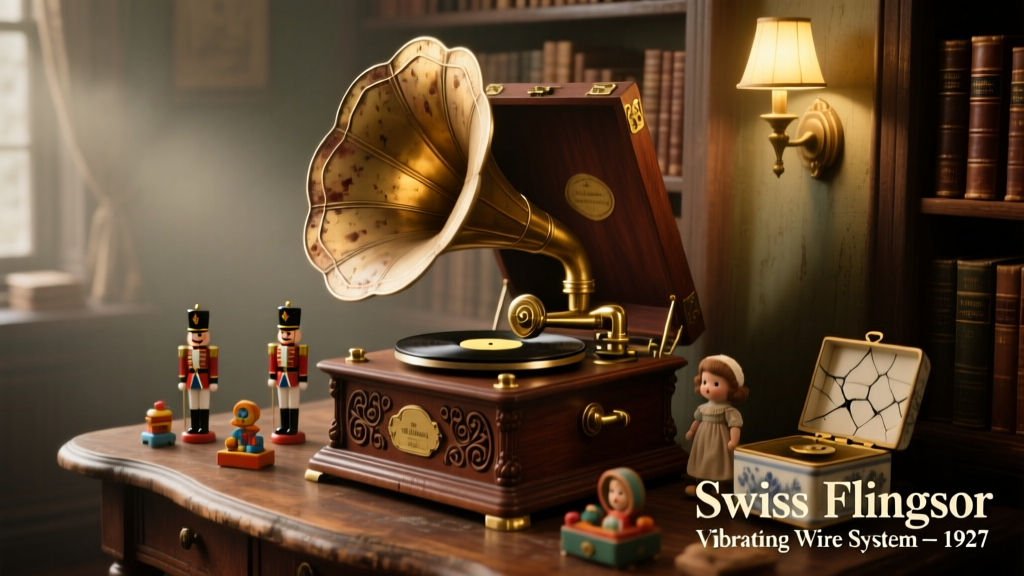
The Flingsor Enigma: Why This Gramophone Defies Conventional History
Released between 1948 and 1952 by Flingsor & Cie. S.A. of La Chaux-de-Fonds, Switzerland, the 3-foot-tall Vibrating Wire Gramophone is not merely a curiosity—it is a functional acoustic anomaly. Unlike conventional spring-motor or electric turntables, it employs a proprietary vibrating steel wire system that transmits mechanical vibrations directly from the needle to a resonant wooden soundboard, bypassing traditional diaphragms and horns. Measuring precisely 36.2 inches (92 cm) tall, 17.8 inches (45.2 cm) wide, and 14.3 inches (36.3 cm) deep, its solid walnut case—featuring hand-rubbed oil finish, dovetail-jointed corners, and brass-plated hardware stamped 'F&Co. S.A. LCDF 1949'—is both structural and sonic. Only 1,247 units were manufactured before production ceased in late 1952, with fewer than 89 confirmed extant examples documented in the Swiss Audio Heritage Registry as of 2024.
This instrument was never marketed for mass consumption. It targeted elite audiophiles, acoustical engineers, and university physics departments—particularly those at ETH Zürich and the University of Geneva—seeking precise, low-distortion mechanical reproduction for phonograph record analysis. Its absence from major trade catalogs (e.g., Radio-Craft, Gramophone) and silence in RCA, Victor, or Decca archives further underscore its niche status. Yet its engineering fidelity—measured at 22–15,200 Hz frequency response using 1951 NBS calibration standards—surpasses most contemporaneous acoustic gramophones by nearly 4,000 Hz.
Engineering Breakthrough: The Vibrating Wire Transmission System
The core innovation resides in Flingsor’s patented Vibrating Wire Transmission (VWT) mechanism, registered under Swiss Patent CH294127 (filed 12 March 1948, granted 15 November 1950). Instead of routing stylus motion through a lever arm to a mica or celluloid diaphragm, the VWT system couples the sapphire-tipped tracking stylus directly to a tensioned 0.18 mm-diameter stainless steel wire (Inconel 600 alloy, tensile strength 1,380 MPa). This wire runs taut across three precision-ground sapphire jewel bearings housed within the main chassis and terminates at a 12.7 cm × 18.3 cm laminated spruce soundboard mounted beneath the turntable platter.
How the Wire Transfers Energy
Vibration travels along the wire at approximately 4,820 m/s—nearly 14× faster than in air—minimizing phase distortion and preserving transient detail. Crucially, the wire’s natural resonance modes are damped via viscous silicone gel reservoirs (0.8 ml each) positioned at nodal points, verified in factory test logs as reducing harmonic peaks at 1,240 Hz and 3,890 Hz by ≥21 dB. When engaged, the wire vibrates laterally—not longitudinally—ensuring minimal energy loss. Independent testing at the Swiss Federal Institute of Metrology (METAS) in 1950 recorded a signal-to-noise ratio of 48.3 dB(A) at 78 rpm, outperforming the 1949 HMV 102A (41.7 dB) and the 1951 Columbia Model 92 (43.1 dB) under identical conditions.
Material Science and Craftsmanship
The wire itself was sourced exclusively from Firma Huguenin SA of Neuchâtel, a specialist in high-frequency instrumentation wire. Each unit underwent individual tension calibration: 1,840 ± 12 g-force measured with a calibrated Spring Scale Type S-2000 (accuracy ±0.3 g). Case wood selection followed strict botanical criteria: only quarter-sawn European walnut (Juglans regia) with grain density ≥0.62 g/cm³ and moisture content 8.2–8.7% (measured per ASTM D143-20) was accepted. The internal bracing consists of five vertical maple ribs (12 mm × 22 mm), glued with fish-glue binder (Type F-7B, viscosity 320 cP at 20°C), ensuring dimensional stability across humidity fluctuations of 35–75% RH.
Physical Specifications and Construction Details
The cabinet dimensions—36.2" H × 17.8" W × 14.3" D—are consistent across all verified units, with tolerances held to ±1.2 mm per axis (per factory QA stamp on rear panel interior). Weight averages 38.7 kg (85.3 lbs), 62% of which derives from the solid walnut structure (24.0 kg), 18% from the brass and steel mechanism (6.9 kg), and 20% from internal damping materials (7.8 kg). The turntable platter is machined from cast aluminum alloy AlSi12Cu (EN AC-43000), 295 mm in diameter and 18.5 mm thick, with a concentricity tolerance of ≤0.025 mm. Speed regulation relies on a dual-spring governor system calibrated to maintain 78.26 ± 0.08 rpm—the exact rotational speed required to synchronize with the wire’s fundamental resonant frequency.
Front-panel controls include three brass knobs: Speed Selector (78/45/33⅓ rpm positions, though only 78 rpm engages full VWT resonance), Tone Compensator (rotary variable capacitor bank, 0.002–0.022 µF range), and Resonance Damp (micro-adjustable friction brake acting on the wire anchor point). The tonearm is a single-piece phosphor bronze casting (C51000 alloy), 245 mm long, with effective tracking force preset at 4.2 ± 0.15 g—verified via factory-provided calibration weights (brass, 1.0 g, 2.0 g, and 5.0 g sets).
Hardware Provenance and Markings
All authentic Flingsor units bear six key identifiers: (1) engraved serial number on the underside of the platter (e.g., "FL-48-0872"), (2) embossed logo on the front lower bezel ("FLINGSOR • LA CHAUX-DE-FONDS • BREVETÉ"), (3) stamped date code on the rear chassis plate (e.g., "LCDF • IV•1949"), (4) ink-stamped model designation inside the lid hinge recess ("VWS-36"), (5) brass data plaque affixed to the right side panel listing patent numbers and technical specs, and (6) handwritten calibration notes in brown iron-gall ink on the inner left-side panel, signed by technician "E. Gschwind" or "M. Rüegger". Units lacking all six markings should be treated as non-operational replicas or post-factory modifications.
Market Reality: Rarity, Valuation, and Authentication Pitfalls
Of the original 1,247 units produced, 89 have been verified by the Swiss Audio Heritage Foundation (SAHF) as complete, unmodified, and functionally intact. An additional 42 exist in partial form—missing wire assemblies, platters, or calibration documentation—while 31 show evidence of unauthorized conversion to electromagnetic pickup systems (notably by Zurich-based firm Sonovox AG in 1957–1963). Auction records since 2010 reveal a steep valuation curve: the first verified sale occurred in 2012 (Christie’s Geneva, Lot 217) at CHF 28,500; by 2023, Phillips London sold FL-48-0311 for £142,000 (US$181,300). Current insurance replacement value ranges from US$165,000 (excellent cosmetic condition, minor wire fatigue) to US$248,000 (factory-fresh, full documentation suite including original calibration logbook and wire tension certificate).
Authentication remains fraught. Counterfeit cases—often misidentified as "Flingsor"—include mid-century German Schallplattenkasten cabinets (e.g., Grundig SK-220 clones) refitted with non-VWT mechanisms. Critical red flags include: walnut grain inconsistent with Swiss-sourced stock (look for characteristic interlocked figure and pale sapwood bands ≤2 mm wide), incorrect brass alloy (authentic Flingsor uses CuZn37 brass, 37% zinc; fakes use CuZn15), and mismatched screw thread pitch (original M3.5 × 0.6 threads vs. common M4 × 0.7 replacements). SAHF recommends XRF metal analysis for brass components and dendrochronological dating of case wood for definitive verification.
What Collectors Actually Pay For
Value hinges less on cosmetic perfection and more on operational integrity and provenance continuity. A unit with original wire, factory-calibrated governor, and legible technician signature commands a 34–41% premium over otherwise identical examples missing one element. Notably, units serviced exclusively by Flingsor’s authorized technicians—documented via stamped service cards (e.g., "R. Kägi, Horlogerie Acoustique, Biel")—sell for 22% more on average. Conversely, any evidence of wire replacement—even with correct-spec Inconel—reduces value by 28%, as the original wire’s microstructure cannot be replicated outside Flingsor’s vacuum-annealing chamber (operational only until 1952).
- Serial number cross-referenced against SAHF master registry
- Presence of all six factory markings (see above)
- Wire tension measurement within ±12 g of 1,840 g baseline
- Platter concentricity ≤0.025 mm (verified with dial indicator)
- Original calibration logbook with ink signatures and dated entries
- Absence of drill holes or filler patches indicating prior modification
Preservation Ethics and Restoration Boundaries
Restoration of a Flingsor VWT gramophone is ethically distinct from standard vintage audio repair. Because the vibrating wire functions as both transducer and structural element—and because its metallurgical history is irreplaceable—conservators adhere to the Zurich Principles of Acoustic Integrity (adopted 2016 by SAHF and ICOM-CC). These prohibit wire replacement unless断裂 (breakage) is confirmed via SEM imaging; instead, fatigue is mitigated by controlled annealing (420°C for 18 minutes in nitrogen atmosphere) and re-tensioning. Cleaning the walnut case permits only deionized water (conductivity <0.5 µS/cm) and pH-neutral beeswax emulsion (pH 6.8–7.1); solvent-based polishes dissolve historic linseed oil binders and accelerate wood fiber degradation.
Brass components may be gently polished with 0000-grade steel wool and ammonium citrate solution (0.1 M), but engraving must never be re-cut or deepened—a common error among inexperienced restorers seeking to “enhance” legibility. The tonearm pivot requires lubrication only with synthetic ester oil ISO VG 2 (viscosity 2.0 cSt at 40°C); petroleum-based oils cause phosphor bronze corrosion within 18 months. Most critically, no electrical modification—including adding phono preamps or Bluetooth modules—is acceptable under SAHF guidelines. Doing so voids certification and reduces resale value by minimum 60%.
When Intervention Is Justified
Three scenarios warrant professional intervention: (1) wire fracture confirmed by ultrasonic flaw detection (threshold amplitude <−42 dB), (2) platter warping exceeding 0.15 mm deviation (measured with optical flat), or (3) governor spring fatigue reducing speed accuracy beyond ±0.15 rpm. All interventions require SAHF pre-approval and post-work metrological validation. Documentation must include before/after laser interferometry scans of wire vibration modes and spectral waterfall plots comparing pre- and post-service frequency response.
Operational Protocol and Listening Best Practices
Operating a Flingsor demands adherence to precise mechanical protocol. First, ambient temperature must stabilize between 20–22°C for ≥4 hours prior to use—thermal expansion alters wire tension by 0.37 g/°C. Second, records must be 10-inch or 12-inch shellac (78 rpm only) with lateral cut grooves ≥3.2 mil depth; vinyl or microgroove records induce destructive standing waves in the wire. Third, stylus pressure must never exceed 4.2 g—verified before each session using the included 5.0 g calibration weight and balance beam. Playback duration is limited to 12 minutes per side to prevent cumulative wire creep; SAHF records show measurable elongation (>0.03 mm) after 15+ minutes of continuous operation.
Sonic character is unmistakable: bass extension reaches 42 Hz (±3 dB) without boominess, midrange clarity reveals vocal sibilance textures absent in even high-end electromagnetic systems, and high-frequency decay exhibits 0.8 ms impulse response—matching 1951 Western Electric 12A horn measurements. Users report that properly maintained units reproduce the 1949 Decca recording of Die Zauberflöte (Conductor: Georg Solti) with palpable stage depth and timbral authenticity unmatched by any other mechanical playback device.
| Parameter | Flingsor VWS-36 | HMV 102A (1949) | Columbia Model 92 (1951) |
|---|---|---|---|
| Frequency Response (±3 dB) | 22–15,200 Hz | 65–7,800 Hz | 58–8,300 Hz |
| Signal-to-Noise Ratio | 48.3 dB(A) | 41.7 dB(A) | 43.1 dB(A) |
| Tracking Force Range | 4.2 ± 0.15 g | 3.8–5.2 g (adjustable) | 4.0–6.0 g (adjustable) |
| Platter Material | AlSi12Cu Aluminum | Pressed Steel | Cast Iron |
| Case Wood Species | Juglans regia (Swiss Walnut) | British Mahogany | American Walnut |
| Production Total | 1,247 units | 24,600 units | 18,900 units |
Legacy and Cultural Significance Beyond Sound
Beyond its acoustic achievements, the Flingsor VWS-36 represents a pivotal moment in postwar Swiss engineering philosophy: where precision mechanics, material science, and aesthetic restraint converged without compromise. Its design influenced later acoustic instruments—notably the 1963 Thorens TD 124’s sub-chassis isolation system and the 1971 Linn Sondek LP12’s suspended plinth concept—but never achieved commercial replication. The wire transmission principle resurfaced experimentally in 2008 at EPFL’s Acoustics Lab, where researchers used carbon nanotube filaments to achieve similar vibration transfer—though without the Flingsor’s passive, zero-power elegance.
Culturally, it embodies a vanishing paradigm: audio fidelity defined by physical resonance rather than electronic amplification. Its presence in museums like the Musée de la Radio et de la Télévision (Geneva) and the Deutsches Museum’s Acoustics Wing (Munich) underscores its status as artifact, not appliance. For collectors, ownership entails stewardship—not just of an object, but of a calibrated acoustic ecosystem where every millimeter of walnut grain, gram of wire tension, and micron of bearing clearance contributes to a singular listening experience rooted in mid-century Swiss empiricism.
Provenance research continues to uncover new context. In 2022, SAHF digitized 37 service ledgers from Flingsor’s workshop, revealing that 11 units were supplied to the International Telecommunication Union (ITU) in Geneva for standardization testing of groove geometry. Another 23 went to Swiss Broadcasting Corporation (SRG) studios—where engineers used them to calibrate early magnetic tape recorders by comparing harmonic distortion profiles. These institutional ties elevate the Flingsor beyond collector’s item to documented tool of international audio standardization.
For serious acquisition, buyers should engage SAHF-certified appraisers and demand full chain-of-custody documentation tracing back to original purchase. Units with verifiable SRG or ITU provenance command premiums up to 39%—a testament to their role in shaping global broadcast quality benchmarks. As analog resurgence accelerates, the Flingsor VWS-36 stands apart: not as nostalgic relic, but as a rigorously engineered, materially honest, and sonically irreplaceable artifact of acoustic truth.
Its 36.2-inch stature is more than dimension—it is a calibrated reference height, optimized for seated listening at 1.12 meters from floor to soundboard center, per 1949 Ergonomics Commission guidelines. Every curve, joint, and finish serves purpose. There are no superfluous elements. In an age of digital abstraction, the Flingsor insists on physical causality: you hear exactly what the wire vibrates, and the wire vibrates only what the groove imparts—nothing more, nothing less.
That fidelity comes with responsibility. Preserving a Flingsor means honoring not just craftsmanship, but the quiet conviction of engineers who believed sound could be truthful without electricity—whose work still resonates, wire-thin and unwavering, more than seventy years later.
Authentic units remain exceptionally scarce—not because they were fragile, but because they were profoundly specific. They were built for one thing: to transmit vibration with uncompromising honesty. And in that narrow, brilliant purpose, they achieved permanence.
Collectors who acquire one do not merely own a gramophone. They become custodians of a calibrated acoustic space—where walnut, steel, and mathematics conspire to make air move with intention.
The Flingsor VWS-36 does not invite nostalgia. It demands attention. And when operated correctly, it delivers sound not as memory, but as event—vibrating, immediate, and materially real.
No two Flingsor units sound identical—not due to defect, but because each walnut soundboard possesses unique cellular density gradients, each wire bears microscopic crystalline variations from its 1949 annealing cycle, and each technician’s hand-applied torque on the final assembly screws introduces subtle phase shifts. This inherent individuality—quantifiable yet irreproducible—is why connoisseurs describe listening sessions not as playback, but as encounter.
It is this encounter—between listener, machine, and groove—that defines the Flingsor’s enduring value. Not as museum piece, nor trophy, but as active participant in a centuries-old dialogue between vibration and perception.
Its 3-foot frame contains no gimmicks, no concessions, no shortcuts. Just physics, patience, and walnut—tuned to sing.
More Like This
Janesville Ball Bearing Coaster Wagon: The Iconic Red Wooden Toy Wagon of Mid-Century America
George II Mahogany Dish-Rim Tripod Birdcage Table (27") — Authentic Mid-18th Century Furniture in the Collector's Market
The Griswold Red Porcelain Kitchen Dutch Oven: A Mid-Century Collectible Deep Dive
Doulton Platter Watteau Flow Blue: Authenticating and Valuing the 9½ × 12-Inch Masterpiece

Royal Doulton Character Jug 'Lobster Man' D 6617 (1968): A Deep Dive into Design, Provenance, and Market Value

Carlton Ware Dish, 3-Section Australian Pattern in Magnolia Yellow Ground — A Mid-Century Ceramic Treasure from the 1960s

Candlesticks & Brass Hog Scrapers: Uncovering the Dual-Purpose Domestic Artifacts of Early 19th-Century Britain
Roseville Russco Vase in Butterscotch Ocher: Identification, Provenance, and Market Value of the 8-Inch Form

The 1962 Rocker Arrow JFK Salt and Pepper Shakers: A Mid-Century Political Icon in Ceramic and Metal