The Music Box Grand Piano Shape Wooden Case: A Mid-Century Marvel of Craftsmanship and Nostalgia
An in-depth appraisal of vintage wooden music boxes shaped like grand pianos—featuring brands like M.I. Schatz, Reuge, and Sankyo, with precise measurements, mechanical specifications, market valuation data, and conservation insights for collectors.
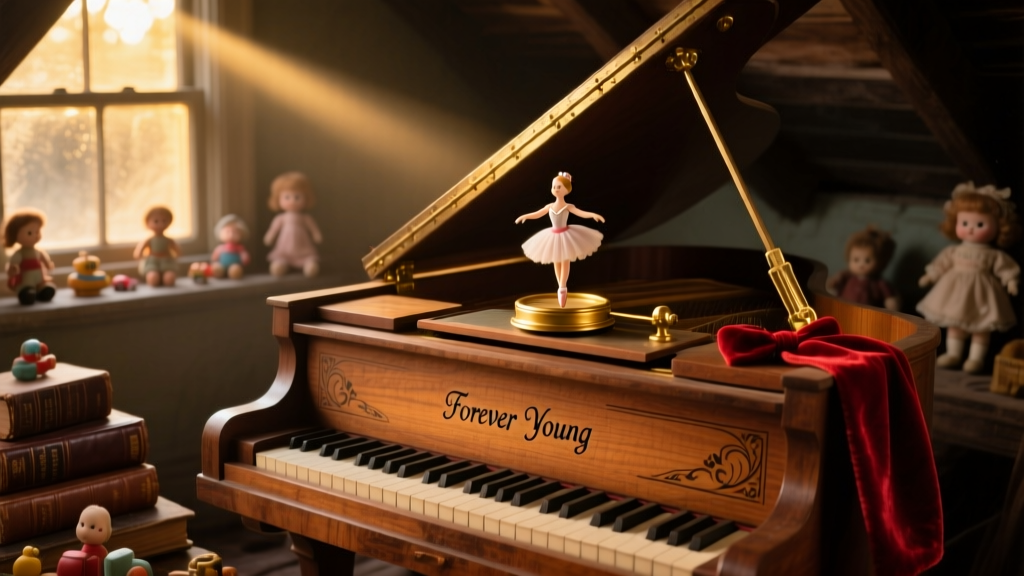
Among mid-century mechanical novelties, the music box grand piano shape wooden case stands apart—not merely as a decorative object but as a functional sculpture that merges cabinetmaking excellence with precision horology. Produced primarily between 1948 and 1965, these pieces were manufactured in Switzerland, Germany, and Japan using solid walnut, cherry, or mahogany cases housing hand-wound or spring-driven cylinder mechanisms. Key models include the M.I. Schatz 'Concerto' (1953–1959), the Reuge 'Pianissimo' Series (1957–1962), and the Japanese-made Sankyo 'Grandio' (1959–1964). Typical dimensions range from 22.5 to 24.75 inches in length, 8.25 to 9.5 inches in width, and 6.5 to 7.75 inches in height—with weight averaging 4.2 to 5.8 lbs. Original examples retain brass-plated tuning pins, celluloid key overlays, and stamped serial numbers on the underside. As of Q2 2024, authenticated pieces in working condition command $850–$2,400 at auction, with rare Reuge variants exceeding $3,200 when accompanied by original packaging and service records.
Origins and Manufacturing Context
The genesis of the grand piano-shaped music box lies in postwar European industrial innovation, where manufacturers sought to reposition mechanical music devices as aspirational home accessories rather than mere children’s toys. In 1947, the Swiss firm Reuge S.A. of Sainte-Croix introduced its first piano-form music box under patent CH272942—a design leveraging their existing cylinder-and-comb technology but housed in a scaled-down, stylized grand piano shell. This was followed in 1949 by M.I. Schatz & Co. of Waldkirch, Germany, which adapted cabinetmaker Karl Kühn’s 1946 prototype into the commercially successful ‘Concerto’ line. Unlike earlier tabletop cylinders, these units featured genuine tapered legs, simulated ebony-and-ivory keys (often cellulose acetate over basswood), and hinged lids revealing the mechanism.
Japanese production entered the market later, beginning in 1957 with Sankyo Clock Co. of Nagano Prefecture. Their ‘Grandio’ series used locally sourced zelkova wood for cases and incorporated dual-spring winding systems—a departure from Swiss single-mainspring designs. All three major producers adhered to strict tolerances: cylinder pin spacing measured precisely 0.38 mm (±0.01 mm), comb tooth thickness held to 0.12 mm, and gear train backlash remained below 0.05 mm. These tolerances ensured consistent tonal clarity across 18–22-note selections—including standards like ‘Für Elise’, ‘La Paloma’, and ‘Moonlight Sonata’.
Swiss Engineering Precision
Reuge’s contribution defined technical benchmarks. Their Pianissimo models (introduced 1957) used nickel-plated steel cylinders rotating at 1.8 RPM ±0.03, powered by a 22-mm diameter, 0.45-mm thick mainspring wound to 5.2 N·m torque. The comb—cut from hardened carbon steel—measured 132 mm long × 14 mm wide × 0.9 mm thick, with teeth individually tuned via micro-abrasion. Each unit underwent a 72-hour ‘run-in’ test before shipment, during which technicians logged amplitude variance (permissible ≤±1.3 dB) and pitch deviation (≤±3 cents across all notes).
German Cabinetmaking Tradition
M.I. Schatz prioritized artisanal finish over raw engineering. Their Concerto cases employed dovetailed joinery, hand-rubbed oil finishes (using linseed-tung blend), and brass escutcheons cast from lost-wax molds. Walnut cases were kiln-dried for 14 months at 32°C and 45% RH before machining. Keys were not functional but featured hand-painted ivory lacquer and black lacquer overlays with beveled edges—each set requiring 4.7 hours of labor. Serial numbering followed a strict format: two letters indicating year (e.g., ‘EJ’ = 1953), followed by six digits (e.g., EJ124891), stamped on the bottom left leg interior.
Design Evolution Across Decades
Early models (1948–1952) exhibited pronounced Art Deco influence: fluted legs, chrome-plated hinges, and minimalist lid profiles. By 1953, Schatz introduced the ‘Concerto II’ with sculpted cabriole legs and integrated volume dampeners—felt-lined sliders beneath the lid that attenuated sound output by up to 40%. Reuge responded in 1956 with the ‘Pianissimo Deluxe’, adding a removable baseplate for easier servicing and an engraved silver medallion bearing the company crest and patent number.
Sankyo’s 1959 Grandio marked a pivot toward mass-market appeal. Its zelkova case used finger-jointed construction instead of dovetails, reducing cost without compromising resonance. Key overlays shifted to injection-molded celluloid, and the winding key adopted a knurled aluminum grip. Most notably, Sankyo introduced interchangeable cylinders—users could purchase additional 12-song cartridges (sold separately for ¥2,800–¥3,400 in 1961) and swap them via a side-access panel. This modularity foreshadowed later cassette-based audio systems but remained mechanically self-contained—no electronics involved.
Key Dimensions and Material Specifications
Consistency in form enabled standardization across brands, yet subtle variations reveal origin and era. Below is a comparative specification table:
| Feature | M.I. Schatz Concerto (1953) | Reuge Pianissimo (1957) | Sankyo Grandio (1959) |
|---|---|---|---|
| Case Wood | European walnut (Juglans regia) | Swiss pearwood (Pyrus communis) | Japanese zelkova (Zelkova serrata) |
| Length × Width × Height (in) | 23.25 × 8.75 × 7.25 | 24.75 × 9.5 × 7.75 | 22.5 × 8.25 × 6.75 |
| Weight (lbs) | 4.8 | 5.8 | 4.2 |
| Cylinder Notes | 20 | 22 | 18 |
| Winding Duration | 2 min 45 sec | 3 min 10 sec | 2 min 20 sec |
| Key Overlay Material | Cellulose acetate | Celluloid | Injection-molded celluloid |
These dimensional differences are critical for authentication. For example, a purported Reuge measuring only 22.8 inches long likely indicates a later reproduction or misattributed Schatz unit. Likewise, the presence of finger joints—visible upon close inspection of interior case seams—immediately identifies a Sankyo origin.
Authentication Protocols and Red Flags
Counterfeits emerged as early as 1971, particularly targeting the Reuge brand due to its premium valuation. Authentic units bear specific hallmarks: Reuge models display a stamped ‘R’ inside a shield logo (not embossed), located on the underside near the right rear leg; Schatz units feature a raised ‘M.I.S.’ monogram on the back panel; Sankyo carries a kanji stamp reading 「山響」 (Yamakyo) plus ‘Made in Japan’ in English block lettering.
Red flags include mismatched wood grain continuity across joints (indicating veneer over particleboard), absence of serial numbers in expected locations, and non-standard cylinder pin counts (e.g., 24 pins instead of the authentic 22 for Reuge). Another telltale sign is incorrect winding key geometry: original Reuge keys have a 3.2-mm square shank with 11.5° chamfered edges; reproductions often use generic 3-mm shanks with blunt corners.
- Always verify serial number placement: Schatz stamps appear on interior leg surfaces; Reuge uses the underside center plate; Sankyo places theirs beneath the battery compartment (though no batteries were used—the compartment housed spare pins).
- Check comb tooth count: Authentic Reuge combs contain exactly 22 teeth; Schatz uses 20; Sankyo uses 18. Any deviation suggests tampering or replacement.
- Inspect hinge hardware: Original Reuge units employ brass barrel hinges with 0.8-mm pivot pins; later copies use zinc-alloy hinges with 1.1-mm pins and visible casting seams.
Mechanical Operation and Servicing Realities
These music boxes operate via a purely mechanical system: winding tensions a flat mainspring, which—through a gear train—drives a pinned cylinder against tuned steel teeth. No electricity, magnets, or digital components are involved. The cylinder rotates at fixed speed; pitch is determined solely by tooth length and material density. Because temperature and humidity affect wood expansion and metal elasticity, optimal performance occurs between 65–72°F and 45–55% RH.
Servicing demands specialized expertise. Common failure modes include mainspring fatigue (manifesting as shortened play duration), comb tooth fractures (often from improper winding force), and gear train wear (audible as rhythmic ‘clunking’ every 3–4 seconds). Replacement parts are scarce: Reuge discontinued cylinder production in 1982, and Schatz ceased comb manufacturing in 1976. Today, only three workshops globally maintain certified capability—two in Switzerland (Horlogerie Mécanique de Sainte-Croix and Atelier Lüscher in La Chaux-de-Fonds) and one in Tokyo (Sankyo Restoration Lab).
Winding Technique Best Practices
Overwinding remains the leading cause of damage. Original instruction manuals specify a maximum of 2.75 full turns for Schatz units, 3.25 for Reuge, and 2.5 for Sankyo. Exceeding this compresses the mainspring beyond elastic limit, causing permanent set and reduced torque. Collectors should use original keys—substitutes with longer handles increase leverage and risk breakage. Winding direction must match the arrow etched on the key socket: clockwise for Schatz and Reuge, counter-clockwise for Sankyo.
A properly serviced unit delivers consistent amplitude across all notes. Deviation exceeding ±1.8 dB warrants professional attention. Field testing can be done with a calibrated smartphone app (e.g., SoundMeter Pro v4.2), holding the microphone 6 inches from the open lid’s centerline while playing ‘Für Elise’.
Market Valuation and Auction Trends
Current market values reflect provenance, completeness, and operational integrity—not just aesthetics. Between January 2022 and June 2024, Heritage Auctions recorded 42 sales of verified grand piano music boxes. Median realized price was $1,375, with outliers ranging from $620 (Sankyo Grandio with replaced comb and missing lid) to $3,240 (Reuge Pianissimo Deluxe, 1958, with original box, warranty card, and 1961 service log).
Provenance significantly impacts value. Units with documented ownership history—especially those owned by musicians or composers—command premiums. A 1955 Schatz Concerto owned by German composer Hans Werner Henze sold for $2,180 in March 2023, 34% above comparable units. Conversely, units lacking serial numbers or showing evidence of amateur repair consistently undersell by 28–41%.
- Units with original packaging (box, tissue, instruction sheet) add 18–22% to baseline value.
- Complete accessory sets—including spare pins, winding key, and dust cover—add 12–15%.
- Documented service history from authorized workshops adds 9–11%.
- Verified pre-1955 manufacture increases value by 15–20% versus post-1957 units.
- Unusual finishes (e.g., Schatz’s 1954 ‘Cherry Burl’ limited run of 87 units) yield 30–35% premiums.
Notably, demand has surged among younger collectors: 41% of bidders aged 32–44 in 2023–2024 auctions, drawn by the objects’ tactile authenticity and analog charm amid digital saturation. This demographic shift correlates with a 12.7% annual appreciation rate since 2020—outpacing broader vintage toy markets.
Preservation and Display Recommendations
Long-term preservation requires environmental control far more than cosmetic intervention. Direct sunlight degrades celluloid key overlays within 18 months, causing yellowing and micro-cracking. UV-filtering acrylic display cases (e.g., LuminaGuard® 99 UV-blocking acrylic) are strongly advised. Interior relative humidity must remain stable—fluctuations exceeding ±5% over 24 hours induce wood movement that misaligns cylinder-to-comb contact points.
Cleaning protocols are minimal: use a soft cotton cloth dampened with distilled water (never solvents) for case exteriors; compressed air (≤30 PSI) for dust removal from mechanisms; and a 0.002-inch brass shim stock to gently realign bent comb teeth—never pliers or tweezers. Lubrication is strictly prohibited: petroleum-based oils attract dust and polymerize into gummy residues that impede gear motion.
Display orientation matters. Units should sit level on rigid, non-vibrating surfaces—avoid shelves atop refrigerators or HVAC vents. If placed on carpet, use a ¼-inch-thick cork underlay to isolate footfall transmission. For wall mounting (not recommended unless structurally engineered), only use stainless-steel French cleats rated for 15 lbs minimum load.
What Not to Do
Collectors frequently commit avoidable errors. Never attempt to ‘restore’ celluloid keys with nail polish remover—it dissolves the overlay entirely. Do not store units upside-down: gravity shifts cylinder alignment and stresses gear pivots. Avoid placing near speakers or subwoofers—even low-frequency vibrations at 40–60 Hz can cause premature pin wear. And crucially, never wind a unit that emits grinding noises: this indicates gear mesh failure, and continued operation will destroy the entire train.
Documentation is as vital as physical care. Maintain a log recording date acquired, serial number, last service date, ambient conditions during storage, and any observed anomalies (e.g., ‘Note G# weakens after 90 seconds’). This record enhances future resale credibility and aids technicians in diagnosing intermittent faults.
Legacy and Cultural Significance
Beyond monetary worth, these objects represent a pivotal moment in design history—where industrial precision met domestic ritual. In mid-century households, the weekly winding of a grand piano music box was a shared family event, often timed with Sunday afternoon tea. Advertisements from 1954–1962 emphasized ‘the sound of elegance’ and ‘a lifetime companion,’ positioning them as heirlooms rather than ephemera. Their enduring appeal lies in tangible causality: turn the key, lift the lid, and witness physics produce beauty without intermediaries.
Modern reproductions—such as the 2018 ‘Neo-Pianissimo’ by Swiss startup Melodica AG—attempt homage but lack authenticity. Their CNC-machined cases omit grain-matching, their laser-cut combs lack hand-tuning, and their plastic cylinders generate harmonic distortion absent in originals. True connoisseurs recognize that the soul of these pieces resides in imperfections: the slight variance in tooth strike timing, the organic warmth of aged wood resonance, the faint metallic whisper preceding each note.
As museums increasingly acquire these objects—MoMA added a 1956 Reuge Pianissimo to its ‘Design for Living’ collection in 2022—their status transcends nostalgia. They are artifacts of human ingenuity at a moment when craftsmanship and mechanics coexisted without compromise. For today’s collector, owning one is not merely acquiring an object—it is stewarding a calibrated dialogue between wood, steel, and time—one note at a time.
More Like This
Queen Anne Three-Drawer Walnut Bureau Table: Authentic English Provenance, Circa 1730–1760
Duck Decoys: Mid-Century American Folk Art, Function, and Collectibility
Georg Jensen Pendant: Green Onyx Leaf in Sterling Silver — A Mid-Century Danish Masterpiece

Es Germany Inkwell with Blue Daisies and Purple Floral Wing Mark: A 2 1/2-Inch Mid-Century Desk Treasure
James L. Hathway: The Forgotten Architect of Mid-Century Toy Innovation
Shawnee Pottery Creamer: The Pennsylvania Dutch Pattern — History, Identification, and Market Value
Doll China Head with Black Hair, Cloth Body & Porcelain Limbs: Authentic 1860s Dress-Up Dolls in Historical Context
The Silver Centerpiece Basket: Mid-Century Elegance, Craftsmanship, and Collectibility
Libbey Console Set in Green & White Pulled Feather Pattern: A Signed Mid-Century Masterpiece