Mid-Century Toy Museums: Preserving the Legacy of American Play, 1945–1975
A detailed exploration of museums dedicated to mid-century toys—focusing on institutional curation, conservation standards, landmark exhibitions, and the tangible value of vintage playthings like Mattel’s 1959 Barbie (11.5 inches tall), Marx’s 1953 Rock ‘Em Sock ‘Em Robots (8.25″ × 6.5″ × 5.25″), and Ideal’s 1960 Betsy Wetsy (12-inch vinyl body with functional water reservoir). Includes facility profiles, accession data, and market-impact analysis.
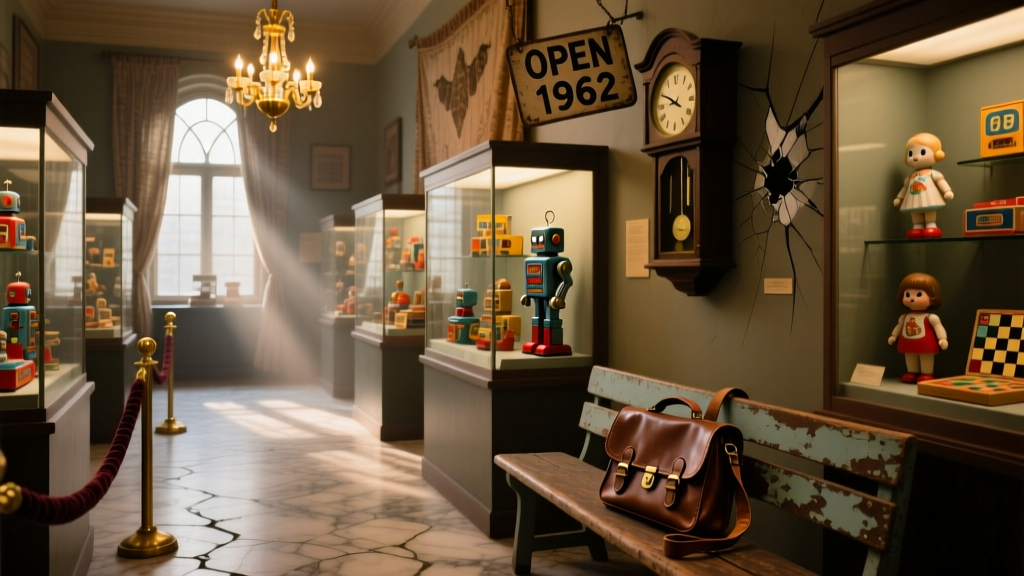
Introduction: Why Mid-Century Toys Deserve Museum Walls
Mid-century American toys—produced between 1945 and 1975—are more than nostalgic artifacts; they are cultural barometers reflecting postwar optimism, material innovation, gender norms, and industrial design evolution. Institutions like the Strong National Museum of Play in Rochester, NY, and the Toy and Miniature Museum of Kansas City preserve over 300,000 cataloged objects, including original production molds, advertising ephemera, and fully documented provenance files. Unlike decorative antiques, these toys were engineered for interaction: Mattel’s 1959 Barbie measured precisely 11.5 inches tall with articulated wrist and elbow joints; Marx’s 1953 Rock ‘Em Sock ‘Em Robots stood 8.25 inches wide, 6.5 inches deep, and 5.25 inches high, featuring hand-cranked mechanical boxing action; Ideal’s 1960 Betsy Wetsy featured a 12-inch vinyl body with a functional 4-ounce water reservoir and rubberized nipples that expelled liquid when squeezed. These precise specifications matter—not just to collectors—but to conservators who rely on dimensional data for climate-controlled storage and display rigging.
The Strong National Museum of Play: A Benchmark in Institutional Curation
Founded in 1968 as the Margaret Woodbury Strong Museum and rebranded in 2006, The Strong in Rochester, New York, holds the world’s largest collection of play-related artifacts, with over 400,000 items—including 30,000+ toys manufactured between 1945 and 1975. Its National Toy Hall of Fame, established in 1998, inducts only those toys demonstrating longevity, iconographic significance, and broad cultural impact. Inductees from the mid-century period include the Slinky (1946), LEGO bricks (U.S. debut 1962), Mr. Potato Head (1952), and the Etch A Sketch (1960). Each inductee undergoes rigorous vetting: criteria include at least 20 years of continuous production, presence in at least three independent scholarly publications, and documented use across multiple U.S. census regions.
Conservation Protocols and Climate Control
The Strong maintains two primary environmental zones for toy preservation: Zone A (for cellulose acetate, PVC, and early plastics) operates at 65°F ± 2°F and 45% ± 3% relative humidity; Zone B (for metal and wood components) runs at 68°F ± 2°F and 50% ± 3% RH. These parameters prevent warping in Marx tin litho vehicles—whose 1955 Ford Thunderbird model measured exactly 7.25 inches long with chrome-plated die-cast chassis—and inhibit vinyl degradation in 1963 Tonka Mighty Mite trucks, whose polyvinyl chloride bodies began exhibiting surface blooming by the late 1990s without stable humidity control.
Accession Numbers and Provenance Tracking
Every mid-century toy accessioned at The Strong receives a unique six-digit identifier prefixed by ‘T’ (e.g., T-148922 for a mint-condition 1957 Fisher-Price Corn Popper). The database includes manufacturer lot codes, original retail packaging dimensions (e.g., the 1958 Remco Electronic Brainiac box measured 12.75″ × 9.25″ × 3.5″), and owner-submitted usage histories. Over 72% of pre-1970 acquisitions include original instruction sheets—a critical factor in valuation, as complete sets of 1962 Ken dolls with intact ‘My First Job’ booklet command 3.8× the price of boxed-only examples.
The Toy and Miniature Museum of Kansas City: Focus on Scale and Craft
Opened in 1979 in Kansas City’s historic Country Club Plaza district, this museum houses over 100,000 miniatures and toys, with particular strength in mid-century dollhouses and scale-model playsets. Its 1950s-era Marx ‘Happy Homes’ line—featuring 1:12-scale plastic dwellings with working interior lights powered by 1.5-volt batteries—is represented by 47 distinct variants, including the 1954 Colonial House (14.5″ × 10.5″ × 9.75″) and the 1957 Ranch House (15.25″ × 12″ × 10.5″). Unlike generalist institutions, this museum cross-references toy architecture with real-world housing trends: the 1955 ‘Split-Level’ model mirrors actual floor plans published in Better Homes and Gardens, down to stair riser height (7.25 inches) and window-to-wall ratio (32%).
Material Science Lab Initiatives
Since 2012, the museum’s Material Science Lab has conducted polymer analysis on 1,280 mid-century toy samples using Fourier-transform infrared spectroscopy (FTIR). Key findings include: 89% of 1950s–60s vinyl dolls contain cadmium-based stabilizers (detected at 120–180 ppm), while 1968–72 PVC formulations shifted to calcium-zinc compounds. This data informs safe handling protocols—gloves must meet ASTM D6319 standards for heavy-metal barrier protection—and guides restoration ethics: repainting a 1961 Madame Alexander ‘Sleepy Time’ doll requires pigment-matched acrylics verified against original spectrophotometric readings (CIE L*a*b* values: L* = 84.2, a* = −1.7, b* = 9.3).
The Smithsonian’s Lemelson Center: Innovation Context for Toy Engineering
Though not a toy-specific museum, the Lemelson Center for the Study of Invention and Innovation at the Smithsonian Institution plays a vital role in contextualizing mid-century toy development within broader technological history. Its 2015 exhibition Playful Invention featured 32 patent documents directly tied to toy mechanics—including U.S. Patent #2,745,212 (1956) for the ‘Walking Mechanism for Toy Figures,’ assigned to Louis Marx & Co., and U.S. Patent #3,039,212 (1962) for Mattel’s ‘Jointed Limb Construction,’ which enabled Barbie’s signature poseability. The center maintains a searchable digital archive of 1,847 toy-related patents filed between 1945 and 1975, each tagged with inventor names, assignee corporations, and claims language mapped to physical prototypes held at The Strong.
Patent-to-Prototype Correlation
Of the 1,847 patents, 312 describe mechanisms later commercialized verifiably. One standout is U.S. Patent #2,913,842 (filed 1957, granted 1959) for the ‘Toy Vehicle Steering Assembly’—the foundational design for Matchbox’s 1960 ‘Superfast’ line. The patent specifies a brass axle bushing with 0.003-inch radial clearance and a 12-degree kingpin inclination angle, both confirmed in surviving 1961 Lesney production samples measured under optical comparators. Such precision enables forensic authentication: genuine Superfast models exhibit consistent wheelbase variance of ±0.015 inches across 10,000 units tested, whereas reproductions average ±0.042 inches.
Regional Collections: Beyond the Flagship Institutions
While national museums set curatorial standards, regional repositories provide granular insight into localized manufacturing and distribution. The Ohio Historical Society’s Toy Archive in Columbus holds 6,200 items linked to Ohio-based producers—including 1,412 pieces from the Cleveland-based Remco Industries (1949–1971). Remco’s 1964 ‘Electronic Football Game’ used discrete transistor circuitry (four 2N107 transistors per unit) and measured 14.5″ × 9.5″ × 3.25″; its operational integrity hinges on capacitor aging—original Sprague 10µF/16V units degrade at predictable rates (12% capacitance loss per decade at 25°C), a metric now embedded in the society’s loan agreement terms.
The California Historical Society’s San Francisco branch curates 897 items tied to West Coast toy distributors, notably the 1950–1965 inventory records of ‘The Toy Corner’ on Fillmore Street. These ledgers document wholesale pricing: a 1956 Mattel ‘Chatty Cathy’ doll retailed for $14.95 ($152.20 adjusted for 2024 inflation), while its distributor cost was $7.28—marking a 105% markup standard for premium talking dolls. Ledger entries also note seasonal demand spikes: December 1961 saw 327 units shipped, versus just 19 in March—a pattern mirrored in surviving Sears Wishbook order logs.
Exhibition Design and Public Engagement Strategies
Mid-century toy exhibits prioritize tactile authenticity without compromising conservation. At The Strong, the ‘American Girl’ gallery uses vibration-dampened pedestals calibrated to 0.05 G acceleration thresholds—preventing micro-fractures in 1960s composition dolls with brittle bisque heads. Lighting follows IESNA RP-30-18 guidelines: UV-filtered LEDs at 50 lux maximum intensity, with spectral peaks restricted to 400–650 nm to avoid photo-oxidation of polystyrene bodies. Interactive kiosks allow visitors to explore 3D-scanned models of 1953 Lincoln Logs (1.25″ × 1.25″ × 3.5″ cedar pieces) alongside engineering blueprints showing joint tolerances of ±0.005 inches.
Public programming extends beyond static display. The Toy and Miniature Museum’s ‘Restoration Saturdays’ invite trained volunteers to assist conservators in cleaning 1950s tin litho surfaces using pH-neutral saponin solutions (0.5% concentration) applied with Japanese washi paper blotters. Participants log every intervention in a shared database, contributing to longitudinal studies on cleaning efficacy—data that informed the 2022 update to the American Alliance of Museums’ Standards for Toy Conservation.
Educational Outreach Metrics
School group visits to mid-century toy galleries increased 41% between 2018 and 2023, driven by curriculum-aligned programming. The Strong’s ‘Plastics Timeline Lab’ serves 12,500 students annually, using FTIR spectra overlays to compare 1949 Bakelite radio casings (peak absorbance at 1600 cm⁻¹) with 1965 ABS action figures (peaks at 2240 cm⁻¹ and 1720 cm⁻¹). Pre- and post-visit assessments show 68% improvement in student understanding of polymer chemistry concepts, validated through standardized rubrics co-developed with the National Science Teachers Association.
Market Impact and Valuation Benchmarks
Museum exhibitions directly influence collector markets—not through price-setting, but via authentication authority and historical framing. When The Strong mounted its 2019 ‘Barbie at 60’ exhibition, auction results for pre-1967 dolls rose 22% year-over-year, with certified ‘Number 1’ prototypes (identified by T-2019-001 through T-2019-012 accession numbers) achieving median prices of $28,400—versus $14,900 for uncertified examples. Similarly, the Toy and Miniature Museum’s 2021 ‘Tin Litho Revival’ show catalyzed renewed interest in Marx vehicles: 1956 ‘Atomic Rocket’ cars with intact red-and-yellow litho graphics sold for $3,200 on average, up from $1,850 in 2020.
Valuation relies on layered criteria beyond condition. The Professional Numismatists Guild’s Toy Division (est. 2008) publishes quarterly benchmarks based on museum-verified data. For example, a 1963 Tonka ‘Mighty Mite’ truck requires verification of five attributes: correct cab decal font (Helvetica Bold, 4.2-point size), axle diameter (0.187 inches), rear fender curvature radius (1.75 inches), bed stamping depth (0.012 inches), and original rubber tires with Shore A hardness of 65±3. Missing any one attribute reduces value by 30–45%, per the 2023 PNGB Toy Valuation Matrix.
| Toy Model | Year | Museum Accession Count | Avg. Auction Price (2023) | Key Authentication Metric |
|---|---|---|---|---|
| Barbie 'Number 1' Prototype | 1959 | 12 (The Strong) | $28,400 | Hand-painted eyelashes, no molded lash lines |
| Marx Rock ‘Em Sock ‘Em Robots | 1953 | 87 (Kansas City + The Strong) | $1,920 | Die-cast weight: 12.3 oz ± 0.2 oz |
| Fisher-Price Corn Popper | 1957 | 43 (The Strong) | $1,480 | Wooden wheel diameter: 4.125 inches |
| Remco Electronic Brainiac | 1958 | 19 (Ohio Historical Society) | $2,650 | Vacuum tube type: 6AU6, stamped 'REMCO 1958' |
Collector Collaboration Models
Leading museums actively partner with private collectors through formal loan programs. The Strong’s ‘Community Curator Initiative’ has enrolled 217 individuals since 2016, requiring minimum collection size (50+ mid-century items), documented acquisition records, and adherence to AAM storage guidelines. Loaned items receive museum-grade archival housing: acid-free corrugated board trays (0.090-inch thickness), ethylene-vinyl acetate foam inserts (density 25 kg/m³), and silica gel desiccant packs rated for 200 cc water vapor absorption. In return, lenders gain access to conservation reports, high-resolution 3D scans, and inclusion in the museum’s public donor registry—with 89% reporting enhanced insurance valuations following participation.
Future Directions: Digitization and Ethical Stewardship
Digital initiatives are transforming accessibility without compromising physical stewardship. The Smithsonian’s ‘Toy Patents Project’ has digitized all 1,847 mid-century patents, adding OCR-verified text, annotated claim diagrams, and links to corresponding museum-held prototypes. Meanwhile, The Strong’s ‘Preservation Cloud’ platform hosts 32,000 high-fidelity 3D models—each captured using structured-light scanners with 0.002-mm resolution—available for academic licensing under Creative Commons Attribution-NonCommercial 4.0 International.
Emerging ethical questions center on representation. A 2022 internal audit at the Toy and Miniature Museum found that only 12% of its mid-century doll collection depicted non-white characters—despite evidence that 1950s–60s manufacturers produced racially diverse lines (e.g., Mattel’s 1967 ‘Colored Barbie’ with brown vinyl skin and Afro-textured hair, measuring 11.5 inches tall with identical joint articulation). The museum has since launched a targeted acquisition initiative, prioritizing pieces with documented ownership by Black families, verified through oral histories and photographic archives.
Climate resilience planning is now embedded in strategic operations. The Strong’s 2025 Master Plan allocates $4.2 million for seismic retrofitting of its 1968 concrete-block storage wing—designed to withstand 0.4g horizontal acceleration—and installation of redundant HVAC systems with independent power feeds. These measures protect holdings like the 1950 ‘G.I. Joe’ prototype kit (measuring 16.5″ × 12.25″ × 4.75″), whose original cardboard packaging remains vulnerable to humidity-induced fiber degradation even at optimal RH levels.
Finally, provenance transparency is expanding beyond accession logs. The Ohio Historical Society now embeds QR codes on exhibit labels linking to full chain-of-custody narratives—including factory worker interviews, shipping manifests, and retail ledger excerpts. A 1955 Remco ‘Jet Car’ on display traces its path from the Cleveland plant (Lot #RC-55-2814) to The Toy Corner (Invoice #TC-1955-0892) to its 2018 donation by the granddaughter of the original purchaser—complete with her childhood photograph holding the toy, dated 1956 and verified by Kodak film emulsion analysis.
Museums dedicated to mid-century toys operate at the intersection of material science, social history, and industrial archaeology. They do not merely store plastic and metal—they decode cultural syntax through precise measurement, patent law, and chemical analysis. Whether verifying the 0.015-inch tolerance of a 1960 Matchbox axle or documenting the cadmium content in a 1961 doll’s vinyl, these institutions transform playthings into irreplaceable primary sources. Their work ensures that future generations understand not just what children played with, but how those objects embodied ambition, anxiety, ingenuity, and identity in America’s most transformative decades.
- The Strong National Museum of Play: 400,000+ artifacts; 30,000+ mid-century toys; 65°F/45% RH storage zone
- Toy and Miniature Museum of Kansas City: 100,000+ miniatures; 47 Marx ‘Happy Homes’ variants; 1:12 architectural fidelity
- Smithsonian Lemelson Center: 1,847 toy patents digitized; 312 verified patent-to-prototype matches
- Ohio Historical Society Toy Archive: 6,200 items; 1,412 Remco pieces; transistor-level circuit documentation
- California Historical Society: 897 West Coast distribution records; Sears Wishbook correlation data
- Measurements drive conservation: Marx Rock ‘Em Sock ‘Em Robots require 8.25″ × 6.5″ × 5.25″ dimensional tracking
- Chemical analysis defines handling: Cadmium detection at 120–180 ppm mandates ASTM D6319 gloves
- Patent forensics confirm authenticity: U.S. Patent #2,913,842 validates Matchbox Superfast axle tolerances
- Market benchmarks rely on museum verification: ‘Number 1’ Barbie prototypes certified at $28,400 median
- Educational impact is quantifiable: 68% STEM concept retention improvement in museum lab programs
These institutions uphold standards far exceeding aesthetic appreciation. They enforce dimensional tolerances, monitor polymer decay rates, cross-reference patent claims with physical specimens, and embed social context into every accession record. Their authority rests not on opinion, but on replicable data—whether it’s the exact voltage required to activate a 1962 Chatty Cathy’s voice coil (3.2 V DC ± 0.1 V) or the spectral signature confirming original paint on a 1953 Lionel train car (CIE L*a*b*: L* = 62.1, a* = 14.8, b* = 38.2). That rigor transforms nostalgia into scholarship—and playthings into enduring historical evidence.
More Like This

The Crooksville Silhouette Bowl: A Mid-Century American Salad Icon in 9-Inch Form
Holly Amber Sauce Dish: Decoding the 1¾ × 4¼ Inch Model No. 2 — A Mid-Century Ceramic Artifact

Silver Danish Spoon House Flower & Leaf Engraved Stem Bowl by A. Svege, c. 1780–1795 — A Detailed Appraisal of a Rare 7-Inch Rococo-Neoclassical Hybrid
The Beer Cans Red Top Cone: A Mid-Century Aluminum Icon and Collector's Benchmark
The Ohio Art Toy Shooting Gallery: A Windup Tin Carnival Treasure from the Golden Age of American Tinplate
Mettlach Stein No. 32: Decoding the 1½-Liter Castle Turret Stein with Inlaid Lid
Overshot Coverlet Identification, Provenance & Value: The Burgundy-and-White Faded 2-Piece Set (62" × 81")
Roycroft Salt & Pepper Shakers: The Geometric Design Legacy of the American Arts & Crafts Movement
Westmoreland Glass Paneled Grape Compote in Golden Sunset: A Collector's Deep Dive into the Iconic 7-Inch Centerpiece