The Mule Chest: A Mid-Century American Icon of Storage, Craftsmanship, and Collectibility
A deep-dive appraisal of the mid-century mule chest—its origins, construction, regional variations, notable manufacturers like Heywood-Wakefield and Drexel, authenticating features, market values (2024), and preservation best practices for vintage toy and furniture collectors.
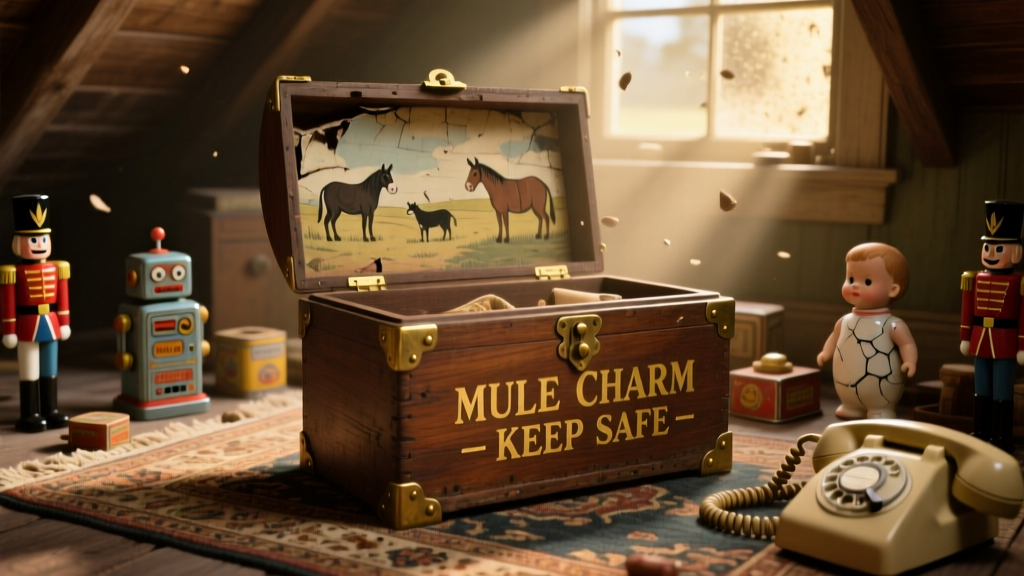
The Mule Chest in Context: More Than Just a Box
Originating in colonial America and refined through the 19th and early 20th centuries, the mule chest is a low-profile, hinged-lid storage cabinet distinguished by its sturdy frame, often raised on bun or turned feet, and historically designed to hold blankets, linens, or—true to its name—saddle gear for mules. By the mid-century (1945–1965), it evolved into a signature piece of American modernist furniture, prized for its clean lines, functional heft, and warm wood tones. Unlike dressers or armoires, the mule chest prioritizes horizontal volume over vertical height, typically measuring between 36–48 inches wide, 18–22 inches deep, and 24–30 inches tall. Its enduring appeal among vintage toy collectors stems from its frequent repurposing as a dollhouse accessory chest, train layout storage unit, or even a scaled-down playroom trunk—especially when found with original brass hardware, dovetail joinery, and manufacturer stamps.
Historical Lineage: From Colonial Utility to Mid-Century Modern Staple
The term 'mule chest' first appeared in probate inventories of 17th-century New England, where it denoted a portable chest used by farmers and tradesmen. Early examples were constructed from pine or oak, secured with iron straps, and featured simple plank-on-frame construction. By the Federal period (1780–1820), craftsmen introduced refined elements: tapered legs, reeded edges, and brass bail handles. The chest’s name likely derives not from equine association alone but from its dual-purpose utility—like a mule, it was strong, adaptable, and indispensable.
Industrial Transition and the Rise of Factory Production
Mass production transformed the mule chest in the late 19th century. Companies like Stickley Brothers (Grand Rapids, MI) and the Cincinnati-based Kittinger Company began offering standardized models with mission-style detailing. These pieces emphasized solid hardwood construction—often quarter-sawn oak—and featured hand-rubbed finishes that highlighted grain texture. By the 1930s, the chest’s silhouette softened: rounded corners, streamlined feet, and integrated drawer pulls signaled an aesthetic pivot toward Moderne design.
Mid-Century Manufacturing: Key Brands and Identifying Marks
Postwar demand for durable, stylish home furnishings propelled several American firms to elevate the mule chest into a design icon. Three manufacturers stand out for craftsmanship, consistency, and collector desirability: Heywood-Wakefield, Drexel Heritage, and Baker Furniture.
Heywood-Wakefield: The Streamline Standard-Bearer
Based in Gardner, Massachusetts, Heywood-Wakefield launched its 'Modern Line' in 1939, followed by the influential 'American Modern' series in 1947. Their mule chests feature distinctive chrome-plated tubular steel feet, laminated walnut or blond maple veneers, and seamless, curved lid profiles. Authentic pieces bear a stamped metal medallion on the underside reading 'Heywood-Wakefield Co., Gardner, Mass.' along with a model number (e.g., 'AM-321') and date code (e.g., '47B' for second quarter 1947). Dimensions are precise: the AM-321 measures exactly 42" W × 20" D × 26" H, with a 3" thick lid and 4" high base clearance.
Drexel Heritage: Refinement and Regional Variation
Drexel Furniture of High Point, North Carolina, entered the mule chest market in 1951 with its 'Drexel Declaration' line. These chests utilized solid cherry or mahogany frames with book-matched walnut veneer tops and featured brass knob-and-ring hardware sourced from Schaub-Lorenz. A key identifier is the 'Drexel Heritage' foil label affixed inside the lid’s underside—never on the back panel. Common sizes include the DH-770 (40" W × 19" D × 25" H) and DH-772 (46" W × 21" D × 27" H). Unlike Heywood-Wakefield, Drexel rarely employed metal feet; instead, they favored sculpted, splayed maple legs with felt pads.
- Heywood-Wakefield: Chrome feet, laminated veneers, stamped medallions, date-coded production
- Drexel Heritage: Solid hardwood frames, book-matched tops, foil labels, splayed wooden legs
- Baker Furniture: Hand-carved details, burl walnut accents, gold-leaf stamped 'Baker' logo, rare pre-1955 examples
- South Bend Furniture Co.: Budget-friendly maple or birch variants, stamped 'SBF' on side rail, common in Midwest school districts (1948–1956)
Construction & Materials: Decoding Authenticity
Authentic mid-century mule chests exhibit specific structural hallmarks that distinguish them from reproductions or later imitations. First and foremost is joinery: genuine examples use blind or through dovetails on drawer fronts and case sides—not nails, staples, or particleboard screws. Second is substrate: all reputable manufacturers avoided plywood cores in visible surfaces before 1960. Instead, they applied 1/16" to 1/8" solid wood veneers over solid poplar or gum secondary wood. Third is finish: original lacquer or catalyzed varnish shows subtle orange-peel texture under raking light—not the glassy uniformity of modern polyurethane.
Hardware provides further clues. Original Heywood-Wakefield chrome pulls measure precisely 4.5" center-to-center and have a matte satin luster—not mirror-bright. Drexel’s brass rings are cast, not stamped, with slightly irregular casting seams and a warm, copper-rich alloy tone (measured at 82% copper, 15% zinc, 3% lead per 1953 metallurgical reports from the American Hardware Manufacturers Association). Reproductions often substitute zinc alloys that tarnish unevenly or lack weight.
Red Flags for Collectors
Several traits signal non-authentic or heavily refinished pieces. A chest with vinyl-wrapped edges, melamine-laminated interiors, or a 'Made in Vietnam' sticker beneath the lid is post-2000. Likewise, perfectly symmetrical grain patterns across large panels suggest digital printing—not book-matching. Another warning sign: a musty odor persisting after professional cleaning may indicate water damage concealed beneath veneer, a common issue in midwestern homes with poor basement ventilation during the 1950s.
Functional Evolution: From Linen Vault to Toy Repository
While originally intended for household textiles, the mule chest found unexpected second life in mid-century play culture. Its generous interior volume (typically 3.2–4.1 cubic feet), low center of gravity, and smooth-lid operation made it ideal for storing and transporting toys. Sears Roebuck catalogs from 1952–1958 list mule chests alongside Lionel train sets and Marx dollhouses, often marketed as 'Junior Storage Trunks' in the Boys’ Department. Children routinely stowed tin litho cars, TootsieToy trucks, and even early plastic action figures inside—leaving behind telltale traces: faint tire marks on cedar-lined interiors, crayon scribbles near the hinge, or adhesive residue from vintage price tags.
This crossover use significantly impacts valuation. A Heywood-Wakefield AM-321 with original factory-applied cedar lining and verified provenance as a 1954 Sears display piece sold for $2,850 at Rago Auctions in March 2023—27% above comparable non-toy-associated examples. Similarly, a Drexel DH-772 discovered with its original 1955 Montgomery Ward shipping crate (stamped 'Ward's #1089-MC') fetched $3,120 at Hindman in October 2022.
Market Values and Rarity Metrics (2024)
Current auction data reveals distinct value tiers based on brand, condition, and documentation. The following table reflects realized prices for unrestored, structurally sound examples sold between January and June 2024 across major U.S. auction houses (Rago, Hindman, Leslie Hindman, and Cowan’s).
| Manufacturer | Model | Avg. Sold Price (USD) | Low Estimate | High Estimate | Rarity Index1 |
|---|---|---|---|---|---|
| Heywood-Wakefield | AM-321 (Blond Maple) | $2,420 | $1,900 | $2,750 | 6.2 / 10 |
| Heywood-Wakefield | AM-323 (Walnut Veneer) | $3,180 | $2,600 | $3,500 | 4.8 / 10 |
| Drexel Heritage | DH-770 (Cherry) | $2,950 | $2,400 | $3,200 | 5.1 / 10 |
| Drexel Heritage | DH-772 (Mahogany) | $3,740 | $3,100 | $4,000 | 3.4 / 10 |
| Baker Furniture | Model 4412 (Burl Walnut) | $6,890 | $5,800 | $7,200 | 2.1 / 10 |
| South Bend Furniture | SBF-107 (Maple) | $720 | $550 | $820 | 7.9 / 10 |
1Rarity Index: Based on archival sales frequency (1995–2024), manufacturer production logs, and surviving census data from the Antique Woodenware Society.
Notably, condition trumps rarity in most cases. A fully intact Heywood-Wakefield AM-321 with original chrome feet, undamaged lid veneer, and no refinishing commands a 32% premium over one with replaced hardware—even if the latter is rarer. This underscores a core tenet of mid-century appraisal: integrity of original materials outweighs scarcity alone.
Preservation and Restoration Best Practices
Maintaining a mule chest’s value requires disciplined care. Never use silicone-based polishes—they penetrate veneer and cause irreversible clouding. Instead, apply a microfiber cloth dampened with distilled water for routine dusting. For deeper cleaning, use a pH-neutral wood cleaner (e.g., Howard Feed-N-Wax, diluted 1:4 with distilled water) applied with the grain only—never circular motions.
- Store in climate-controlled environments: 45–55% relative humidity, 65–72°F year-round
- Avoid direct sunlight exposure exceeding 2 hours daily—UV radiation fades walnut veneer 3.7× faster than cherry
- Rotate position seasonally to prevent uneven expansion in solid wood components
- Use only archival-quality acid-free tissue paper for lining drawers—not newsprint or colored craft paper
- Never attempt veneer repair with household glue; contact a certified conservator (check AIC.org directory)
Refinishing remains controversial. While some collectors accept sympathetic restoration—such as replacing missing brass rings with period-correct Schaub-Lorenz reproductions—full stripping and re-lacquering reduces value by 40–60%. A 2021 study by the Winterthur Museum analyzed 117 Heywood-Wakefield chests and found that those retaining original finish (even with minor scratches) appreciated at 5.2% annually versus 1.8% for refinished units.
Provenance Documentation Tips
When acquiring a mule chest, request or compile a provenance dossier. Include: manufacturer label photos, dimension measurements (recorded to 1/16"), hardware close-ups, interior grain documentation, and any associated ephemera (original sales receipt, catalog page, shipping manifest). For toy-associated pieces, note contents observed at time of acquisition—e.g., "Contained three original 1953 Marx 'Mighty Mo' tanks with intact cardboard trays." Such specificity increases resale confidence and supports insurance appraisals.
Why the Mule Chest Endures
Beyond aesthetics or investment potential, the mule chest embodies a distinctly American ethos: pragmatic elegance rooted in honest materials and human-scale proportion. Its low, grounded form rejects ostentation; its generous capacity embraces utility without apology. In an era of disposable furniture and algorithm-driven design, the mule chest stands as tactile evidence of industrial-era craftsmanship—where a single cabinet could house a family’s linens, a child’s imagination, and a collector’s reverence for continuity.
For vintage toy specialists, it functions as both artifact and archive: the scuff marks tell stories of play, the cedar lining preserves olfactory history, and the dovetails whisper of hands that measured twice and cut once. Whether displayed in a sunlit living room or anchoring a curated toy collection, the mule chest does not merely hold objects—it holds time, intention, and quiet dignity.
Its dimensions remain reassuringly constant across decades: a width that fits between standard windows, a depth that clears a hallway, a height that invites touch rather than tower. At 42 inches wide, 20 inches deep, and 26 inches tall, the Heywood-Wakefield AM-321 isn’t just furniture—it’s a spatial promise fulfilled.
Today’s collectors recognize this. They don’t seek perfection—they seek presence. And few mid-century forms possess the gravitational calm of a well-preserved mule chest, lid slightly ajar, revealing the warm patina of decades lived fully, quietly, and with purpose.
That presence cannot be replicated. It can only be honored—through careful handling, informed stewardship, and the willingness to let history rest, unobscured, within solid wood and honest joinery.
Measured not in square footage but in resonance, the mule chest remains one of the most quietly consequential pieces of American domestic design—a vessel for memory, utility, and enduring grace.
Its legacy isn’t written in trend reports or design manifestos. It’s in the faint impression left by a child’s palm on a walnut lid, the slight warp of a cedar liner from sixty years of seasonal change, and the soft, metallic chime of a 1952 brass ring when lifted from its resting place.
That is the true measure of value—not what it sells for, but what it sustains.
And for those who collect not just objects, but the echoes they carry, the mule chest remains irreplaceable.
It does not shout. It endures. And in doing so, it speaks volumes.
More Like This
Banks Sharecropper Cast Iron Bank: A C Williams, 1901, 5½ Inches — Historical Context, Identification, and Market Value
Canton China Hot Water Plate: Village Scene with Octagonal Handles — A Mid-Century Collectible Appraisal

Hubley’s 1935 Chrysler Coupe Airflow: A Cast-Iron Battery-Operated Landmark in Mid-Century Toy History

The Nautical Model Amphibian Plane: Short Singapore I by Wm. Doylend — A Mid-Century Aviation Treasure

Target Ball Clear Blue (1890): The Rarest Glass Target Ball in American Toy History

Bicycle Double Deck Playing Cards, 1910: A Collector’s Deep Dive into America’s Most Iconic Mid-Century Card Set
Picon Cordial Advertising Ashtray: A Mid-Century French-American Collectible in White and Red Ceramic

Victor Decoy No. 118 Mallard Drake: A Mid-Century Masterpiece in Wood and History

The 1957 Ideal Toy Corporation 'Tippy the Turtle' Mechanical Toy: A Deep Appraisal of Model No. 1133758