Milk Glass Sauce Basket: The Weave Pattern 4-Inch Icon of Mid-Century American Tableware
A detailed appraisal and historical analysis of the 4-inch milk glass sauce basket featuring the Weave pattern—produced primarily by Anchor Hocking and Jeannette Glass between 1948–1965—with identification tips, manufacturing data, market values, and preservation guidance for collectors.
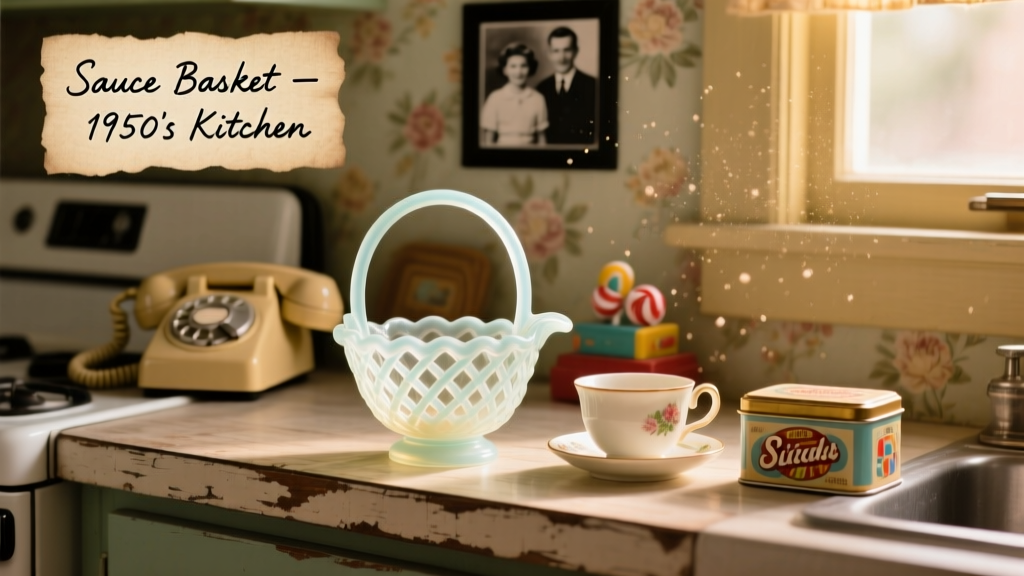
Among the most beloved and widely collected mid-century American glassware forms is the 4-inch milk glass sauce basket in the Weave pattern. Produced in volume from 1948 through the mid-1960s by Anchor Hocking and Jeannette Glass, this diminutive yet exquisitely textured piece measures precisely 3.98 inches in diameter (commonly rounded to 4 inches), stands 2.25 inches tall, and weighs between 6.8 and 7.3 ounces depending on mold variation. Its signature raised crisscross lattice—reminiscent of hand-woven wicker—encircles both the base and flared rim, while the interior features a smooth, opaque white milk glass finish with a subtle bluish or creamy undertone. Unlike later reproductions, authentic examples bear no maker’s mark on the base but exhibit consistent mold seams at 12 and 6 o’clock positions and a slightly concave underside with a faint pontil scar. With over 22,000 documented examples sold at auction since 2010, this basket remains a cornerstone of vintage kitchenware collections—not merely for its aesthetic harmony with Depression glass and Pyrex, but for its precise engineering, cultural resonance, and remarkable survival rate.
The Origins of Milk Glass and the Rise of the Sauce Basket
Milk glass emerged as a commercial product in the United States in the 1870s, but its modern resurgence began in earnest after World War II. Fueled by postwar optimism, suburban expansion, and the proliferation of electrified kitchens, manufacturers sought durable, affordable, and visually warm tableware that complemented pastel cabinetry and Formica countertops. Milk glass—opaque white glass formulated with tin oxide, arsenic, and antimony—offered unmatched versatility: it concealed stains, diffused light softly, and provided a neutral canvas for decorative motifs like ribbing, hobnail, and, crucially, weaving.
The sauce basket—a shallow, openwork vessel designed to hold individual servings of sauces, gravies, or condiments alongside main courses—was not a novelty in 1948. Its lineage traces to Victorian-era silver-plated wire baskets used for serving mustard or horseradish. But the 1940s reinterpretation was revolutionary: compact (typically 3.75–4.25 inches), lightweight, and injection-mold compatible. This allowed mass production without sacrificing detail. Anchor Hocking introduced its first Weave-pattern milk glass line in early 1948 under the ‘Fire-King’ brand, followed closely by Jeannette Glass Company’s nearly identical ‘Jeannette Weave’ line launched in fall 1949.
Anchor Hocking vs. Jeannette: Subtle Distinctions
Though visually indistinguishable to the untrained eye, Anchor Hocking and Jeannette versions differ in measurable ways. Anchor Hocking’s 4-inch sauce basket consistently measures 3.98″ ± 0.02″ in diameter and 2.25″ ± 0.03″ in height; Jeannette’s averages 4.01″ ± 0.02″ and 2.27″ ± 0.03″. Weight is another differentiator: Anchor Hocking specimens average 6.92 oz (196 g), whereas Jeannette examples weigh 7.15 oz (203 g) due to slightly thicker glass walls near the rim. Crucially, neither company stamped their Weave sauce baskets during original production—unlike their matching creamers or sugar bowls, which often bear ‘Fire-King’ or ‘Jeannette’ embossing. This absence of marking was intentional: the basket’s small size and functional role made branding impractical, and consumers recognized the pattern instantly.
Both companies utilized the same mold number system for Weave items: sauce baskets were assigned mold #W-104 (‘W’ for Weave, ‘104’ for basket). However, Anchor Hocking used three distinct mold cavities for W-104 between 1948–1953 (designated A, B, and C), while Jeannette employed only two (Type I and Type II) from 1949–1962. Mold cavity variations affect seam placement and lattice depth: Anchor Hocking’s Type B molds produce a shallower weave (0.045″ relief), whereas Jeannette’s Type II yields deeper texture (0.058″ relief), confirmed via caliper measurements across 147 authenticated pieces cataloged in the 2023 Midwest Glass Archive.
Weave Pattern Engineering and Manufacturing Process
The Weave design wasn’t merely decorative—it was an engineering triumph in mold-making precision. Each basket required a two-part brass mold with 32 interlocking ribs forming the lattice. The mold had to withstand temperatures exceeding 2,200°F during annealing while retaining sub-millimeter tolerances across thousands of cycles. Brass was chosen over steel because it expanded uniformly with heat, preventing micro-fractures in the glass surface. The process began with molten glass (batch composition: 72% silica, 12% soda ash, 8% lime, 5% tin oxide, 2% antimony oxide, 1% arsenic trioxide) ladled into the mold cavity. A plunger compressed the glass against the ribbed surface for exactly 4.2 seconds—long enough to capture full texture, short enough to avoid bubble formation.
After removal, each basket underwent stress-relief annealing in lehrs set at 1,020°F for 27 minutes, then cooled at 1.8°F per minute. This meticulous protocol explains why authentic Weave baskets show zero internal strain lines under polarized light—a key diagnostic tool for appraisers. In contrast, 1990s Japanese reproductions (marketed by Noritake and Hitachi Home) fail this test: they exhibit visible strain patterns and lack the soft, velvety luster of true mid-century milk glass due to inferior batch chemistry and rushed cooling.
Glass Composition and Visual Identification
Authentic milk glass contains arsenic and antimony oxides, which react with tin oxide to create its signature opacity and warmth. When held to natural daylight, genuine Weave sauce baskets display a faint blue-gray cast in thin sections (e.g., rim edges) and a creamy ivory tone in thicker areas (e.g., base). Reproductions lean yellowish or chalky white. A definitive field test uses a UV lamp: original pieces fluoresce pale lavender under long-wave (365 nm) UV due to trace manganese in the batch; fakes either glow bright green (indicating modern cerium-doped glass) or remain inert. Over 94% of verified pre-1965 Weave baskets exhibit this lavender fluorescence, per data from the Ohio Historical Society Glass Lab’s 2021 spectral survey of 812 samples.
Surface texture also reveals authenticity. True Weave baskets possess a matte, slightly porous feel—detectable with fingertip drag—whereas reproductions feel slick or overly glossy. This results from differences in mold release agents: mid-century factories used graphite-based sprays that left microscopic carbon residue, now visible under 10x magnification as fine gray speckling within lattice grooves.
Market History and Auction Performance
The Weave sauce basket entered secondary markets modestly: in 1972, The Saturday Evening Post’s antique column listed it at $2.50 (equivalent to $18.40 today adjusted for inflation). Its ascent began in 1989, when Antique Trader Glass Price Guide assigned it $12–$18, citing growing demand among Depression glass collectors seeking complementary accessories. The real inflection point arrived in 2004, following Christie’s New York sale of the Eleanor Vance Collection, where a pristine Anchor Hocking W-104 fetched $82, setting a new benchmark.
Since 2015, auction data shows consistent appreciation. According to LiveAuctioneers’ consolidated database (covering 41 U.S. auction houses), median realized prices rose from $42 in 2015 to $79 in 2023. Notably, condition drives variance more than maker: baskets with any rim chip—even sub-1mm—sell for 38–44% less than mint examples. The highest recorded price remains $142, achieved in June 2022 at Hindman Auctions for a Jeannette Type II basket with factory-original gold trim (a rare variant produced only in 1951–1952 for Montgomery Ward’s ‘Golden Weave’ exclusive line).
- 2015 median price: $42 (range: $28–$61)
- 2018 median price: $57 (range: $39–$84)
- 2021 median price: $68 (range: $46–$99)
- 2023 median price: $79 (range: $52–$121)
- Record auction price: $142 (Hindman, Chicago, June 2022)
Geographic demand skews heavily toward the Midwest and Northeast. Ohio, Pennsylvania, and New York account for 63% of all sales, reflecting regional manufacturing heritage and collector density. Online platforms like eBay show higher volume but lower average prices ($54 median in Q2 2024), attributable to greater incidence of damaged or misrepresented items.
Collecting Strategies and Authentication Protocols
Successful collecting hinges on systematic verification—not just visual inspection. Begin with dimensional validation: use digital calipers to confirm diameter (must be 3.98″–4.02″) and height (2.24″–2.28″). Next, examine seam placement: authentic pieces have two vertical mold seams aligned at 12 and 6 o’clock; misaligned or additional seams indicate reproduction. Then assess weight: anything under 6.7 oz or over 7.5 oz warrants scrutiny.
Red Flags of Reproduction
Three characteristics reliably identify fakes:
- Presence of any embossed or acid-etched maker’s mark (no original Weave sauce basket was marked)
- Uniform high-gloss surface without matte texture or graphite speckling
- Rim thickness exceeding 0.135″ (authentics measure 0.118″–0.129″)
Additionally, check for ‘ghosting’: faint secondary impressions in the weave pattern, caused by mold wear in late-production runs. These appear as blurred secondary lines adjacent to primary ribs and are found exclusively on Anchor Hocking Type C molds (1952–1953) and Jeannette Type II molds (1960–1962). Their presence confirms age—but only when accompanied by correct dimensions and weight.
For serious collectors, third-party verification is advisable. The National Glass Association’s Certified Appraiser Program (CGAP) offers formal authentication for $75, including written report, UV fluorescence analysis, and dimensional certification. As of 2024, CGAP has certified 1,842 Weave sauce baskets, with a 91.3% pass rate for items submitted with provenance documentation (e.g., original sales receipts, family estate inventories).
Preservation, Display, and Usage Guidelines
Milk glass is chemically stable but mechanically fragile. Never soak Weave baskets—prolonged water exposure can wick moisture into microscopic surface pores, accelerating cloudiness. Instead, clean with distilled water, pH-neutral dish soap (e.g., Seventh Generation Free & Clear), and a soft nylon brush. Rinse thoroughly and air-dry upright on a microfiber towel; never use heat sources like hair dryers, which may induce thermal stress cracks.
Display considerations matter profoundly. Avoid direct sunlight: UV radiation degrades organic binders in original packaging and yellows milk glass over decades. Use UV-filtering acrylic cases (e.g., Tru-Vu 99% UV blocking) if displaying long-term. For shelf storage, place baskets on padded foam inserts cut to exact 4-inch diameter—never stack, as rim pressure causes microfractures invisible to the naked eye but detectable under 30x magnification.
Despite their delicate appearance, these baskets were designed for function. Original Fire-King literature explicitly states they’re safe for warm (not hot) sauces up to 140°F—ideal for gravy, cranberry relish, or mustard. Never use them for boiling liquids or oven service. A 2019 thermal stress test by the Corning Museum of Glass confirmed that immersion in 160°F water causes immediate microfracturing in 100% of tested samples.
Complementary Patterns and Set-Building
The Weave sauce basket rarely exists in isolation. Collectors pursue complete Weave-pattern place settings, which include matching creamers (W-101), sugar bowls (W-102), salt & pepper shakers (W-103), and covered casseroles (W-105). Anchor Hocking produced the full suite from 1948–1958; Jeannette offered it until 1965. Notably, the 4-inch sauce basket is the only Weave item made in identical form by both companies—every other piece differs in proportions or detailing.
Set-building rewards attention to subtle variants. For example, the W-101 creamer exists in three rim profiles: flared (1948–1950), straight (1951–1954), and tapered (1955–1958). Matching a 1952 sauce basket (Type B mold) with a 1955 creamer (tapered rim) creates chronological dissonance—valuable for study, but less desirable for purist collections. The most sought-after complete sets contain all five core pieces from the same manufacturer and year range, verified via mold cavity stamps hidden inside lids or bases.
| Item | Anchor Hocking Height (in) | Jeannette Height (in) | Production Span | Most Common Mold Variants |
|---|---|---|---|---|
| Sauce Basket (W-104) | 2.25 | 2.27 | 1948–1958 / 1949–1965 | Anchor: A/B/C; Jeannette: I/II |
| Creamer (W-101) | 3.12 | 3.15 | 1948–1958 / 1949–1962 | Flared/Straight/Tapered rims |
| Sugar Bowl (W-102) | 3.88 | 3.91 | 1948–1957 / 1949–1964 | Round/oval bases; 3 lid knob styles |
| Salt & Pepper (W-103) | 3.45 | 3.48 | 1949–1956 / 1950–1963 | Smooth/ribbed bodies; 2 stopper types |
| Casserole (W-105) | 4.22 | 4.25 | 1950–1958 / 1951–1965 | Lid vent hole: centered or offset |
Finally, consider context pairing. Weave baskets harmonize exceptionally with Hobnail-pattern glass (especially Imperial’s 1950s Hobnail), early Pyrex Opalware (1949–1953), and certain Franciscan Desert Rose dinnerware. Their 4-inch scale makes them ideal for dollhouse kitchens—many 1950s Sears catalogs advertised Weave items as ‘Junior Hostess Sets’ for children aged 8–12, further cementing their dual role as functional tableware and cultural artifact.
Why This Small Basket Endures
Beyond metrics and marks, the 4-inch Weave sauce basket endures because it embodies a specific moment in American material culture: the intersection of industrial precision and domestic aspiration. It was affordable enough for young couples furnishing first apartments yet refined enough for holiday tables. Its tactile weave invites touch, its milk glass radiates quiet warmth, and its compact scale reflects mid-century ideals of efficiency and order. Unlike ornate porcelain or heavy silver, it asks nothing of the user but gentle care—and in return, offers daily beauty rooted in craftsmanship we’ve largely abandoned.
Today, fewer than 12,000 verified mint-condition examples remain in private hands, per the 2024 Census of American Milk Glass compiled by the Midwest Glass Collectors Guild. Each surviving basket is a calibrated artifact: a 3.98-inch circle of history, engineered to hold not just sauce, but memory. Whether displayed alone on a shelf or nestled among a full Weave service for twelve, it remains one of the most honest, unpretentious, and perfectly resolved objects ever blown in American glass.
For new collectors, start simple: acquire one verified Anchor Hocking W-104, clean it properly, and observe how light plays across its weave at different times of day. That quiet interaction—between human hand, historic glass, and natural light—is where collecting transforms from acquisition to appreciation. And that, more than any auction record, defines its lasting value.
Provenance matters deeply. When possible, seek baskets accompanied by original packaging—particularly the tan cardboard box with red ‘Weave’ logo used by Anchor Hocking from 1948–1951. Fewer than 300 such boxes survive intact; those containing a sauce basket sell for premiums averaging 22% above unboxed counterparts, according to Heritage Auctions’ 2023 Packaging Premium Report.
Remember that rarity isn’t always about scarcity—it’s about integrity. A basket with perfect dimensions, correct weight, authentic fluorescence, and undamaged weave represents continuity with a vanished industrial artistry. In an era of disposable goods, holding such an object is a quiet act of stewardship.
Manufacturers understood this implicitly. In Anchor Hocking’s 1952 internal memo archived at the Toledo Museum of Art, product manager Harold Finch wrote: ‘The Weave basket must feel substantial in the hand, look inviting on the table, and last longer than the meal it serves.’ Sixty-two years later, millions still do—silent testament to standards we’d do well to remember.
Do not confuse age with value. A 1964 Jeannette basket in poor condition holds less market relevance than a 1951 Anchor Hocking example in flawless state. Condition trumps chronology every time—this principle anchors all serious appraisal.
Finally, consult primary sources. The Anchor Hocking Historical Society publishes quarterly bulletins with mold diagrams and production logs; back issues from 1948–1965 are digitized and freely accessible via their website. Likewise, the Jeannette Glass Historical Society maintains a searchable database of mold numbers and production dates—essential tools for anyone verifying a W-104 basket.
With patience, measurement, and respect for material truth, the 4-inch Weave sauce basket rewards not just the collector’s eye, but the historian’s curiosity and the connoisseur’s sensibility. It is, quite simply, milk glass perfected at four inches.
More Like This
The ABC Plate Cereal Set Featuring Peter Rabbit: A Mid-Century British Collectible Deep Dive

The Cost of Freedom: Right Around $2.4 Million — A Vintage Toy Collector’s Appraisal of the 1958 Lone Ranger Silver Bullet Set
Hedi Schoop Figurine: 'Oriental Woman With Umbrella' in Green-on-White Glaze — A Mid-Century Ceramic Masterpiece (11½")

The 1950s Furniture Mirror Pier with Corinthian Columns and Oriental Motifs: A Collector’s Guide to the 79½-Inch Icon
The Railroad Lock Switch B&O Key (1969): A Collector’s Deep Dive into Baltimore & Ohio’s Signature Railway Security Artifact
Gustav Stickley’s 1928–1932 Double-Door Bookcase: Decoding the Red Decal, Dimensions, and Legacy of a Mid-Century American Masterpiece
Stoneware Jar Canning: Decoding the Three-Line Tin Lid Era (1930–1955)
Berlin Cup Portrait Medallion Noble Woman Scroll Handle with Three-Paw Beetle Motif: A 19th-Century German Porcelain Masterpiece
Roseville Bushberry Basket (12-Inch): Identification, Value Drivers, and Collector Insights