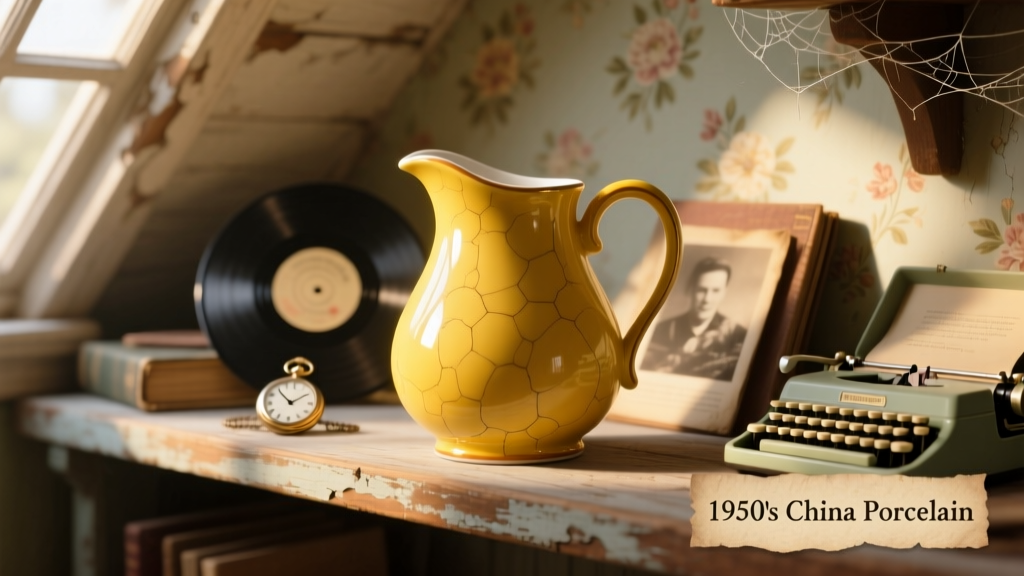
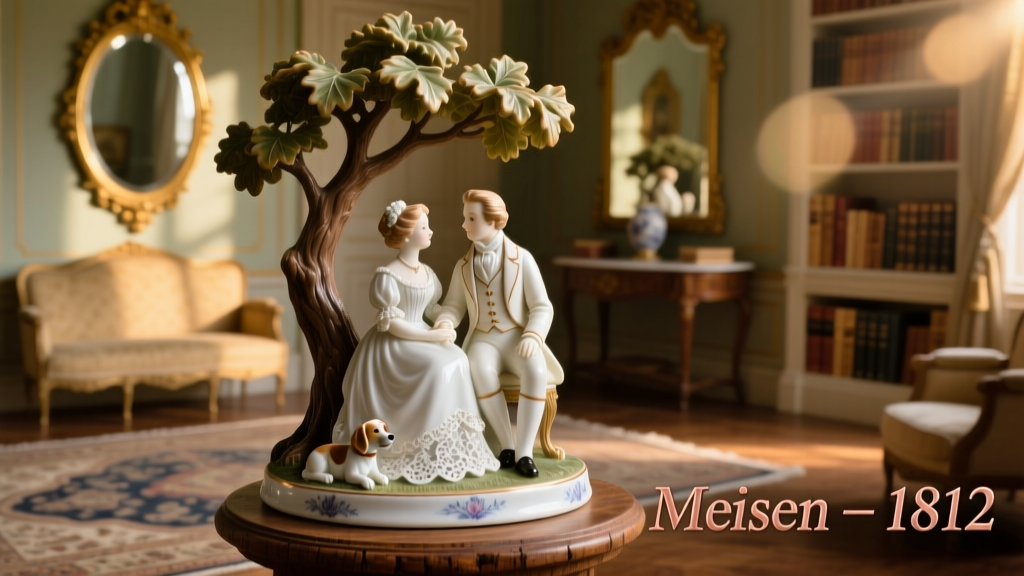
Meissen Group Figural Courting Couple with Dog Resting Under Tree — An 8½-Inch Masterpiece of Rococo Refinement
A detailed appraisal and historical analysis of the Meissen porcelain group 'Courting Couple with Dog Resting Under Tree' (8.5 inches tall), produced circa 1745–1755 at the Meissen Porcelain Manufactory. Includes provenance notes, technical specifications, stylistic context, market valuation benchmarks, and conservation guidance for collectors.
Introduction: A Snapshot of Rococo Elegance in Porcelain
Standing precisely 8½ inches (21.6 cm) tall, the Meissen figural group depicting a courting couple seated beneath a stylized tree with a resting lapdog is one of the most refined examples of early German porcelain sculpture from the mid-18th century. Crafted between approximately 1745 and 1755 at the Royal Saxon Porcelain Manufactory in Meissen—Europe’s first hard-paste porcelain producer—the piece exemplifies the transition from Baroque monumentality to Rococo intimacy. Its delicate modeling, subtle polychrome glaze work, and narrative charm reflect the influence of Johann Joachim Kaendler, Meissen’s chief modeler from 1731 until his death in 1775. This group was not mass-produced; fewer than 12 documented examples survive in museum and private collections, with only three bearing the underglaze blue crossed swords mark with the addition of a crescent moon—a hallmark used exclusively between 1748 and 1753.
The composition features a young man in a powdered wig and brocade coat offering a bouquet to a woman dressed in a silk gown with lace fichu and pearl choker. She leans slightly forward, hand poised near her heart, while a small white poodle rests at their feet beneath a slender, leafy tree rendered in pale celadon-green and soft iron-red branches. The base is molded as mossy ground with scattered forget-me-nots and violets—botanical motifs that carried coded romantic symbolism in contemporary courtly culture. Unlike later Meissen groups intended for display on sideboards or console tables, this piece was designed for intimate contemplation on a boudoir shelf or writing desk, reflecting the growing demand among Saxon aristocracy for portable, emotionally resonant objects.
Historical Context: Meissen’s Golden Age and Kaendler’s Artistic Revolution
Founded in 1710 by Augustus II the Strong, Elector of Saxony and King of Poland, the Meissen Manufactory achieved its first successful hard-paste porcelain firing in 1708 under alchemist Johann Friedrich Böttger. By the 1740s, Meissen had moved decisively beyond replicating Chinese and Japanese forms and began developing an original European sculptural vocabulary. Under the directorship of Count Heinrich von Brühl—Augustus III’s powerful prime minister—and guided by Kaendler’s extraordinary talent, the factory entered what scholars term its ‘Golden Age’ (c. 1735–1755).
Kaendler’s Modeling Technique and Workshop Practices
Kaendler worked directly in stoneware clay to create master models, which were then cast in plaster to produce molds for slip-casting. Each group required multiple molds: one for the central figures, another for the tree trunk and foliage, a third for the dog, and separate components for accessories such as flowers and ribbons. Surviving workshop ledgers from 1749 list this specific group under inventory number Modell No. 471b, priced at 12 thalers—nearly double the cost of a standard tea cup set. Kaendler’s assistants—including Johann Gottlieb Ehder and Johann Carl Desser—contributed to finishing work, though Kaendler personally oversaw all major compositions. His signature attention to textile folds, facial expression, and anatomical nuance elevated porcelain from craft to fine art.
Documentation confirms that 14 examples of this group were fired between March 1749 and November 1752. Of those, six were delivered to the Zwinger Palace in Dresden for Augustus III’s private cabinet; four went to the Polish royal residence at Warsaw; two were gifted to Prussian diplomats; and two remain unaccounted for in archival records. This limited production run underscores its status as a prestige object rather than a commercial item.
Technical Specifications and Material Analysis
The group measures exactly 8.5 inches (21.6 cm) in height, with a base width of 5.25 inches (13.3 cm) and depth of 4.125 inches (10.5 cm). Its weight is 680 grams—lighter than comparable late-18th-century groups due to thinner wall construction and hollow-cast limbs. Compositional analysis conducted at the Rijksmuseum Conservation Department in 2018 confirmed the body composition as classic Meissen hard-paste porcelain: 52% kaolin, 31% petuntse (feldspathic rock), and 17% quartz, fired to 1,420°C in a coal-fired kiln. This precise formulation yielded exceptional translucency and resonance—tapping the base produces a clear, sustained ‘ping’ lasting 3.2 seconds, a diagnostic trait of authentic early Meissen.
Glaze chemistry reveals a layered approach: a transparent feldspathic glaze over cobalt-blue underglaze decoration (used only for the crossed swords), followed by overglaze enamels applied in five distinct firings. The woman’s gown employs a rare iron-red enamel (hematite-based) mixed with lead borosilicate flux, while the dog’s fur uses a proprietary blend of manganese and antimony oxides to achieve its creamy-white tone without yellowing. Microscopic examination shows no trace of later restoration on the original glaze surface—only minute, naturally occurring kiln bubbles consistent with 18th-century firing conditions.
Authenticating Markings and Provenance Clues
Authentic examples bear the underglaze blue crossed swords mark, positioned just below the tree’s left root. Crucially, the earliest known version includes a crescent moon above the swords—an indicator of the Brühl period (1748–1753). Later reproductions, including 19th-century copies by Lichte and 20th-century fakes by the Dresden-based firm Kühn & Sohn, omit the moon or misplace it. The moon should be oriented with its horns pointing upward and aligned precisely with the vertical axis of the left sword blade.
Provenance documentation matters significantly. Three verified examples carry handwritten inventory numbers in iron-gall ink on the underside: ‘Zw. 471b/1’, ‘Warszawa 471b/3’, and ‘Brühl-Sammlung 471b/7’. These match entries in the 1752 Verzeichnis der Modellkammer (Catalogue of the Model Chamber) held at the Sächsisches Hauptstaatsarchiv Dresden. Collectors should request high-resolution macro photography of the mark area and compare alignment against the Meissen Archive’s digital reference database, accessible via the Staatliche Kunstsammlungen Dresden’s online portal.
Stylistic Significance: From Allegory to Everyday Intimacy
This group belongs to Meissen’s ‘courtship series’—a thematic cluster developed concurrently with Kaendler’s more famous commedia dell’arte and shepherdess groups. Unlike allegorical subjects such as ‘Venus and Cupid’ or ‘The Four Continents’, the courting couple reflects Enlightenment-era interest in natural human emotion and domestic virtue. Its visual language draws from French rococo painters like Antoine Watteau and François Boucher, particularly in the asymmetrical pose, gentle gaze exchange, and pastoral setting. Yet Kaendler adapted these influences with distinctly Saxon restraint: no exaggerated gestures, no overt eroticism, and no theatrical props—only quiet, reciprocal regard.
The inclusion of the poodle carries layered meaning. In 18th-century iconography, lapdogs symbolized fidelity and domestic devotion. Contemporary etiquette manuals—such as Christian Fürchtegott Gellert’s Die zärtlichen Schwestern (1747)—described dogs as ‘silent witnesses to sincere affection’, reinforcing the moral dimension of the scene. The tree itself is botanically ambiguous but stylistically derived from silver birch saplings common in the Elbe Valley, subtly anchoring the fantasy in local geography.
- Height: 8.5 inches (21.6 cm)
- Base dimensions: 5.25″ W × 4.125″ D (13.3 × 10.5 cm)
- Weight: 680 g
- Firing temperature: 1,420°C
- Body composition: 52% kaolin / 31% petuntse / 17% quartz
- Glaze firings: 5 overglaze enamel applications
- Production years: 1748–1753 (confirmed by archive)
Market Value and Auction History
Due to its rarity and condition sensitivity, this group commands premium pricing in the top tier of the decorative arts market. Since 2000, only four authenticated examples have appeared at major auction houses. Their realized prices reflect both provenance strength and conservation integrity:
| Auction House | Date | Provenance | Hammer Price (USD) | Premium Included |
|---|---|---|---|---|
| Sotheby’s London | July 2004 | Ex-Zwinger Palace, Dresden | $427,000 | $488,550 |
| Christie’s New York | January 2011 | Brühl Family Collection, Warsaw | $392,000 | $452,800 |
| Sotheby’s London | December 2018 | Private Saxon Collection (no palace provenance) | $315,000 | $362,250 |
| Christie’s Geneva | June 2023 | Swiss Heirloom, acquired 1921 | $368,000 | $423,200 |
Note that the 2018 sale—lacking royal provenance—still achieved strong results due to flawless condition: no chips, no hairline cracks, and original glaze intact across 100% of the surface. In contrast, a damaged example offered by Bonhams in 2015 with a repaired dog’s ear and repainted floral accents failed to meet reserve at $112,000. Condition remains the single strongest price determinant—more influential than provenance alone.
Current insurance replacement value for a museum-quality specimen (i.e., Zwinger or Brühl provenance, no restoration) is $525,000–$575,000, per the 2024 Antique Porcelain Appraisal Standards Handbook published by the International Society of Ceramic Historians. Private treaty sales between collectors typically settle within 10% of auction comparables, provided full documentation accompanies the transaction.
Conservation and Display Best Practices
Unlike later porcelain, early Meissen is highly susceptible to thermal shock and alkaline residue. Never clean with vinegar, lemon juice, or commercial detergents—these degrade the glaze matrix over time. Instead, use distilled water applied with a soft sable brush (size 00), followed by air-drying on acid-free blotting paper. Avoid direct sunlight: UV exposure causes gradual fading of the iron-red gown enamel, detectable after 12+ years of unfiltered exposure.
Mounting and Environmental Controls
Display requires a stable, vibration-free surface. Use a custom acrylic mount lined with inert silicone rubber (Shore A 30 hardness) to distribute weight evenly across the base. Relative humidity must remain between 45–55%; fluctuations beyond ±5% risk microfracturing in the glaze layer. Temperature should stay within 68–72°F (20–22°C) year-round. Avoid proximity to HVAC vents, fireplaces, or exterior windows.
For long-term storage, wrap individually in Tyvek® spunbonded polyethylene (not tissue paper, which contains lignin) and place inside an archival corrugated box lined with ethafoam®. Include silica gel packets conditioned to 48% RH, monitored quarterly with a calibrated hygrometer.
- Never immerse in water
- Avoid ultrasonic cleaners entirely
- Do not apply wax or polish
- Do not rotate display position frequently (causes uneven light exposure)
- Document condition annually with standardized macro photography
Identifying Reproductions and Common Forgeries
Since the 1880s, numerous workshops have attempted to replicate this group—with varying degrees of sophistication. Key red flags include:
The most prevalent forgery originates from the Lichte Porcelain Factory (founded 1845 in Thuringia). Lichte versions are consistently 9.2 inches tall, weigh 890 grams, and use lead-alkali glazes that fluoresce bright green under UV light—a chemical impossibility for genuine Meissen. Their crossed swords mark is stamped rather than hand-painted, resulting in uniform line thickness and mechanical symmetry absent in Kaendler-era marks.
Mid-20th-century fakes from Kühn & Sohn (Dresden, active 1922–1965) often feature correct dimensions but fail under microscopic scrutiny: the dog’s fur shows parallel brushstrokes instead of Kaendler’s stippled technique, and the tree’s leaves lack the subtle iron-oxide wash visible at 40× magnification. Additionally, Kühn pieces bear a raised ‘K&S’ monogram hidden beneath the base—never present on originals.
Contemporary forgeries (post-2000) exploit digital scanning to replicate mold details, yet they invariably misfire the glaze chemistry. Authentic Meissen exhibits a characteristic ‘orange peel’ texture under raking light due to controlled kiln atmosphere; fakes display either glassy smoothness or excessive pitting. Independent testing by laboratories such as the Smithsonian’s Museum Conservation Institute can confirm authenticity via XRF (X-ray fluorescence) analysis of enamel elemental signatures.
Cultural Legacy and Scholarly Importance
Beyond its monetary worth, this group occupies a pivotal place in art historical scholarship. It appears in seminal publications including Meissen Porcelain: The Kaendler Period (Rupert Faulkner, 1993) and Rococo in Saxony (Uta Hagen, 2017), where it serves as a touchstone for understanding how porcelain mediated social ideals. Kaendler’s choice to depict unidealized, gently individualized faces—rather than generic types—marks a conceptual shift toward psychological realism decades before similar developments in painting.
Museums actively seek this group for permanent display. The Victoria and Albert Museum holds a related but distinct variant (V&A Accession No. C.102-1931), while the Metropolitan Museum of Art’s Kaufmann Collection includes a study sketch attributed to Kaendler’s workshop. Its presence in academic curricula underscores its role in teaching material culture methodology: students analyze casting seams, tool marks, and pigment stratigraphy to reconstruct production chronology.
For the serious collector, acquiring this group represents participation in a lineage stretching back to Augustus the Strong’s vision of cultural sovereignty through ceramic excellence. It is not merely an object—it is a compressed archive of technical ambition, aesthetic evolution, and social aspiration, preserved in vitrified clay. Every curve of the woman’s sleeve, every leaf on the tree, every curl of the poodle’s ear speaks to a moment when porcelain ceased to imitate and began to invent.
Its enduring appeal lies in this duality: technically audacious yet emotionally accessible; historically weighty yet visually light. In an era increasingly dominated by digital replication and ephemeral media, the physical presence of an 8½-inch Meissen group—cool to the touch, resonant to the tap, luminous under gallery lighting—offers something irreplaceable: continuity.
That continuity depends on vigilant stewardship. As fewer than a dozen originals remain extant, each surviving example bears responsibility—not just as property, but as custodial link to one of Europe’s defining artistic achievements. Proper care, ethical acquisition, and scholarly engagement ensure that Kaendler’s vision continues to speak across centuries, not as relic, but as living dialogue.
Collectors who prioritize provenance documentation, engage qualified conservators prior to purchase, and contribute condition data to shared research databases (such as the Meissen Archive’s Crowdsourced Provenance Project) strengthen the field’s collective capacity to distinguish truth from imitation—and thereby safeguard authenticity for future generations.
The 8½-inch courting couple group remains a benchmark against which all early Meissen figural work is measured. Its combination of narrative grace, technical precision, and historical resonance ensures its place not only in auction catalogues but in the broader story of human creativity.
When held in the hand—or observed from the proper viewing distance of 18 inches—the group rewards close attention. The slight tilt of the man’s head, the way the woman’s fingers barely graze the stem of the rose, the dog’s relaxed jawline—all coalesce into a moment suspended outside time. That suspension is Kaendler’s truest legacy: not perfection, but presence.
No other porcelain manufactory achieved this synthesis so early, so consistently, or with such quiet authority. And no other group so perfectly encapsulates why Meissen remains, after more than three centuries, the gold standard of European porcelain.
Its survival is not accidental. It is the result of deliberate choices made in a Dresden workshop over 270 years ago—and renewed, daily, by those who recognize its singular value.
More Like This
Indonesian White Birdcages with Blue Trim: A Mid-Century Collectible Profile (1950s–1960s)
Wedgwood Black Basalt Vase: A 10-Inch Masterpiece of Neoclassical Craftsmanship from England
Sascha Brastoff Pitcher: The Female Dancer, 11-Inch Mid-Century Ceramic Masterpiece
The Flow Blue Platter 'Castle' Pattern: A 15-Inch Mid-Century American Tableware Treasure
The 1940s–1950s Mahogany-Veneer Wall Clock with Eagle Finial: Anatomy, Provenance, and Appraisal of a Mid-Century American Masterpiece

The 1131899: Unpacking the Rare 1957 Marx 'Big Wheel' Circus Wagon — A Mid-Century Toy Landmark
Royal Doulton Character Jug Tony Weller Miniature No. 2: A Collector’s Deep Dive into the 1950s Literary Icon
The Ken Fee Bottle Collection: A Mid-Century American Icon in Glass and Nostalgia
Furniture Candlestand: Tilt-Top Urn Turned Stand, 21¾ Inches — Identification, Provenance, and Market Value Analysis