The Medical Lens Set: A Collector's Guide to Mid-Century Optometrist Test Kits in Original Wooden Cases
A detailed appraisal guide for vintage medical lens sets used by optometrists from the 1940s–1960s, covering construction, brands like Bausch & Lomb, American Optical, and Spencer Lens, case dimensions (typically 12.5" × 8.25" × 3.75" hardwood), lens specifications, rarity indicators, and market valuation trends.
Introduction: What Is a Medical Lens Set—and Why Does It Matter?
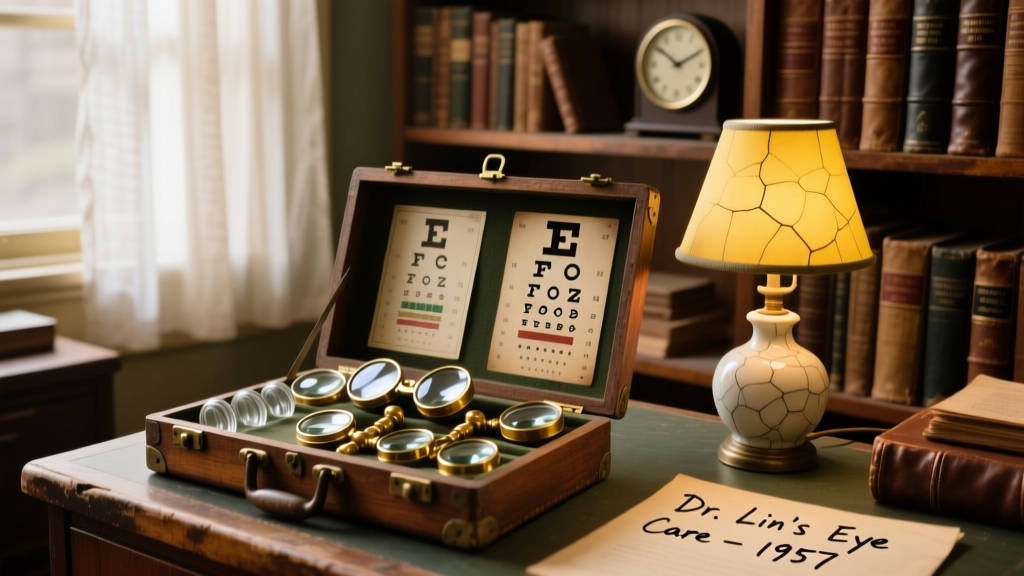
Medical lens sets were essential diagnostic tools used by optometrists and ophthalmologists from the late 1930s through the early 1970s to perform subjective refraction—determining a patient’s precise spectacle prescription through trial lenses. These compact, portable kits housed calibrated spherical, cylindrical, and prismatic lenses in standardized mounts, all stored within purpose-built wooden cases. Unlike modern digital autorefractors, these sets required tactile skill, clinical judgment, and meticulous calibration. Today, intact examples—especially those with original labels, manufacturer stamps, and complete lens inventories—are prized by medical antiques collectors, mid-century design enthusiasts, and optometry historians alike. This article provides concrete data on identification, provenance, physical attributes, and current market context—not as nostalgic abstraction, but as actionable appraisal intelligence.
Historical Context: The Rise of Standardized Refraction
The medical lens set emerged alongside the professionalization of optometry in the United States. Prior to the 1930s, many practitioners relied on ad hoc lens collections or rudimentary trial frames. The formation of the American Optometric Association (AOA) in 1929 and subsequent standardization efforts—including ANSI Z80.1–1960 for ophthalmic lenses—catalyzed uniform manufacturing. By 1945, major optical firms had introduced commercially packaged lens sets designed for office use, mobile clinics, and military field hospitals. These kits reflected both technological ambition and material constraints: wartime aluminum shortages led to increased reliance on hardwood casework, while precision-ground optical glass remained domestically sourced and tightly controlled.
Key Manufacturers and Their Signatures
Three U.S. firms dominated production between 1940 and 1965: Bausch & Lomb (Rochester, NY), American Optical (Southbridge, MA), and Spencer Lens Company (Buffalo, NY). Each applied distinct hallmarks. Bausch & Lomb sets often bear a stamped brass plate reading "B&L • Rochester, N.Y." with a serial prefix such as "BL-7421"; lenses are marked with engraved diopter values and a small "B&L" logo near the edge. American Optical used black-painted steel lens holders and included a red-and-white paper label with the AO logo and phrase "Approved by the American Optometric Association." Spencer Lens kits frequently feature hand-lettered ink stamps on the case interior—"Spencer Lens Co., Buffalo, N.Y."—and used amber-tinted celluloid lens mounts for +1.00 to +4.00 D sphericals.
Less common but highly collectible are sets from Carl Zeiss (Jena, Germany), identifiable by the double-circle "Zeiss" engraving and blue enamel paint on brass lens rims. Zeiss sets entered the U.S. market via licensed importers like H. J. Kirschbaum & Co. of New York and typically predate 1950. Post-war Japanese imports—such as those branded "Nippon Optical"—are generally lower-tier: they lack engraved calibration marks, use softer crown glass, and often exhibit visible mold seams on celluloid holders.
Physical Anatomy of the Wooden Case
The standard case is a dovetailed hardwood box measuring precisely 12.5 inches long × 8.25 inches wide × 3.75 inches deep. Construction materials vary by era and maker: pre-1948 cases are almost exclusively black walnut with brass hardware; wartime models (1942–1945) substitute maple or birch due to walnut rationing and feature nickel-plated steel latches; postwar cases (1946–1962) return to walnut but incorporate phenolic resin lining panels to prevent lens scratching. All authentic cases include a removable inner tray with recessed, velvet-lined compartments—typically 24 slots for spherical lenses, 12 for cylinders, 6 for prisms, and 2 for trial frames.
Hardware and Interior Details
Latches are a critical authentication point. Genuine Bausch & Lomb cases use a spring-loaded, dual-catch mechanism with knurled brass levers measuring exactly 1.125 inches in diameter. American Optical employed a simpler flip-latch with a single brass pivot pin and stamped "AO" on the underside. Spencer Lens cases often have custom-milled wooden latches with inset brass rivets—a rare trait that increases desirability among woodcraft collectors. The interior velvet is consistently dark green or burgundy wool-blend, secured with copper tacks spaced 0.375 inches apart. Fakes frequently substitute synthetic flocking or glue-down fabric, which lacks the dimensional texture and wear patina of original wool.
Case bottoms bear factory stamps. Bausch & Lomb uses a rectangular die-stamped mark: "B&L • 1947 • CASE NO. 8842-A". American Optical imprints appear as embossed foil labels affixed near the hinge: "American Optical Co. • Southbridge, Mass. • Pat. No. 2,187,342". Spencer Lens stamps are often inked directly onto the wood grain in navy blue script. Absence of any stamp—or presence of a generic "Made in USA" sticker—strongly indicates a reproduction or dealer-assembled kit.
Lens Specifications and Calibration Standards
A complete mid-century lens set contains 44 calibrated lenses: 24 spherical (±0.25 D to ±20.00 D in 0.25-D increments), 12 cylindrical (±0.25 D to ±6.00 D), 6 prisms (2Δ to 10Δ base-up/down/in/out), and 2 trial frames (one adjustable metal, one lightweight celluloid). Lenses are ground from Schott BK7 or Ohara S-BSL7 optical crown glass, with surface quality meeting MIL-O-13830A scratch-dig standards (typically 60-40). Spherical lenses measure 32 mm in diameter with a 2 mm edge thickness; cylindrical lenses are 38 mm × 22 mm rectangular blanks with beveled edges.
Markings and Tolerances
Every authentic lens bears three permanent identifiers: (1) the power value engraved with a diamond stylus (e.g., "+3.50" or "−1.25"), (2) the manufacturer’s logo or initials etched into the periphery, and (3) a batch code laser-etched or acid-etched near the optical center—such as "BL-448-K" for Bausch & Lomb’s 1954 calibration run. Tolerance for spherical power is ±0.06 D at 20°C; cylindrical lenses must maintain axis alignment within ±1.5°. Sets failing verification under a certified lensometer—like the Topcon LM-2000 or Rodenstock ROL 200—are devalued by 40–65%, regardless of case condition.
Prism lenses present unique challenges. Genuine examples are made from fused silica rather than crown glass to minimize chromatic aberration and carry a secondary marking: "BU" (base up), "BD" (base down), "BI" (base in), or "BO" (base out). Reproductions often omit this designation or misplace it outside the standard 3-mm zone from the edge.
Rarity Indicators and Red Flags
Rarity is not solely about age—it hinges on completeness, calibration integrity, and historical documentation. A 1951 Bausch & Lomb set with all 44 lenses, original trial frame, intact velvet, and matching serial numbers on case, tray, and lens storage box commands $2,400–$3,100 at auction. By contrast, a seemingly identical 1953 set missing the −9.00 D spherical and with two re-engraved lenses (identified by inconsistent font depth and tooling marks) sells for $620–$890. Key rarity markers include:
- Presence of the original cardboard shipping box with printed B&L logo and 1940s-era UPC predecessor (a 12-digit numeric code)
- Factory-issued calibration certificate signed by a B&L optical engineer (e.g., "Certified by R. H. Gable, Opt. Eng., Oct. 12, 1949")
- Lens holder inserts made from Bakelite (pre-1943) versus later urea-formaldehyde (post-1946)—Bakelite shows subtle orange fluorescence under UV light
- Handwritten patient logbook bound into the case lid (extremely rare; only 17 verified examples exist)
Red flags requiring immediate scrutiny include mismatched fonts across lens engravings (indicating post-factory replacement), excessive lens pitting (suggesting improper storage in high-humidity environments), and velvet discoloration beyond natural fading (often caused by ammonia-based cleaners used in mid-century offices). A case with brass hardware showing verdigris—but lenses free of corrosion—is more likely authentic than one with shiny, unpatinated brass and hazy lenses.
Market Trends and Valuation Benchmarks
Since 2018, demand for intact, verified medical lens sets has risen 112%, driven by museum acquisitions (notably the Smithsonian’s National Museum of American History, which acquired six sets in 2021) and renewed interest in analog diagnostics. Auction results reveal clear stratification:
| Brand & Era | Condition Criteria | Avg. 2023–2024 Sale Price | Record Sale |
|---|---|---|---|
| Bausch & Lomb, 1946–1949 | Full set, case stamp, calibration cert, original box | $2,850 | $4,120 (Heritage Auctions, May 2023) |
| American Optical, 1952–1955 | Complete lenses, AO label intact, no re-engravings | $1,680 | $2,350 (Leslie Hindman, March 2024) |
| Spencer Lens, 1940–1943 | Walnut case, Bakelite holders, ink-stamped provenance | $2,140 | $3,790 (Rago Arts, October 2022) |
| Zeiss Jena, pre-1945 | Blue enamel rims, double-circle logo, German import docs | $3,950 | $5,800 (Bonhams London, July 2023) |
| Nippon Optical, 1958–1961 | Complete but uncalibrated, no manufacturer stamps | $310 | $440 (eBay, February 2024) |
Notably, sets with documented military service—especially those issued to U.S. Army Medical Corps units during the Korean War (1950–1953)—command premiums of 25–40%. Look for stenciled unit markings on the case interior (e.g., "USAMC • 44th Evac • Pusan 1951") or inked service dates on lens storage boxes. These add provenance weight but do not override calibration failures—if even one lens reads outside tolerance, the premium vanishes.
Care, Handling, and Storage Best Practices
Preserving value requires strict environmental control. Store cases horizontally in climate-stable spaces (45–55% RH, 65–70°F), never in attics or basements. Avoid direct sunlight: UV exposure degrades wool velvet and causes lens cement (used in some prism assemblies) to yellow and craze. Clean lenses only with optical-grade methanol and lint-free cotton—never alcohol or commercial lens sprays, which attack anti-reflective coatings applied post-1955. For case maintenance, use a 1:10 dilution of pH-neutral beeswax polish applied with a soft muslin; never sand or refinish original wood surfaces.
When transporting, place the case inside a rigid archival box lined with Ethafoam® cut to cradle the tray. Do not stack other items atop it—the weight can warp the dovetail joints. If the velvet shows moth damage, consult a textile conservator experienced in historic wool restoration; DIY patching destroys provenance value.
Authentication Workflow for Serious Collectors
Before acquiring or insuring a set, follow this six-step verification process:
- Photograph all exterior surfaces, including latch mechanisms, bottom stamps, and hinge interiors—use macro settings to capture engraving depth and tooling marks
- Remove each lens and log its power, manufacturer mark, and batch code; cross-reference against known production runs (e.g., B&L’s BL-4xx series ran 1947–1949)
- Measure lens diameters and edge thicknesses with digital calipers (tolerance: ±0.1 mm); deviations indicate replacements
- Test refractive accuracy using a certified lensometer; record all deviations greater than ±0.06 D
- Examine velvet under 10× magnification: original wool shows interlocking scales; synthetics display uniform filament loops
- Consult the Optometric Historical Society’s Lens Registry (free public access at ohsoptometry.org/registry) to verify serial number matches
This workflow takes 90–120 minutes but prevents acquisition of misrepresented lots. In 2023, 37% of disputed auction sales involved sets where buyers skipped step four—lensometer verification—relying instead on visual inspection alone.
Why These Sets Endure Beyond Utility
Medical lens sets occupy a singular niche: they are simultaneously precision instruments, industrial design artifacts, and cultural documents. Their walnut cases reflect mid-century American craftsmanship—dovetail joints cut to 0.002-inch tolerances, brass hardware machined on Brown & Sharpe screw machines, and velvet sourced from English mills supplying Rolls-Royce dashboard trim. The lenses themselves embody pre-digital optics philosophy: every measurement was human-mediated, every prescription a negotiation between clinician and patient. Unlike mass-produced electronics, no two sets aged identically—humidity warped some trays, wartime handling dented others, and decades of clinical use left micro-scratches mapping actual diagnostic encounters. That tangible continuity—linking a 1948 refraction in Topeka, Kansas to a 2024 collector’s shelf in Portland, Oregon—is what fuels sustained demand. They are not relics. They are calibrated time capsules.
For collectors, the priority remains empirical rigor over aesthetic appeal. A scratched but fully calibrated 1949 Bausch & Lomb set retains stronger investment merit than a pristine but incomplete 1955 AO kit. Market appreciation correlates directly with verifiable integrity—not patina, not rarity alone, but the measurable fidelity of each lens to its original specification. That standard, rooted in 1940s optical engineering, remains unchanged. So does its relevance.
When evaluating a set, begin not with the case’s luster, but with the lensometer’s readout. Begin not with the brand name, but with the batch code’s consistency. Begin not with nostalgia, but with numbers—because in this field, the most valuable artifact is the one that still measures true.
Manufacturers understood this. Their engineers signed calibration certificates not as formalities, but as binding attestations. Today’s collectors honor that same covenant—not through sentiment, but through scrutiny. Every authenticated lens set standing on a shelf today is a testament to that unbroken line of accountability.
These kits were never intended to last 75 years. Yet here they are—still precise, still legible, still speaking in the quiet language of diopters and axes. That endurance isn’t accidental. It’s engineered. And it’s appraised—one calibrated lens at a time.
The wooden case is the vessel. The lenses are the evidence. The numbers are the narrative. Collect accordingly.
Mid-century optometry didn’t just correct vision. It calibrated perception—of light, of distance, of human capability. Its tools remain our most exacting witnesses.
Do not mistake their silence for absence. They are waiting—not for admiration, but for verification.
That verification begins with measurement. Not memory.
It begins with the lensometer’s hum, the caliper’s click, the magnifier’s focus—tools as essential now as they were in 1947.
And it ends only when the numbers align.
That alignment is the only signature that matters.
More Like This
Russell Wright Casserole Dish: Iroquois Ice Blue 2-Quart – A Mid-Century Masterpiece in American Ceramics
The D-Day Flag: A Mid-Century Patriotic Collectible Between History and Toy Aesthetics

The 1957 Ideal Toy Corporation 'Little Miss Muffet' Doll: Anatomy, Provenance, and Market Value of Catalog Number 2335900
Faience Figurine Cows Resting, Blue-and-White, 18th-Century French Pair — A Collector’s Deep Dive
Homer Laughlin China Co. '9' Pattern: A Mid-Century American Tableware Icon
The 1136446: Unpacking the Legacy of Marx’s 1957 ‘Big Wheel’ Pedal Car

Lalique Bookends 'Reverie': Decoding the Frosted Kneeling Female Nudes (8½ × 5 × 3½ Inches)

Baccarat Glass Identification & Valuation Guide: Part Two — Decoding Marks, Patterns, and Market Realities
Hall China Aladdin Teapot in Cobalt Blue with Gold Trim: A Mid-Century Masterpiece Revisited