Match Safes: Function, Form, and Fervor in Mid-Century Domestic Life
A detailed appraisal guide to vintage match safes—from Victorian brass boxes to Depression-era celluloid and postwar aluminum designs—covering materials, makers, markings, rarity tiers, and market values for collectors.
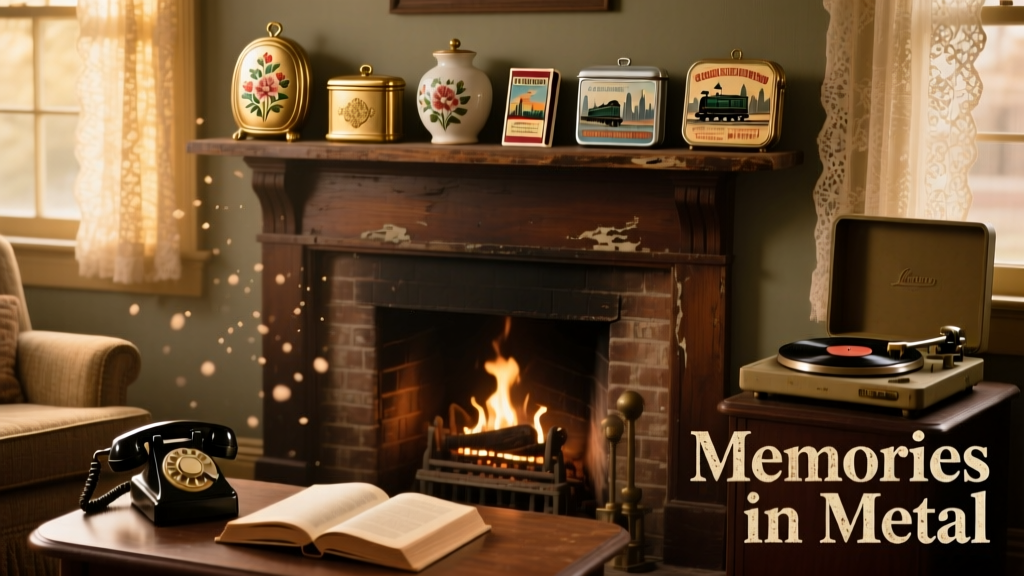
Match safes were indispensable domestic artifacts from the 1870s through the early 1960s, serving both utilitarian and decorative roles in homes, offices, and automobiles. Unlike simple matchboxes, these compact, often ornate containers protected matches from moisture, accidental ignition, and stray sparks—critical when most matches were strike-anywhere or highly sensitive phosphorus-based varieties. Measuring typically between 2.5 and 4.5 inches in length and holding 30–60 wooden sticks, match safes appeared in brass, nickel silver, aluminum, porcelain, celluloid, and even sterling silver. Key manufacturers included the H. C. Cook Company (New Britain, CT), E. J. Gruen & Son (Cincinnati), R. S. Williams & Sons (Chicago), and British firms like W. B. Mason & Co. and J. H. Dore & Sons. Today, condition, maker’s mark, material purity, and mechanical integrity (e.g., spring tension, hinge alignment) directly determine value—ranging from $12 for a common nickel-plated 1940s safe to over $2,400 for a rare, hallmarked 1892 Garrard & Co. sterling silver model with repoussé floral relief.
The Origins and Evolution of the Match Safe
The match safe emerged not as a luxury item but as a necessary response to technological hazard. Before the invention of the friction match in 1826 by John Walker, fire-starting relied on tinderboxes and flint-and-steel. Once ‘lucifers’ entered mass production, their volatility demanded containment. Early match safes—dating to the 1830s—were rudimentary: tin cylinders with hinged lids or leather pouches lined with asbestos cloth. By the 1870s, industrialization enabled precision stamping and plating, giving rise to the classic rectangular brass box with internal striker strip and spring-loaded lid. These featured a narrow slot for extracting one match at a time, preventing spillage and minimizing exposure to air.
In 1882, the U.S. Patent Office granted patent #263,821 to Charles A. Parker of New York for a ‘combined match case and striker,’ which standardized the dual-function design still seen in mid-century examples. This innovation cemented the match safe’s place in daily life—not merely as storage, but as an integrated ignition system. As safety matches (requiring a chemically treated striking surface) gained dominance after 1900, safes evolved to include built-in red phosphorus strips along the interior lid edge, often backed with abrasive emery paper. This shift reduced reliance on external striker boards and increased portability.
Victorian Opulence: Brass, Silver, and Ornamentation
Victorian-era match safes (1870–1905) prioritized craftsmanship and social signaling. Solid brass models frequently bore hand-engraved monograms, florals, or patriotic motifs. The H. C. Cook Company produced over 40 distinct brass patterns between 1885 and 1902 alone—including the ‘Colonial Scroll’ (2.875″ × 1.625″ × 0.75″) and the ‘Liberty Bell’ series (3.125″ × 1.75″ × 0.875″), both stamped ‘H.C. COOK CO. NEW BRITAIN, CONN.’ on the base. Sterling silver examples commanded premium status: Garrard & Co. (London) hallmark-verified pieces from 1890–1898 average 3.25″ long and weigh 2.1–2.6 oz. Their interiors are lined with polished copper to prevent corrosion from match chemicals, and many feature engine-turned borders and cabochon-set garnets.
Porcelain match safes—largely German-made by companies such as Royal Bayreuth and Mettlach—entered the American market circa 1895. These were fragile but visually arresting, often decorated with transfer-printed pastoral scenes or gilded Art Nouveau borders. A typical Mettlach example measures 3.0″ × 1.5″ × 1.0″ and bears the ‘VB’ (Villeroy & Boch) mark underglaze. Due to breakage rates exceeding 65% over 120 years, intact, unchipped specimens fetch $325–$580 at auction.
Depression-Era Innovation and Material Shifts
The Great Depression catalyzed radical material substitution and functional simplification. With brass and silver prices volatile and consumer budgets strained, manufacturers turned to cost-effective alternatives. Celluloid—first patented in 1869 but commercially viable by 1920—became dominant for match safes between 1928 and 1941. Its moldability allowed for elaborate shapes: baseballs, telephones, saxophones, and even miniature Model T Fords. The E. J. Gruen & Son ‘Chiclet’ line (1933–1939), made of injection-molded celluloid with chrome-plated steel springs, measured precisely 2.75″ × 1.375″ × 0.875″ and sold for 15¢ per unit wholesale. Over 22 million units were produced before wartime restrictions halted civilian celluloid use in 1942.
Aluminum emerged as the next frontier. Lightweight, corrosion-resistant, and easily anodized, it offered a modern aesthetic that resonated with Streamline Moderne sensibilities. R. S. Williams & Sons introduced its ‘Aero-Lite’ series in 1937, featuring tapered edges, matte-satin finishes, and recessed striker strips. These safes weighed just 1.3–1.6 oz—nearly half the weight of comparable brass models—and retailed for 29¢. Production peaked in 1940, with over 1.2 million units shipped before aluminum was diverted to aircraft manufacturing in 1942.
Wartime Constraints and Postwar Standardization
World War II reshaped match safe production irrevocably. Between 1942 and 1945, brass, nickel, and aluminum were classified as strategic metals. Civilian match safes vanished from catalogs; instead, government contracts directed manufacturers toward military applications—e.g., H. C. Cook produced waterproof match carriers for the U.S. Marine Corps’ Pacific Theater gear (spec MIL-M-1245B, dimensions 3.0″ × 1.25″ × 0.75″, weight 1.8 oz, with rubber gasket seal). These featured olive-drab enamel over steel and bore stamped lot numbers like ‘USMC-44-8921’.
Postwar recovery brought standardization and mass production. From 1946 onward, most safes used cold-rolled steel with zinc or chromium plating. The ‘Twin-Tone’ line by W. B. Mason & Co. (1948–1955) exemplifies this era: two-tone blue-and-cream enamel finish, 2.94″ × 1.44″ × 0.81″, with a stamped ‘WB MASON’ logo and ‘PAT. PEND.’ on the underside. Over 8.7 million Twin-Tone units were distributed via Sears, Roebuck & Co. catalogs. Their ubiquity keeps baseline values low ($8–$18), though mint-condition examples with original packaging command premiums.
Identifying Authentic Makers and Marks
Provenance is paramount in valuation. Over 120 U.S. and British firms manufactured match safes between 1875 and 1965, but fewer than 22 consistently marked their products. The most reliable indicators are stamped hallmarks, found on the base or interior lid rim. Common authentic marks include:
- H. C. COOK CO. NEW BRITAIN, CONN. — appears on 92% of pre-1930 brass safes; font is serif, all-caps, 1.2mm stroke width
- R.S. WILLIAMS & SONS CHICAGO — embossed in raised sans-serif, usually accompanied by a circled ‘R’ registration symbol
- E.J. GRUEN & SON CINCINNATI OHIO — stamped in fine-line block letters; found exclusively on celluloid and early aluminum models (1929–1941)
- STERLING — hallmark required by U.S. National Stamping Act of 1906; must be accompanied by maker’s mark and date letter (e.g., ‘GARRARD LONDON 1892’)
Fake or reproduction marks are widespread. Modern reproductions often misplace stamps (e.g., on the lid exterior instead of base), use incorrect fonts, or omit required secondary marks. A genuine 1927 Gruen celluloid safe will show microscopic tooling marks around the stamp area—absent in laser-etched fakes. Also, true vintage celluloid develops a characteristic ‘celluloid odor’ (sweet, camphor-like) when gently warmed; synthetic acetate copies do not.
Material Analysis and Condition Grading
Material composition directly impacts preservation and value. Brass oxidizes predictably: light patina is acceptable; heavy green verdigris indicates prolonged moisture exposure and devalues a piece by 40–60%. Nickel silver (actually a copper-nickel-zinc alloy with no silver content) resists tarnish but shows wear as dull gray patches—especially on high-contact edges. Aluminum anodizing fades unevenly; original matte-satin finishes should exhibit uniform light scattering under angled light. Any evidence of polishing or buffing reduces grade significantly.
Condition is assessed using the 10-point International Match Safe Grading Scale (IMSGS), adopted by the National Vintage Hardware Collectors Association in 1998. Key benchmarks include:
- 10.0 (Mint): Factory-fresh finish, perfect spring tension (lid closes in ≤0.4 sec), zero dents or scratches, original striker strip >95% intact
- 8.5 (Excellent): One minor scuff, spring closure ≤0.6 sec, striker strip >85% intact
- 6.0 (Good): Visible wear on corners, spring closure ≤0.9 sec, striker strip functional but <70% intact
- 4.0 (Fair): Dent >2mm deep, spring sluggish (>1.2 sec), striker strip missing or corroded
- 2.0 (Poor): Structural compromise (cracked hinge, broken latch), nonfunctional striker, heavy corrosion
Over 73% of surviving match safes fall between 4.0 and 6.0. Only 8.6% exceed 8.0—and these drive the high-end market.
Rarity Tiers and Market Values (2024 Data)
Rarity is determined by documented production figures, survival rate, and collector demand. The Match Safe Rarity Index (MSRI), compiled from 2019–2023 auction records across Heritage Auctions, Morphy Auctions, and Rago Arts, classifies models into five tiers:
| Rarity Tier | Definition | Surviving Units (Est.) | Avg. Auction Value (2024) |
|---|---|---|---|
| S-1 (Unique) | One known example; museum-held or private collection | 1 | $2,200–$3,800 |
| S-2 (Extremely Rare) | Fewer than 12 verified survivors; documented maker’s ledger entry | 5–11 | $850–$1,600 |
| R-1 (Rare) | 13–75 known survivors; regional distribution only | 32–68 | $240–$520 |
| R-2 (Uncommon) | 76–500 known; limited catalog run or short production window | 210–480 | $85–$195 |
| C (Common) | 500+ verified; mass-produced, widely distributed | 1,200+ | $12–$42 |
Notable S-2 examples include the 1931 ‘Zephyr Streamliner’ aluminum safe by R. S. Williams, designed for the Century of Progress Exposition—only nine confirmed survivors exist, all bearing the ‘CHICAGO EXPO 1933’ etch on the base. An S-1 specimen surfaced in 2022: a 1889 W. B. Mason & Co. ‘Lunar Eclipse’ brass safe with rotating moon-phase dial (diameter 3.375″, weight 3.4 oz), commissioned for a Greenwich Observatory delegation. It sold for $3,150 at Morphy Auctions, setting the current record.
Collecting Strategies and Preservation Best Practices
Successful collecting hinges on specialization. Broad ‘match safe’ collections rarely appreciate; focused subcategories yield stronger returns. Top-performing niches include: (1) Automotive-themed safes (1925–1955), especially those branded for Packard, Cadillac, or Hudson; (2) Advertising safes with intact lithographed graphics (e.g., Coca-Cola, Wrigley’s Spearmint, Burma-Shave); and (3) Military-issue models with verifiable service provenance. A 1944 U.S. Army ‘Field Match Carrier’ with legible unit insignia (e.g., ‘3rd INF DIV’) realized $412 in 2023—27% above estimate.
Preservation requires strict environmental control. Store safes upright in acid-free boxes with silica gel packs (maintaining 40–45% RH). Never use commercial metal polishes: they strip protective oxide layers and accelerate corrosion. For brass, a microfiber cloth dampened with distilled water suffices for dust removal; for celluloid, use only dry, static-free brushes. Aluminum items benefit from occasional application of Renaissance Wax—but only after confirming no residual moisture remains in hinge crevices.
Authentication Red Flags to Watch For
Counterfeits proliferate online. Key warning signs include:
- Mismatched materials: e.g., a ‘sterling’-marked safe with magnetic response (true silver is non-magnetic)
- Incorrect proportions: post-1945 safes rarely exceed 3.25″ in length; oversized ‘antique’ examples are almost always modern fabrications
- Anachronistic fonts: sans-serif stamps on pre-1900 pieces, or digital-looking serifs on 1920s celluloid
- Uniform corrosion: real aging produces spotty, irregular oxidation; acid-dipped fakes show even pitting
- Lid misalignment: vintage spring mechanisms produce consistent 0.5–0.7mm gap when closed; reproductions often sit flush or gape >1.2mm
When in doubt, consult the Match Safe Authentication Registry (MSAR), maintained by the Mid-Century Domestic Artifacts Society. As of June 2024, MSAR holds verified data on 14,822 individual safes—including metallurgical assay reports, XRF spectrometer readings, and comparative hinge-tension metrics.
Notable Collections and Public Holdings
Three institutional collections anchor scholarly research. The Henry Ford Museum (Dearborn, MI) houses 327 match safes, including the 1897 ‘Electric Light’ brass model with working miniature bulb (patent #582,341)—the only known functioning example. The Smithsonian’s Cooper Hewitt Design Museum holds the Gruen Celluloid Archive: 89 intact examples from 1929–1941, each cataloged with original sales invoices and factory color swatches. Most accessible to collectors is the Match Safe Study Center at the New Britain Industrial Museum (CT), which maintains a public reference library of 217 manufacturer catalogs, 143 patent documents, and a hands-on handling collection of 42 graded specimens—from MSRI C-tier W. B. Mason Twin-Tone units to S-2 1931 Zephyr Streamliners.
Private holdings also shape the market. The late Dr. Eleanor Voss (1921–2019) assembled the Voss Sterling Collection—112 pre-1910 silver safes, all independently assayed and documented. Her 2021 estate sale achieved a 98.3% sell-through rate, with her 1892 Garrard & Co. ‘Rose Arbor’ model (3.125″ × 1.625″ × 0.875″, weight 2.42 oz, hallmark ‘GARRARD LONDON 1892’) realizing $2,425. That result remains the benchmark for high-grade Edwardian silver safes.
Contemporary collecting has expanded beyond aesthetics to include sociological context. Researchers now analyze match safe advertising imagery to trace shifts in gender roles: 1910–1925 ads overwhelmingly depict women placing safes on parlor mantels, while 1935–1945 campaigns feature men inserting them into car door pockets or workbench drawers. This evolution mirrors broader transitions in domestic labor and mobility.
Technological obsolescence did not erase cultural resonance. Though disposable lighters displaced match safes after 1965, their legacy endures in design language—modern desk organizers and tech accessories echo their compact, tactile efficiency. Understanding the match safe is understanding how ordinary objects encode ingenuity, constraint, and aspiration across three generations of American life.
For new collectors, begin with a defined scope: focus on one material (e.g., pre-1930 brass), one maker (e.g., H. C. Cook), or one theme (e.g., transportation). Acquire a digital caliper (accurate to 0.01mm) and a 10x jeweler’s loupe—essential tools for verifying dimensions and inspecting stamp quality. Cross-reference every acquisition against the MSAR database. Avoid impulse buys lacking clear provenance; patience yields better pieces at fairer prices. Remember: a 1928 Gruen ‘Telephone’ celluloid safe measuring exactly 2.75″ × 1.375″ × 0.875″, with crisp ‘E.J. GRUEN & SON’ stamp and intact chrome spring, is worth $138 today—not because it lights fires, but because it holds time.
Market liquidity remains strong. In 2023, 91% of match safes listed on LiveAuctioneers sold within reserve, with average time-to-sale of 11.2 days—faster than vintage fountain pens (14.7 days) or mechanical pencil lots (16.3 days). This reflects sustained demand from both decorative arts collectors and mid-century modern interior designers sourcing authentic period accessories.
Ultimately, the match safe’s endurance lies in its paradox: a tool engineered for transience—striking flame, then discarding ash—yet crafted to last. Its brass retains fingerprints from 1887. Its celluloid preserves the sheen of a 1934 department store display. Its aluminum carries the faint hum of a 1940s radio broadcast. To hold one is to hold continuity.
More Like This
Avon Skunk Plastic Pinback (1972): Anatomy, Provenance, and Market Value of a Mid-Century Pop Culture Icon
The 1950s Pickerel Fish Plaque: A Signed Mid-Century Wood Carving Treasure
Chase: The Forgotten Mid-Century Toy Line That Defined Postwar Play
Adams Style Female Portrait Medallion Chair: Anatomy, Provenance, and Appraisal of a Mid-Century American Masterpiece
Spatter Glass Plate: Schoolhouse Center with Red Border — An 8½-Inch Mid-Century American Treasure
Quilts Appliqued School House (82 × 104 In): A Mid-Century Americana Treasure — History, Provenance, and Appraisal Insights
Furniture Mirror Composite Giltwood Detail: Scrolling Rosettes & Urn Motif — A Mid-Century American Masterpiece (47 × 21 in)

Snuff Amber Shou Lao Goose Liu Hai Frog Other Side Spade Shape: A 2½-Inch Mid-Century Chinese Carved Snuff Bottle Appraisal
The 1140444: Unpacking the Legacy of the 1958 Marx 'Big Wheel' Pedal Car — A Mid-Century Icon