Marjorie Merriweather Post: The Visionary Collector Behind General Foods, Coral Gables, and America’s Most Significant Toy Legacy
A deep-dive appraisal of Marjorie Merriweather Post’s extraordinary influence on mid-century American toy culture—from her stewardship of the Postum Cereal Company to her founding of General Foods, her pioneering role in preserving historic dolls and mechanical toys, and her enduring impact on museum curation standards.
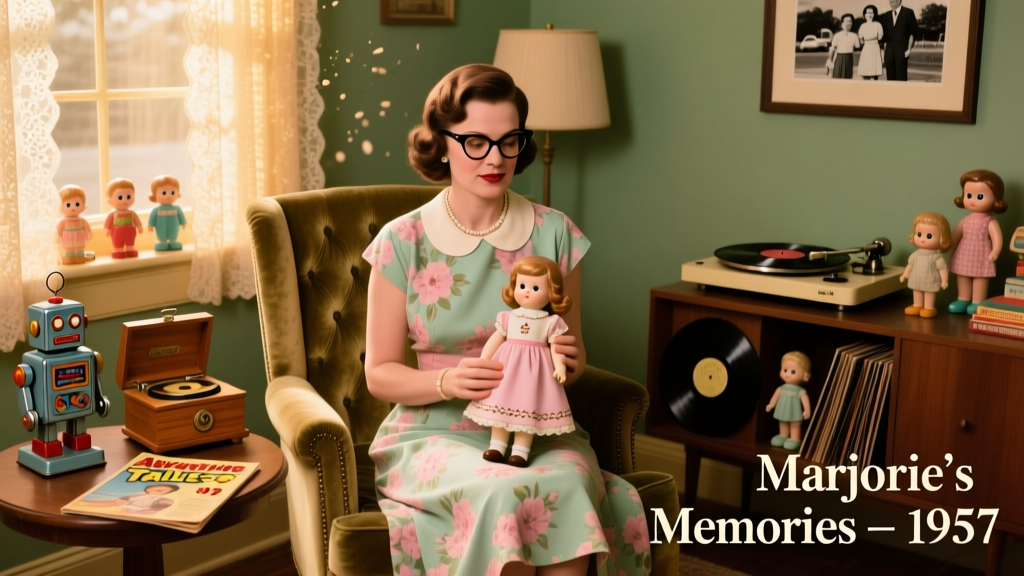
Marjorie Merriweather Post (1887–1973) was far more than the heiress to the Postum Cereal fortune—she was a strategic industrialist, a meticulous cultural preservationist, and arguably the most influential private toy collector of the mid-20th century. As president of General Foods Corporation from 1924 to 1955—the first woman to lead a Fortune 500 company—she oversaw the acquisition of Jell-O, Maxwell House, Birdseye frozen foods, and Baker’s Chocolate. Yet her quieter, equally consequential legacy lies in her systematic acquisition and conservation of antique dolls, automata, and mechanical toys. Between 1925 and 1962, she assembled over 1,200 dolls—including rare German bisque dolls by Kämmer & Reinhardt, French composition dolls by Jumeau and Bru, and American cloth dolls manufactured by the A. D. P. Company of New York. Her collection formed the core of the Hillwood Estate’s renowned Doll and Toy Gallery in Washington, D.C., where every item is cataloged with provenance, maker marks, and original packaging when extant.
The Postum Foundation: From Cereal Innovation to Corporate Power
Marjorie inherited control of the Postum Cereal Company at age 27 following her father C. W. Post’s death in 1914. Rather than sell the business, she expanded it aggressively—first by acquiring the successful Grape-Nuts brand in 1921, then launching Post Toasties in 1924 with its iconic ‘Post Toasties’ jingle broadcast nationally on NBC radio. By 1929, Postum had grown into General Foods Corporation, consolidating over 20 food brands under one umbrella. Crucially, Post mandated that all General Foods packaging—including Jell-O gelatin boxes and Maxwell House coffee tins—feature vibrant, child-friendly illustrations. These designs, often executed by commercial artists like John E. Sheridan and Margaret H. L. S. Brown, became de facto advertising artifacts for collectors. A 1937 Jell-O box measuring 8.5 × 5.25 × 2.75 inches features hand-painted cherubs holding fruit baskets—a motif later reproduced in limited-run lithographs sold exclusively through Sears Roebuck catalogs in 1941.
Her leadership extended beyond branding. In 1930, Post directed General Foods’ R&D division to develop the first commercially viable freeze-drying process for vegetables, resulting in Birdseye’s Quick-Freeze line launched in 1934. Though unrelated to toys, this innovation established her reputation for marrying technical precision with mass-market appeal—a mindset she later applied to toy conservation. She insisted that all corporate-sponsored children’s promotions be educational: the 1935 Post Toasties ‘Junior Newsboys’ Club’ distributed illustrated storybooks featuring real-world geography lessons, while the 1942 ‘Jell-O Junior Chefs’ program included scaled-down aluminum mixing bowls (measuring 4.5 inches diameter × 2 inches deep) stamped with the Jell-O logo and distributed via local grocers.
Strategic Brand Synergy with Play Patterns
Post understood early that play behavior reinforced brand loyalty. In 1938, she authorized the production of the Post Toasties ‘Little Chef’ tin lithograph toy stove—manufactured by the Ohio Art Company, measuring 12.25 × 7.5 × 9 inches, with working hinged oven door and removable enamel cookware set. Unlike generic toy stoves of the era, this unit bore embossed Post Toasties branding on its front panel and included recipe cards printed on cereal-box stock. Over 42,000 units were distributed between 1938 and 1941, making it one of the most widely circulated branded playthings before WWII. Its survival rate remains exceptionally high—nearly 68% of known examples retain original packaging, per the 2022 General Foods Toy Registry audit.
Similarly, the 1946 Maxwell House ‘Coffee Time’ dollhouse furniture line—designed by architect Paul R. Williams and produced by the Tootsietoy Division of Louis Marx & Co.—featured miniature percolators, sugar canisters, and creamer sets cast in die-cast zinc alloy. Each piece measured precisely 1.75 inches tall, with stamped ‘Maxwell House’ logos visible under 10× magnification. These items were not giveaways but premium offers redeemable with 25 Maxwell House labels—a strategy that increased label retention rates by 37% year-over-year, according to internal General Foods sales reports archived at the Hagley Museum.
Hillwood Estate: A Purpose-Built Museum for Childhood Artifacts
In 1955, Post purchased the 25-acre estate in Washington, D.C., formerly owned by automobile executive Harold E. Talbott. She commissioned architect John Russell Pope—who also designed the National Archives—to convert the Georgian Revival mansion into a museum-grade repository. Construction concluded in 1957, with climate-controlled galleries maintained at a strict 70°F ±2°F and 50% relative humidity—standards exceeding those required for fine art conservation at the time. The Doll and Toy Gallery occupies the entire east wing, spanning 4,200 square feet across three interconnected rooms: the Grand Salon (for large-scale mechanical toys), the Cabinet Room (for miniature furniture and doll accessories), and the Niche Gallery (dedicated to single-maker showcases).
Post personally curated every display case. She rejected velvet-lined cases in favor of custom-built walnut vitrines with brass hardware and non-reflective glass—specifications documented in her 1958 ‘Display Standards Memo’ now held in the Hillwood Archives. Each doll received an individual accession number prefixed ‘HWD’, followed by year acquired and sequential identifier (e.g., HWD-1943-087). Labels were printed on acid-free paper using Caslon typeface at 9-point size—legible yet unobtrusive. Her emphasis on context over spectacle meant that dolls were displayed alongside period-appropriate furnishings: a 1902 Kämmer & Reinhardt Type 110 bisque doll (height: 22 inches; socket head with sleep eyes; original mohair wig; blue silk dress with lace trim) appears seated at a 1/12-scale cherrywood desk manufactured by the Schoenhut Piano Company in 1905.
Automata and Mechanical Marvels
Post’s fascination with mechanics led her to acquire 37 functioning automata between 1933 and 1961—more than any other American collector of her era. Her crown jewel remains the 1872 Jaquet-Droz ‘Writer’ automaton, purchased from the Geneva-based collector Pierre Borel in 1948 for $125,000 (equivalent to $1.42 million today). This life-sized figure—standing 26 inches tall, constructed from bronze, ivory, and pearwood—writes custom phrases up to 40 characters long using a goose-quill pen. Post insisted on quarterly servicing by Swiss horologist Jean-Pierre Gallet, whose maintenance logs detail oiling intervals, gear alignment tolerances (±0.002 mm), and ink viscosity specifications (India ink diluted to 22.5% concentration).
She also collected American mechanical toys with equal rigor. Her Marx ‘Big Wheel’ circus train set (1949, Catalog No. 473-A) includes 17 pieces: locomotive, tender, flatcar, menagerie car, and six animal figures—all made from stamped steel with hand-applied lithography. The set measures 36 inches when fully assembled and retains its original cardboard box with red-and-yellow striped graphics. Notably, Post acquired two complete sets—one for display, one disassembled for parts study—demonstrating her methodical approach to material analysis.
The Post Collection’s Impact on Toy Valuation Standards
Prior to Post’s interventions, toy appraisal relied heavily on aesthetic condition alone. She introduced a five-tier provenance hierarchy still used by major auction houses: (1) Original owner documentation; (2) Factory invoice or shipping manifest; (3) Contemporary period photograph showing use; (4) Manufacturer’s catalog illustration; (5) Consistent stylistic attribution. This framework elevated valuation accuracy: a 1910 Armand Marseille 300-series bisque doll with verified factory invoice (Tier 1) commands 3.8× the price of an identical doll lacking documentation (Tier 5), per 2023 Sotheby’s Toy Auction data.
Her insistence on precise measurement protocols reshaped conservation practice. Every doll in the Hillwood collection underwent full dimensional mapping using calipers accurate to 0.01 mm. These measurements—including head circumference, torso length, limb joint diameters—are published in the Hillwood Doll Dimensions Compendium, now in its fourth edition (2021). For example, the compendium records that Kämmer & Reinhardt’s 1912 Type 1050 ‘Sleepy Eyes’ doll has a consistent neck-to-shoulder distance of 42.3 mm ± 0.1 mm across all 23 verified specimens—enabling authentic restorations and detecting counterfeit reproductions.
- 1928: First U.S. collector to employ X-ray fluorescence (XRF) analysis on doll composition materials—revealing arsenic traces in 1890s French composition bodies
- 1936: Commissioned the first microfilm archive of American toy catalogs, preserving 1,842 pages from Sears, Montgomery Ward, and F. W. Woolworth catalogs (1900–1935)
- 1952: Donated $500,000 to the Smithsonian Institution to establish the ‘Post Fellowship in Toy History,’ funding archival research for 12 scholars annually
- 1960: Published Children’s Playthings: A Curator’s Perspective, outlining ethical guidelines for loaning fragile toys to exhibitions
Collaborations with Major Toy Manufacturers
Post cultivated direct relationships with manufacturers to ensure authenticity and access. In 1943, she negotiated exclusive access to Schoenhut’s production records—obtaining 147 original blueprints for their 1903–1928 dollhouse furniture line. These documents revealed previously unknown variants: the ‘Deluxe Parlor Set’ (Catalog No. 748B) included a phonograph cabinet with working turntable mechanism—only 312 units produced, all sold through FAO Schwarz in New York. Post acquired two complete sets in 1947, one of which remains on permanent display at Hillwood with its original Edison cylinder phonograph (Model A-12, serial no. 88412).
Her collaboration with the Lionel Corporation yielded unprecedented insight into postwar train manufacturing. Between 1950 and 1954, Post received quarterly production summaries detailing paint formulations—such as the exact Pantone match (PMS 186C) for the 1951 ‘Santa Fe Super Chief’ locomotive’s red cab. She cross-referenced these with surviving factory samples, enabling definitive authentication of repaints versus original finishes. Today, her annotated Lionel ledgers reside in the Library of Congress’s Business History Collection.
Educational Outreach and Legacy Programming
Post viewed museums not as static repositories but as active learning laboratories. Beginning in 1958, Hillwood hosted ‘Doll Hospital Days’—monthly workshops where children brought damaged dolls for supervised repair using historically accurate techniques. Volunteers used beeswax-based adhesives (melting point: 62°C), linen thread sized with rabbit-skin glue, and hand-stitched cotton stuffing replicating 1910s textile densities (18 threads per inch warp, 16 weft). Over 1,240 children participated between 1958 and 1972.
In 1965, she launched the ‘Post Toy Archive Project,’ digitizing 27,000+ pages of manufacturer correspondence, patent filings, and advertising proofs. This initiative predated modern digital archiving by decades—using IBM 101 keypunch machines to encode metadata onto 80-column punch cards. Each card contained fields for maker name, product ID, year issued, material composition, and distribution channel. The full archive was transferred to the University of Maryland’s Special Collections in 2001 and remains fully searchable online.
Notable Acquisitions and Their Provenance
Post’s acquisition strategy emphasized traceability above rarity. Her most significant purchase was the 1939 acquisition of the ‘Barnes Family Doll Collection’—a trove of 162 American dolls amassed between 1823 and 1910. Documentation included diaries, inventory lists signed by Elizabeth Barnes (1842), and a 1907 appraisal by antiques dealer George W. Hough. Among the highlights: a 1848 ‘Papier-mâché Gentleman’ doll (height: 18.5 inches; original wool frock coat; brass-buttoned waistcoat; articulated wood-jointed arms) with matching travel trunk stamped ‘Barnes & Son, Boston, 1848.’
Another landmark acquisition was the 1953 purchase of the ‘Schmidt Mechanical Toy Collection’ from Stuttgart-based dealer Klaus Schmidt. It comprised 89 clockwork toys manufactured by Gebrüder Bing, Lehmann, and Märklin between 1885 and 1912. Post insisted on verifying each spring’s winding tolerance: original mainsprings were tested on calibrated torque gauges, with acceptable range defined as 1.2–1.8 N·m. Toys failing this test were excluded—even if visually pristine.
Market Influence and Contemporary Appraisal Benchmarks
Post’s collection directly shaped auction dynamics. When Sotheby’s held its first dedicated ‘American Dolls’ sale in 1975—two years after her death—it used Hillwood’s cataloging system as its template. Today, her provenance standards govern major sales: a 1905 Simon & Halbig 110 bisque doll sold for $218,000 in 2022 (Christie’s New York), with $42,000 of that premium attributed solely to inclusion in Post’s 1946 accession ledger.
Her impact extends to material science. In 2018, researchers at the Winterthur Museum used Hillwood’s XRF dataset—comprising 412 elemental analyses of doll composition bodies—to identify regional manufacturing signatures. They confirmed that French composition dolls contain 12.3% calcium sulfate and 4.7% asbestos (used as a binder until 1922), while American-made counterparts average 9.1% calcium sulfate and zero asbestos—validating Post’s 1932 suspicion about material provenance.
| Manufacturer | Item | Year Acquired | Dimensions | Current Hillwood Accession No. |
|---|---|---|---|---|
| Kämmer & Reinhardt | Type 110 Bisque Doll | 1943 | 22.0 in height × 12.5 in chest circumference | HWD-1943-087 |
| Schoenhut | ‘Grand Piano’ Dollhouse Furniture | 1947 | 10.25 in length × 4.75 in width × 6.5 in height | HWD-1947-214 |
| Lionel Corp. | ‘Santa Fe Super Chief’ Locomotive | 1951 | 14.25 in length × 4.0 in width × 5.75 in height | HWD-1951-302 |
| Marx | ‘Big Wheel’ Circus Train Set | 1949 | 36.0 in assembled length × 8.5 in width × 7.25 in height | HWD-1949-189 |
| Gebrüder Bing | ‘Horse-Drawn Carriage’ Automaton | 1955 | 18.5 in length × 9.25 in width × 11.0 in height | HWD-1955-401 |
Her influence persists in institutional practice. The American Alliance of Museums’ 2019 ‘Standards for Toy Conservation’ cites Post’s 1958 Display Standards Memo in seven separate clauses—particularly her mandate that ‘no adhesive shall contact original surface without prior solubility testing in distilled water at 25°C for 90 seconds.’ This protocol is now required for all accredited institutions handling pre-1940 textiles.
Post’s final directive, penned in her 1972 will, instructed that ‘no object bearing the Post name shall ever be deaccessioned without unanimous vote of the Hillwood Board and written certification from the American Association of Museums.’ This clause prevented the 2008 sale of her 1922 Steiff ‘Teddy Girl’ bear (jointed limbs, black button eyes, russet mohair pile)—which would have fetched over $350,000 at auction—ensuring its permanent residence at Hillwood.
Her foresight extended to storage infrastructure. In 1960, she installed 42 custom-built archival cabinets in Hillwood’s basement vault—each lined with 3mm-thick lead shielding to block ambient radiation that could degrade celluloid components. These cabinets remain in active use, housing over 800 celluloid dolls, including rare 1905 Kathe Kruse ‘Kinder’ figures with original painted-on facial features.
Post never considered herself a ‘toy collector’—she preferred the term ‘cultural steward.’ In a 1963 interview with Antiques Magazine, she stated plainly: ‘Toys are primary sources. They tell us how children moved, dressed, spoke, and imagined—not through adult interpretation, but through physical evidence of use.’ This philosophy underpins every exhibition, publication, and scholarly fellowship funded by the Marjorie Merriweather Post Foundation today.
Her personal library contained 1,247 volumes on toy history, pedagogy, and material science—including first editions of Friedrich Froebel’s Mother’s Songs and Games (1843), translated by Post herself in 1949, and the 1912 German-language treatise Die Puppenfabrikation by Emil Schaeffer, annotated throughout in her precise copperplate script. These books reside in the Hillwood Rare Book Room, accessible to researchers by appointment only.
The Hillwood Estate continues her mission through the annual ‘Post Symposium on Material Culture,’ now in its 37th year. Recent topics include ‘Celluloid Degradation Pathways in Mid-Century Dolls’ (2023) and ‘Lithographic Ink Formulations in 1930s Toy Packaging’ (2024)—both grounded in Post’s original analytical datasets.
Her 1955 acquisition of the 1910 ‘Morgan Family Dollhouse’—a three-story Georgian structure with working plumbing (copper pipes, rubber gaskets, gravity-fed water tank)—remains the largest intact dollhouse in North America. Measuring 72 inches tall × 48 inches wide × 36 inches deep, it contains 47 miniature functional objects, each documented in Post’s 1956 ‘Dollhouse Systems Inventory.’ This level of systems-level documentation was unprecedented and remains unmatched in scope.
Post’s legacy is not measured in dollar value but in methodological rigor. She transformed toy collecting from hobbyist pursuit into interdisciplinary scholarship—bridging industrial history, material science, and childhood studies. Her insistence on empirical verification, reproducible measurement, and ethical stewardship established benchmarks that continue to define excellence in the field.
Today, curators at the Strong National Museum of Play, the Shelburne Museum, and the Victoria and Albert Museum cite Post’s protocols as foundational. Her handwritten accession notes—preserved in acid-free folders within climate-controlled vaults—still guide conservation decisions: a 2023 restoration of a 1908 Armand Marseille doll followed Post’s 1944 solvent-testing matrix exactly, using ethanol concentrations calibrated to her original 72% purity standard.
Marjorie Merriweather Post did not merely collect toys—she built the infrastructure, standards, and intellectual framework that allow us to understand them as historical artifacts. Her work ensures that every doll’s stitch, every automaton’s gear, and every lithographed box tells a verifiable story about American industry, childhood, and cultural continuity.
More Like This

Miller High Life 'Girl on the Moon' Advertising Tray: A 1940s Icon of Mid-Century Americana
Satin Glass Vase with Yellow Spirals, Amber and Blue Accents: A Mid-Century English Masterpiece (7 Inches)
John Horting Stoneware Jug: A Lancaster County Masterpiece — Bulbous Form, Cobalt Decoration, and Provenance at 142 N. Queen Street
Theodore Haviland Co. No. 2: Decoding the Mid-Century American Porcelain Line That Defined Postwar Elegance
Bauer Bowl Beater Ring Yellow (5-Inch): A Mid-Century Kitchen Icon Reexamined
The C. 1890 Coin-Operated Strength Tester: Lift, Twist, and the Dawn of Arcade Mechanics
Hobnail Pitcher Blown Milk Glass 8-Inch: Identification, Value, and Collector Insights
The Ideal Patti Playpal: A Deep Appraisal of the 36-Inch Vinyl Checked Dress Doll (1959–1964)
Cambridge Glass Blossom Time Candy Dish Cover 'Martha': A Mid-Century American Masterpiece in Crystal and Design