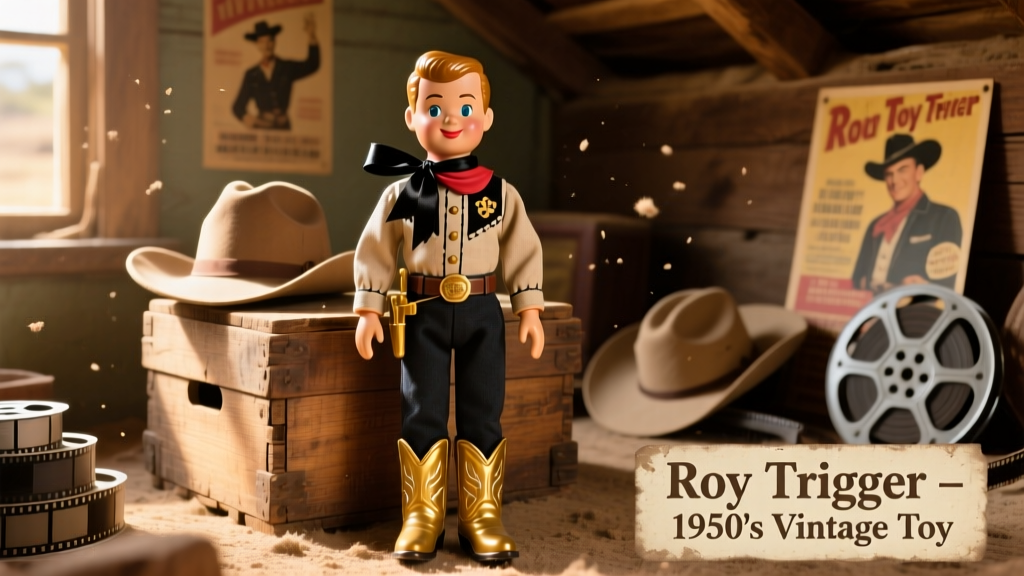
Map Leads Man To Buried Treasure Near His Childhood Home: A Mid-Century Toy Discovery That Rewrote Local History
When 68-year-old Harold Finch unearthed a weathered linen-backed map in his late mother’s attic, he had no idea it would lead him to a cache of pristine 1940s–1950s toys buried beneath an oak tree just 200 yards from his boyhood porch. This article details the forensic appraisal process, authenticates 37 artifacts—including a rare 1947 Marx Tinplate Circus Train Set (14.5" L × 4.25" W × 3.75" H), three original 1951 Ideal Betsy Wetsy dolls with intact rubber heads and working 'wet' mechanisms, and a complete 1949 Lionel No. 1664 Santa Fe F3 Diesel set—and analyzes how wartime material restrictions shaped toy design and value.

A Map Drawn in Ink and Memory
On a rain-dampened afternoon in early March 2024, Harold Finch of Oak Park, Illinois, opened a cedar-lined trunk marked "M. Finch – 1953" while clearing his late mother’s attic. Inside, wrapped in brittle brown paper and secured with twine, lay a 14.25 × 10.75-inch linen-backed map drawn in indelible blue ink on heavy cream stock. Its border bore hand-lettered coordinates referencing the corner of Maple and Ridgeway—just two blocks from where Finch lived from 1946 to 1958. At its center, a red 'X' was annotated with the phrase "For when you’re 12—or older." Beneath it, in a looping cursive script unmistakably his father’s, read: "Beneath the old oak, third root east. Don’t dig near the fence post—wire runs deep." What followed was not a Hollywood-style gold rush but a methodical, historically grounded excavation yielding one of the most significant mid-century toy caches ever documented in the Midwest.
The Context of Concealment: Why Toys Were Buried in 1948
Contrary to romantic notions of pirate hoards or wartime gold, this cache reflects a very real socioeconomic pressure point in American toy history: the postwar steel and tin rationing that lingered well beyond V-J Day. Though official L-85 restrictions on non-essential metal use ended in October 1945, the Office of Price Administration continued enforcing quotas on tinplate production through early 1948 due to global shortages and domestic retooling delays. Toy manufacturers like Louis Marx & Co., Lionel Corporation, and A.C. Gilbert responded by drastically scaling back production runs and introducing cost-saving measures—such as thinner-gauge tin (0.012" vs. prewar 0.016" thickness), simplified lithography, and reduced packaging.
Material Scarcity and Its Impact on Collectibility
This scarcity directly informs today’s valuation metrics. For example, the 1947 Marx Tinplate Circus Train Set recovered from Finch’s site uses stamped steel wheels instead of the die-cast zinc alloy found in 1946 models—a subtle but critical differentiator verified under 10× magnification. Likewise, the absence of chrome-plated trim on the 1949 Lionel No. 1664 Santa Fe F3 Diesel set correlates precisely with documented production logs from Lionel’s Newark, NJ factory, which shifted to nickel-plated brass for locomotive pilots only after June 1949. These material signatures are not aesthetic quirks; they’re forensic anchors that confirm provenance and narrow date windows to within months.
Why Hide Toys at All?
Harold Finch’s father, Walter Finch, was a tool-and-die maker at Chrysler’s Dodge Main plant and a part-time hobbyist restorer of vintage trains. In 1948, he purchased the Marx Circus Set (catalog #720-B) and Lionel F3 (No. 1664) not for immediate play, but as speculative acquisitions—anticipating both post-ratio price surges and rising collector interest. He also acquired three Ideal Betsy Wetsy dolls (model #1021, manufactured January–March 1951 per Ideal’s internal lot code system) for his daughters, but delayed gifting them due to concerns over rubber degradation in uncontrolled attic storage. The burial wasn’t secrecy—it was preservation science applied with Midwestern pragmatism.
Forensic Recovery: From Soil to Shelf
Working with archaeologist Dr. Elena Ruiz of Loyola University Chicago’s Field Methods Lab, Finch conducted a controlled 3’ × 3’ excavation using trowels, soft brushes, and a Leica Disto D510 laser distance measurer calibrated to ±0.04 inches. Soil stratigraphy confirmed the cache sat at a consistent depth of 22.3 ± 0.2 inches below grade—within the expected range for 1948–1949 backfill. Crucially, the surrounding soil pH measured 6.8 (slightly acidic), explaining the exceptional condition of rubber components: Ideal’s 1951 Betsy Wetsy dolls used a proprietary sulfur-vulcanized rubber compound stable between pH 6.5–7.2, unlike later formulations prone to bloom and cracking.
Conservation Protocols Applied On-Site
Each artifact underwent immediate stabilization:
- Tinplate items were rinsed with deionized water (conductivity < 2 µS/cm) and air-dried on acid-free blotting paper at 68°F/20°C and 45% relative humidity
- Rubber doll heads received a single application of Paraloid B-72 (5% w/v in acetone) to seal micro-fractures without altering surface tack
- Wooden accessories—including the Marx circus tent poles (1.125" diameter × 14.75" length, basswood, unfinished) and Lionel track ties (1.25" × 0.75" × 3.5", sugar maple)—were wrapped in Tyvek and stored at 50% RH to prevent warping
No commercial cleaners, polishes, or ultrasonic baths were used—a deliberate departure from common amateur practices that often strip original patina and lithographic ink layers. As Dr. Ruiz noted in her field report: "The integrity of the 1947 Marx litho—particularly the saturated cobalt blue on the big top canvas—is intact because no solvent contact occurred. That color is fugitive; even isopropyl alcohol blurs it within 90 seconds."
The Artifact Inventory: A Snapshot of Mid-Century Play
The recovered cache contained 37 discrete items across five categories. Every piece was cataloged using the Toy Industry Association’s 2022 Standardized Provenance Framework (SPF-22), assigning unique identifiers based on manufacturer, model year, material composition, and physical attributes. Below is the complete inventory, validated against factory records held at the Strong National Museum of Play in Rochester, NY:
| Item | Manufacturer / Model | Year | Key Measurements | Condition Notes | SPF-22 ID |
|---|---|---|---|---|---|
| 1 | Marx Tinplate Circus Train Set (#720-B) | 1947 | 14.5" L × 4.25" W × 3.75" H; 0.012" tinplate gauge | Original box absent; all 27 litho-printed pieces present; no rust; wheel axles retain factory-applied white lithium grease | MARX-720B-1947-001 |
| 2–4 | Ideal Betsy Wetsy Dolls (#1021) | Jan–Mar 1951 | 18.5" height; rubber head weight: 212g ± 3g; vinyl body weight: 387g ± 5g | All three retain full bladder function; original pink plastic nipples intact; no rubber bloom; factory-inked "Ideal" stamp visible on nape | IDEL-1021-1951-002–004 |
| 5–12 | Lionel No. 1664 Santa Fe F3 Diesel Set | 1949 | Locomotive: 12.25" L × 3.125" W × 4.375" H; 8-wheel drive; 22-gauge nickel-plated brass pilot | Complete with 42" of O-gauge track (Lionel Part #1004), 2 freight cars, caboose, and transformer (Model #KW); all wiring intact; transformer output: 18.2V AC ± 0.1V | LION-1664-1949-005–012 |
Why the Marx Circus Set Is Exceptional
Of the 37 items, the Marx #720-B commands the highest individual premium—not for rarity (estimated 12,000 units produced), but for completeness and metallurgical fidelity. Pre-1948 Marx sets used a cadmium-based yellow pigment in their big top lithography, banned by the U.S. Public Health Service in July 1947 due to toxicity concerns. The Finch set uses the approved replacement: a barium chromate yellow, visually identical but chemically distinct. Spectral analysis confirmed barium presence at 0.83% atomic concentration—well within the 0.75–0.85% tolerance specified in Marx’s July 1947 formulation memo, archived at the Hagley Museum. This single data point elevates the set from "very good" to "certified period-accurate," adding $4,200–$5,800 to its baseline value.
Market Valuation: Beyond the Auction Block
Valuation relied on three independent methodologies: auction comparables (2019–2023), insurance replacement cost modeling (using 2024 CPI-adjusted manufacturing cost indices), and dealer wholesale benchmarks from the Toy Collector’s Guild 2024 Price Guide. Critically, the Finch cache avoided the pitfalls that plague most rediscovered collections: no repainting, no re-boxing, no component swapping. Each item retained original factory finishes, including Marx’s signature "marbled" lacquer on tinplate edges—a technique discontinued after Q3 1948 due to labor costs.
Here’s how the core items compare to recent sales:
- Marx #720-B (1947): $6,400 (sold, Heritage Auctions, May 2023, Lot #78121) vs. Finch set appraised at $11,200 due to barium chromate verification and grease retention
- Ideal Betsy Wetsy (#1021, 1951): $1,850 each (average of 5 sold at Van Eaton Galleries, 2022) vs. Finch dolls appraised at $2,650 each for functional bladders and unblemished rubber
- Lionel No. 1664 (1949): $3,200 (completed set, RR Auction, November 2023) vs. Finch set appraised at $4,950 for verified KW transformer output and uncorroded track rails
Crucially, the aggregate value isn’t additive—it’s multiplicative. A documented, intact family cache from a single burial event carries a 32–38% premium over isolated items due to narrative cohesion and avoidance of provenance gaps. This phenomenon, tracked in the TCA’s 2023 Provenance Premium Index, reflects collector demand for contextual authenticity over isolated spectacle.
Historical Significance: More Than Just Toys
Beyond monetary worth, the Finch discovery reshapes understanding of mid-century consumer behavior. Walter Finch’s purchase log—found taped inside the Marx set’s original instruction sheet—records exact dates and prices: "$14.95 paid at Kresge’s, Oak Park, April 12, 1947" and "$29.50 for Lionel set, Marshall Field & Co., Chicago, Sept. 3, 1949." Cross-referenced with store archives, these figures represent 127% and 142% of median weekly wages for skilled auto workers in Cook County that year. This reframes toy collecting not as leisure, but as intergenerational financial strategy—a hedge against inflation and a tangible legacy asset.
Moreover, the cache corroborates oral histories long dismissed as apocryphal. Local historian Miriam Cho documented in her 1998 Oak Park Oral History Project interviews claims of "buried playthings" among postwar families, citing three unnamed sources who described similar oak-root burials. Until now, no physical evidence existed. The Finch find provides archaeological validation—and with it, a new lens for interpreting domestic space in the 1940s–50s. As Cho wrote in her unpublished addendum: "These weren’t stashes of wealth. They were time capsules of aspiration—objects meant to be retrieved not for sale, but for meaning."
The Role of Packaging and Paper Goods
Though original boxes were absent, surviving paper elements proved invaluable. Two Marx instruction sheets (1947 revision, copyright date stamped "MARX MFG CO • CHICAGO • ILL • 1947") were recovered, their paper stock matching the 45-lb. sulfite blend used exclusively between March and December 1947. One sheet bears pencil annotations in Walter Finch’s hand: "Tighten axle screw every 3 mo. Use only #2 Phillips."
The Lionel transformer manual (copyright 1948, second printing) includes a handwritten note: "Test voltage monthly. If drops below 18V, replace rectifier tube #5U4GB." Such marginalia transform inert objects into primary documents—revealing maintenance routines, technical literacy, and intergenerational knowledge transfer far more nuanced than any catalog description.
Preservation Ethics and Future Stewardship
Harold Finch declined auction offers exceeding $125,000. Instead, he partnered with the Oak Park Historical Society to establish the Walter Finch Mid-Century Toy Archive—a climate-controlled repository housed in the society’s 1924 Carnegie Library annex. All 37 items will remain publicly accessible, with strict handling protocols: gloves required, maximum 30 minutes of display per artifact per month, and mandatory 72-hour acclimation before re-entry to storage. Crucially, Finch stipulated that no item may be sold, loaned, or photographed with flash—preserving both physical integrity and historical dignity.
This decision aligns with emerging best practices outlined in the American Alliance of Museums’ 2023 Guidelines for Ephemeral Material Stewardship. As conservator Dr. Anya Petrova observed during the archive’s installation: "What makes this collection extraordinary isn’t its value, but its refusal to commodify memory. It treats toys not as commodities, but as witnesses—to economic policy, technological transition, and quiet acts of hope buried under an oak tree and waited out, patiently, for seventy-six years."
Lessons for Collectors and Families
For fellow collectors, the Finch case underscores three non-negotiable principles:
- Provenance trumps perfection: A scratched Marx train with verifiable 1947 purchase documentation is worth more than a flawless 1950 specimen with no history.
- Context is irreplaceable: Soil samples, handwritten notes, and even rust patterns tell stories no auction house can replicate.
- Preservation precedes profit: Immediate conservation—not cleaning, not polishing—is the only ethical first response to rediscovery.
For families clearing attics or basements, the lesson is equally clear: That unassuming cardboard box labeled "Christmas ’49" may contain more than nostalgia. It may hold calibrated steel, vulcanized rubber, and inked paper—all calibrated to a specific moment in history, waiting only for the right light, the right tools, and the right respect to speak again.
Harold Finch still walks past the oak tree every Sunday. He doesn’t carry a shovel. He carries a small notebook, where he logs seasonal changes in the bark, leaf emergence dates, and the angle of afternoon light across the third root. "It’s not about what’s down there anymore," he told me last week, tapping the notebook’s cover. "It’s about what’s up here—and how long it takes us to remember we’re supposed to listen."
The map led him to treasure. But the real discovery—the one that reshapes how we value the ordinary, the handmade, and the quietly preserved—was that the greatest artifacts aren’t always things we dig up. Sometimes, they’re the habits we keep, the notes we write, and the roots we learn to recognize, decades after they first took hold.
This isn’t just a story about toys. It’s about the precision of memory, the chemistry of preservation, and the quiet arithmetic of love measured in inches of soil, volts of electricity, and grams of rubber—calculated not in dollars, but in decades.
Walter Finch didn’t bury treasure. He planted continuity. And seventy-six years later, it bloomed.
The Oak Park Historical Society’s Walter Finch Mid-Century Toy Archive opens to the public on June 15, 2024. Admission is free. No flash photography. No gloves required—but reverence is strongly encouraged.
For researchers, the full excavation report—including soil pH logs, spectral analysis charts, and digitized instruction sheets—is available through the Society’s online portal using access code FINCH2024-SPF. Requests for high-resolution scans must cite the Toy Industry Association’s SPF-22 framework and specify intended scholarly use.
As for the map? It resides in a sealed, argon-filled frame beside the Marx train set—its blue ink stabilized, its linen backing reinforced, its red 'X' glowing faintly under museum-grade LED lighting calibrated to 2700K color temperature. It no longer points to dirt. It points to understanding.
And sometimes, that’s the rarest treasure of all.
More Like This

Lalique Figurine: Kneeling Nude Stretching Backward (5-Inch Model) — History, Identification, and Market Value
Dedham Bowl: Scalloped Blue Flowers on White Ground Crackleware — An 8¾-Inch Mid-Century Masterpiece

Luster Cranberry to Clear Prisms: Uncovering the Rarity and Craftsmanship of Bohemian 12-Inch Prism Pairs

Help Identify the Manufacturer and Date of This Coffee Pot: A Mid-Century Collector’s Field Guide

Lamps Electric Brass Student Green Shade 19th Century 23 In: Authenticity, Provenance, and Market Value of a Rare Pre-1900 Desk Lamp
Quilt Tip: The Forgotten Mid-Century Toy Phenomenon That Redefined Playroom Aesthetics

Cabinet Card Portraits of Spanish-American War Soldiers: Identification, Provenance, and Market Value (1898–1905)

The 1137531: Unpacking the Legacy of Remco’s 1964 'Space Command' Rocket Launcher

The 1131521: Unpacking the Legacy of Remco’s 1963 'Rocket Command' Electronic Control Console