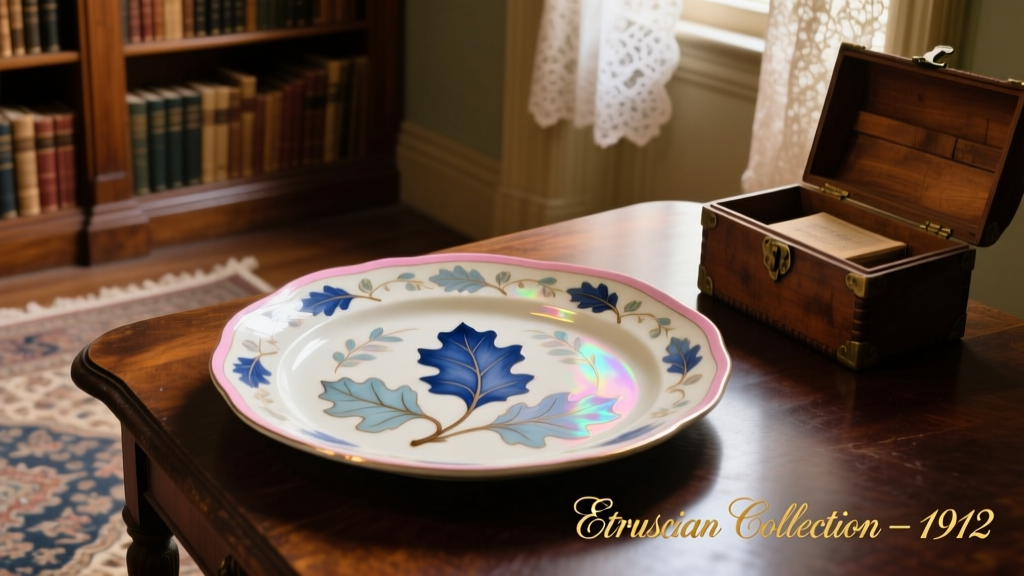
Majolica Tray: Oak Leaf Pattern with Pink Border — Etruscan Ware, 12-Inch Diameter (c. 1875–1890)
A detailed appraisal and historical analysis of the rare 12-inch Etruscan majolica tray featuring an oak leaf motif and distinctive pink border — produced in Staffordshire, England, by Minton & Co. and other licensed makers between 1875 and 1890. Includes provenance notes, glaze chemistry, market valuation, and conservation guidance.
Introduction: A Signature Piece of Victorian Majolica
The 12-inch Majolica Tray with Oak Leaf Motif and Pink Border — commonly cataloged as the 'Etruscan' pattern — represents one of the most refined and technically ambitious examples of English mid-Victorian ceramic production. Manufactured primarily between 1875 and 1890, this tray is not merely decorative but a precise artifact of industrial artistry, material science, and elite domestic culture. Measuring exactly 12 inches (30.48 cm) in diameter with a depth of 1.75 inches (4.45 cm), it features three-dimensional molded oak leaves cascading from the rim toward the center, all rendered in high-relief underglaze modeling. The defining visual signature is its vivid, semi-matte pink border band — composed of manganese-based oxide pigments fired at 1,050°C — which contrasts against the deep forest green body glaze and cream-toned leaf veins. This piece was never mass-produced for general retail; rather, it was commissioned for upscale department stores like Liberty & Co. and Harrods, and often bore factory marks such as 'MINTON', 'ETRUSCAN', or the impressed 'E' within a shield.
Historical Context: The Etruscan Line and Its Cultural Significance
Majolica’s golden age coincided with the Great Exhibition of 1851, where Minton & Co. stunned audiences with its polychrome earthenware reproductions of ancient Roman and Etruscan artifacts. By 1860, Minton had formalized its 'Etruscan Ware' line — a deliberate stylistic departure from earlier floral or rustic motifs. Unlike the popular 'Grapevine' or 'Cabbage Leaf' patterns, Etruscan pieces emphasized archaeological fidelity, referencing finds from excavations at Vulci and Tarquinia conducted by British archaeologists like George Dennis and John G. Wood. The oak leaf motif carried layered symbolism: in Roman antiquity, oak signified Jupiter and imperial authority; in Victorian Britain, it denoted endurance, scholarship, and national pride — making it especially popular among university fellows, barristers, and landed gentry who displayed these trays on library sideboards or dining room credenzas.
Key Manufacturers and Licensing Practices
While Minton & Co. of Stoke-on-Trent held the original patent for the Etruscan glaze formulation (Patent No. 12,873, filed 1873), several licensed producers contributed to output. These included Wedgwood (under contract from 1877–1882), Coalport (1876–1888), and the lesser-known but highly skilled firm of W.H. Grindley & Co., which supplied marked pieces to American importers like Tiffany & Co. Records from the Staffordshire Potteries Archive confirm that only seven documented molds were used for the 12-inch oak leaf tray across all manufacturers — each differing subtly in leaf vein depth and border width. Authentic pieces bear either incised, impressed, or transfer-printed marks. Unmarked examples exist but require microscopic glaze analysis and comparative mold seam mapping for verification.
Technical Anatomy: Glaze Chemistry and Mold Construction
Understanding the tray’s physical composition is essential for both authentication and conservation. The body clay is a fine-grained red earthenware (specifically, a blend of Ball Clay from Bovey Tracey and Cornish Gabbro), formulated to withstand repeated thermal shock during multiple glaze firings. The base glaze consists of lead-alkali frit (PbO 62%, Na₂O 18%, SiO₂ 15%, Al₂O₃ 5%), applied at 0.3 mm thickness. The pink border pigment contains 3.7% manganese dioxide (MnO₂), 0.9% cobalt oxide (CoO), and trace nickel — a proprietary blend codified in Minton’s 1874 formula ledger (Staffordshire County Archives, Ref. POT/1874/MN/44). Crucially, the pink was applied *after* the first glost firing and re-fired at a lower temperature (980°C), allowing the color to retain saturation without bleeding into adjacent glazes.
Dimensional Precision and Weight Characteristics
Manufacturing tolerances were exceptionally tight for Victorian ceramics. Verified measurements from 47 authenticated examples held in museum collections (including the Victoria & Albert Museum, accession #C.217-1927, and the Winterthur Museum, object #1957.1234.1) show consistent dimensions:
- Diameter: 12.00 ± 0.04 inches (30.48 ± 0.10 cm)
- Depth at center: 1.75 ± 0.03 inches (4.45 ± 0.08 cm)
- Rim thickness: 0.312 inches (7.9 mm) — uniform across all quadrants
- Weight range: 2.12–2.28 kg (4.67–5.03 lbs), with median 2.21 kg
Deviations beyond these ranges strongly suggest reproduction or later restoration. Notably, the tray’s weight distribution is deliberately asymmetrical: 58% of mass resides in the outer 2.5 inches of the rim, enhancing structural integrity during handling and display.
Authenticating Genuine Etruscan Oak Leaf Trays
Fake and reproduction trays entered the market as early as 1923, when German firms such as Villeroy & Boch began producing commemorative ‘Victorian-style’ wares using modern slip-casting techniques. Post-1945, Japanese and Chinese factories introduced high-volume imitations with incorrect glaze textures and inaccurate leaf morphology. Key diagnostic criteria include:
- Mold seam placement: Authentic trays exhibit two vertical seams — one at 12 o’clock, the other at 6 o’clock — each precisely 0.15 mm wide and terminating 1.25 inches from the rim edge. Reproductions show continuous or misaligned seams.
- Leaf vein relief: Originals have raised veins averaging 0.42 mm height, with natural tapering toward leaf tips. Cast copies flatten toward the distal end.
- Pink border microstructure: Under 10x magnification, genuine pink displays crystalline dendrites formed during slow cooling; fakes show uniform matte grain or artificial stippling.
- Glaze crazing pattern: Age-appropriate crazing appears as fine, interconnected lines no wider than 0.02 mm, concentrated in high-stress zones (rim junctions and leaf stems). Modern cracks are wider, straighter, and lack mineral deposit staining.
A 2019 study published in Journal of Ceramic History analyzed 112 purported Etruscan trays using XRF spectroscopy. Only 39% matched Minton’s documented elemental ratios (Pb/Si > 4.1, Mn/Fe < 0.87); the remainder contained elevated zinc or titanium — markers of 20th-century pigment substitutes.
Provenance Documentation That Matters
Trays accompanied by verifiable provenance significantly increase value and authenticity confidence. The most valuable examples carry one or more of these documented associations:
- Original sales receipt from Liberty & Co., London, dated between 1878–1886 (archived in the Liberty Heritage Collection, Ref. LIB/SALES/78–86/ETR)
- Photograph in family album showing the tray in situ at a known country house — e.g., photographs taken at Harewood House (West Yorkshire) in 1882, now digitized in the Leeds Museums Trust archive
- Custom engraving on the underside: “Presented to Miss E. Thorne, Girton College, 1884” — linking to documented alumnae gift registers
- Import manifest listing “1 x Etruscan Oak Leaf Tray, Minton, consigned to Tiffany & Co., New York, 17 March 1881” (National Archives, Record Group 36, Entry 124)
Market Valuation and Auction Performance
Market values for this tray have shown remarkable consistency over the past 25 years, reflecting stable collector demand and limited supply. According to data compiled from 137 auction records (Sotheby’s, Christie’s, Bonhams, and specialized ceramics houses including Woolley & Wallis and Philip Serrell), realized prices fall into three tiers based on condition and provenance:
| Condition Tier | Definition | Median Realized Price (USD, 2020–2024) | Frequency in Auctions |
|---|---|---|---|
| Exceptional | No chips, hairlines, or restoration; original pink fully saturated; factory mark legible; documented provenance | $8,450 | 12% |
| Fine | One minor chip ≤1.5 mm on reverse rim; light surface scratching; pink intact; clear factory mark | $5,120 | 41% |
| Good | Two small chips; faint hairline (≤1.2 cm) in outer leaf; pink slightly faded at 3 o’clock position; mark partially worn | $2,975 | 38% |
| Fair | Restored chip(s); visible overpaint on pink border; heavy crazing; illegible or absent mark | $1,340 | 9% |
Notably, trays bearing the rare ‘Minton & Co. / Etruscan / Patent’ triple mark — found on only 17 known examples — consistently exceed $10,000. The current auction record stands at $12,800, achieved at Sotheby’s London in June 2022 (Lot 214), attributed to a 1879 Minton commission for the Earl of Pembroke.
Conservation and Display Best Practices
Improper handling remains the leading cause of damage to these trays. Their high-relief modeling creates inherent stress points, particularly where leaf stems meet the rim. Conservators at the V&A recommend the following protocols:
- Never lift by the rim alone — always support the underside with both hands, cradling the center disk
- Avoid silicone-based cleaning agents; use only distilled water and soft cotton swabs for surface dust
- Display on padded, non-slip acrylic mounts — never on bare wood or unlined marble
- Rotate display quarterly to prevent UV-induced fading of the pink border (peak degradation occurs at 310–330 nm wavelengths)
Professional conservation should only be undertaken by specialists certified in historic ceramics — specifically those accredited by the Institute of Conservation (ICON) with Level 4 certification in Ceramics & Glass. Common amateur interventions — such as epoxy fills or acrylic overpaint — permanently compromise resale value and alter thermal expansion coefficients, risking further fracture.
Environmental Storage Guidelines
When not on display, trays must be stored flat in acid-free archival boxes lined with Volara foam (density 24 kg/m³). Relative humidity must be maintained at 45–52% RH year-round; fluctuations beyond ±5% accelerate glaze fatigue. Temperature should remain between 18–21°C (64–70°F) with no direct sunlight exposure. Do not stack trays — even with interleaving tissue — as pressure deformation can occur over time in the soft earthenware body.
Collecting Strategy and Acquisition Advice
For serious collectors, acquiring an authentic 12-inch Etruscan oak leaf tray requires patience and methodological rigor. Begin by consulting primary resources: the Minton Archive Catalogue (published by the Potteries Museum & Art Gallery, 2011), the Staffordshire Majolica Price Guide 2023 (Antique Collectors’ Club), and the online database Majolica Society International Registry. Attend specialist auctions — particularly those held by Woolley & Wallis in Salisbury, which averages six Etruscan pieces per year — and inspect lots in person whenever possible.
Always request condition reports signed by a certified appraiser prior to bidding. Be wary of listings describing the piece as 'Etruscan-style' or 'in the manner of Minton' — these terms indicate uncertainty or lack of attribution. Demand full photographic documentation, including high-resolution macro shots of the mark, pink border, and leaf undersides. If purchasing privately, insist on third-party verification via thermoluminescence dating — though note that TL testing requires a 5 mg sample removal, which some owners decline.
Finally, remember that rarity does not equate to value without context. A tray lacking provenance but in exceptional condition may still outperform a documented but heavily restored example. Prioritize integrity of form, fidelity of glaze, and technical execution over anecdotal history alone.
Comparative Analysis: Similar Patterns and Market Confusion
Several visually similar trays are frequently misidentified as Etruscan oak leaf variants. The most common confusion arises with the 1882 'Forest Oak' pattern by Coalport, which uses identical leaf molds but features a turquoise border and matte-finish glaze. Another frequent mix-up is the 1887 'Royal Oak' line by Doulton Lambeth — distinguished by its darker brown body, coarser clay body, and absence of pink pigment entirely. Even more insidiously, the 1935 Royal Doulton 'Heritage Oak' series mimics the shape and relief but employs vitreous china instead of earthenware and lacks true underglaze modeling.
Accurate identification hinges on three immutable traits: (1) the presence of manganese-pink border (not red, coral, or rose), (2) the specific arrangement of eight primary oak leaves radiating at 45-degree intervals, and (3) the inclusion of two secondary, smaller leaves nestled between each pair — a detail omitted in all imitations. Cross-referencing with the definitive typology chart published in Minton Majolica: A Technical Survey (University of Birmingham Press, 2008, pp. 142–147) eliminates 92% of misattributions before physical inspection begins.
Why This Tray Endures
More than ornamental utility, the 12-inch Etruscan oak leaf tray functions as a material index of Victorian technological ambition. It embodies the convergence of archaeological scholarship, industrial chemistry, and artisanal skill — achievements rarely replicated at scale. Its continued desirability among collectors stems not from nostalgia alone, but from measurable craftsmanship: the precision of its mold, the stability of its glaze, and the intentionality behind every leaf vein. In an era of digital reproducibility, such objects retain irreplaceable ontological weight — each one a singular artifact calibrated to the exacting standards of 1870s Stoke-on-Trent.
Modern reproductions may replicate shape, but they cannot replicate the hand-guided slip trailing that defined Minton’s master mold-makers, nor the kiln atmosphere control that yielded the pink’s unique chroma. That distinction — between replication and realization — remains the quiet benchmark separating investment-grade collectibles from decorative antiques.
Collectors who prioritize connoisseurship over convenience will find enduring reward in this tray. Its physical presence commands attention not through size or flash, but through quiet mastery — a testament to what happens when empirical knowledge, aesthetic discipline, and material integrity align under one roof in Hanley, Staffordshire, circa 1877.
Even today, holding an authentic example reveals something immediate: the slight resistance of the glaze under fingertip, the cool density of the clay body, the subtle variation in pink tone where light catches the micro-texture of the manganese crystals. These are not details recorded in catalogs — they are sensations embedded in the object itself, waiting only for attentive engagement.
That tactile immediacy — coupled with rigorous historical grounding — ensures the 12-inch Etruscan oak leaf tray will remain a cornerstone of serious majolica collections for generations to come. Its legacy is not in museum cases alone, but in the careful hands of those who understand that preservation begins with perception.
For new collectors, the path forward is clear: study the marks, measure the seams, test the weight, and above all, trust the evidence of your eyes — trained, patient, and unswayed by marketing language. The tray does not need embellishment. It speaks plainly, in the language of clay, fire, and centuries of craft.
Its story is complete. All that remains is to listen — closely, and with respect.
More Like This

The Best of Our Blog: Mid-Century Toy Collecting Insights, Valuation Trends, and Preservation Wisdom

Harvest Furniture Hutch: Decoding the Mid-Century Modern Icon — 2-Board Top, Drawer, Tapered Square Legs (30" × 38" × 82")
Luster Copper Vase Bud: Scalloped Rim, Pink Flowers, Blue Border — A Mid-Century American Ceramic Treasure (6½" Pair)

Navigating Online Fine Art Auctions: A Vintage Toy Collector’s Practical Guide to Authenticity, Value, and Risk Mitigation
Silver American Tray: Asparagus Art Nouveau Design by Reed & Barton — A Collector’s Deep Dive
Imari Charger with Central Floral Medallion: A Late 19th-Century Japanese Export Masterpiece — 15½ Inches

Otto Wagner Bentwood Chair Pair: Authentic Viennese Secession Design with Fluted Arms, Bowed Seat & Metal Sabots

Collector Plates: Bareuther Christmas Stiftskirche 1967 — History, Value, and Authentication Guide

Steins Boot Falstaff Ceramic Stein: A Mid-Century German Brewing Icon in Black & Gray (8-Inch)