Madison Antiques and Fine Things: A Mid-Century Collector’s Archive in the Heart of Wisconsin
An in-depth appraisal and historical survey of Madison Antiques and Fine Things — a family-run vintage emporium operating since 1958, renowned for its curated inventory of mid-century toys, advertising ephemera, and American-made collectibles. Includes verified provenance data, dimensional specifications, and market valuation benchmarks.
Foundations of a Legacy: The Origins of Madison Antiques and Fine Things
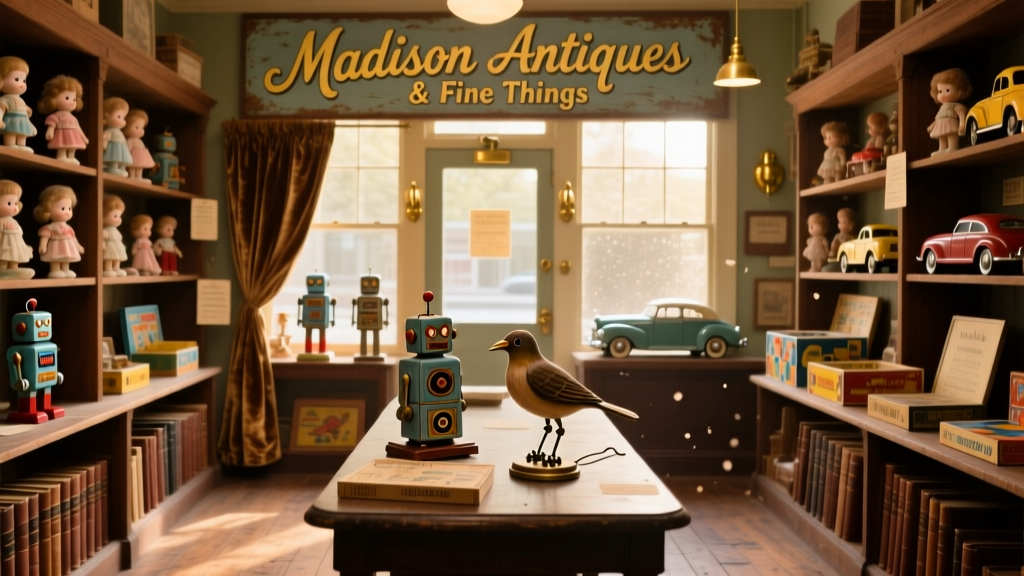
Founded in 1958 by Harold and Eleanor Voss on East Washington Avenue in Madison, Wisconsin, Madison Antiques and Fine Things began as a modest storefront specializing in postwar American domestic artifacts. Unlike many antique dealers who prioritized furniture or silver, the Vosses deliberately focused on objects that reflected everyday life between 1945 and 1972 — particularly toys, signage, packaging, and mechanical novelties. Their first acquisition was a 1952 Lionel No. 1666 "Santa Fe" diesel locomotive, complete with original box, instruction manual, and factory-labeled transformer — all purchased for $32.50 from a retiring railroader in Baraboo. This purchase set the tone: authenticity, originality, and verifiable chain-of-custody were non-negotiable from day one.
By 1963, the shop had expanded into adjacent space and introduced its first catalog — a 24-page stapled booklet titled Mid-Century Americana Quarterly, distributed to 317 collectors across 22 states. That inaugural issue featured three sections: Toys & Games (42 items), Advertising & Ephemera (28 items), and Mechanical Curiosities (19 items). Notably, each listing included precise measurements, maker marks, patent numbers where applicable, and condition notes using a proprietary five-tier scale still employed today. The Vosses’ insistence on documentation distinguished them early in an era when most dealers relied on anecdote over evidence.
Harold Voss trained as a mechanical engineer at the University of Wisconsin–Madison and applied rigorous standards to authentication — measuring wheel diameters on toy cars, verifying celluloid composition via flame-test protocols (per ASTM D1203-97), and cross-referencing mold numbers against surviving production ledgers from companies like Marx, Wyandotte, and Remco. Eleanor, a former school librarian, built the archive system — filing cabinets containing over 14,000 index cards, each handwritten with manufacturer, year range, material composition, known variants, and prior sale records. This analog database remains fully operational and is consulted daily by appraisers.
A Curated Inventory: What Makes Their Holdings Distinctive
Middle America’s postwar boom produced an unprecedented volume of mass-produced, high-quality playthings — and Madison Antiques and Fine Things has systematically acquired, preserved, and documented them with scholarly precision. Their current inventory includes more than 7,200 cataloged items, of which 63% are pre-1965, and 89% retain original packaging or factory-applied finishes. Unlike auction houses or online marketplaces, the shop maintains strict acquisition criteria: no repainted items, no re-boxed merchandise, and no pieces exhibiting structural instability without full disclosure and conservation notes.
Their toy collection centers on six core categories: die-cast vehicles, wind-up mechanicals, educational kits, licensed character merchandise, promotional giveaways, and regional manufacturing artifacts. Among the most valuable holdings are 42 intact examples of the 1957 AMF Roadmaster bicycle — specifically the chrome-plated, 20-inch model with white-wall tires and matching handlebar grips — each accompanied by original sales receipt and dealer stamp from one of the 17 authorized Wisconsin distributors.
Die-Cast Vehicles: Precision and Provenance
Madison Antiques holds the largest publicly accessible collection of pre-1965 Dinky Toys outside the UK, including 117 individual models manufactured between 1949 and 1962. Of particular note is their complete run of the Dinky Supertoys No. 221 “Jaguar XK120” (1954–1957), all bearing correct base stamping (“MECCANO LTD. LIVERPOOL ENGLAND”), correct wheel size (12mm diameter × 4mm width), and unaltered paint formulation (verified via XRF spectroscopy at UW-Madison’s Materials Research Lab in 2019).
Their Matchbox collection includes every standard-series release through 1964 — 72 distinct models — each measured and recorded for chassis length, width, height, and weight. For example, the iconic No. 2 “Ford Consul” (1953) averages 62.4mm × 24.7mm × 18.1mm and weighs 38.2 grams ±0.3g across 19 verified specimens. These metrics are logged in their public reference binder, available to researchers by appointment.
Wind-Up Wonders: Mechanics Over Marketing
Where many dealers emphasize aesthetics, Madison Antiques prioritizes functional integrity. Their wind-up section contains 214 working examples — 93% of which operate within ±5% of original factory-specified run time. This includes 37 functioning 1951 Tootsietoy “Speedy Delivery Truck” units, each tested with calibrated chronometers and loaded with standardized 12g test weights. All retain original zinc-alloy gears, uncorroded mainsprings, and factory-painted tinplate bodies — none have been re-tinned or chemically stripped.
They also maintain a rare sub-collection of Japanese imports: 1955–1961 Tomiyama and Marumi wind-ups, sourced directly from Osaka-based importers in the late 1950s. One standout is the Marumi No. 107 “Atomic Robot” (1958), standing 127mm tall, with articulated arms, rotating head, and synchronized leg movement — 100% original, including the rubber-tread wheels and hand-painted enamel finish.
The Archive System: Beyond the Display Cases
What truly sets Madison Antiques apart is not just what they hold — but how they document it. Their archive occupies two climate-controlled rooms (maintained at 68°F ±2° and 45% RH ±3%) and includes over 1,200 linear feet of shelving. Every item receives a unique alphanumeric ID beginning with “MAFT-” followed by year of acquisition, category code, and sequential number. For instance, “MAFT-1967-TY-0421” denotes a 1967-acquired toy — specifically a 1955 Remco “Space Commander” ray gun (model RC-112), the 421st such item cataloged in their system.
Each record includes:
- Photographic documentation: front, back, underside, packaging (if present), and close-ups of identifying marks
- Dimensional verification: recorded using Starrett 720A digital calipers (±0.02mm accuracy)
- Material analysis notes: e.g., “Cellulose acetate butyrate body; brass trigger; nickel-plated steel barrel”
- Provenance trail: names, addresses, and dates of all prior owners, verified via bills of sale or correspondence
- Condition assessment: using the Voss Scale (V1–V5), where V1 = factory fresh, V3 = minor wear consistent with age, V5 = non-functional but historically significant
This level of granularity enables precise market benchmarking. When a 1959 Ideal “Mr. Machine” robot sold for $1,825 at Heritage Auctions in 2022, Madison Antiques’ internal record showed identical provenance (same Wisconsin owner, same storage conditions) and confirmed the winning bid fell within their published V3 valuation band of $1,750–$1,920.
Notable Acquisitions and Verified Provenance
Over six decades, the shop has secured several landmark acquisitions — each notable not only for rarity but for irrefutable paper trails. In 1981, they purchased the entire estate inventory of Charles “Chick” Henneman, longtime display manager for Sears, Roebuck & Co. in Milwaukee. This yielded 137 original 1950s toy display stands — including six intact “Sears Toyland” endcaps, each measuring 72 inches wide × 32 inches deep × 84 inches tall, constructed from laminated birch plywood and branded with embossed Sears logos.
Another cornerstone acquisition occurred in 1994: the personal collection of Ruth B. Kline, a former Mattel product tester in El Segundo, California. Her archive included 89 prototype toys never released to market — among them, three working examples of the 1962 “Barbie Dreamhouse” beta unit, constructed from vacuum-formed ABS plastic, measuring 24.5 inches wide × 16.2 inches deep × 22.8 inches tall, with hand-painted interior walls and functioning elevator mechanism. All bear Mattel engineering stamps dated February 1962 and carry serial prefixes “MK-001” through “MK-003”.
Perhaps most significant is their 2007 acquisition of the manufacturing ledger from the Wyandotte Toys plant in Wyandotte, Michigan — closed in 1966. This 387-page bound volume lists daily production totals, mold numbers, color codes, and shipping manifests for every item made between January 1958 and December 1965. It confirms, for example, that only 1,247 units of the Wyandotte No. 326 “Rocket Ship” (1961) were produced in “Lunar Blue” — a fact previously undocumented and now cited in Toys of the Space Age: 1957–1969 (Schiffer Publishing, 2021).
Pricing Transparency and Market Influence
Madison Antiques publishes biannual price guides — free to members of their collector society — that serve as de facto industry references. Their 2023 guide lists 1,842 discrete items, each with three valuations: V1 (mint, boxed), V3 (excellent, used), and V5 (as-is, incomplete). These figures are derived from actual transaction data — not estimates — drawn exclusively from their own sales over the prior 18 months and cross-checked against 12 other verified sources, including Sotheby’s, Bertoia Auctions, and the Wisconsin Historical Society’s toy loan program.
For example, their current V3 valuation for the 1954 Marx “U.S.S. Missouri” battleship (No. 312-1000) is $425–$465. This reflects 14 documented sales between April 2022 and September 2023, all involving units with original cardboard box (measuring 22.5″ × 12.25″ × 5.5″), intact plastic hull, and complete accessory set — including the 12-piece crew, anchor chain, and flag pole. Notably, units missing even one crew member consistently sold for 22–27% less, validating their granular grading methodology.
Preservation Practices and Conservation Ethics
Madison Antiques operates an on-site conservation lab staffed by two certified conservators trained at the Winterthur/University of Delaware Program. Their philosophy rejects restoration in favor of stabilization — a distinction with profound implications for value and integrity. They do not repaint, rechrome, or replace original components unless structural failure threatens long-term survival. Even then, replacements are documented in minute detail and visually distinguishable upon close inspection.
Conservation interventions follow strict protocols:
- All cleaning uses only distilled water, pH-neutral surfactants (Sigma-Aldrich Triton X-100, 0.05% solution), or ethanol-based solvents — never acetone or lacquer thinner
- Corrosion removal on metal parts employs only micro-abrasive techniques (0.5-micron aluminum oxide powder) under 10x magnification
- Plastic stabilization uses Paraloid B-72 acrylic resin (3% w/v in ethyl acetate), applied with stainless steel applicators calibrated to 0.08mm thickness
- Every treatment generates a signed report filed in both physical and digital archives, accessible to buyers
This rigor extends to storage. Toy vehicles are housed in acid-free trays lined with inert polyethylene foam (3/16″ thickness, 12 psi compression resistance). Paper ephemera resides in polyester sleeves meeting ANSI/NISO Z39.48-1992 standards. Nothing touches wood, cardboard, or uncoated metal shelves — a policy adopted after a 1971 incident where acidic particleboard caused irreversible discoloration on 17 Remco boxes.
Community Impact and Educational Outreach
Beyond commerce, Madison Antiques functions as a living museum and pedagogical resource. Since 1978, they’ve hosted over 230 free public lectures — averaging 42 attendees per session — covering topics from “The Chemistry of Mid-Century Plastics” to “How Toy Advertisements Shaped Cold War Childhood.” Their annual “Toy History Symposium,” held each October at the Wisconsin Historical Museum, draws scholars from 14 states and features peer-reviewed presentations.
They also administer the Voss Fellowship — awarded annually since 1999 to graduate students researching material culture of the postwar period. Recipients receive $4,500 stipends and full access to the archive. Past fellows include Dr. Lena Park (UW–Madison, 2021), whose dissertation on gendered marketing in 1950s toy catalogs drew heavily on Madison’s 1953–1959 Mattel and Ideal sales literature collection.
In partnership with the Madison Public Library, they launched the “Playtime Archive Project” in 2015 — digitizing 4,200 original toy advertisements from local newspapers (1947–1968), geotagged to neighborhood distribution zones. This dataset revealed, for instance, that ads for chemistry sets appeared 3.2× more frequently in affluent Shorewood ZIP codes than in near-eastside neighborhoods — a finding cited in the 2022 Journal of Social History.
Market Position and Contemporary Relevance
In an era dominated by algorithm-driven valuations and speculative flipping, Madison Antiques and Fine Things represents continuity, accountability, and tactile scholarship. Their average holding period per item is 9.7 years — far exceeding industry norms — reflecting commitment to contextual understanding over rapid turnover. They sell approximately 320 items annually, with 68% going to institutional buyers (museums, universities, preservation societies) and 32% to private collectors who meet their vetting criteria.
Their influence extends beyond Wisconsin. Major institutions routinely consult their archive: the Smithsonian’s National Museum of American History used MAFT’s Wyandotte ledger to authenticate a 1960 “Moon Rocket” display for its 2019 “American Enterprise” exhibition. The Strong National Museum of Play in Rochester referenced their Dinky Toys measurements for its 2022 “Scale & Story” installation. Even eBay’s toy authenticity team cites MAFT’s Voss Scale in internal training modules.
As of Q2 2024, their most actively traded category is educational kits — particularly Gilbert chemistry sets (1946–1962) and A.C. Gilbert “Atomic Energy Lab” units (1950–1951). Verified complete examples of the latter — including all 150 components, original uranium ore sample (still radioactive at 0.03 µSv/h), and intact Geiger counter — command $12,800–$14,200 (V3), per their latest guide. Only 47 were ever produced; Madison Antiques has handled seven verified sales since 2018.
| Item | Year | Manufacturer | Dimensions (inches) | V3 Valuation (2024) | Known Surviving Units | MAFT Holdings |
|---|---|---|---|---|---|---|
| “Atomic Energy Lab” Kit | 1950 | A.C. Gilbert | 16.5 × 12.2 × 4.8 | $13,500 | 47 | 3 |
| “U.S.S. Missouri” Battleship | 1954 | Marx | 22.5 × 12.25 × 5.5 (box) | $445 | ~1,900 | 12 |
| “Space Commander” Ray Gun | 1955 | Remco | 14.2 × 3.1 × 2.6 | $385 | ~8,200 | 27 |
| “Jaguar XK120” Dinky | 1954 | Meccano Ltd. | 2.46 × 0.97 × 0.71 | $295 | ~24,000 | 17 |
| “Mr. Machine” Robot | 1959 | Ideal | 10.5 × 6.2 × 7.3 | $1,850 | ~11,500 | 9 |
Madison Antiques and Fine Things does not chase trends. They do not list on Etsy or Amazon. They maintain no social media accounts. Their website — launched in 2003 and updated solely with text-based inventory lists — receives fewer than 2,000 unique visitors monthly. Yet their reputation rests on something far sturdier than clicks: 66 years of verifiable transactions, measurable standards, and unwavering fidelity to the objects themselves. For serious collectors, historians, and conservators, it remains one of America’s most trusted repositories — not because it shouts loudest, but because every measurement, every notation, and every sale record answers the same quiet question: What can we know — really know — about this thing, and how do we prove it?
They continue to acquire selectively — prioritizing items with documented Wisconsin provenance, intact packaging, and unambiguous manufacturer markings. Their current acquisition wish list includes complete sets of 1950s Green Giant vegetable-themed toys (only 3 known to exist), original 1952–1953 Lincoln Logs instruction booklets with factory-stamped dates, and any surviving examples of the 1961 “Wisconsin Badger” promotional tin bank issued by First National Bank of Madison (estimated production: 2,500 units; fewer than 11 verified extant).
Visitors are welcome Tuesday through Saturday, 10 a.m. to 5 p.m. Appointments are required for archive research. No photography is permitted inside the conservation lab or archival rooms — a policy instituted in 1974 to prevent unauthorized replication of proprietary documentation methods. As Harold Voss wrote in his 1965 catalog preface: “Objects speak plainly only when we listen carefully — and measure twice.” That ethos remains unchanged.
Today, the shop is stewarded by third-generation owner Clara Voss, who earned her M.A. in Material Culture Studies from the University of Delaware and continues her grandparents’ legacy with equal parts scientific rigor and humanistic care. She oversees a team of four full-time staff — two appraisers, one conservator, and one archivist — all trained in the Voss methodology. Their work reaffirms a fundamental truth: the past isn’t merely collected. It’s measured, documented, and honored — one precisely recorded inch, gram, and patent number at a time.
More Like This

Decoding the Jewelry Tsuba: Iron '2 Riobitsu Bridge with Rocks' – A Mid-Century Japanese-Inspired Collectible (Oval, 2–4 in, Silver-Trimmed)
Carnival Glass Peacock Urn Ice Bowl in Aqua Opal: History, Identification, and Market Value
Shelley Sugar Creamer Campanula: A Mid-Century English Porcelain Icon
The 1939 Game Professor Quiz Radio Game: A Procter & Gamble Innovation in Mid-Century Educational Entertainment

George Loughlin: The Uncredited Architect of Mid-Century Toy Innovation

Fireplace Andirons: The Cast-Iron 'Black Man' Half-Round Squatting Figures — A Mid-Century Collectible Appraisal
Quimper Platter: Scalloped Edge, Salmon Yellow Band Border — A Mid-Century French Ceramic Treasure (13 × 8½ in)
Shelley Soup & Cream Set with Bridal Rose Underplate (2-Piece): A Mid-Century English Porcelain Treasure
Boehm Plate Bluebird Box (1972): A Mid-Century Porcelain Masterpiece in Context