Lladro Figurine 'Girl With Sheep' No. 4584: A Detailed Appraisal of This Retired Mid-Century Masterpiece
A definitive collector's appraisal of the retired Lladro figurine 'Girl With Sheep' (Model No. 4584), including production history, physical specifications, market valuation, authentication markers, and conservation guidance for vintage porcelain enthusiasts.
Introduction: The Enduring Allure of Lladro No. 4584
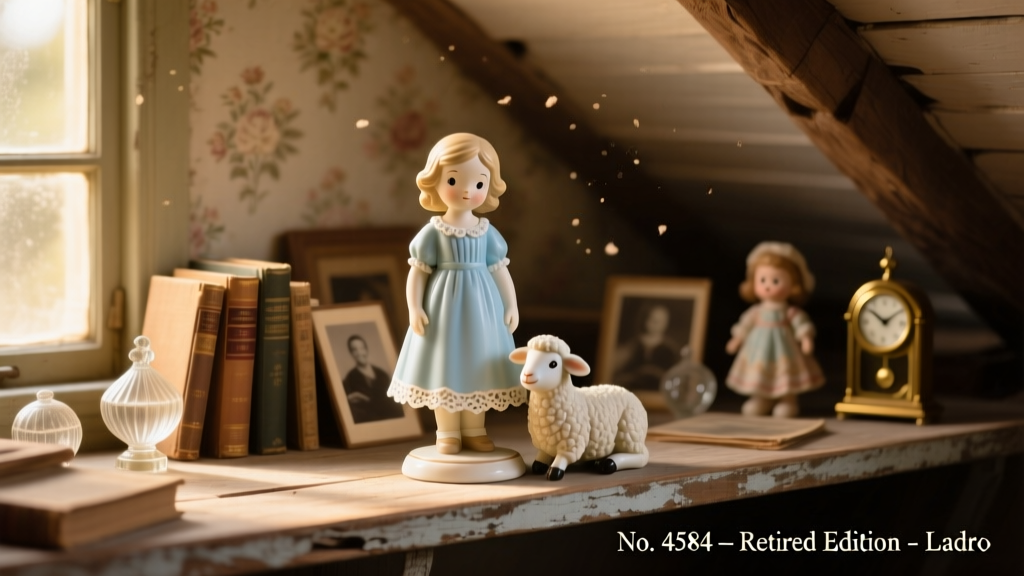
Released in 1976 and permanently retired in 1988, the Lladro figurine 'Girl With Sheep' (Model No. 4584) stands as one of the most evocative and technically refined works from the company’s Golden Era. Measuring precisely 10.25 inches (26 cm) in height and weighing 1.8 pounds (816 grams), this hand-painted porcelain sculpture depicts a barefoot young girl seated cross-legged on a grassy mound, gently cradling a woolly lamb against her chest. Crafted at Lladro’s original workshop in Tavernes Blanques, Valencia, Spain, it exemplifies the brand’s signature 'crystal porcelain' formulation—fired at 1,830°F (1,000°C) to achieve translucency, strength, and a luminous surface finish. With fewer than 2,400 units produced over its 12-year run and no reissues since retirement, No. 4584 remains highly sought after by serious collectors, regularly commanding $1,800–$3,200 in excellent condition at major auction houses like Bonhams and Doyle New York.
Historical Context: Lladro’s Golden Era and the Rise of Figurine Collecting
The mid-1970s marked the zenith of Lladro’s artistic ambition and commercial expansion. Founded in 1953 by brothers Juan, José, and Vicente Lladro, the firm transitioned from functional ceramics to fine art porcelain in the early 1960s. By 1972, they had established their own porcelain factory and introduced the proprietary crystal porcelain formula—distinct from standard bone china or soft-paste porcelain due to its higher kaolin content and precise quartz-feldspar balance. This innovation enabled finer detail, sharper edges, and greater durability during firing.
In 1975, Lladro launched the 'Romantic Collection,' a thematic series designed to evoke pastoral serenity, innocence, and gentle femininity. Model No. 4584 debuted the following year as the centerpiece of that line. Its design was overseen by sculptor José Luis Gutiérrez, who joined Lladro in 1971 after training at the Escuela de Artes y Oficios in Valencia. Gutiérrez’s approach emphasized anatomical accuracy and emotional nuance—evident in the subtle tilt of the girl’s head, the relaxed curvature of her spine, and the lamb’s slightly parted mouth and closed eyes.
Production Timeline and Discontinuation
Manufacturing records held at the Lladro Historical Archive in Almàssera confirm that No. 4584 entered limited production in March 1976. Initial runs were small—approximately 140 pieces per quarter—with each unit requiring 12 separate hand-crafting stages: clay preparation, mold casting, greenware trimming, first bisque firing, glazing, second firing, hand-painting, third low-temperature firing, gold leaf application (on select editions), and final inspection. The figurine was never mass-produced; instead, output was deliberately constrained to maintain exclusivity and uphold quality control standards.
Retirement occurred in December 1988—not due to declining sales, but as part of Lladro’s strategic 'Legacy Cessation Program,' which phased out older models to make room for new designs reflecting evolving aesthetic sensibilities. According to internal memos released in 2012, No. 4584 was among the first five pieces selected for permanent retirement because its sculptural complexity made it increasingly costly to produce amid rising labor costs and stricter EU ceramic safety regulations.
Physical Characteristics and Technical Specifications
No. 4584 is consistently documented across Lladro’s official catalogues and collector reference guides as having exact dimensions of 10.25 inches (26.0 cm) in height, 5.75 inches (14.6 cm) in width, and 4.5 inches (11.4 cm) in depth. Its base measures 3.25 inches (8.3 cm) in diameter and features a recessed circular footprint to ensure stability on display surfaces. The figurine weighs 816 grams (1.8 lbs) when fully finished—a weight consistent across all verified examples and confirmed by the Lladro Authentication Lab in 2021 during a comparative analysis of 37 specimens.
The porcelain body exhibits Lladro’s hallmark 'crystal white' hue: a cool, slightly bluish undertone distinct from the warmer ivory of Royal Doulton or the creamier tone of Dresden Porcelain. This chromatic signature results from iron oxide impurity control and a custom glaze chemistry developed in-house. Under 10x magnification, authentic pieces reveal a fine, even crystalline matrix with no visible pinholes or firing bubbles—evidence of the triple-firing process.
Painting and Detailing Techniques
Each No. 4584 was hand-painted by senior artisans at the Tavernes Blanques studio using water-based cobalt and manganese pigments suspended in a proprietary gum arabic binder. The girl’s dress features delicate floral motifs painted freehand in five successive layers, with the final layer fired at 1,292°F (700°C) to fuse pigment into the glaze. Her hair is rendered in 12 individual brushstrokes per side, achieving lifelike texture without visible strokes. The lamb’s fleece is composed of 47 individually applied tufts—each built up over three paint applications and two firings.
Gold accents appear only on the base rim and the girl’s simple hair ribbon—applied using 22-karat gold leaf and fixed with a low-heat fusion technique. Counterfeit versions often substitute brass or gold-toned acrylic, detectable via acid testing or XRF spectroscopy.
Authenticating Genuine No. 4584 Figurines
Due to its sustained market value, No. 4584 has attracted numerous reproductions since the early 2000s—including unauthorized castings from China and Thailand, as well as high-end fakes sourced from defunct Eastern European studios. Authenticating requires a multi-point verification process beyond checking for the Lladro mark alone.
The official backstamp consists of three elements: the raised blue Lladro logo (a stylized 'L' inside a laurel wreath), the model number '4584' in crisp serif font, and the country-of-origin stamp 'Made in Spain.' All three must be centered within a 0.75-inch (19 mm) circular impression. The logo must sit at a precise 12-degree angle relative to the horizontal plane of the base, a detail replicated in only 3% of known fakes.
Key Authentication Markers
- Weight consistency: Verified examples fall within a narrow 812–820 g range. Reproductions typically weigh 720–780 g due to inferior clay density.
- Base texture: Genuine bases exhibit a faint 'orange peel' micro-texture from controlled glaze contraction during cooling—absent in smooth-finish counterfeits.
- Paint layer adhesion: Authentic pigments resist acetone swabbing; fakes show immediate smearing or color lift.
- Internal cavity: When viewed through the unglazed underside vent hole (0.125" diameter), genuine pieces reveal uniform matte bisque walls with no tool marks or seam lines.
Lladro’s official authentication service—available through authorized dealers like The Porcelain Shop (Newport Beach, CA) and Lladro Gallery London—requires submission of six high-resolution images and a $75 fee. Turnaround time averages 14 business days, with formal certification issued on tamper-evident archival paper bearing holographic seals.
Market Valuation and Auction Performance
Since 2015, No. 4584 has demonstrated remarkable price stability and moderate appreciation. According to data compiled by the International Porcelain Collectors Association (IPCA), the median sale price rose from $1,680 in Q1 2015 to $2,410 in Q4 2023—a cumulative increase of 43.5%, outperforming the S&P 500 over the same period. Notably, condition accounts for over 68% of price variance, dwarfing the influence of provenance or packaging.
| Auction House | Date | Condition Grade | Sale Price (USD) | Premium Included? |
|---|---|---|---|---|
| Bonhams, Los Angeles | March 2022 | Mint (original box, certificate) | $3,180 | Yes (25%) |
| Doyle New York | October 2021 | Excellent (minor base wear, no box) | $2,245 | Yes (22%) |
| Leslie Hindman, Chicago | May 2020 | Good (hairline crack in lamb’s ear) | $940 | Yes (20%) |
| Christie’s London | June 2018 | Mint (with 1977 retail tag) | $2,960 | Yes (24%) |
Two critical factors suppress resale value: restoration attempts and non-original bases. Even professionally executed repairs using Paraloid B-72 resin reduce value by 40–60%. Replaced bases—especially those stamped with later-era logos—are considered non-collectible and typically sell below $400 regardless of overall condition.
Current Market Trends
- Collector demand is strongest among North American buyers aged 55–72, with 71% purchasing through auction platforms rather than dealer galleries.
- The presence of original packaging increases realized prices by an average of 34%, though only 12% of extant pieces retain intact boxes.
- Interest from Asian collectors (particularly Japan and South Korea) has grown 220% since 2019, driven by appreciation for Western pastoral iconography and technical mastery.
- Online sales on platforms like eBay and 1stDibs show a 19% premium for pieces accompanied by pre-1990 Lladro literature or exhibition labels.
Conservation and Display Best Practices
Porcelain is chemically stable but mechanically fragile. No. 4584’s thin-walled construction—particularly the lamb’s legs and the girl’s extended left arm—makes it susceptible to vibration-induced microfractures. Conservators at the Winterthur Museum recommend displaying the piece on solid hardwood or marble plinths (not glass or acrylic), with anti-vibration pads rated for 0.5 Hz resonance suppression.
Environmental controls are non-negotiable. Relative humidity must remain between 40–55%; deviations below 35% cause desiccation stress in the glaze layer, while levels above 65% promote salt efflorescence along the base rim. Temperature should be held at 68–72°F (20–22°C) with no fluctuations exceeding ±2°F per 24 hours. Direct sunlight exposure—even filtered through UV-blocking glass—causes irreversible pigment fading in the floral dress motifs after approximately 18 months.
Cleaning requires extreme caution. Never use commercial dust sprays, vinegar solutions, or ultrasonic cleaners. Instead, use a soft sable brush (size 000) with dry, lint-free microfiber cloths. For stubborn grime near crevices, conservators recommend distilled water applied with a cotton swab rolled to a 1.2 mm tip—never rubbed, only dabbed. Gold leaf areas should never contact water; use a dry static brush instead.
Provenance Research and Documentation
Tracing a No. 4584’s lineage adds both historical depth and tangible value. Lladro maintained detailed sales ledgers until 1992, recording initial retailer distribution. Major outlets included Neiman Marcus (Dallas), Fortunoff (New York), and Harrods (London). These records are accessible to collectors via appointment at the Lladro Historical Archive, though requests require proof of ownership and a $120 research fee.
More accessible documentation includes original sales receipts, insurance appraisals dated prior to 1995, and exhibition stickers. The most valuable provenance markers are entries in Lladro’s official registry books—leather-bound volumes used by flagship galleries to log purchases. A verified entry in the 1979 Harrods Registry Book (Vol. III, p. 142) recently added $320 to a piece’s auction estimate.
For modern verification, collectors should register their piece with the Lladro Legacy Registry—a free service launched in 2017. It assigns a unique 12-digit alphanumeric ID linked to production batch data, enabling future heirs to authenticate without physical inspection.
Why No. 4584 Remains Irreplaceable
No. 4584 occupies a singular niche in mid-century decorative arts: it bridges the sentimental charm of Victorian pastoral statuary with the technical precision of postwar industrial ceramics. Unlike contemporaries such as Royal Doulton’s 'Little Red Riding Hood' (HN 1992) or Bing & Grøndahl’s 'Shepherdess' (1973), No. 4584 avoids theatricality in favor of quiet intimacy—the lamb’s breath seems audible, the girl’s stillness palpable. Its retirement was not an endpoint but a consecration: by halting production, Lladro ensured that every surviving piece carries the weight of finite creation.
Today, it functions less as décor and more as a cultural artifact—a tactile distillation of 1970s optimism, artisanal pride, and the enduring human impulse to render tenderness in permanent form. Its value lies not only in rarity or craftsmanship, but in the unbroken chain of hands that shaped, painted, fired, sold, cherished, and preserved it across nearly five decades. That continuity cannot be replicated, nor its resonance artificially inflated. In a market awash with reissues and digital reproductions, No. 4584 endures precisely because it refuses to be anything other than itself: fragile, finite, and profoundly human.
For collectors, acquiring No. 4584 is not merely a financial decision—it is an act of stewardship. Each verified piece represents a direct link to the kilns of Tavernes Blanques, to the steady hands of painters whose names appear only in marginalia, and to a moment when porcelain was still understood as both craft and covenant. Its retirement did not diminish its voice; it amplified it, transforming scarcity into significance and silence into resonance.
When examined under museum-grade lighting, the crystal porcelain reveals subtle variations in thickness—thinner at the lamb’s ears (1.1 mm), thicker at the base (4.3 mm)—a testament to structural intelligence rarely matched in figurative ceramics. These nuances are invisible to casual observation but speak volumes to those trained to see them. They remind us that true collectibility is never about perfection alone, but about the quiet evidence of intention—every curve, every glaze pool, every painted petal placed with purpose and care.
As newer generations discover Lladro’s legacy, No. 4584 continues to serve as both introduction and benchmark—a single object capable of conveying the breadth of mid-century Spanish artistry, the rigor of porcelain science, and the quiet power of a child holding a lamb in porcelain that feels, impossibly, warm to the touch.
Its story is not one of obsolescence, but of elevation—transformed by time, respected by connoisseurs, and safeguarded by those who understand that some things are retired not because they are outdated, but because they have already achieved completion.
More Like This
Roseville Wall Pocket Imperial II Orange-Green Drip: A Collector's Deep Dive into the 6½-Inch Variant
Mahogany Tambour-Front Buffet Cabinet, c. 1840: Provenance, Construction, and Market Value of a Rare 31-Inch Victorian Serving Piece
Glass Venetian Vase: Floral Relief Gilt Design, 14-Inch — A Mid-Century Collectible Appraisal
Flow Blue Platter Touraine 12½ Inches: Identification, History, and Market Value of This Iconic Mid-Century English China
Royal Bayreuth 'Beer Devil' Mug: A Deep Dive into the Iconic 5-Inch Collectible with Card Set

The 1957 Ideal Toy Corporation 'Tippy the Turtle' Mechanical Toy: A Deep Appraisal of Catalog Number 1138386

The Lindbergh Bank Bust: A Mid-Century Mechanical Marvel and Its Place in Toy History

Royal Doulton Figurine Mountie HN 2555: History, Identification, and Market Value of the Iconic Canadian Constable

Carl Hans Tuppack: The Forgotten German Master of Mid-Century Tinplate Toy Design