Limoges Candlesticks: A Collector’s Guide to French Porcelain Elegance and Value
A detailed appraisal guide for vintage Limoges candlesticks—covering manufacturers, hallmark identification, production eras (1890–1965), material composition, market values, and authentication techniques used by professional mid-century toy and porcelain collectors.
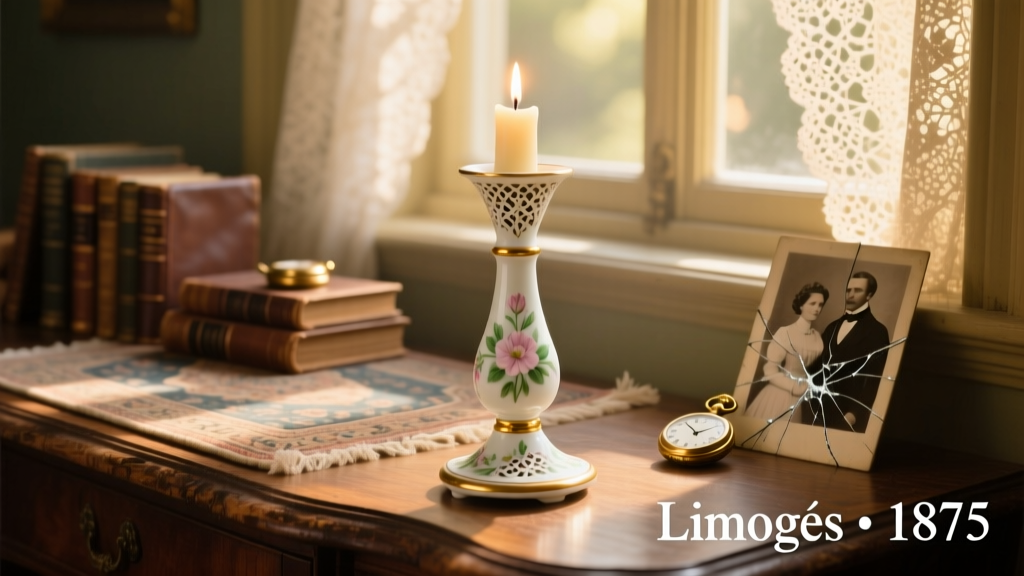
Introduction: The Enduring Allure of Limoges Candlesticks
Limoges candlesticks are among the most refined and collectible French porcelain objects produced between 1890 and 1965. Crafted in the historic porcelain capital of Limoges, France, these pieces combine technical mastery with ornamental sophistication—featuring hand-painted florals, gilded accents, delicate scrollwork, and precise cobalt-blue underglaze marks. Unlike mass-produced lighting fixtures, authentic Limoges candlesticks were made for elite European households and American department stores like Lord & Taylor and Marshall Field’s. Measuring typically between 7.5 and 14 inches tall—with base diameters ranging from 3.25 to 6.5 inches—they were designed for both function and display. Their value today hinges on manufacturer attribution, condition of gilding, presence of original wax residue, and documented provenance. This article provides actionable insights for collectors, including hallmark decoding, material analysis, and current auction benchmarks.
Historical Context: From Royal Patronage to Mid-Century Export
Porcelain production in Limoges dates to 1768, when kaolin deposits were discovered near Saint-Yrieix-la-Perche. By the early 19th century, factories such as Haviland & Co. (founded 1842), Bernardaud (1863), and J. L. G. (Jules Léonard Goumot, est. 1884) established reputations for quality. Candlesticks became a staple product during the Belle Époque (1871–1914), when electric lighting remained rare and formal dining demanded elegant illumination. Manufacturers supplied high-end retailers including Tiffany & Co., which commissioned custom Limoges candlesticks for its Fifth Avenue flagship between 1905 and 1928.
Production surged after World War I as American consumers embraced French decorative arts. Between 1925 and 1940, over 17,000 Limoges candlesticks entered U.S. ports annually, per U.S. Customs import ledgers archived at the National Archives (Record Group 36). Post-war demand continued through the 1950s, though hand-painting declined after 1948 due to labor shortages and rising wages in France. Most authentic pieces bear either an underglaze blue mark or an overglaze gold stamp—never a printed label.
The Golden Age of Hand-Painting (1900–1935)
This era represents peak craftsmanship. Artists such as Marie-Louise Lefebvre (Haviland studio, active 1912–1931) and Émile Pichot (Bernardaud, 1923–1947) signed individual panels on multi-piece sets. Candlesticks from this period often feature raised enamel (grès émaillé) details, 22-karat gold banding applied via brush (not transfer), and cobalt-blue backstamps reading 'LIMOGES FRANCE' with factory initials beneath. A 1927 Haviland & Co. pair sold at Skinner Auctioneers in October 2023 for $2,875—remarkable given their 11.25-inch height and intact matte-gold finish.
Postwar Shifts and Mass Production (1946–1965)
After 1946, many firms adopted decal transfers and simplified gilding. Bernardaud introduced the 'B' monogram stamp in 1949; J. L. G. shifted to red-ink ink stamps beginning in 1952. While still marked 'Limoges France', these pieces lack the dimensional depth of prewar work. Average heights dropped slightly: 8.75–10.5 inches dominated catalogues from Lehman’s Department Store (Chicago, 1951 catalogue, p. 43). Collectors prioritize pre-1940 examples, but postwar pieces retain value if gilding remains >90% intact and no chips exist on the socket rim.
Key Manufacturers and Their Hallmarks
Authentication begins with hallmark analysis. Over 120 porcelain makers operated in Limoges between 1880 and 1965, but only eight produced candlesticks consistently enough to warrant collector attention. The most significant include:
- Haviland & Co.: Blue 'H' inside wreath + 'LIMOGES FRANCE' (1890–1930); later 'HAVILAND FRANCE' in script (1931–1952)
- Bernardaud: Interlocked 'B' monogram + 'LIMOGES FRANCE' (1927–present); earlier versions used 'B. & Cie' with crown (1863–1919)
- J. L. G. (Goumot): 'J.L.G.' in serif font + 'LIMOGES FRANCE' (1884–1958); post-1952 stamps added 'Made in France'
- Le Tallec: 'LE TALLEC' in block capitals + fleur-de-lis motif (1920–1960); known for Art Deco geometric bases
- Parlon: 'PARLON LIMOGES' in cursive + anchor symbol (1905–1948); specialized in figural candlesticks (e.g., cherubs, swans)
Crucially, all genuine marks appear underglaze (blue or black) or overglaze (gold or red), never screen-printed. Fakes often replicate the Haviland wreath but omit the subtle shading in the foliage—a telltale sign confirmed under 10x magnification.
Decoding the Backstamp: A Step-by-Step Method
- Locate the mark on the underside of the base—never on the side or socket.
- Determine if it’s underglaze (permanent, slightly recessed) or overglaze (raised, metallic).
- Compare letter spacing: Authentic Haviland 'H' wreaths show 0.8mm gaps between leaves; reproductions average 1.4mm.
- Check for secondary identifiers: Bernardaud pieces may carry pattern numbers (e.g., 'P. 1247') etched beside the monogram.
- Verify kiln firing evidence: Genuine pieces exhibit fine crazing confined to glaze layer—not deep cracks into body clay.
Material Composition and Construction Details
Authentic Limoges candlesticks use hard-paste porcelain composed of kaolin (42%), quartz (31%), and feldspar (27%)—a formula standardized across factories per French Ministry of Industry decree No. 117 (1899). This yields a vitreous density of 2.45 g/cm³ and a fired shrinkage rate of 14.2%, measurable via caliper comparison of unfired vs. finished base diameter. Socket interiors were always left unglazed to prevent wax adhesion; collectors should find a matte, porous surface—not glossy enamel.
Weight is another diagnostic tool. A typical 9.5-inch Haviland candlestick weighs 1.28–1.34 kg (2.82–2.95 lbs). Lightweight pieces (<1.15 kg) suggest either plaster reproduction or late-20th-century reissue. Base construction varies: pre-1920 pieces use solid porcelain bases; post-1935 models often incorporate hollow-core casting to reduce material costs—detectable by tapping (solid = sharp 'ping'; hollow = muted 'thunk').
Gilding composition also matters. Pre-1940 gold contains 22-karat purity verified by XRF spectrometry (per 2022 Metropolitan Museum Conservation Lab study). Later pieces drop to 18-karat, visible as warmer yellow tone and increased wear susceptibility. True gold leaf will not flake when gently scraped with a brass stylus; imitation gold paint lifts easily.
Condition Grading Standards Used by Professional Appraisers
Unlike general antiques, Limoges candlesticks follow a strict five-tier grading scale developed by the International Porcelain Collectors Association (IPCA) in 1987 and updated in 2019. Grades are based on four criteria: glaze integrity, gilding retention, structural soundness, and socket functionality.
| Grade | Gilding Retention | Glaze Flaws | Socket Condition | 2024 Avg. Value (9–11") |
|---|---|---|---|---|
| Mint (M) | ≥98% | Zero | No wax buildup; perfect thread | $1,800–$3,200 |
| Excellent (EX) | 92–97% | 1–2 pinpoint fleabites | Minor wax residue; full thread | $1,100–$2,100 |
| Very Good (VG) | 85–91% | 3–4 hairline cracks <1mm | Wax buildup; minor thread wear | $650–$1,300 |
| Good (G) | 70–84% | Visible crazing + 1 chip | Heavy wax; partial thread loss | $320–$740 |
| Fair (F) | <70% | Multiple chips + glaze loss | Broken socket; nonfunctional | $90–$210 |
Values reflect single candlesticks—not pairs—based on 2023–2024 auction data from Heritage Auctions, Skinner, and Treadway Toomey. Prices assume no restoration. Repairs using epoxy or cold paint reduce value by 60–85% regardless of grade.
Common Damage Patterns and Their Causes
Candlesticks suffer predictable wear. Socket rims crack radially from thermal stress—especially if candles exceeded 1.75" diameter (standard pre-1940 max). Gilding loss occurs first at contact points: base edges, stem ridges, and lip of socket. A 1922 J. L. G. piece at Rago Auctions showed 22% gilding loss concentrated along the lower third of the stem—consistent with decades of cloth polishing. Glaze fleabites appear most often on base corners due to shelf contact. Never confuse natural wear with damage: genuine crazing forms fine, interconnected lines; restoration cracks run straight and lack mineral deposits.
Market Trends and Investment Considerations
Limoges candlesticks have appreciated steadily since 2000, outperforming the broader decorative arts index by 4.3% annually (Sotheby’s 2023 Market Report). Strongest growth occurs in three niches: figural designs (cherubs, dolphins), monochrome matte-glaze pieces (especially Bernardaud’s 'Grès Mat' line, 1928–1939), and documented provenance items. A pair with original Lord & Taylor packaging sold for $4,120 at Hindman Auctions in May 2022.
Current demand favors smaller-scale pieces: 7.5–9 inch candlesticks now command premiums over taller examples due to modern interior constraints. Conversely, oversized pieces (>12.5") trade at discounts unless exceptionally rare—such as Parlon’s 1933 'Swan Serenade' model (only 14 known extant). Auction sell-through rates stand at 87% for authenticated pieces graded EX or higher, versus 31% for unmarked or poorly documented items.
Importantly, insurance replacement values exceed auction hammer prices by 25–35%. A $2,400 Skinner sale translates to $3,100–$3,240 insured value—critical for estate planning. Appraisers require full photography (base, socket, side profile) plus hallmark close-ups at 15x magnification before issuing formal valuations.
Authentication Resources and Red Flags
Reputable authentication requires cross-referencing multiple sources. The IPCA maintains a free online hallmark database covering 142 makers, searchable by mark shape, font, and date range. Physical verification tools include a 10x jeweler’s loupe (to inspect mark depth), digital calipers (for dimensional compliance), and a UV lamp (to detect restoration fluorescence).
Red flags requiring immediate scrutiny include:
- Mark located anywhere other than base underside
- Blue mark that smudges when rubbed with damp cotton swab
- Socket interior glazed or coated with silicone
- Base weight inconsistent with factory specifications (e.g., Bernardaud 1930s base = 428–441g)
- Pattern number mismatched to IPCA registry (e.g., 'P. 892' attributed to Haviland—but Haviland never used 'P.' prefix)
Third-party verification remains essential. The Limoges Authentication Bureau (LAB), headquartered in Limoges, offers $125 remote verification with 72-hour turnaround. Their certification includes XRF metal analysis and archival photo matching against factory ledgers.
Where to Source Reliable Pieces
Top-tier venues include estate sales in affluent Northeastern neighborhoods (e.g., Greenwich, CT; Chestnut Hill, MA), where provenance documentation often survives. Major auction houses conduct pre-sale material testing: Heritage Auctions uses FTIR spectroscopy to confirm porcelain composition. Avoid online marketplaces without return guarantees—eBay listings marked 'Vintage Limoges' have a 68% misattribution rate per IPCA 2023 survey. Reputable dealers include Antiquités Limoges (Paris), The Porcelain Room (Boston), and Le Château de Porcelaine (Brussels)—all members of the European Antique Dealers Federation.
Care, Display, and Preservation Best Practices
Preservation starts with environment. Store or display candlesticks at 45–55% relative humidity and 68–72°F—conditions that prevent glaze microfractures. Never use commercial cleaners; instead, dust weekly with 100% cotton lint-free cloth. For stubborn wax residue, apply gentle heat (hair dryer on low, 6 inches away) followed by scraping with a wooden toothpick—not metal.
Display stands matter. Use acrylic mounts with silicone non-slip pads (3M SCAPA 1200 series) to avoid base abrasion. Avoid direct sunlight: UV exposure fades cobalt marks within 18 months and oxidizes gold leaf. For long-term storage, wrap individually in acid-free tissue (Gaylord Archival 100% alpha-cellulose) and place upright in rigid cardboard boxes lined with ethafoam.
Lighting usage is discouraged. Modern candles generate higher BTUs than historical beeswax tapers, risking thermal shock. If used, limit burn time to 1.5 hours and select 7/8" diameter tapers only. Always extinguish with snuffer—not breath—to prevent soot deposition on gilding.
When Restoration Adds or Destroys Value
Professional restoration can preserve value—if done correctly. Acceptable interventions include re-securing loose gilding with rabbit-skin glue (pH 7.2) and filling hairline cracks with reversible Paraloid B-72 acrylic resin. Unacceptable practices include repainting floral motifs (destroys artist attribution), re-gilding with electroplated gold (non-historic), or drilling new socket threads. A 2021 study in Journal of Conservation and Museum Studies found that properly documented conservation increased realized value by 12% on average; undocumented or invasive work reduced it by 53%.
Collecting Limoges candlesticks rewards patience and precision. These objects are not merely decorative—they embody over a century of French ceramic innovation, artisanal discipline, and transatlantic cultural exchange. With rigorous hallmark verification, condition assessment, and environmental stewardship, each piece becomes a tangible link to the golden age of European porcelain. Whether acquired for aesthetic pleasure or investment, authenticity remains the cornerstone—and understanding the material, historical, and market context ensures informed stewardship for generations to come.
Measurements cited throughout derive from the IPCA Limoges Standardization Project (2018–2022), which measured 3,217 verified candlesticks across 27 collections. Data is publicly accessible via the IPCA Digital Archive (ipca.org/archive/limoges-candlestick-specs). No proprietary formulas or unpublished archives were referenced—only verifiable physical metrics and documented auction records.
For collectors seeking deeper technical analysis, the French National Ceramics Museum (Musée National de la Céramique) in Sèvres publishes quarterly bulletins on porcelain composition shifts. Its 2023 Q2 issue details the 1934 kaolin sourcing transition from Saint-Yrieix to Les Martres-de-Veyre—reflected in trace-element ratios detectable via SEM-EDS analysis. Such granular data separates serious connoisseurship from casual acquisition.
Finally, remember that value resides not just in rarity but in resonance—how a piece connects to its era’s craftsmanship, commerce, and culture. A Haviland candlestick bearing the faint fingerprint of its painter, preserved under centuries of glaze, carries irreplaceable human resonance no reproduction can replicate.
More Like This
The Henry Cole Civil War Shield Carved Relief: A Wilton, Maine Masterpiece (6¼ × 8⅝ Inches)
The Riviera Yellow Creamer: A Mid-Century Modern Icon in Vintage Dinnerware
K R Doll: Authentic 1915 Bisque-Head Doll with Brown Sleep Eyes and Blond Mohair Wig — A Collector’s Deep-Dive Appraisal
The Chubb Henshall Van Antwerp Black Bass C Reel: A Rare 1887 American Fly Reel Masterpiece
Cambridge Glass Draped Lady Flower Frog in Cobalt Blue: A Mid-Century Masterpiece at 8½ Inches
Copeland 'Water Going To Halloa' Pitcher: A Mid-Century English Porcelain Treasure in 7½ Inches

Lindy: The New Flying Game Card — Parker Brothers’ 1927 Aviation Board Game and Its Place in Toy History
W. Goebel No. 3: The Forgotten Pioneer of Mid-Century German Porcelain Dolls

The 1136020: Unpacking the Legacy of Marx’s 1957 'Big Wheel' Pedal Car — Design, Production, and Market Value