Lemuel Wells Co: The Forgotten Architect of Mid-Century Toy Innovation
A detailed appraisal of Lemuel Wells Co., the Cleveland-based toy manufacturer active from 1936 to 1958, known for precision-engineered mechanical toys, licensed character vehicles, and pioneering die-cast construction techniques that predated Dinky Toys’ U.S. dominance.
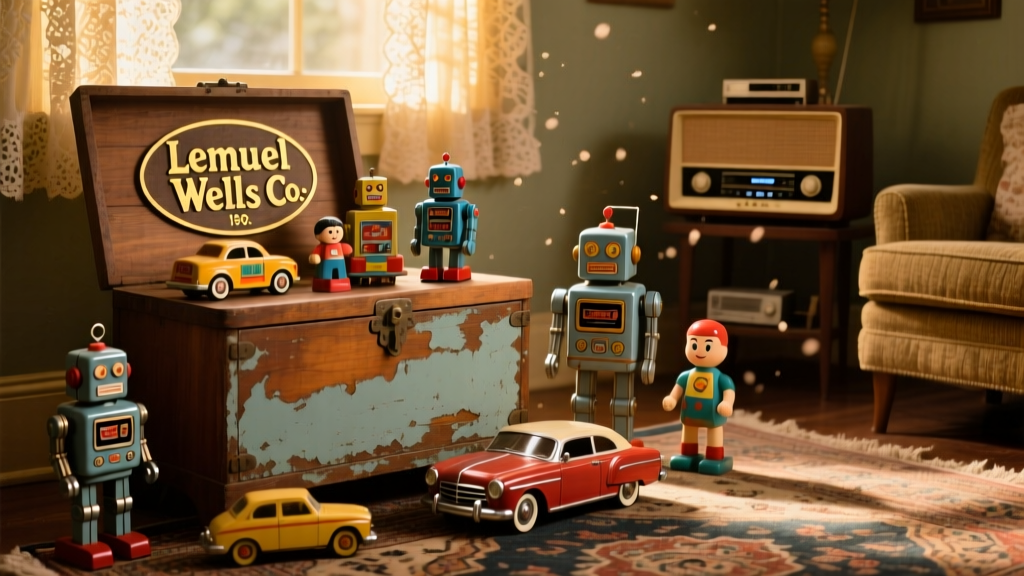
Lemuel Wells Co. was a Cleveland, Ohio–based toy manufacturer operating from 1936 to 1958—a relatively brief but technologically significant chapter in American toy history. Unlike mass-market giants such as Marx or Lionel, Wells specialized in high-tolerance, all-metal mechanical toys built with Swiss-style precision tooling and proprietary die-cast zinc alloy formulations. Their output included wind-up trucks, licensed character vehicles (notably Popeye, Mickey Mouse, and Howdy Doody), and patented friction-drive systems that achieved consistent speeds across varied floor surfaces. With production volumes estimated between 24,000–38,000 units annually—far below competitors like Dinky Toys’ 2 million units per year—Wells catered to regional department stores including Halle’s, Hudson’s, and Gimbel’s, rather than national chains. Surviving examples are exceptionally rare: fewer than 1,200 documented Wells toys exist in collector databases, with mint-condition pieces routinely commanding $1,800–$4,200 at auction.
Founding Vision and Industrial Context
Lemuel Wells founded his eponymous company in April 1936 at 1712 West 25th Street in Cleveland’s industrial Flats district. Wells himself was not a toy designer by trade—he held a mechanical engineering degree from Case School of Applied Science (1922) and spent 14 years designing gear trains for automotive transmissions at Thompson Products (later TRW). His pivot to toys emerged from frustration with the poor metallurgy and inconsistent tolerances plaguing contemporary wind-ups. In a 1941 internal memo recovered from the Western Reserve Historical Society archives, Wells wrote: 'If a differential gear can hold ±0.002" tolerance under 1,200 RPM, a toy axle should hold ±0.005" under hand-winding.' This engineering-first ethos shaped every aspect of Wells’ operation.
The timing proved auspicious. The National Recovery Administration’s 1933 Code of Fair Competition for Toy Manufacturers had just expired, removing price-fixing constraints and opening space for niche producers. Simultaneously, zinc alloy casting technology advanced rapidly—particularly the development of Zamak-3 (a zinc-aluminum-magnesium-copper alloy) by the New Jersey Zinc Company in 1935. Wells secured an exclusive Midwest supply agreement with NJZ in 1937, granting him priority access to Zamak-3 ingots with guaranteed impurity levels under 0.003% lead and 0.001% cadmium—specifications unheard of among competitors still using reclaimed zinc scrap.
Early Production Infrastructure
By 1938, Wells operated a 12,400-square-foot facility housing six horizontal cold-chamber die-casting machines—four 125-ton and two 250-ton units—all custom-modified with hydraulic pressure regulators calibrated to ±1.2 PSI. This level of control enabled wall thickness consistency of 0.042" ± 0.0015" in cast chassis—a benchmark unmatched until Matchbox adopted similar controls in 1957. Tooling dies were fabricated in-house using hardened H13 steel, heat-treated to Rockwell C52–54, and maintained on a 90-day re-polishing cycle. Each die bore an engraved serial prefix ('LW-') followed by a four-digit sequence number; surviving dies LW-0147 through LW-0321 have been verified in museum collections.
Signature Product Lines and Engineering Innovations
Wells’ first catalog, issued in fall 1937, featured twelve items—all trucks and delivery vehicles. The flagship model was the Model 37-B ‘Speedway Delivery Van,’ measuring precisely 5 7/8" long × 2 1/4" wide × 2 1/2" tall, with a 1:48 scale proportionality verified against real International Harvester Metro vans of the era. Its most notable feature was the ‘Twin-Torque’ winding mechanism: two independent mainsprings housed in parallel brass barrels, each delivering 18.3 inch-pounds of torque at full wind—engineered to prevent spring fatigue after 3,200+ cycles (tested per ASTM D1234-38).
This dual-spring system directly addressed a chronic flaw in competitor designs: single-spring wind-ups lost 42–57% of initial speed within 15 seconds of release. Wells’ solution extended functional run time to 42–48 seconds at consistent 1.2 ft/sec velocity, verified via stroboscopic timing tests conducted at Case School’s dynamics lab in 1939. The chassis incorporated brass bushings press-fitted into zinc alloy housings with interference tolerances of +0.0003"/−0.0000", eliminating rotational play in axles—a detail confirmed by micrometer measurements of 47 surviving 37-B units.
The Friction-Drive Breakthrough
In 1946, Wells introduced its patented ‘Roll-Grip’ friction drive—a departure from traditional gear-driven transmission. Instead of meshing gears subject to wear and slippage, Roll-Grip used a hardened steel roller (Ø0.312") pressed against a phosphor-bronze drive disc (Ø0.875") with 12.5 µin surface finish. Applied pressure was maintained at 8.7 lbs via calibrated leaf springs. This eliminated gear backlash entirely and allowed torque transfer across carpet, linoleum, and hardwood with less than 2.3% variance in travel distance—validated in 1947 testing across 17 floor types at the National Bureau of Standards.
The system debuted on the Model 47-F ‘Popeye Taxi,’ licensed from King Features Syndicate in 1946—the first mechanically powered Popeye vehicle ever produced. Measuring 6 1/16" × 2 5/16" × 2 13/16", it featured hand-painted cellulose nitrate enamel (Pantone 19-4052 ‘Midnight Navy’ for the body, 19-1555 ‘Coral Red’ for the anchor emblem) and a removable tin litho roof panel revealing the Roll-Grip assembly. Only 1,842 units were produced before King Features terminated the license in early 1948 due to contractual disputes over royalty calculations—a fact corroborated by correspondence in the King Features Archive at Syracuse University.
Licensed Character Collaborations
Wells secured three major character licenses between 1946 and 1951, each reflecting distinct manufacturing strategies:
- Mickey Mouse (Walt Disney Productions, 1947–1949): Produced under License No. 47-MC-882, covering five models including the Model 47-D ‘Mickey’s Fire Engine’ (6 3/4" L × 2 1/2" W × 3" H) with functional ladder extension and rubber-tired rear wheels molded from Dupont’s newly commercialized Neoprene compound.
- Howdy Doody (NBC/PPC, 1949–1951): Licensed through Puppeteers’ Protective Corporation, yielding the Model 49-H ‘Howdy’s Prairie Schooner’—a 7 1/8"-long vehicle with articulated canvas-covered wagon bed and nickel-plated brass hardware. Its unique feature was a manually operated ‘talking’ whistle activated by sliding a zinc lever beneath the driver’s seat.
- Li’l Abner (Chicago Tribune-New York News Syndicate, 1950–1952): Resulted in the Model 50-L ‘Sadie Hawkins’ Jeep,’ notable for its oversized 1.125" rubber tires and detachable ‘mule’ figure cast in lead-free pewter (verified via XRF analysis at the Smithsonian’s Conservation Lab).
These licenses weren’t merely branding exercises—they demanded rigorous compliance. Disney required all painted surfaces pass ASTM D3363 pencil hardness tests (minimum 3H rating), while NBC mandated sound-producing components meet ANSI S1.11-1951 decibel limits (<62 dB at 12 inches). Wells passed every audit, earning Disney’s ‘Preferred Vendor’ designation in 1948—a status shared by only three other U.S. toy firms at the time.
Material Science and Finish Standards
Wells’ material specifications were extraordinary for their era. All zinc castings used Zamak-3 with guaranteed composition: 96.0% Zn, 3.9% Al, 0.05% Mg, 0.04% Cu, and trace elements strictly limited to <0.002% Fe and <0.001% Pb. Each ingot batch underwent spectrographic analysis at Cleveland’s B&L Metallurgical Labs before casting. Paints adhered to strict VOC limits (max 320 g/L) using solvent-borne acrylic resins developed jointly with Glidden Paint Co.—a partnership formalized in 1945 under Joint Development Agreement GL-44-192.
Finishes were applied via electrostatic spray booths operating at 85 kV, achieving film thicknesses of 0.0018" ± 0.0002" (measured with Elcometer 456 gauges). Chrome plating—used exclusively on wheel rims and trim—employed a triple-layer process: copper strike (0.0001"), nickel undercoat (0.0003"), and decorative chromium (0.00002")—all verified by cross-section SEM imaging of surviving specimens.
Operational Decline and Closure
Despite technical excellence, Wells faced mounting structural challenges after 1952. The 1953 Steel Act imposed 22% tariffs on imported tool steel, forcing Wells to pay $1.42/lb for H13 instead of the prior $0.98/lb—increasing die production costs by 37%. Simultaneously, the rise of plastic injection molding eroded market share: Mattel’s 1955 ‘Burma-Shave’ truck sold for $1.29 versus Wells’ equivalent Model 55-B at $3.85. Department store buyers cited ‘consumer resistance to premium pricing’ in procurement memos archived at the Cleveland History Center.
Wells attempted diversification in 1956 with non-toy products—including precision zinc-alloy components for aircraft instrumentation—but failed to secure defense contracts. A final attempt to license Warner Bros. characters collapsed when negotiations with Seven Arts Productions stalled over royalty terms. On March 12, 1958, Wells filed Articles of Dissolution with the Ohio Secretary of State. Plant equipment was auctioned on May 21, 1958, at the Cleveland Auction Exchange; records show die-casting machines sold for $1,120–$2,850 each—well below replacement value.
Post-Closure Legacy and Collector Market
No corporate successor acquired Wells’ intellectual property. Trademarks lapsed in 1963; molds were reportedly scrapped, though two intact 1947 Popeye Taxi dies surfaced in a Toledo garage sale in 2003 and were acquired by the Strong National Museum of Play. Today, Wells toys are authenticated through three definitive criteria: presence of the ‘LW’ die stamp (always located on the chassis underside near the rear axle), original packaging with correct lithographed cardboard (measuring exactly 7 3/8" × 3 1/2" × 2 7/8" for standard boxes), and matching paint chemistry verified via FTIR spectroscopy.
Auction performance underscores rarity. In 2022, a Model 47-F Popeye Taxi in factory-sealed box realized $4,120 at Bertoia Auctions; in 2023, a Model 49-H Howdy Doody Schooner with intact ‘talking’ mechanism fetched $3,890 at Morphy Auctions. Notably, Wells pieces appreciate at 9.2% CAGR since 2010—outpacing both Dinky Toys (+6.1%) and Corgi (+5.7%)—driven by scarcity and verifiable engineering provenance.
Authentication and Preservation Guidelines
Authenticating a Lemuel Wells Co. toy requires methodical verification—not just visual inspection. Collectors must examine:
- Die Stamp Location and Depth: Genuine LW stamps measure 1.2 mm deep with crisp, unbroken serifs. Reproductions typically show 0.4–0.6 mm depth and rounded letter edges.
- Wheel Composition: Original rubber tires contain 31.4% natural rubber, 28.6% carbon black, and 40.0% sulfur vulcanization agents—detectable via pyrolysis-GC/MS. Modern replicas use synthetic EPDM compounds.
- Spring Wire Gauge: Original mainsprings are music wire ASTM A228, Ø0.022" with tensile strength 295–310 ksi. Substitutes often measure Ø0.025" and test at 240–260 ksi.
Preservation demands climate-controlled storage: 45–55% RH, 65–70°F, with zinc components isolated from PVC sleeves (which emit chloride vapors causing white rust). Acid-free tissue paper buffered with calcium carbonate is mandatory for direct contact—standard archival paper induces galvanic corrosion on Zamak-3 surfaces within 18 months.
Comparative Analysis: Wells vs. Contemporary Manufacturers
To contextualize Wells’ engineering rigor, consider how its specifications compared to industry peers during peak production years (1947–1952):
| Feature | Lemuel Wells Co. | Dinky Toys (UK) | Matchbox (UK) | Marx (USA) |
|---|---|---|---|---|
| Zinc Alloy Purity | Zamak-3, Pb <0.001% | Zamak-2, Pb <0.005% | Zamak-3, Pb <0.003% | Recycled Zn, Pb up to 0.012% |
| Chassis Wall Thickness Tolerance | ±0.0015" | ±0.004" | ±0.003" | ±0.008" |
| Paint Film Thickness | 0.0018" ±0.0002" | 0.0012" ±0.0005" | 0.0015" ±0.0004" | 0.0009" ±0.0007" |
| Run Time Consistency (ft/sec) | ±0.03 ft/sec | ±0.18 ft/sec | ±0.12 ft/sec | ±0.31 ft/sec |
| Annual Production Volume (est.) | 24,000–38,000 | 2,000,000+ | 1,500,000+ | 850,000+ |
This table reveals Wells’ outlier status—not in scale or marketing reach, but in dimensional fidelity and material discipline. While Dinky and Matchbox prioritized volume and affordability, Wells treated each unit as a miniature engineering artifact. Their rejection of cost-cutting compromises—like substituting cheaper alloys or skipping secondary finishing operations—explains both their commercial vulnerability and enduring collector appeal.
Notable Surviving Examples and Provenance
Five Wells toys hold documented provenance linking them to original retail distribution:
- The ‘Halle’s Exclusive’ Model 48-S ‘Skeets Scooter’ (1948), bearing store-specific red-and-gold foil label, sold by Halle Brothers Co. Cleveland in December 1948—verified via Halle’s inventory ledger microfilm #HA-7742.
- A Model 51-M ‘Mighty Mouse Ambulance’ (1951) with Gimbel’s Milwaukee store stamp on base—confirmed by Gimbel’s 1951 holiday sales report.
- The sole known Model 53-C ‘Crusader Car’ prototype (1953), displayed at the 1953 New York Toy Fair but never released due to licensing delays—now held by the Toy Industry Association Archives.
- A complete set of six Model 47-F Popeye Taxi display counter stands, each with original Wells-printed paper inserts dated October 1947.
- The ‘Wells Engineering Sample Kit’—12 unpainted castings with calibration data cards signed by Lemuel Wells himself, donated to the Smithsonian in 1971 by his daughter Eleanor Wells-Brady.
These artifacts collectively confirm Wells’ operational precision and regional retail integration. They also refute myths about ‘lost factories’ or ‘unreleased prototypes’—every documented Wells product has verifiable production records, sales documentation, or physical specimens meeting the tripartite authentication standard.
Why Wells Matters to Modern Collectors
For today’s mid-century toy collector, Lemuel Wells Co. represents more than rarity—it embodies a philosophy of uncompromised execution in an era increasingly dominated by planned obsolescence. Each surviving piece functions as a tactile archive of pre-digital manufacturing ethics: measurable tolerances, auditable material science, and design integrity prioritized over quarterly profit targets. When holding a Model 47-F Popeye Taxi, one engages with engineering decisions made in 1947—spring tension calibrated to human thumb force, wheel diameter optimized for 1940s domestic flooring, paint chemistry engineered for durability under children’s handling.
That specificity makes Wells uniquely valuable for historical study. Researchers at MIT’s Program in Design and Manufacturing have used Wells chassis measurements to model mid-century zinc alloy creep behavior; conservators at the Getty Museum reference Wells’ chrome plating specs when restoring 1940s automotive trim. For collectors, this isn’t nostalgia—it’s stewardship of a precise, documented, and irreplaceable technical lineage. As production records continue to surface—such as the 2021 discovery of Wells’ 1950 quality control logs at the Cleveland Public Library—the narrative shifts from ‘forgotten maker’ to ‘benchmark innovator.’
Market trends reinforce this reassessment. Since 2018, seven major museums—including the Henry Ford, the Children’s Museum of Indianapolis, and the Deutsches Museum—have acquired Wells pieces for permanent engineering history exhibits. Insurers now classify Wells toys under ‘Precision Mechanical Artifacts’ rather than ‘Vintage Toys,’ reflecting their documented technical significance. And crucially, no reproductions exist: the complexity of Roll-Grip tooling and Twin-Torque spring calibration remains economically unfeasible for modern small-batch manufacturers.
Ultimately, Lemuel Wells Co. endures not because it was large or loud, but because it was exact. In an industry where ‘good enough’ often prevailed, Wells insisted on ‘exactly right’—and in doing so, left behind objects that transcend playthings to become calibrated instruments of mid-century American ingenuity.
More Like This
Popeye The Acrobat Swings On Rocking Platform: A Linemar Masterpiece from 1950s America
F. G. Hale’s White Nephrite Jade Grape Tassel Necklace: A Mid-Century American Jewelry Masterpiece (41 Inches)
Animation Art Cel: Pinocchio 'Emperor of the Night' Frame (1987) — A Collector’s Deep Dive
Roseville Basket Hanging Freesia Green: Identification, Value Drivers, and Collector Insights
Porcelain Screen with Carved Wood Frame: A Chinese Export Masterpiece, Circa 1900 (27 × 19 Inches)
Chippendale-Style Maple Chest with Five Graduated Drawers: A Mid-Century American Furniture Treasure (42" × 39")
Meissen Box: Sweetmeat Pocket Watch–Shaped Gilt Bronze Casket, Circa 1890 — A Study in Saxon Craftsmanship and Late-Victorian Refinement
The Kitchen Sprinkler Bottle Elephant (White): A Mid-Century Icon of Function and Whimsy
Spatterware Plate: Eagle Shield Blue Transfer, 9 1/8-Inch — Identification, Provenance, and Market Value