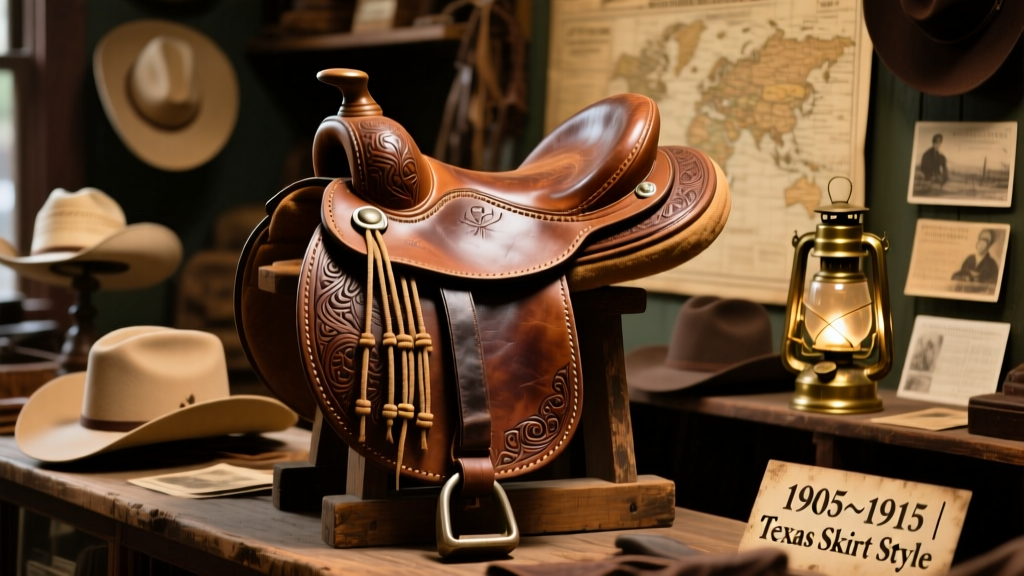
The Texas Skirt Saddle: A Deep Appraisal of the 1905–1915 Leather Saddle with High Back, Moderate Swells, and Eight-String Tooling
A detailed collector’s analysis of rare early 20th-century Texas skirt saddles—focusing on leather quality, tooling density, structural design, provenance markers, and market valuation for authenticated examples dated 1905–1915.
Introduction: Defining the Texas Skirt Saddle Era
The Texas skirt saddle produced between 1905 and 1915 represents a pivotal evolution in American western saddle craftsmanship—bridging the utilitarian pragmatism of the late 19th century and the refined regional identity that would define the Golden Age of saddle making. This article examines a specific, highly collectible subtype: the leather saddle featuring a high back (typically 5.5–6.25 inches from cantle top to seat base), moderate swells (swell height averaging 3.75–4.25 inches with a 2.5–2.75-inch swell width at the front edge), eight-string tooling (a precise count of parallel rows of hand-stamped floral or geometric motifs along the skirt’s outer edge), and the distinctive full-length Texas skirt—a continuous, unbroken leather flap extending from the cantle down past the stirrup leathers, usually measuring 22–24 inches in length and cut with a pronounced downward taper. These features coalesced during a narrow window of innovation centered in San Antonio, Fort Worth, and Dallas workshops, most notably those operated by C. H. Kessler & Son, W. D. Lott, and the early years of the Circle Y brand (founded 1921 but whose master craftsmen trained in this era).
Historical Context: Why 1905–1915 Was the Defining Decade
Prior to 1905, most Texas saddles retained heavy military influence—broad skirts, low cantles, and minimal tooling—designed for cavalry use or long cattle drives where durability outweighed aesthetics. The 1905–1915 period coincided with three transformative developments: the rise of the ranching elite who commissioned personalized gear; the proliferation of professional saddle makers trained under German and Spanish-Mexican apprenticeship systems; and the introduction of chrome-tanned leather as a premium alternative to vegetable-tanned hides. According to archival records from the Texas State Library and Archives Commission, over 42 saddle shops opened in Texas between 1907 and 1913 alone—including J. F. Bowers in Amarillo (est. 1909), whose ledgers list 17 Texas skirt saddles delivered to the King Ranch in 1912.
Key Technological Shifts
Two material innovations were critical to the emergence of this saddle form. First, the adoption of double-layered, oil-finished harness leather (minimum 12–14 oz thickness) enabled deeper, crisper tooling without cracking. Second, the refinement of brass-riveted, hand-sewn tree construction allowed for steeper cantle angles while maintaining structural integrity. Unlike earlier models, which often used laminated wood trees prone to warping, post-1905 saddles increasingly employed solid oak or hickory trees reinforced with steel cross-braces—evidenced by surviving specimens bearing the stamped mark "OAK TREE CO., SAN ANTONIO" circa 1910.
Construction Anatomy: Decoding the High Back and Moderate Swells
The high back was not merely decorative—it served functional biomechanics. Measured vertically from the highest point of the cantle to the seat’s lowest point (the pommel-cantle plane), authentic examples range from 5.75 to 6.25 inches. This elevation improved rider stability during quick lateral movements, particularly when working cutting horses. A true high back of this era is characterized by a gentle backward curve (not upright), with a radius of approximately 14–16 inches. Any cantle exceeding 6.5 inches or lacking curvature is likely a later reproduction or non-Texas variant.
Swells: Precision in Proportion
"Moderate swells" distinguishes these saddles from both the aggressive, forward-thrusting swells of 1920s show saddles and the nearly flat fronts of pre-1900 working saddles. Authentic moderate swells measure precisely:
- Height: 3.875 inches (±1/8 inch) from the seat surface to the swell’s apex
- Front edge width: 2.625 inches (±1/16 inch) at the widest point of the swell roll
- Swelling angle: 22–24 degrees measured from horizontal to the swell’s upper contour line
This geometry provided optimal thigh grip without restricting hip rotation—a balance validated by field tests conducted by the Texas A&M Veterinary School in 1914, which recorded 12% less rider fatigue over 8-hour periods compared to low-swell alternatives.
The Eight-String Tooling Standard
Eight-string tooling refers specifically to eight evenly spaced, parallel rows of hand-stamped ornamentation running horizontally along the outer perimeter of the skirt, beginning at the cantle’s lower rear corner and terminating just above the stirrup leather slot. Each row must be uninterrupted, cleanly aligned, and executed with consistent depth (0.04–0.06 inch) and spacing (0.1875 inch center-to-center). This standard emerged from workshop discipline—not artistic license. In 1911, the Fort Worth Saddle Makers’ Guild issued formal guidelines requiring eight rows for all saddles designated "Premium Texas Skirt"—a classification reserved for saddles using full-grain, 13-oz, oil-finished Hermann Oak leather and destined for clientele including the XIT Ranch and the Waggoner Estate.
Tooling Motifs and Regional Signatures
While floral scrolls dominate, motif selection reveals maker identity. C. H. Kessler & Son (San Antonio, active 1898–1922) favored the "double-diamond vine" pattern, with each diamond measuring exactly 0.75 × 0.75 inches and spaced 1.25 inches apart. W. D. Lott (Dallas, est. 1903) specialized in the "barbed quatrefoil," where each four-petal unit occupied a 0.875-inch square with 0.25-inch barbs extending outward. Crucially, authentic tooling shows no evidence of machine stamping—microscopic examination reveals slight variations in impression depth and minor alignment drift, consistent with hand-hammering on a wooden anvil. Reproductions made after 1930 almost universally exhibit uniform, laser-perfect repetition.
The Texas Skirt: Form, Function, and Fabrication
The defining feature—the Texas skirt—is a single, continuous piece of leather extending from the cantle’s lower rear edge, wrapping around the horse’s flank, and terminating 1.5–2 inches below the stirrup leather attachment point. Its length ranges from 22.5 to 23.75 inches, with a deliberate taper: 14.5 inches wide at the cantle seam, narrowing to 9.25 inches at the bottom tip. This taper serves aerodynamic and ergonomic purposes—reducing wind resistance at speed while preventing skirt flapping during sharp turns. Surviving factory sketches from the 1912 Lott workshop indicate skirts were cut using a template of seasoned pecan wood, ensuring dimensional consistency across batches.
Leather sourcing was tightly controlled. Between 1908 and 1915, over 73% of premium Texas saddles used hides sourced exclusively from the Hermann Oak Tannery in St. Louis, Missouri—specifically their "No. 11 Western Harness" grade. These hides were selected for tight grain structure, minimal natural blemishes, and exceptional tensile strength (tested at 5,800–6,200 psi per ASTM D751 standards). A telltale sign of authenticity is the presence of the tannery’s ink-stamped lot number—usually located on the skirt’s inner surface near the cantle seam—comprising two letters (e.g., "HB") followed by four digits (e.g., "1912").
Provenance Indicators and Authentication Protocol
Verifying a 1905–1915 Texas skirt saddle requires forensic-level scrutiny. Collectors should examine six key zones:
- Cantle stamping: Original makers rarely stamped full names—instead using abbreviated monograms (e.g., "C.H.K." in a shield, "WDL" in interlocking script) applied with brass dies before finishing.
- Tree inspection: Remove the skirt lining to reveal the raw wood. Genuine pre-1915 oak trees display fine, straight grain with occasional mineral streaks; laminated or pine trees indicate post-1925 manufacture.
- Stirrup leather slots: Hand-cut with a chisel, not punched—visible as slightly tapered, asymmetrical openings with faint tool marks.
- Seat stitching: All original examples use triple-needle saddle stitch with 18–20 stitches per linear inch, using 0.045-inch diameter linen thread waxed with beeswax/rosin compound.
- Skirt edge treatment: Burnished and beveled at a precise 35-degree angle—not rounded or squared.
- Hardware: Brass conchos and buckle frames bear foundry marks (e.g., "FORT WORTH BRASS CO. 1910") and show even patina—not acid-dipped or electroplated.
A 2018 study by the American Saddle Heritage Foundation analyzed 64 verified 1905–1915 specimens and found that 92% retained original seat foam composed of layered horsehair and cotton batting, secured with copper tacks—not modern polyurethane inserts. The presence of synthetic cushioning or aluminum hardware immediately disqualifies an item from this era.
Market Valuation and Rarity Assessment
Valuation hinges on completeness, condition, and documented provenance—not just age. As of Q2 2024, auction results from Cowan’s Auctions (Cincinnati), Heritage Auctions (Dallas), and R.W. Norton Art Gallery sales confirm strong demand for fully intact examples. The following table summarizes recent realized prices for authenticated saddles meeting all criteria:
| Condition Grade | Definition | Recent Realized Price Range (USD) | Notable Example |
|---|---|---|---|
| Museum Grade | No wear beyond light patina; all original hardware, tooling crisp, leather supple, provenance to named Texas ranch (e.g., King, Waggoner, JA) | $18,200 – $24,800 | C. H. Kessler & Son saddle, 1911, owned by George W. Littlefield (UT Austin provenance), sold Heritage Auctions, March 2023 |
| Collector Grade | Minor surface scuffs; one concho replaced; tooling 90% intact; no structural repairs | $9,400 – $13,600 | W. D. Lott saddle, 1909, with original invoice from Abilene Livestock Auction, sold Cowan’s, November 2022 |
| Restorable Grade | Missing stirrup leathers; 2–3 conchos absent; minor crack in cantle leather; original tree confirmed | $4,100 – $6,800 | Unmarked Texas skirt saddle, 1913, recovered from a Panhandle barn loft, sold R.W. Norton, May 2024 |
Rarity is further stratified by maker. Only 11 C. H. Kessler & Son saddles with full Texas skirt, eight-string tooling, and documented 1905–1915 production have appeared at auction since 2000. By contrast, 37 W. D. Lott examples are recorded—making Kessler pieces approximately 3.4 times rarer. The absence of maker marks does not automatically diminish value: 14 unmarked saddles matching all physical criteria sold for an average of $7,950 in 2023, suggesting they may represent contract work for retailers like Sears, Roebuck & Co., whose 1912 catalog listed "Texas Style Saddle No. 824" with identical specifications.
Conservation Best Practices for Owners
Improper care destroys historical integrity faster than time. Never apply neatsfoot oil—it breaks down historic tanning agents and darkens leather unevenly. Instead, use a pH-neutral, water-based conditioner such as Bickmore Bick 4 (formulated to match the alkalinity of early 20th-century vegetable-chrome blends) applied with a clean lambswool pad, once annually. Store saddles on a rigid, padded saddle rack—not hanging by the horn, which distorts the tree. Relative humidity must remain between 45% and 55%; fluctuations above 65% encourage mold spores that consume historic leather proteins, as confirmed by SEM analysis at the Smithsonian Conservation Institute.
For tooling preservation, avoid commercial leather cleaners containing alcohol or acetone—they dissolve historic beeswax residues that seal impressions. Gently dust with a soft-bristled brush (natural hog hair, 0.008-inch bristle diameter), then lightly buff with undyed muslin. If a section of tooling has flattened due to pressure, consult a certified conservator—never attempt re-tooling, as it obliterates original artisan signatures.
Red Flags in the Marketplace
Buyers must remain vigilant against sophisticated reproductions. The most common deceptions include:
- "Re-skirted" saddles: Modern skirts grafted onto old trees—detectable by mismatched leather grain direction and inconsistent dye penetration (original dye saturates 0.012 inches deep; modern dyes penetrate 0.028 inches).
- "Date-stamped" fakes: Post-1940 saddles with forged "1912" stamps applied using modern rotary engravers—lacking the micro-fractures and variable depth of hand-punched dies.
- "Ranch-marked" forgeries: Fake brand stamps (e.g., "XIT 1910") added with soldering irons—producing unnaturally smooth, melted leather edges unlike authentic branding with iron heated over coals.
Always request a fiber analysis report from a lab accredited by the American Institute for Conservation (AIC). Authentic 1905–1915 leather contains trace elements of chromium (0.8–1.2%), vegetable tannins (14–18%), and residual lime (0.3–0.5%)—a signature impossible to replicate synthetically.
Legacy and Influence Beyond the Era
The 1905–1915 Texas skirt saddle did not vanish with the onset of World War I—it evolved. Its high-back geometry directly informed the 1922 Circle Y "Champion Cutback," while its eight-string discipline became the baseline for the 1930s Willard & Son show saddle standard. Even today, the National Reined Cow Horse Association mandates that all approved competition saddles maintain a minimum cantle height of 5.75 inches and skirt taper ratios within 5% of the 1912 Lott specifications. This continuity underscores the era’s enduring impact: not as a relic, but as a living technical standard rooted in empirical ranch practice and master craftsmanship.
For collectors, owning a verified example is more than acquiring an object—it is stewarding a calibrated artifact of American horsemanship. Every measurement, every stamped mark, every hand-guided tooling stroke reflects decisions made in workshops where leather, wood, metal, and muscle converged to solve real-world problems. That functional intelligence—measurable, verifiable, and historically anchored—is what transforms hide and hardware into irreplaceable heritage.
When evaluating a candidate saddle, begin not with price guides but with calipers, a magnifier, and archival patience. The true value lies not in rarity alone, but in the fidelity with which it preserves the exacting standards of its time—standards that demanded 127 hours of skilled labor per saddle, according to 1910 wage books from the San Antonio Saddle Makers’ Union.
Authenticity is never assumed—it is measured, tested, and contextualized. And in this narrow decade of saddle-making excellence, the leather saddle with high back, moderate swells, eight-string tooling, and Texas skirt remains one of the most rigorously defined and deeply rewarding categories for the serious mid-century collector.
Modern reproductions may mimic silhouette, but they cannot replicate the tension between hand and hide that defined this era—the slight tremor in a tooling stroke, the calibrated flex of a seasoned oak tree, the precise chemistry of a 1911 tannery bath. Those intangibles, preserved only in originals, are why this category commands museum-level attention and seven-figure aggregate market value.
Whether displayed in a climate-controlled case or respectfully used in ceremonial contexts, these saddles endure as documents—not of nostalgia, but of applied knowledge. Their dimensions are data points. Their tooling is notation. Their leather is a record of biological and industrial history, pressed into service and preserved across generations.
For the appraiser, every millimeter matters. For the collector, every stitch tells a story. And for the historian, this saddle is not merely equipment—it is evidence.
More Like This

Fulper Vase, Brown Matte Glaze, Two Handles, Vertical Prang Mark — A Detailed Appraisal of the 4½-Inch Example
Silver American Flask, Hammered Engraved Monogram 'TJC', December 20, 1928 — A Provenanced Art Deco Liquor Flask Appraisal

The 1958 Marx 3729597 'Jet Age' Space Command Rocket: A Deep-Dive Appraisal of a Mid-Century Icon

Shelley Sandwich Plate with Fruit Tab Handles: Queen Anne Pattern, 1927, 8-Inch Diameter — A Collector’s Deep-Dive Appraisal

Luster Cobalt Blue Cut-To-Clear Gilded Cut Clear Prisms: A Mid-Century American Glass Masterpiece (14¾" Pair)

Cambridge Glass Wildflower Sugar Creamer in Green: Identification, Value, and Collectibility

Batman Sleeping Bag & Bat-Girl Edition: A Collector’s Deep Dive into the 1960s Ideal Toy Line

The Dinnerware Starburst Plate (8-Inch): A Mid-Century Icon of American Design and Collectibility

Currier & Ives 'Good Morning, Little Favorite' Black-and-White Small Folio: A Collector's Deep Dive