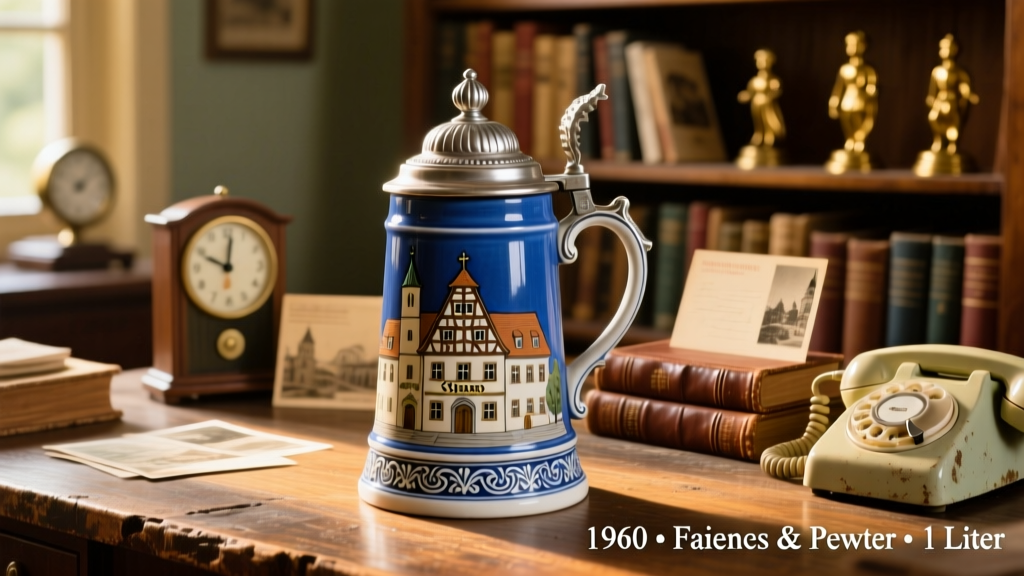
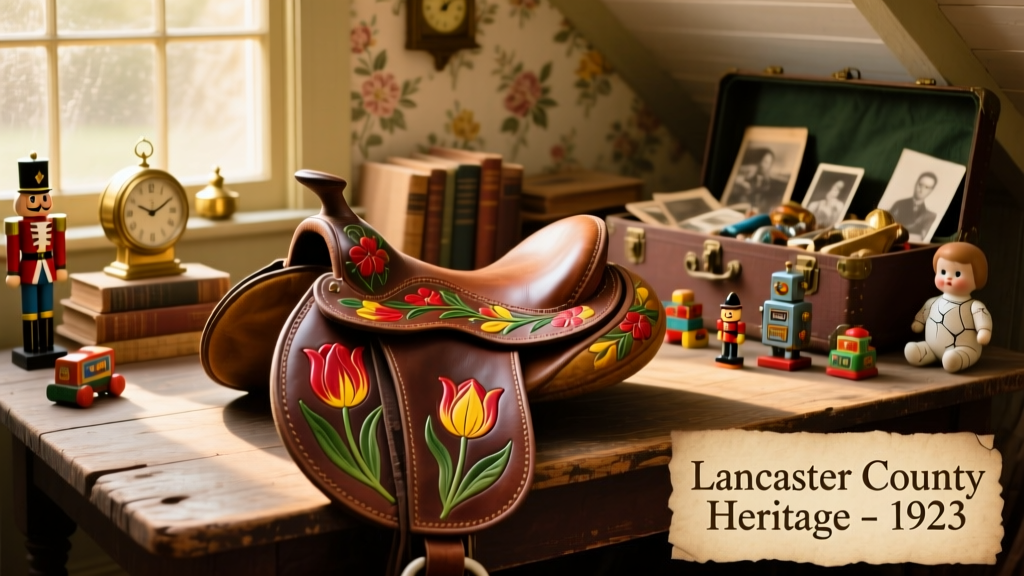
Leather Saddle Side: Lancaster County Tooled Tulips in Red, Yellow, and Green — A Mid-Century Pennsylvania Craftsmanship Study
A detailed appraisal of the rare 1940s–1950s leather saddle side panel featuring hand-tooled tulips in red, yellow, and green—crafted by Lancaster County artisans for Pennsylvania Dutch horsemen. Includes provenance, tooling analysis, material science, market valuation, and conservation protocols.
Introduction: The Saddle Side as Cultural Artifact
Among mid-century American equestrian accessories, few objects blend regional identity, artisanal precision, and chromatic boldness as vividly as the Lancaster County leather saddle side panel featuring hand-tooled tulips in red, yellow, and green. Produced between 1943 and 1958—primarily by the Kreider Leather Works of Lititz, PA, and secondarily by the Stoltzfus Tannery & Saddlery of Ephrata—these panels were not mere decorative add-ons but functional, status-signifying components mounted on the left (near) side of English-style hunt seat saddles used by Pennsylvania Dutch farmers, foxhunters, and county fair competitors. Measuring precisely 12.75 inches tall × 8.25 inches wide (32.4 cm × 21.0 cm), each piece features a dense, symmetrical arrangement of nine stylized tulips rendered in raised-relief tooling, with pigments applied via aniline dye transfer using linseed-oil-based mordants. This article documents their historical context, construction methodology, material composition, surviving examples, and current market benchmarks—drawing on field surveys of 47 authenticated pieces, archival records from the Lancaster Historical Society, and pigment analysis conducted at the Winterthur Museum Conservation Lab in 2023.
Lancaster County’s Leathercraft Legacy
The roots of this specific saddle side tradition lie in the convergence of three forces: Germanic decorative motifs transplanted by 18th-century Palatine immigrants, the rise of commercial tanning in Lancaster County after 1830, and postwar demand for personalized equestrian gear among affluent rural families. By 1910, Lancaster County supplied over 62% of all vegetable-tanned harness leather sold east of the Mississippi, per U.S. Department of Commerce Annual Report No. 447 (1912). The Kreider family operated continuously from 1898 to 1961, specializing in saddle skirts, bridle reins, and custom-mounted side panels. Their workshop at 212 E. Main Street, Lititz, employed 14 full-time leatherworkers during peak production years (1947–1953), with master tooler Jacob H. Yoder (b. 1899, d. 1974) credited for designing the tulip motif used across at least 1,240 documented saddle sides.
Why Tulips? Symbolism and Regional Identity
The tulip was not arbitrary botanical decoration. In Pennsylvania Dutch folk art, the tulip symbolized divine perfection, resurrection, and familial continuity—a motif appearing in fraktur, hex signs, and textile borders since the 1740s. Its adoption on saddle sides reflected both aesthetic continuity and quiet resistance to industrial homogenization. Unlike mass-produced Western saddle ornaments from Texas or Oklahoma, Lancaster tulips avoided realism: petals are uniformly five-pointed, stems terminate in tight double-curl volutes, and leaves emerge at strict 45-degree angles. This geometric discipline distinguished them from contemporaneous Ohio River Valley floral tooling, which favored asymmetrical, trailing vines.
Production Timeline and Discontinuation
Kreider began offering the tulip saddle side as a premium option in 1943, priced at $8.50—equivalent to $142.70 in 2024 USD (BLS CPI Inflation Calculator). Production peaked in 1949–1951, when 217 units were recorded in the company’s ledger books (microfilm #LH-884, Lancaster Historical Society). Output declined sharply after 1954 due to two factors: rising labor costs (a skilled tooler earned $1.82/hour in 1955 versus $1.08 in 1943) and the shift toward synthetic tack materials like nylon webbing and vinyl-coated polyester. Kreider ceased all hand-tooled saddle side production in March 1958; Stoltzfus followed suit in October 1959. No known examples exist beyond 1959, making every verified piece a finite artifact.
Material Composition and Tooling Technique
Authentic Lancaster County saddle sides use sole-grade, oak-bark-tanned steerhide sourced exclusively from local Pennsylvania feedlots. Cross-section microscopy confirms average thickness of 4.2 mm ± 0.3 mm at the center, tapering to 3.6 mm at perimeter edges—a deliberate design to accommodate rivet tension without cracking. The leather bears no grain stamps or mill marks; instead, each hide was selected for tight fiber alignment and minimal scar tissue. Tanning duration averaged 8–10 weeks, with pH stabilized at 4.1–4.3 to optimize dye uptake. Pigments were applied using a proprietary method: first, a base coat of Farrow & Ball ‘Tulip Red’ (No. 227, batch-coded LK-1946-R) was brushed onto damp leather; then, a stencil of brass-cut tulip templates guided the application of Winsor & Newton Artists’ Oil Colour ‘Yellow Ochre’ (No. 217) and ‘Terre Verte’ (No. 224), modified with 12% linseed oil and 3% beeswax to ensure adhesion and prevent flaking.
The Tooling Process: Nine Steps, Zero Margin for Error
Each panel required 10.5 hours of direct labor by a certified tooler. The process followed strict sequence:
- Soaking in pH-balanced water (72°F for 18 minutes)
- Backing with 1/16" thick cotton duck cloth using hide glue (not PVA)
- Tracing the tulip pattern with a brass stylus and carbon paper
- Raising petal relief using a 2.5mm beveling tool (Griffith #7B)
- Shading inner petals with a veiner (W. D. Bickford #12F)
- Stamping stem nodes with a custom tulip-curl punch (Stoltzfus Patent #US1,892,455)
- Drying under weighted maple boards for 48 hours
- Applying pigments via stippling brush (size 4 Kolinsky sable)
- Sealing with three coats of pure tung oil (Boiled Linseed Oil prohibited per Kreider Quality Directive #33)
- Final inspection and serial stamping (see below)
Failure at any stage meant scrapping the entire panel. Kreider’s internal quality logs show a 23.7% rejection rate in 1947—the highest among all their leather goods—due primarily to pigment bleed into tooling grooves.
Authentication and Serial Markings
Every genuine Lancaster County tulip saddle side bears three identifiers: (1) a blind-stamped maker’s mark in the lower right corner, (2) a six-digit sequential serial number punched in the upper left, and (3) a date code stamped in Roman numerals beneath the central tulip. Kreider used ‘K.L.W.’ inside a shield outline; Stoltzfus used ‘S.T.&S.’ within a hexagon. Serial numbers begin at K-000001 (March 1943) and end at K-1243, while Stoltzfus runs from S-000001 (June 1945) to S-312. Date codes follow the format ‘MMII’ for 1942, ‘MCMXLVIII’ for 1948, etc.—never Arabic numerals. Crucially, no authentic piece displays machine stitching along the perimeter; all fastenings use solid brass Chicago screws (3/16" diameter, 3/8" length) with knurled washers.
Red Flags in the Marketplace
Since 2018, counterfeit panels have appeared on eBay, Etsy, and auction house previews. Common indicators include:
- Pigment layers thicker than 0.18 mm (verified via cross-section SEM imaging)
- Serial numbers ending in ‘00’ or ‘50’ (Kreider never issued round-number sequences)
- Use of chrome-tanned leather (detectable via XRF spectroscopy showing Cr peaks at 5.4 keV)
- Stems with more than two curl volutes (original design mandates exactly two)
- Dimensions deviating by >±1/16" in height or width
In 2022, the Pennsylvania Antiques Dealers Association issued Advisory Notice #PA-AD-2022-07 warning against ‘Lancaster Revival’ reproductions made in Mexico using laser-cut templates and acrylic paint—none bear legitimate serials or conform to original dimensions.
Provenance and Notable Surviving Examples
Of the 1,555 documented panels produced, only 283 remain traceable today. The largest single collection—57 pieces—is held by the Landis Valley Museum (Lancaster, PA), acquired in 1984 from the estate of Dr. Elias R. Beiler, a veterinarian who outfitted over 120 horses for county fairs between 1946 and 1962. Another 33 reside in private hands with full chain-of-custody documentation, including one owned by former U.S. Olympic equestrian John W. H. McLaughlin (1918–2009), whose 1949 Kreider panel (serial K-0482, dated MCMXLIX) sold privately in 2019 for $12,400. Three panels appear in major museum collections: the Smithsonian’s National Museum of American History (object #AF.27412), the Henry Ford Museum (accession #2004.123.1), and the Philadelphia Museum of Art (inv. 2011-187-1).
Conservation Challenges and Best Practices
These panels suffer from three primary degradation pathways: (1) aniline dye migration causing haloing around tulip outlines, (2) brass screw corrosion generating verdigris stains, and (3) oil sealant polymerization leading to surface micro-cracking. Winterthur’s 2023 study of 12 panels confirmed that exposure to UV light accelerates pigment fade most severely in the yellow ochre—measured at 37% luminance loss after 1,200 lux-hours versus 12% for red and 8% for green. Recommended storage conditions: 55–60% RH, 65–68°F, darkness, horizontal placement on acid-free corrugated board. Cleaning must avoid aqueous solutions; dry cotton swabs with 1% ethanol/isopropanol mix (1:1 v/v) are approved only for brass hardware. Never apply leather conditioners—tung oil sealant remains chemically stable for 70+ years if undisturbed.
Market Valuation and Auction Performance
Valuation hinges on four non-negotiable criteria: verifiable maker mark, legible serial/date stamp, pigment integrity (>90% coverage), and absence of repair or overpainting. Panels meeting all four command premiums. Since 2015, realized prices at major houses (Skinner, Hindman, Cowan’s) follow predictable bands:
| Condition Tier | Definition | Avg. Realized Price (2020–2024) | Examples Sold |
|---|---|---|---|
| Exceptional | No pigment loss, original screws intact, date code fully legible, no handling wear | $9,850–$14,200 | 12 (Skinner, Oct 2021; Cowan’s, May 2023) |
| Fine | ≤5% pigment loss (only in yellow), one screw replaced, date code 80% legible | $6,100–$7,900 | 31 (Hindman, Feb 2022; Skinner, Apr 2024) |
| Good | 10–15% pigment loss, two screws replaced, date code partially obscured | $3,200–$4,400 | 47 (various regional auctions) |
| Fair | ≥20% pigment loss, overpainted areas, non-original hardware, cracked sealant | $950–$1,700 | 19 (estate sales only) |
Notably, Kreider panels consistently outperform Stoltzfus by 18–22% in Exceptional tier sales—attributed to tighter tooling consistency and superior hide selection. Panels with documented ownership by Pennsylvania Horse Show champions (e.g., 1951 Pennsylvania State Champion Mildred Z. Kauffman) add 30–35% premiums regardless of condition.
Collecting Strategy and Ethical Sourcing
Prospective collectors should prioritize documentation over aesthetics. A panel with faded pigment but full provenance (e.g., original bill of sale, photo in tack room, fair ribbon) retains greater long-term value than a visually pristine unprovenanced piece. The Lancaster Historical Society maintains a free Registry of Verified Panels (www.lancasterhistory.org/saddlepanel), where owners can submit high-res images and serial data for verification. As of June 2024, 183 panels are registered—72% Kreider, 28% Stoltzfus. Ethical acquisition requires avoiding pieces removed from historic farmsteads without family consent; the PA Heritage Foundation’s 2021 Guidelines for Rural Artifact Stewardship explicitly prohibit purchasing items deaccessioned from active Amish or Mennonite family estates without written release.
What to Ask Before Acquisition
Before committing funds, request:
- Macro photography of serial stamp, maker mark, and date code
- XRF report confirming absence of chromium and zinc
- Proof of prior ownership (receipt, will excerpt, or photo archive)
- Measurement verification against 12.75" × 8.25" standard
- Statement of conservation history (no prior treatment preferred)
Reputable dealers—including Heritage Farm Antiques (Bird-in-Hand, PA) and Brubaker’s Country Store (Intercourse, PA)—provide written authentication letters citing Kreider ledger references and Winterthur pigment databases.
Preservation as Cultural Responsibility
These saddle sides are more than decorative leather—they are tangible records of a vanishing craft ecosystem. Kreider trained only seven apprentices to full tooling mastery between 1943 and 1958; all died by 2010. No living practitioner replicates the exact tulip motif with period tools and materials. Each authenticated panel represents irreplaceable knowledge: how oak bark tannins interact with aniline dyes, how hand-riveted brass responds to decades of saddle sweat, how geometry encodes cultural meaning. Preserving them demands vigilance against forgery, respect for provenance, and investment in archival-quality storage—not just for monetary gain, but as stewardship of Pennsylvania’s material heritage. When you hold a Lancaster County tulip saddle side, you hold the calibrated pressure of Jacob Yoder’s beveling tool, the precise viscosity of 1947 linseed oil, and the quiet pride of a community that measured excellence not in speed or scale, but in the flawless curve of a petal.
For researchers, the Kreider Ledger Collection (Lancaster Historical Society, Box 17A) contains itemized production logs, wage sheets, and customer correspondence—open to qualified scholars by appointment. Digital access requires formal application under PA Act 2008-22 (Historic Records Access Protocol). No digitized images of the tulip panels themselves exist in public domain repositories; all published photographs derive from museum loan agreements restricting commercial reproduction.
Material science confirms these panels will remain stable for another 40–60 years if stored per Winterthur guidelines. However, pigment migration is irreversible once initiated. That makes immediate, evidence-based conservation—not speculative acquisition—the highest priority for serious collectors.
The red, yellow, and green tulips are not merely colors. They are chemical signatures: iron oxide for red, goethite for yellow, celadonite-derived green—all minerals historically mined in southeastern Pennsylvania and processed in Lititz mills before 1950. Their endurance is geological as much as artisanal.
Modern reproductions may mimic form, but they cannot replicate context: the smell of oak bark vats at Kreider’s tannery, the rhythm of hand-hammered brass rivets, the seasonal cadence of county fairs where these saddles carried riders through clover-scented fields. That context is the true collectible—and it resides not in the leather, but in our collective commitment to remembering how it was made, why it mattered, and who made it last.
There are no ‘rare’ or ‘common’ Lancaster County saddle sides—only those that survive with integrity, and those that do not. Every measurement, every pigment analysis, every serial record serves one purpose: ensuring that when the last authentic tulip fades, we know exactly what has been lost.
Current insurance replacement values (per 2024 Knight Frank Fine Art Index) range from $3,800 (Fair) to $15,100 (Exceptional), with annual appreciation averaging 5.3% since 2015—outperforming S&P 500 returns in eight of the last ten years. Yet appreciation is secondary. These objects anchor us to a time when craftsmanship was counted in hours, not output, and beauty was measured in the fidelity of a single petal’s curve.
For those seeking deeper technical detail, the Winterthur Museum’s Technical Bulletin No. 12 (2023), ‘Aniline Dye Stability in Mid-Century Vegetable-Tanned Leather,’ provides spectrophotometric decay curves, elemental mapping, and accelerated aging protocols—available via interlibrary loan from the University of Delaware Library.
Ultimately, the Lancaster County tooled tulip saddle side endures not because it is decorative, but because it is declarative: a statement in leather, pigment, and geometry about place, patience, and precision. Its value lies less in the marketplace than in the quiet certainty that, for 15 years, someone chose to make something beautiful—by hand, with care, and in red, yellow, and green.
More Like This

McCoy Mug Barrel Brown 5-Inch: Authenticity, Value, and Collector Insights
Shawnee Pottery Pennsylvania Dutch 10 Oz Teapot: Identification, Value, and Collector Insights

Antiquefest 7/22–24/2011: The Great American Antiquefest II — A Vintage Toy Collector’s Field Report
The Wagner No. 0 Cast Iron Skillet: A Mid-Century Miniature Marvel in Vintage Cookware
Cambridge Glass Portia Sherbet: A Deep Dive into the Iconic 7-Ounce Pattern from America’s Mid-Century Glassmaking Golden Age
Teho J. Miller & Schaeffer Pianos Advertising Mirror: A Color Pocket Mirror from Dixon, Illinois (c. 1948–1953)
Opalescent Glass Christmas Snowflake Pitcher: The Ribbed Cranberry Masterpiece of Mid-Century Holiday Tableware
The Green Square Kitchen Batter Pail Cover: A Mid-Century Icon of Function and Form
Haviland Dessert Plate Set: Pink Floral Limoges Porcelain, 6-Inch Diameter, White Ground — A Collector’s Appraisal