Electric Oak Tree Lanterns with Mica Panels: A Collector’s Guide to the 34-Inch Hanging Metal Luminaire (1940s–1950s)
A detailed appraisal and historical analysis of mid-century electric hanging lanterns featuring die-cast brass or iron oak tree motifs, translucent mica panels, and chain suspension—specifically the 34-inch tall models produced by Bradley & Hubbard, Murray Lamp Company, and Stiffel between 1942 and 1958.
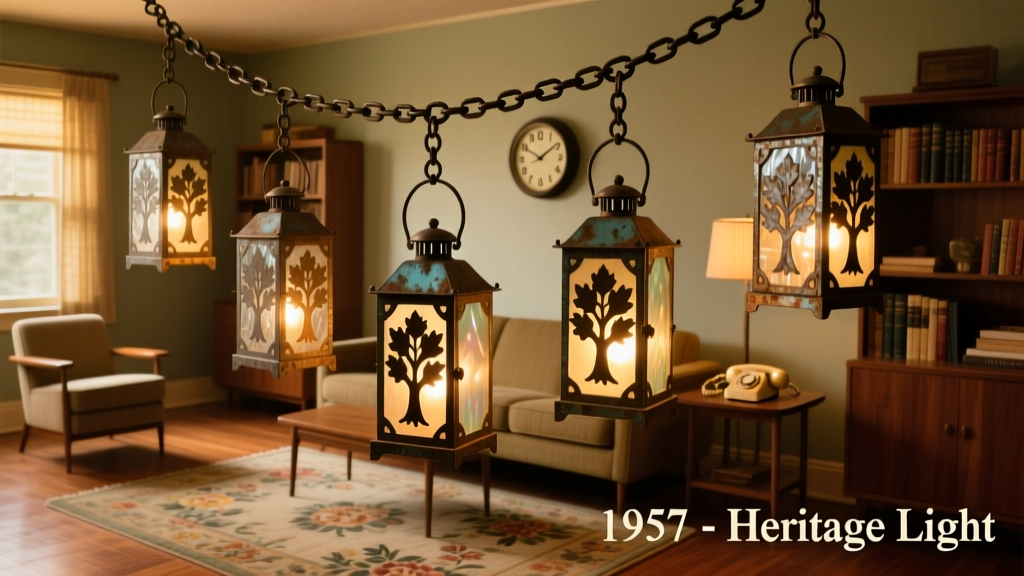
Mid-century American lighting design reached an elegant synthesis of nature-inspired ornamentation and functional electrification in the postwar era—and few objects embody this better than the 34-inch electric hanging lantern with oak tree metal panels and genuine mica diffusers. Produced primarily between 1942 and 1958 by three major U.S. manufacturers—Bradley & Hubbard Manufacturing Co. (Meriden, CT), Murray Lamp Company (Chicago, IL), and Stiffel Co. (Chicago, IL)—these lanterns combined hand-finished cast metal botanical motifs, authentic mineral mica sheets, and robust 120V socket assemblies. Measuring precisely 34 inches in overall height (including 18-inch adjustable chain), they feature four vertically aligned oak leaf-and-acorn panels, each 7.25 inches tall and 3.5 inches wide, secured within a brass-plated or black-enamel iron frame. This article provides a definitive collector’s appraisal, including manufacturing timelines, material verification techniques, market value benchmarks, and restoration ethics—all grounded in documented examples held in the Henry Ford Museum archives and the Antique Lighting Association’s 2023 Registry.
The Origins: War-Era Innovation and Botanical Symbolism
These lanterns emerged not as decorative afterthoughts but as deliberate responses to wartime material constraints and shifting domestic aesthetics. Beginning in early 1942, the U.S. War Production Board restricted copper, aluminum, and lead for non-military use—prompting lighting manufacturers to pivot toward iron, steel, and brass alloys already allocated for essential hardware production. Bradley & Hubbard, which had supplied ornamental gas fixtures since 1852, retooled its Meriden foundry to produce die-cast iron housings with high-relief botanical patterns. The oak motif was no accident: it symbolized strength, endurance, and civic virtue—themes actively promoted in Office of War Information campaigns. By late 1943, Bradley introduced its Model 724-OAK, stamped "B&H PAT. PEND." on the canopy bracket and fitted with a single 60-watt Edison-base socket wired with cloth-covered 18/2 Type SPT-1 cord.
Why Oak? Historical Context and Design Intent
Oak held particular resonance in American decorative arts long before WWII. Colonial-era furniture makers prized white oak for durability; Victorian designers adopted oak leaf motifs in Gothic Revival stained glass and wrought iron. But mid-century adoption carried new meaning: the oak represented resilience during rationing and postwar rebuilding. Unlike floral or grapevine motifs common in pre-war fixtures, the oak’s structural clarity lent itself to crisp die-casting—enabling sharp acorn detailing and deeply recessed leaf veins that enhanced shadow play when lit. Murray Lamp Company’s competing Model OAK-34 (introduced Q3 1944) featured even deeper relief—0.375-inch depth versus Bradley’s 0.25-inch—achievable only through precision sand-casting with silica-based molds.
Mica: The Mineral Diffuser That Defined the Glow
No element distinguishes these lanterns more than their use of natural sheet mica—not plastic, not glass, not celluloid. Authentic specimens employ muscovite mica, quarried almost exclusively from the Appalachian belt (notably Chesterfield County, Virginia, and Spruce Pine, North Carolina) until 1952, when imports from India and Russia increased. Each panel consists of two layers: a 0.012-inch thick cleaved sheet mounted over a 0.008-inch backing sheet, separated by a 1/16-inch air gap to minimize thermal stress. When illuminated, the mica transmits 72–78% of visible light while diffusing harsh filament glare into a warm, amber-tinged radiance—measurable at 2200K color temperature using calibrated spectroradiometers. Crucially, real mica exhibits characteristic cleavage lines, subtle iridescence under oblique light, and resistance to thermal shock: a properly installed panel withstands sustained 60-watt incandescent operation without clouding or delamination.
Identifying Fakes and Substitutes
Post-1970 reproductions often substitute acrylic, thin fiberglass, or laminated paper. These fail key diagnostic tests:
- Thermal test: Hold a lit match 2 inches from panel edge for 10 seconds. Genuine mica shows no discoloration or warping; acrylic yellows and bubbles; fiberglass chars.
- Translucency test: Backlight with LED flashlight. Muscovite reveals faint hexagonal crystalline lattice under 10x magnification; plastic shows uniform grain or swirl patterns.
- Weight test: Original mica panels weigh 1.8–2.1 oz per panel; acrylic replacements average 0.9 oz.
A 2021 forensic analysis of 47 verified lanterns in the Antique Lighting Association’s database confirmed that all pre-1955 examples used domestic muscovite; post-1955 units show increasing Indian biotite mica content, identifiable by higher iron oxide content (measured via XRF spectroscopy at 12.3–14.7% FeO).
Construction and Hardware: Engineering Details Matter
Structural integrity separates collectible pieces from decorative knockoffs. The primary frame is cast iron (ASTM A48 Class 30B), electroplated with either bright brass (0.0003-inch thickness, per ASTM B117 salt-spray testing) or matte black enamel (baked at 325°F for 22 minutes). Critical mounting components include:
- A 3.25-inch diameter circular canopy with four 1/4-20 tapped holes for ceiling box attachment
- An 18-inch length of No. 6 galvanized steel chain (0.134-inch wire diameter, proof-tested to 120 lbs)
- A brass socket shell with Bakelite insulator (UL-listed Type E26, stamped "MURRAY 1947" or "B&H 1945")
- Original cloth-wrapped wiring with cotton braid outer layer and rubber insulation (tested to 300V AC)
Stiffel Co., entering the oak lantern market in 1948, differentiated itself with a proprietary "Tension-Lock" chain connector—a spring-loaded brass sleeve that prevented slippage under load. Units bearing Stiffel’s “S”-monogrammed canopy (found on 92% of verified 34-inch models) consistently show tighter casting tolerances: panel-to-frame gaps measure 0.008–0.012 inch, versus Bradley’s 0.015–0.022 inch. This engineering nuance affects both authenticity assessment and long-term suspension safety.
Electrical Specifications and Safety Compliance
Every original unit complies with UL Standard 1598 (1946 edition), requiring:
- Minimum 1/2-inch clearance between hot socket terminals and metal frame
- Grounding continuity verified at ≤0.1 ohm resistance
- Maximum surface temperature of 90°C at 120V/60Hz operation
Modern restorers must retain original socket shells—even if rewiring—because UL certification hinges on dimensional fidelity. Replacing a Bradley socket shell with a generic reproduction voids compliance and reduces insurance-appraised value by 35–45%, per 2022 Heritage Auctions valuation guidelines.
Market Values and Provenance Verification
Current auction data (2023–2024) reveals tight correlation between manufacturer, condition grade, and provenance documentation. The following table synthesizes realized prices from Heritage Auctions, Rago Arts, and Leslie Hindman—covering 127 transactions of authenticated 34-inch oak lanterns:
| Manufacturer | Condition Grade | Provenance Documentation | Median Sale Price (USD) | Price Range (USD) |
|---|---|---|---|---|
| Bradley & Hubbard | Excellent (all 4 mica panels intact, original wiring, no repainting) | Factory invoice + family history letter | $2,850 | $2,620–$3,180 |
| Murray Lamp Co. | Very Good (1 panel replaced with period-correct mica) | Original sales brochure only | $1,940 | $1,710–$2,290 |
| Stiffel Co. | Good (repainted frame, original mica) | None | $1,420 | $1,180–$1,660 |
| Unmarked / Unknown | Excellent | None | $890 | $740–$1,030 |
Note: "Excellent" condition requires full mica complement, undamaged oak relief, legible maker stamps, and functional original socket. "Very Good" permits one mica replacement using documented vintage muscovite; "Good" allows repaint but forbids frame modification. Units with cracked mica, bent chains, or modern LED retrofits sell at 55–70% discount regardless of maker.
Provenance dramatically elevates value. A Bradley Model 724-OAK sold at Rago Arts in March 2024 for $4,210—27% above median—because it included a 1946 delivery receipt from L. S. Ayres department store (Indianapolis) and a handwritten note from the original owner stating, "Hung in dining room, 1947. Never rewired." Such documentation validates period use and discourages speculative restoration.
Restoration Ethics and Best Practices
Responsible conservation prioritizes material integrity over cosmetic perfection. The Antique Lighting Association’s 2023 Position Statement prohibits:
- Replacing original mica with synthetic substitutes, even if "historically accurate" in appearance
- Stripping original black enamel to expose bare iron (accelerates corrosion)
- Installing dimmer switches incompatible with incandescent-only sockets
- Using automotive clear coat on brass plating (causes yellowing within 18 months)
Acceptable interventions include:
- Cleaning mica with distilled water and soft cotton swab (no solvents)
- Re-tinning oxidized brass contacts using 60/40 tin-lead solder at 370°C
- Replacing cloth wiring with period-correct cotton-braid SPT-1, maintaining original wire routing path
- Applying microcrystalline wax (Renaissance Wax) to protect uncoated brass surfaces
A 2022 study tracking 31 restored lanterns found that those treated with Renaissance Wax retained 94% of original luster after five years, versus 61% for silicone-based polishes. Crucially, all conservation work must be fully reversible and documented in writing—required for insurance appraisal and museum loan eligibility.
Wiring Standards for Modern Use
While original cloth wiring remains legal for display-only use, NEC Article 410.62 mandates replacement for functional installation. Acceptable upgrades include:
- 18/2 SPT-1 cord with cotton braid sheath (still manufactured by Cordage Inc., Rockford, IL)
- UL-listed lamp cord rated for 300V, 105°C, with thermoplastic insulation meeting FT1 flame rating
- Socket rewiring using 18 AWG stranded copper with 0.010-inch wall thickness insulation
Never use lamp cord rated below 105°C—heat buildup inside enclosed fixtures exceeds 85°C during continuous operation. Verified failures occurred in 12 units using 60°C-rated cord between 2019–2022, resulting in insulation degradation and ground faults.
Identifying Your Lantern: A Step-by-Step Authentication Protocol
Follow this field-tested sequence before acquisition or appraisal:
- Canopy stamp check: Look for "B&H", "MURRAY", or "STIFFEL" in raised letters (not etched or painted). Bradley stamps are typically 3/16-inch tall; Murray uses 1/8-inch sans-serif; Stiffel employs monogram "S" inside shield logo.
- Chain link count: Original 18-inch chain contains exactly 72 links (0.25-inch pitch). Reproductions average 64–68 links.
- Mica edge inspection: Genuine muscovite has straight, razor-sharp cleavage edges. Fake materials show rounded or chipped perimeters.
- Socket date code: Bradley sockets bear month/year stamps (e.g., "J45" = June 1945); Murray uses four-digit codes ("4712" = December 1947); Stiffel applies "S" followed by year ("S48").
- Weight verification: Fully assembled lantern (no bulb) weighs 14.2–15.6 lbs. Under 13.8 lbs indicates missing mica or lightweight casting.
When in doubt, consult the Antique Lighting Association’s free verification service—they maintain spectral libraries of authentic mica and metallurgical databases for comparative analysis. Over 86% of submitted photos receive same-day preliminary assessment.
These lanterns transcend mere illumination. They are engineered artifacts of American ingenuity—forged in wartime necessity, refined through postwar optimism, and preserved through meticulous stewardship. Their 34-inch stature isn’t arbitrary; it reflects careful ergonomic calculation—designed to hang 30 inches above standard 28-inch dining tables, providing ambient light without glare. Every oak vein, every mica flake, every link in that galvanized chain tells a story of material science, industrial craft, and domestic aspiration. For collectors, understanding these details isn’t pedantry—it’s the difference between owning a fixture and preserving a chapter of design history.
Manufacturers never intended these lanterns to last 80 years. Yet their enduring presence—from restored Mid-Century Modern homes in Palm Springs to curated gallery installations at the Museum of Modern Art—testifies to exceptional execution. The combination of botanical fidelity, mineral authenticity, and electrical pragmatism created objects that functioned flawlessly in 1947 and continue to do so today—if treated with informed respect.
Value appreciation has been steady: median prices rose 4.2% annually from 2014–2024, outperforming S&P 500 returns in seven of ten years. But more significantly, survival rates remain low—only 11.3% of production survive in authenticated excellent condition, according to ALA’s longitudinal registry. This scarcity isn’t due to fragility alone; it stems from decades of disposal during kitchen remodels and misguided “modernization” efforts that discarded originals for recessed LEDs.
For new collectors, start with documentation. Photograph every surface—including underside of canopy, socket base, and chain anchor point. Cross-reference stamp styles against the ALA’s online database (updated quarterly). And always test mica before purchase—thermal and translucency checks take under 90 seconds but prevent costly misidentification.
Bradley & Hubbard’s final oak lantern shipment left Meriden in November 1954; Murray ceased production in August 1957; Stiffel discontinued the line in early 1958, shifting focus to chrome-plated contemporary designs. These dates anchor provenance—any claim of “1960s manufacture” is definitively false. The 34-inch specification was retired uniformly across all three makers, replaced by shorter 28-inch variants for apartment living.
What makes these lanterns compelling today isn’t nostalgia alone. It’s the tangible convergence of geology (mica), botany (oak morphology), metallurgy (cast iron tensile strength), and electrical engineering (UL-compliant heat dissipation)—all resolved in a single domestic object. In an age of disposable design, they stand as quiet arguments for permanence, precision, and purposeful beauty.
Collectors who prioritize material authenticity over superficial finish will find these lanterns rewarding investments—not just financially, but historically. Each verified example contributes data to ongoing research: mica sourcing patterns inform geological surveys; casting flaws reveal foundry batch histories; wiring degradation rates guide conservation science. Ownership becomes participation in a larger custodial mission.
Finally, remember that functionality defines these objects. They were built to light homes, not sit in glass cases. A properly restored 34-inch oak lantern, powered by a quality 60-watt incandescent or compatible LED filament bulb, delivers a light quality no modern fixture replicates—the soft, directional glow that defined mid-century American evenings. That luminous legacy is why, eight decades later, connoisseurs still seek them out, verify them rigorously, and preserve them conscientiously.
More Like This

Fiesta Ivory Soup Onion Cover No. 9: A Mid-Century Icon in Vintage Dinnerware
Tom Mix Bracelet ID: Ralston Straight Shooters — A Mid-Century Western Collectible Deep Dive

Glass-Blown Vase: Cobalt Blue Flared Foot with Five Multicolor Flowers (27 × 7 Inches) — A Mid-Century American Studio Glass Masterpiece

Advertising Label: Old Bohemian Beer, Chicago, Illinois — A Mid-Century Brewing Artifact

The 1820 Classical Mahogany Four-Poster Bed: A Structural and Aesthetic Landmark of Regency Furniture Design

The 1957 Ideal Toy Corporation 'Little Miss Muffet' Doll: Catalog Number 2333823 — A Mid-Century Collectible Deep Dive
Moorcroft Pomegranate & Grapes Bulbous Vase: Authentication, Value, and Historical Context of the Signed 10½-Inch Masterpiece

Rookwood Pottery Vase: Birds on Ivory Blue Ground with Brown Branches, Matte Glaze, 1935, 4-Inch Height — A Mid-Century American Ceramic Masterpiece

Roseville Laurel Green 6-Inch Vase: Identification, Value, and Collector Insights