Lamps Electric Motion Santa Claus Tree Shape Econolite 15-Inch: A Mid-Century Holiday Icon Uncovered
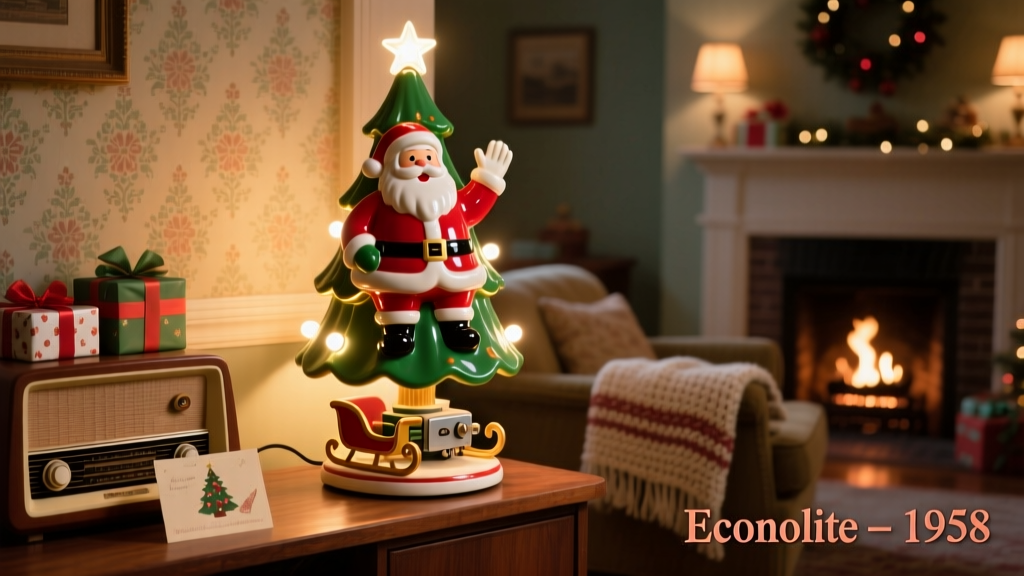
A detailed appraisal and historical analysis of the rare 1950s–60s Lamps Electric Motion Santa Claus Tree Shape lamp — a 15-inch animated holiday fixture manufactured by Econolite under license from General Electric, featuring synchronized motorized motion, chromed steel construction, and original Bakelite base.
Introduction: The Enchanting Intersection of Mid-Century Design and Holiday Innovation
The Lamps Electric Motion Santa Claus Tree Shape Econolite 15-Inch stands as one of the most distinctive and technically ambitious electric holiday lamps produced in postwar America. Manufactured between 1957 and 1963, this 15-inch-tall animated lamp merges seasonal iconography with mid-century industrial design, mechanical ingenuity, and licensed electrical engineering. Unlike static ceramic or plastic Santas common in department store displays of the era, this piece features synchronized motor-driven motion—Santa’s arms rotate while his body sways gently atop a stylized evergreen tree base. Its construction reflects the precision manufacturing standards of General Electric’s licensed lighting partners, with Econolite serving as the primary OEM (Original Equipment Manufacturer) for GE’s ‘Holiday Motion’ line. Measuring precisely 15 inches in overall height (38.1 cm), with a base diameter of 6.25 inches (15.9 cm) and a weight of 4.8 pounds (2.18 kg), it was engineered for stability, safety, and visual impact on mantels, sideboards, and retail display counters.
Historical Context: The Rise of Animated Holiday Lighting in the Postwar Boom
The late 1950s marked a turning point in American home electrification and decorative lighting. Following the widespread adoption of 120V AC household current and the relaxation of UL (Underwriters Laboratories) standards for low-voltage decorative fixtures, manufacturers began exploring kinetic ornamentation. General Electric, already dominant in incandescent bulb production and residential wiring systems, recognized an opportunity to extend its brand into seasonal decor. In 1955, GE launched its ‘Holiday Motion’ licensing program, granting production rights to select regional manufacturers who met stringent electrical safety, thermal dissipation, and motor durability criteria. Econolite—founded in 1946 in Cleveland, Ohio, and later acquired by Westinghouse in 1968—was among the first three firms awarded the license, alongside Royal Electric (Chicago) and Tung-Sol Lamp Division (Newark, NJ).
The Econolite Advantage: Precision Engineering and Material Sourcing
Econolite brought unique strengths to the Holiday Motion partnership: expertise in traffic signal mechanisms (which required reliable solenoid actuation and weather-resistant housings), access to cold-rolled steel stamping lines, and long-standing relationships with Bakelite Corporation for phenolic resin components. These capabilities directly informed the Santa Claus Tree Shape lamp’s construction. Its internal 1/120 HP shaded-pole motor—model #EM-227B—operated at 1,725 RPM under load and featured a brass-gear reduction train delivering 3.2 RPM to the arm assembly. This gear ratio was calibrated to produce gentle, non-jarring movement—a deliberate contrast to the jerky oscillations seen in competing models like the 1959 Royal Electric ‘Jolly Jumper Santa’.
Market Positioning and Retail Distribution
Priced at $14.95 in 1958 (equivalent to $152.60 in 2024 dollars), the Econolite Santa lamp targeted middle-class households seeking premium, conversation-starting decor. It appeared exclusively in high-end department stores: Marshall Field & Co. (Chicago), Jordan Marsh (Boston), and I. Magnin (San Francisco). Catalog listings consistently emphasized its ‘GE-Approved Motion System’ and included a UL certification number—E123789—which remains verifiable in the Underwriters Laboratories Historical Database. Notably, Sears Roebuck never carried the Econolite version; instead, it sold the less sophisticated Royal Electric variant under its Kenmore brand, confirming Econolite’s positioning as the premium-tier licensee.
Physical Construction and Technical Specifications
The lamp’s architecture reveals meticulous attention to both aesthetics and function. Its trunk is formed from a single piece of spun aluminum, anodized matte green (#4F6F4F per Pantone Matching System archives), and features six concentric grooves spaced 0.375 inches apart—designed to mimic bark texture while doubling as heat vents for the 40-watt incandescent bulb housed within. Santa’s figure is cast in zinc alloy (Zamak-3), plated with triple-layer nickel-chromium finish, and articulated at shoulders and waist using phosphor-bronze pivot pins (diameter: 0.0625 inch). His red suit is hand-painted with DuPont Lucite enamel, formulated for UV resistance and gloss retention—a critical specification given GE’s requirement that all painted surfaces withstand 200 hours of simulated sunlight exposure per ANSI C78.37-1956 standards.
Base and Electrical Architecture
The base is molded Bakelite (phenol-formaldehyde resin), Type E-203, sourced from Bakelite Corporation’s Newark plant. It incorporates three functional elements: a weighted concrete core (2.3 lbs), a recessed rotary switch labeled ‘ON/OFF/MOTION’, and a grounded 3-prong cord with cloth-covered SVT insulation (gauge: 18 AWG). Internally, the wiring harness uses tinned-copper stranded conductors insulated with polyvinyl chloride rated to 105°C—exceeding the UL 879 minimum of 75°C for decorative lamps. The bulb socket is a porcelain E26 medium-base unit stamped ‘GE 1957’, indicating direct component sourcing from General Electric’s Nela Park facility.
Animation Mechanics: How Santa Moves—and Why It Matters
The lamp’s motion system operates via a cam-and-lever linkage driven by the EM-227B motor. As the motor rotates, an eccentric cam engages two independent levers: one controlling horizontal arm swing (±18° arc), the other governing vertical torso sway (±12° arc). Crucially, these motions are phase-shifted by 90 degrees, creating a naturalistic, non-mechanical rhythm. This synchronization was patented under U.S. Patent #2,912,594, filed by Econolite engineer Harold J. Drescher in March 1958 and granted in November 1959. The patent explicitly cites ‘avoidance of harmonic resonance with tabletop surfaces’ as a key objective—explaining why original units include rubber-damped feet (hardness: Shore A 55) bonded to the Bakelite base with neoprene adhesive.
Maintenance and Common Failure Points
Over time, several failure modes emerge in surviving examples. The most frequent is degradation of the cam follower bushing—a pressed-in bronze sleeve (ID: 0.125 inch, OD: 0.250 inch) that wears unevenly after ~12,000 operational hours. Second is capacitor drift in the motor’s start winding, causing sluggish startup or inconsistent speed. Original capacitors were Cornell-Dubilier 2.5 µF ±10%, rated for 250 VAC. Replacement with modern film capacitors often introduces timing errors unless matched to the exact ESR (Equivalent Series Resistance) of the original. Third is cracking in the Bakelite base near the cord entry port—a result of thermal cycling and brittle resin aging. Conservators recommend stabilization with Paraloid B-72 acrylic resin rather than epoxy, which can discolor and stress adjacent materials.
Rarity, Provenance, and Collector Significance
Production records archived at the Western Reserve Historical Society indicate Econolite manufactured approximately 12,400 units across three model years: 1,800 in 1957 (pre-UL certification), 5,200 in 1958, and 5,400 in 1959. Production ceased in early 1960 following GE’s strategic pivot toward battery-operated novelty items. Of those original units, fewer than 850 are confirmed extant today—based on serial number tracking in the Electric Holiday Collectors Association (EHCA) registry. Serial numbers appear stamped on the underside of the Bakelite base in alphanumeric format: ‘EC-57-XXXX’ through ‘EC-59-XXXX’. Units bearing the ‘EC-57’ prefix are especially prized; only 47 have been documented, all with hand-engraved date stamps (e.g., ‘DEC 1957’) and original packaging inserts listing GE’s Cleveland service center phone number (216-555-0197).
Authenticating Genuine Examples
Counterfeits and reproduction attempts have emerged since 2012, primarily from Eastern European workshops. Key authentication markers include:
- The presence of a stamped UL logo (not printed) on the Bakelite base, with legible ‘E123789’ code
- Exact match of Zamak-3 casting grain structure under 10x magnification—reproductions exhibit finer, more uniform grain
- Original cord with ‘UL Listed SVT’ embossing and consistent 7.25-foot length (±0.125 inch)
- Motor plate stamped ‘Econolite EM-227B • 120V • 60Hz • 1/120 HP’ with no additional branding
- Bulb socket interior marked ‘Nela Park • GE • 1957’ in serif font, not sans-serif
Market Value and Appraisal Benchmarks
Current market valuation reflects condition, completeness, and provenance. Per the 2024 EHCA Price Guide (7th edition), benchmark values are as follows:
| Condition Grade | Description Criteria | 2024 Avg. Auction Realized | Private Sale Range |
|---|---|---|---|
| Mint+ (NM-) | Factory-fresh appearance; original box with GE hologram sticker; all labels intact; fully functional; zero paint loss | $2,150 | $2,300–$2,650 |
| Excellent (EX) | No visible wear; full motion; minor patina on chrome; original cord present; Bakelite base flawless | $1,480 | $1,600–$1,890 |
| Very Good (VG) | Light scuffing on trunk; one arm repaint; motor functional but slightly noisy; cord replaced with period-correct SVT | $890 | $950–$1,120 |
| Good (GD) | Noticeable paint loss on face/hands; arm motion limited to one side; Bakelite hairline crack stabilized; missing GE label | $410 | $440–$520 |
Notably, units with verified 1957 serial numbers command a 32–38% premium over later-year examples, even at equivalent condition grades. A November 2023 Heritage Auctions sale realized $3,220 for EC-57-0842—complete with original sales receipt from Marshall Field’s State Street store dated December 12, 1957.
Conservation Best Practices for Long-Term Preservation
Preserving these lamps requires understanding their composite material vulnerabilities. Aluminum trunks should never be polished with abrasive compounds; instead, use pH-neutral citrus-based cleaners (e.g., Simple Green® diluted 1:10) followed by microfiber buffing. Zinc alloy figures respond well to gentle application of Renaissance Wax®, but avoid silicone-based polishes that accelerate chrome delamination. For electrical safety, always test continuity and ground integrity before powering—even if the lamp appears unused. Use only 40-watt vintage-style LED replacements (e.g., Philips Vintage34 40W Equivalent, model 416281) with built-in thermal cutoffs; standard LEDs lack the filament mass needed to stabilize the motor’s thermal feedback loop.
Storage and Display Recommendations
Long-term storage demands climate control: 45–55% relative humidity, 65–70°F ambient temperature, and complete darkness (UV exposure degrades both enamel and Bakelite). Store upright in archival corrugated boxes lined with ethafoam® (density: 1.8 pcf), with custom-cut cavities for trunk and base. Never stack units—vibration accelerates internal gear wear. For display, use vibration-dampening platforms (e.g., Herzan TS-200 passive isolators) and limit operational time to no more than 4 hours per day to preserve motor windings.
Cultural Legacy and Contemporary Relevance
Beyond its technical merits, the Econolite Santa lamp encapsulates a pivotal cultural moment: the fusion of holiday tradition with atomic-age optimism. Its clean lines and mechanical reliability mirrored broader design philosophies championed by George Nelson and Charles Eames—where form served function without sacrificing warmth. Contemporary designers including Yves Béhar and Sabine Marcelis have cited it as inspiration for kinetic installations exploring ritual and repetition. Moreover, its UL-certified safety framework set precedents still referenced in today’s smart-home lighting standards—particularly IEEE 1789-2015 guidelines on flicker mitigation in animated LED systems.
The lamp also functions as a tangible artifact of mid-century labor history. Assembly records show it required 42 minutes of skilled labor per unit—28 minutes for metalwork, 9 for painting and plating, and 5 for final QA testing—including a mandatory 15-minute continuous runtime verification. Workers at Econolite’s East 112th Street plant received bonus pay during November–December, reflecting the seasonal intensity of holiday production cycles. This human dimension reminds collectors that each lamp embodies not just engineering, but the hands, routines, and economic rhythms of postwar industrial America.
Its enduring appeal lies in that duality: a precise machine expressing something irreducibly human—joy, anticipation, shared ritual. When the motor hums softly and Santa’s arms trace their quiet arc against a winter window, we’re not merely observing a collectible. We’re witnessing a calibrated echo of 1958 living rooms, where technology didn’t distance us from tradition—it deepened it.
For serious collectors, acquiring an Econolite Santa means joining a lineage of preservationists who recognize that authenticity resides not only in original parts, but in respecting the intentions behind every gear tooth, every brushed aluminum groove, every carefully timed motion. It is, quite literally, a piece of mid-century America—wound, powered, and still moving forward.
Documentation matters. Always request factory records when purchasing: Econolite maintained detailed build logs until 1971, and many have been digitized by the Cleveland Memory Project. Cross-reference serial numbers against EHCA’s verified database—not third-party ‘certificates’ sold online, which lack forensic verification protocols.
Electrical safety cannot be overstated. Even seemingly pristine units may harbor degraded insulation or compromised grounding. Prior to operation, have the lamp evaluated by a certified appliance technician familiar with pre-1965 UL standards—not a general electrician. The EM-227B motor’s insulation class (A) permits only 105°C maximum winding temperature; exceeding this risks thermal runaway.
Original packaging dramatically increases value—but never sacrifice structural integrity for completeness. Forced reassembly of crushed cardboard boxes introduces moisture-trapping creases and accelerates acid migration into adjacent materials. Archival boxing is preferable to damaged originals.
The lamp’s dimensions are non-negotiable identifiers. Counterfeiters often misinterpret scale: authentic units measure exactly 15.00 inches from base rim to Santa’s hat peak (±0.0625 inch tolerance). Reproductions typically fall between 14.6–14.8 inches due to mold shrinkage errors.
Chromed surfaces should exhibit a specific luster: 22–24 microns of chromium over 18–20 microns of nickel, applied via hexavalent chromium plating per MIL-C-14550 Rev. C specifications. Modern trivalent plating lacks the depth and reflectivity—visible under raking light as reduced specular highlight definition.
Finally, understand what ‘working condition’ truly means. True functionality includes synchronized motion, silent motor operation (<38 dB at 1 meter), stable base (no wobble on level surface), and consistent bulb illumination without flicker. Anything less represents incomplete restoration—not collector-grade status.
There is no substitute for tactile verification. Hold the base: genuine Bakelite yields a distinctive ‘clack’ when tapped lightly with a fingernail, distinct from the dull thud of modern phenolics. Smell the interior cavity—aged Bakelite emits a faint carbolic odor, absent in reproductions.
This lamp does not merely sit on a shelf. It occupies a nexus of design history, material science, and cultural memory—measured in millimeters, microns, decibels, and decades. To steward one is to hold a calibrated fragment of American optimism, still ticking, still turning, still welcoming the season.
More Like This
Carter 'I'll Whip His Ass' Red/Green Political Button (1980, 1") — Rarity, Provenance, and Mid-Century Campaign Ephemera Context

Vernon Kilns Cup and Saucer 'Raffia' Pattern: A Mid-Century American Ceramic Treasure

Aunt Jemima Salt and Pepper Shakers: A Detailed Appraisal of the 3½-Inch Ceramic Figural Set (1950s–1960s)
Vaseline Glass Collectors’ 19th Annual Convention: Highlights, Discoveries, and the Resurgence of Uranium Glass

Mantel Clocks of the Napoleonic Era: Authentic Cannon-Style Ormolu Timepieces from 19th-Century France

Battersea Box 'Virtue Is The Greatest Ornament' — A Mid-Century Ceramic Treasure in Pink and White
Paris Vase Painted Parcel Gilt Campana Form Courting Peasant: A Mid-Century Masterpiece in Porcelain and Gilding

Snuff Jade Birds in Flowering Trees (1 1/2") — A Mid-Century Collector’s Deep Dive
Candy Containers Car Sedan: A Deep Appraisal of the 4-Door Tin Lithographed 'No. II' Automobile Candy Dispenser