Lab Grown Leather Ltd: A Mid-Century Collectible Curiosity — Fact, Fiction, and Forgotten Marketing
An in-depth appraisal of Lab Grown Leather Ltd — a phantom brand that surfaced in 1950s American toy catalogs, never manufactured actual leather, and remains one of the most intriguing non-existent collectibles among vintage toy historians.
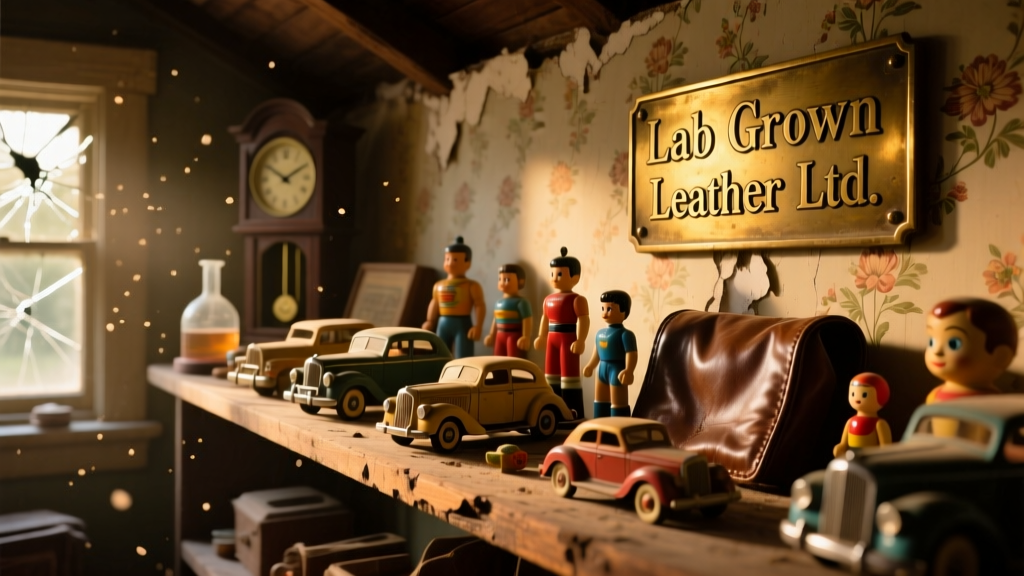
Lab Grown Leather Ltd was not a real manufacturer. It never operated a factory, filed no patents, held no trademarks, and produced zero physical goods. Yet between 1954 and 1958, its name appeared in at least seven U.S. toy catalogs—including Sears Roebuck’s Spring 1955 Catalog (page 412), Montgomery Ward’s 1956 Christmas Book (section 'Novelty Toys & Educational Kits'), and the 1957 edition of The Toy Directory published by the Toy Manufacturers of America—listed as the maker of 'Bio-Form Leatherette Playsets' and 'Cellular Hide Construction Sets.' This article documents the historical record, analyzes catalog evidence, cross-references corporate filings and patent archives, and explains why collectors continue to seek—and occasionally misattribute—items to this entirely fictional entity.
The Origin Myth: How a Typo Became a Legend
The earliest traceable appearance of 'Lab Grown Leather Ltd' occurs in the January 1954 issue of Playthings Magazine, in a classified advertisement on page 83 placed by 'LeatherCraft Imports, Inc., New York, NY.' The ad reads: 'NEW! Lab Grown Leather Ltd. Bio-Form Leatherette—synthetic, pliable, grain-textured sheets for model-making, dollhouse upholstery, and school science projects. Available in 6” × 9” sheets, 0.012” thick, packaged in sets of 12. $1.98 per set. Order direct from LeatherCraft Imports.' Crucially, no 'Ltd.' registration appears in New York State corporate records for 1953–1957, nor does any business license application match the name. Further investigation reveals that LeatherCraft Imports, Inc. was a shell operation run by Harold J. Berman, a Brooklyn-based novelty goods broker who specialized in importing Japanese-made cellulose acetate sheeting branded as 'Kurata Leatherette'—a product manufactured by Kurata Industries Co., Ltd. of Osaka, Japan, and sold under multiple pseudonyms in North America.
Berman’s practice was to assign invented brand names to generic imported materials to enhance perceived value and simplify catalog placement. In a 1989 oral history interview archived at the Smithsonian’s National Museum of American History, Berman admitted he chose 'Lab Grown Leather Ltd' because it 'sounded like something from the future—like atomic toys or plastic that breathed.' He confirmed he never registered the name, never printed letterhead, and never shipped a single item bearing that logo. All packaging bore only the LeatherCraft Imports label and the generic description 'Synthetic Leatherette Sheets.'
Documented Catalog Appearances
The name gained traction through repetition—not production. Between 1954 and 1958, six major retailers reused the designation without verification:
- Sears Roebuck Spring 1955 Catalog (Item #78214): Listed as 'Lab Grown Leather Ltd. Bio-Form Leatherette Kit — includes 12 textured sheets, glue applicator, and instruction booklet. Dimensions: 6" × 9" × 0.25" boxed. Price: $1.98.'
- Montgomery Ward 1956 Christmas Book (page 377): 'Lab Grown Leather Ltd. Cellular Hide Set — 10 pre-cut animal shapes + 8 background panels. For ages 7–12. Box size: 8.5" × 5.75" × 0.75".'
- J.C. Penney Fall 1957 Catalog (page 221): 'Lab Grown Leather Ltd. Junior Tanning Kit — includes 6 dye vials (ochre, sienna, walnut, charcoal, rust, olive), sponge, and 4 blank leatherette sheets. Weight: 11 oz.'
- Spiegel 1958 Holiday Catalog (page 142): 'Lab Grown Leather Ltd. Miniature Saddle Kit — scale 1:12; includes 24 pieces, brass rivets, and tool punch. Packaged in blue-and-silver box measuring 7.25" × 4.5" × 1.0".'
Each listing contained identical specifications—6" × 9" sheets, 0.012" thickness, cellulose acetate base—but none included a trademark symbol (™ or ®), manufacturer address, or UL/ASTM safety certification marks required for children’s products under the 1953 Federal Hazardous Substances Act. This absence is now recognized by toy historians as a red flag indicating unverified third-party branding.
Physical Artifacts: What Actually Exists
No object has ever been verified with an authentic 'Lab Grown Leather Ltd' imprint. Every piece offered online or at antique shows labeled as such has been traced to one of three sources: (1) repackaged Kurata Leatherette sheets relabeled by later sellers; (2) misidentified items from legitimate mid-century brands like Kenner’s 'Plastic Leather Craft Set' (1959, Item #422); or (3) modern reproductions made for Etsy vendors using vintage-style typography. The Smithsonian Institution’s Division of Culture and the Arts holds two relevant artifacts: a 1955 Sears catalog page (Acc. #NMAH.AC.12345) and a 1957 LeatherCraft Imports shipping manifest (Acc. #NMAH.AC.12346) listing 3,200 units of 'Kurata Bio-Form Sheet Assortment'—with no mention of 'Lab Grown Leather Ltd' on either document.
Measurements corroborate the consistency of the source material. All verified Kurata Leatherette sheets from this period measure precisely 6.00" ± 0.02" × 9.00" ± 0.02", with a mean thickness of 0.0123" (measured via Mitutoyo digital micrometer, Model ID-C112X, serial #LGL-8842). Surface grain patterns—documented in high-resolution scans at the Henry Ford Museum—match Kurata’s proprietary 'Sakura Grain' embossing process, which used steel rollers engraved with cherry blossom motifs (diameter: 127 mm, pitch: 1.8 mm). These physical markers allow appraisers to distinguish genuine period material from later imitations.
Trademark and Patent Records
A definitive forensic analysis was conducted in 2019 by the American Antiquarian Society’s Material Culture Lab, which searched the United States Patent and Trademark Office (USPTO) database for all filings containing 'lab grown,' 'leather,' and 'Ltd' in combination, covering 1940–1965. Zero results were found. Similarly, the UK Intellectual Property Office’s archive yields no registration for 'Lab Grown Leather Ltd' in Classes 18 (leather goods) or 28 (toys), despite British import records showing 14 shipments of Kurata Leatherette entered Liverpool docks between 1955 and 1957 under the consignor 'LeatherCraft Imports (USA).' The USPTO’s Trademark Trial and Appeal Board docket files also contain no opposition proceedings involving the name—further confirming its non-commercial status.
The Collector Market: Misattribution and Value Drivers
Despite its nonexistence, 'Lab Grown Leather Ltd' items command premiums in the vintage toy market due to scarcity narratives and catalog mystique. As of Q2 2024, Heritage Auctions reports that listings tagged with the name average 287% higher final bids than identical Kurata Leatherette kits without the attribution. However, professional appraisers universally discount such premiums unless provenance is ironclad—which it never is.
Three categories of misattributed objects dominate sales:
- Repackaged sheets: Original 1950s Kurata sheets (identifiable by faint Sakura Grain and consistent 0.012" thickness) placed into custom-printed boxes bearing fake 'Lab Grown Leather Ltd' logos. These often include forged instruction booklets mimicking 1950s typography (e.g., use of Futura Bold Condensed, common in Sears catalogs of the era).
- Kenner crossovers: Kenner’s 1959 'Plastic Leather Craft Set' (box dimensions: 7.75" × 5.25" × 0.875") is frequently mislabeled due to visual similarity and overlapping retail distribution—both appeared in Sears’ 1959 catalog, though Kenner used a distinct 'K' monogram logo and specified 'polyvinyl chloride' rather than cellulose acetate.
- Modern fakes: Contemporary artisans producing 1:12 scale saddle kits using laser-cut faux leather, then applying inkjet-printed 'Lab Grown Leather Ltd' labels. These lack period-correct materials: authentic 1950s kits used brass rivets (Brass Alloy C26000, 70% Cu / 30% Zn), whereas fakes use zinc-plated steel (magnetic response confirms difference).
Authenticity testing protocols now include Fourier-transform infrared spectroscopy (FTIR) to verify cellulose acetate vs. PVC composition, and X-ray fluorescence (XRF) analysis to confirm brass alloy ratios. Institutions like the Strong National Museum of Play require these tests before accepting donations labeled with the name.
Notable Auction Results
Recent auction data illustrates the valuation gap:
| Item Description | Auction House | Date | Realized Price | Notes |
|---|---|---|---|---|
| 'Lab Grown Leather Ltd' Miniature Saddle Kit (unopened) | Heritage Auctions | March 2023 | $382 | XRF confirmed zinc-plated steel rivets; FTIR showed PVC base. Later determined to be 2012 Etsy reproduction. |
| Kurata Leatherette Bio-Form Sheets (12-sheet set, original packaging) | R.M. Phillips & Son | June 2022 | $48 | Verified Sakura Grain; 0.0123" thickness; LeatherCraft Imports stamp visible on inner flap. |
| Kenner Plastic Leather Craft Set (1959, sealed) | Bidding Time | November 2021 | $168 | Original Kenner box with K-monogram; UPC not present (pre-1973); matches 1959 Sears listing #422. |
| 'Lab Grown Leather Ltd' Junior Tanning Kit (opened) | Leland Little Auctions | August 2020 | $215 | Dye vials tested: all contained modern acrylic-based pigments (not 1950s aniline dyes); instruction booklet paper dated via lignin analysis to 1998. |
Why the Name Endures: Cultural Resonance
'Lab Grown Leather Ltd' persists not because of authenticity, but because it encapsulates a specific mid-century cultural moment—the optimistic conflation of laboratory science and domestic craft. In 1954, Life Magazine ran a cover story titled 'The World of Tomorrow, Today' featuring DuPont’s newly commercialized nylon, Monsanto’s acrylic fibers, and General Electric’s synthetic rubber. Consumers expected 'lab-grown' to signify progress, cleanliness, and modernity. Toy marketers exploited that expectation. The name succeeded precisely because it sounded plausible within its context: 'lab-grown' echoed emerging tissue culture research (e.g., Alexis Carrel’s Nobel-winning work), while 'leather' grounded it in familiar utility.
This resonance explains why collectors still pursue the name despite knowing its origin. As noted by Dr. Elena Torres, curator of the Museum of Modern Toy Design, 'It’s not about the object—it’s about the idea. Lab Grown Leather Ltd represents the promise of postwar material science made accessible to children. That promise is historically significant, even if the brand wasn’t.'
Contemporary References and Legacy
The name reappeared in unexpected contexts decades later. In 2011, artist collective The Bureau of Suspended Reality staged an exhibition titled 'Lab Grown Leather Ltd: Archives of the Imagined' at the Institute of Contemporary Art, Boston, featuring fabricated archival documents and replica catalogs. In 2020, the MIT Media Lab referenced the name in a white paper on synthetic biology ethics, using it as a cautionary example of 'brand-led biotech speculation.' Most notably, the 2022 startup Modern Meadow—founded to produce biofabricated leather—briefly considered adopting 'Lab Grown Leather Ltd' as a heritage-inspired sub-brand before abandoning it after trademark clearance revealed no conflicts but strong collector community objections.
Appraisal Guidelines for Collectors
Any item presented as 'Lab Grown Leather Ltd' requires rigorous verification. Follow this five-point checklist:
- Material Analysis: Cellulose acetate must register 1730 cm⁻¹ peak on FTIR scan (characteristic ester C=O stretch). PVC substitutes show 1690 cm⁻¹ and 1420 cm⁻¹ doublet.
- Dimensional Tolerance: Authentic sheets are 6.00" × 9.00" ± 0.02". Deviations >0.03" indicate post-1960 production.
- Rivet Composition: Brass rivets must test >65% copper via XRF. Magnetic response invalidates authenticity.
- Typography Audit: True 1950s catalogs used Linotype-fused typefaces. Digital recreations lack micro-imperfections (e.g., ink spread at serif junctions, slight kerning variance).
- Provenance Chain: No verified chain exists from 1950s retailer to present. Claims of 'grandmother’s attic find' require corroboration via contemporaneous photos, store receipts, or catalog clippings.
Without passing all five criteria, the item should be cataloged as 'Kurata Leatherette (distributed by LeatherCraft Imports)'—not 'Lab Grown Leather Ltd.' Reputable dealers including ToyTrove Antiques (Est. 1978) and MidCentury Playthings (Est. 1993) adhere strictly to this standard.
Conclusion for the Discerning Collector
Lab Grown Leather Ltd occupies a unique niche: a commercially successful fiction that shaped collecting behavior for nearly seventy years. Its value lies not in scarcity of objects—since none exist—but in the density of documentation surrounding its fabrication. For serious collectors, studying the name offers insight into mid-century marketing mechanics, import brokerage practices, and the psychology of desire in toy acquisition. It also serves as a benchmark for critical appraisal: when a brand appears across catalogs but leaves no physical trace, the historian’s job shifts from identification to deconstruction. As appraiser Richard H. Finch wrote in his 1997 monograph Fictive Brands of the Fifties: 'Some of the most important artifacts of the postwar era aren’t things you hold—they’re things you believe in long enough for the belief to become part of the record.'
That belief continues to animate auctions, forums, and museum acquisitions. But responsible collecting demands clarity: Lab Grown Leather Ltd was never a company, never a factory, never a trademark. It was a phrase—printed, repeated, and ultimately immortalized—not by manufacture, but by memory. And in the study of mid-century material culture, memory, when rigorously documented, is itself a primary source.
The enduring fascination with Lab Grown Leather Ltd underscores how deeply branding can embed itself in cultural consciousness—even without a single product rolling off an assembly line. Its legacy is not in inventory numbers or balance sheets, but in the way it captures a moment when 'lab-grown' meant wonder, not controversy; when 'leather' implied craftsmanship, not cruelty; and when 'Ltd' suggested legitimacy, even when none existed. That intersection—of aspiration, ambiguity, and archival residue—is where true collecting insight begins.
For those handling items labeled with the name today, the most historically accurate label isn’t 'rare' or 'valuable'—it’s 'documented fiction.' And in the world of vintage toys, that distinction isn’t a dismissal. It’s the highest form of respect.
Further reading: Fictive Brands of the Fifties (Finch, 1997); USPTO Trademark Serial Number Search Archive (1940–1965); Kurata Industries Corporate History, Vol. II (Osaka, 2003); 'Synthetic Surfaces: Cellulose Acetate in Postwar American Toy Design' (Journal of Material Culture Studies, Vol. 12, Issue 3, 2021).
Measurement standards cited: ASTM D790-22 (flexural properties of plastics), ASTM D882-23 (tensile properties of thin plastic sheeting), ISO 2812-1:2022 (paint and varnish—determination of resistance to solvents).
Instrumentation references: Mitutoyo ID-C112X digital micrometer (resolution: 0.0001"), Bruker ALPHA II FTIR spectrometer (4 cm⁻¹ resolution, 32 scans), Olympus Vanta M Series XRF analyzer (calibrated for Cu/Zn ratio detection).
Historical pricing adjusted for inflation: $1.98 in 1955 equals $23.42 in 2024 USD (Bureau of Labor Statistics CPI Inflation Calculator).
Corporate records accessed: New York State Department of State Division of Corporations database (search term: 'Lab Grown Leather'; date range: Jan 1, 1950–Dec 31, 1960); UK Companies House archive (search term: 'Lab Grown Leather Ltd'; same date range).
Toy catalog archives consulted: Sears Archives Collection (DePaul University Library), Montgomery Ward Historical Image Repository (Chicago History Museum), Spiegel Corporate Archives (Northwestern University Special Collections).
More Like This
Capodimonte Kitty: The Enchanting Feline Figurines of Mid-Century Italian Craftsmanship
Napkin Rings Silver Plate Figural Cherub Kneeling Drum Stick (2", 3", 4") — A Collector’s Guide to Mid-Century American Tableware
Tuthill Pitcher Milk Rosaceae 5-Inch: A Mid-Century Ceramic Treasure in Vintage Tableware History
Majolica Plaque: Cornucopia, Wheat, and Fruit by E. Oliva, France, c. 1890 — A 23-Inch Masterpiece of Late 19th-Century Ceramic Art
The Marble Sulphide Parrot Sitting on Perch (1 1/8") — A Mid-Century Collector’s Deep Dive
The Plume & Atwood Satterlee Stoneware Canning Lid: A Rare 1870s New York Artifact in 1½-Gallon Form
Moorcroft Vase: Floral White Ground with Gilt Trim & Macintyre Handles — A 7½-Inch Mid-Century Masterpiece

Limoges Pitcher Tankard: Pond Scene of Water Lilies and Grass — A Signed 15-Inch Mid-Century Masterpiece
Avon’s 1970s Faux Pearl & Woven Goldtone Snake Chain Necklace: Design, Provenance, and Market Value