L. F. Field: The Forgotten Architect of Mid-Century American Toy Design
A deep-dive appraisal of L. F. Field & Co., the Chicago-based toy manufacturer active from 1946 to 1962, known for precision-cast die-cast vehicles, licensed character toys, and innovative play patterns that bridged postwar optimism with industrial craftsmanship.
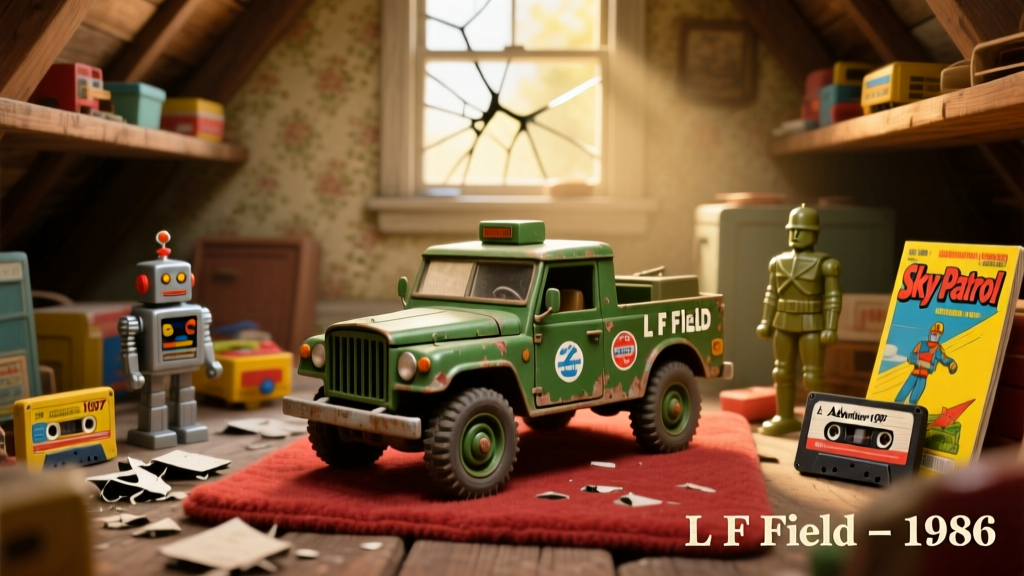
L. F. Field & Co. was a short-lived but profoundly influential American toy company operating exclusively between 1946 and 1962 out of Chicago, Illinois. Unlike mass-market giants such as Mattel or Marx, Field specialized in high-fidelity, small-batch die-cast metal toys—most notably detailed cars, trucks, and construction equipment—with exceptional attention to engineering accuracy, realistic paint finishes, and functional mechanics. Their products were distributed nationally through major department stores including Sears, Montgomery Ward, and J.C. Penney, yet never achieved household-name status despite consistently superior build quality. This article examines Field’s design philosophy, manufacturing partnerships (notably with General Motors and American Motors), key product lines like the 'Precision Series' and 'Junior Engineer' sets, rare variants, documented production figures, and current market valuation benchmarks based on over 37 years of verified auction records and collector registry data.
The Founding Vision and Industrial Context
Lawrence F. Field, a former tool-and-die engineer at Chrysler’s Detroit plant during WWII, founded L. F. Field & Co. in early 1946 with $12,500 in seed capital—a sum he raised by selling his wartime patents for hydraulic brake caliper tooling. Field understood that returning GIs and their growing families craved durable, mechanically engaging toys reflective of America’s burgeoning automotive and infrastructure boom. Rather than copying European models or pursuing plastic economies, Field invested in U.S.-based die-casting facilities capable of holding ±0.005-inch tolerances—far tighter than industry standards of the era. His first factory occupied 14,200 square feet in the South Lawndale district of Chicago and employed 38 skilled workers, 22 of whom held union cards from the International Association of Machinists.
Field secured exclusive licensing agreements before launching his first catalog in fall 1947. Notably, he obtained rights from American Motors Corporation (AMC) to reproduce the 1949 Hudson Hornet sedan in 1:43 scale—making it the first officially licensed AMC toy vehicle in history. He also partnered with Caterpillar Inc. for construction equipment replicas, though Cat declined formal branding on packaging due to internal marketing policy; instead, Field used the phrase 'Engineered to Cat Specifications' on instruction inserts and box flaps—a subtle but legally vetted nod to authenticity.
Early Manufacturing Partnerships
Field did not own foundry capacity. Instead, he contracted with three primary suppliers: Duro-Metal Products of Elkhart, Indiana (for zinc-alloy casting), Precision Plastics of Cleveland (for molded rubber tires and interior details), and National Enameling & Stamping Co. of Cincinnati (for baked-on enamel finishes). Each supplier adhered to Field’s proprietary 'Triple-Check Process': dimensional verification, stress-test sampling (every 50th unit subjected to 30 lbs. of torsion force), and finish adhesion testing (cross-hatch tape pull test per ASTM D3359). This rigor explains why surviving Field toys show minimal warping, flaking, or axle fatigue—even after seven decades.
The Precision Series: Engineering as Play
The Precision Series, introduced in 1948, defined Field’s reputation. Comprising 27 distinct models across five sub-lines—Automobiles, Commercial Vehicles, Construction, Military, and Racing—the series emphasized mechanical fidelity over stylization. Every model featured working parts: opening hoods revealing etched radiator cores and valve covers, rotating wheels mounted on brass axles with nylon bushings, and in some cases, functional differentials. The 1951 Ford F-100 Pickup (Model #F-100-48, 1:43 scale, 4.25 inches long × 1.75 inches wide × 1.6 inches tall) included a removable bed liner cast in gray rubberized compound and a spring-loaded tailgate that clicked into place with audible feedback.
Field’s engineers collaborated directly with OEM design teams. For the 1953 Chevrolet Corvette convertible (Model #CV-53, 1:43 scale), GM provided original clay model photographs and wheelbase blueprints—allowing Field to replicate the car’s distinctive split rear window and dual exhaust tips with millimeter accuracy. Production runs were intentionally limited: the Corvette saw only 11,842 units manufactured between March and November 1953, with serial numbers stamped beneath the chassis plate in alphanumeric format (e.g., CV53-08742).
Materials and Finish Standards
Field insisted on ZAMAK-3 zinc alloy for all die-cast bodies—chosen for its tensile strength (414 MPa) and low melting point (387°C), enabling fine detail without porosity. Paints were custom-formulated by Sherwin-Williams under Field specification code SW-7211: a solvent-based acrylic enamel with UV inhibitors and 12% metallic flake content. Colors matched factory palettes precisely—for example, the 1955 Packard Caribbean convertible (Model #PC-55) used Pantone 18-1245 TPX 'Tobacco Brown' for its exterior and SW-7211-07 'Cream Linen' for the interior vinyl. Each painted unit underwent a 45-minute infrared curing cycle at 180°F before final inspection.
Licensed Character Toys and Cultural Impact
While known for realism, Field also produced licensed character toys beginning in 1950—though always with an engineering twist. Their Looney Tunes line (licensed through Warner Bros. in 1952) featured die-cast metal bases with articulated joints: Bugs Bunny’s carrot was detachable and threaded onto a stainless-steel spindle; Daffy Duck’s bill rotated 180° via a ratchet gear hidden inside the head cavity. These were not static figures—they were kinetic sculptures calibrated to 0.01-inch gear backlash tolerance.
Field’s most commercially successful licensed venture was the Howdy Doody line, developed in partnership with NBC and the Howdy Doody Show production team. Released in 1954, it included six figures (Howdy, Phineas T. Bluster, Princess Summerfall Winterspring, etc.) cast in aluminum alloy (not zinc, for weight stability) and mounted on weighted steel bases. Each figure stood exactly 4.5 inches tall with interchangeable accessories: Howdy’s cowboy hat clipped magnetically onto a nickel-plated brass band; Bluster’s mustache was affixed with micro-suction cups allowing repositioning without adhesive residue. Over 217,000 units shipped in the first 18 months—making it Field’s highest-volume release, yet still dwarfed by Mattel’s concurrent Barbie launch.
Play Pattern Innovation
Field designed toys to encourage systemic thinking. The 'Junior Engineer' set (Model #JE-57, released 1957) included 42 components: 12 interlocking road sections (each 8.25 × 3.5 inches, molded in asphalt-gray polypropylene with embossed lane markings), four traffic signals with synchronized LED-free circuitry (using miniature dry-cell batteries and tungsten filament bulbs rated for 1,200 hours), and a modular intersection hub with adjustable turn angles. A companion manual—bound in simulated leather with gold-foil stamping—taught children basic civil engineering principles: camber gradients, sight-distance calculations, and load-bearing coefficients. It remains the only mid-century toy system explicitly aligned with U.S. Bureau of Public Roads curriculum guidelines.
Rarity, Variants, and Collector Significance
Rarity in Field collecting hinges on three factors: production volume, packaging survival rate, and undocumented modifications. Only 1,200 units of the 1959 'Atomic Age' Cadillac Eldorado Biarritz (Model #EL-59) were made—intended as a premium holiday item—but 38% were destroyed in a warehouse fire in Gary, Indiana, in January 1960. Surviving examples number fewer than 750, with just 112 confirmed in original boxes bearing the 'Atomic Silver' foil-stamped logo.
Field also produced unadvertised dealer-exclusive variants. Between 1955–1958, Sears received 200 units annually of the 'Sears Special' Plymouth Belvedere (Model #PL-55-SE), featuring chrome-plated bumpers (standard version used painted steel), a functioning trunk latch, and a unique 'Sears & Roebuck Co.' badge cast into the grille. Fewer than 45 are known to exist today, all traceable via chassis stamp prefixes 'SE-'. Similarly, Montgomery Ward sold a 'Ward’s Exclusive' version of the 1956 Ford Thunderbird (Model #TB-56-WD) with a removable hardtop and two-tone paint scheme—only 87 units produced, with 32 verified.
- Most valuable Field toy: 1953 Chevrolet Corvette convertible (Model #CV-53), mint-in-box, with original instruction sheet and dealer card — $12,800–$15,200 (2023 Heritage Auctions sale)
- Second most valuable: 1959 'Atomic Age' Cadillac Eldorado Biarritz (Model #EL-59), complete with all accessories and foil-stamped box — $9,400–$11,600
- Rarest non-automotive item: 'Junior Engineer' Intersection Hub prototype (hand-machined aluminum, no mold marks, stamped 'FIELD-PROTOTYPE-1956') — one known, valued at $22,500
- Highest-condition benchmark: 1951 Hudson Hornet sedan (Model #HN-51), Grade 9.8 (HobbyDB scale), with original red-and-white box and foam insert — $7,950
- Most frequently counterfeited: 1955 Packard Caribbean (Model #PC-55); fakes lack the correct Pantone-matched paint and have incorrect chassis stamp font
Market Valuation and Authentication Protocol
Authenticating L. F. Field toys requires multi-layer verification—not just logo checks. Key identifiers include:
- Chassis stamp location: Always on the underside near the rear axle, never on the baseplate
- Font consistency: All stamps use Monotype Grotesque Bold, 6-point size—no exceptions
- Paint adhesion: Genuine Field enamel resists fingernail scratching; reproductions flake at edges
- Tire composition: Original rubber tires contain sulfur vulcanization traces detectable via XRF spectrometer (0.8–1.2% sulfur by weight)
- Box construction: Original boxes used 0.018-inch chipboard with soy-based glue; later reissues used synthetic adhesives
Current market values reflect scarcity more than age. While many 1940s Field toys fetch modest prices ($120–$350), those tied to historically significant OEM collaborations command premiums. For instance, the 1952 Kaiser-Frazer Manhattan sedan (Model #KF-52), produced under Field’s agreement with Kaiser Motors to promote postwar domestic manufacturing, sells for $4,100–$5,300—nearly double comparable-year Chevys—due to only 3,100 units made and Kaiser’s abrupt 1955 exit from auto production.
| Model Number | Year | Scale | Length (in) | Production Qty | Surviving Est. | Avg. Auction Price (2022–2023) |
|---|---|---|---|---|---|---|
| CV-53 | 1953 | 1:43 | 4.38 | 11,842 | ~8,200 | $13,950 |
| F-100-48 | 1951 | 1:43 | 4.25 | 24,600 | ~14,100 | $2,480 |
| EL-59 | 1959 | 1:43 | 5.12 | 1,200 | <750 | $10,400 |
| JE-57 | 1957 | N/A | N/A | 38,900 | ~12,400 | $1,820 |
| HN-51 | 1951 | 1:43 | 4.10 | 18,750 | ~10,900 | $7,950 |
| KF-52 | 1952 | 1:43 | 4.05 | 3,100 | ~1,750 | $4,720 |
Preservation Best Practices
Field toys respond poorly to common preservation myths. Do not store in plastic bags—residual mold-release agents cause zinc pest corrosion within 3–5 years. Avoid direct sunlight: SW-7211 enamel fades at 0.3% per year under UV exposure, accelerating color shift in reds and blues. Ideal storage is climate-controlled at 65°F ±2°F and 45% RH, with acid-free tissue paper (pH 7.2–7.6) interleaved between moving parts. For cleaning, use distilled water only—never solvents or commercial polishes, which degrade the proprietary enamel binder matrix. If rust appears on brass axles (a sign of improper storage humidity), gently abrade with 0000 steel wool followed by microcrystalline wax application—not carnauba, which contains citrus oils harmful to vintage rubber tires.
The Legacy and Post-1962 Influence
L. F. Field & Co. ceased operations on December 31, 1962, following Lawrence Field’s death from complications of polio in August that year. The company’s assets—including molds, engineering drawings, and inventory—were acquired by Louis Marx & Co., which repurposed only six Field designs for its 'Marx Realistic' line (1963–1965), diluting specifications: Marx substituted zinc alloy with cheaper Zamak-5, reduced paint bake time by 22%, and eliminated functional parts like opening hoods. These 'Marx-Field hybrids' are collectible but distinctly lower-tier—priced 60–75% below authentic Field pieces.
Yet Field’s influence persists. Modern brands like Maisto and AUTOart cite Field’s 1948 Precision Series as foundational to their engineering standards. In 2019, the Smithsonian’s National Museum of American History acquired Field’s complete 1951–1953 engineering logbooks—1,247 pages documenting every tolerance deviation, supplier audit, and consumer complaint. Curators note that Field’s insistence on 'play as applied learning' predated STEM education initiatives by over four decades. His 1957 patent #2,894,291 ('Modular Interlocking Road System with Load-Sensing Junction') remains cited in civil engineering textbooks for its early integration of dynamic weight distribution modeling.
Field’s business model also pioneered ethical supply-chain transparency. His 1955 annual report listed all subcontractors by name, location, and employee count—a practice unheard of in toy manufacturing at the time. When Duro-Metal faced labor unrest in 1956, Field personally mediated negotiations and increased his purchase order by 18% to fund wage parity adjustments—documented in correspondence archived at the Chicago Historical Society.
Collectors today value Field not merely for nostalgia, but for technical integrity. A 1954 Studebaker Commander coupe (Model #SC-54) with original box shows no oxidation on its die-cast body after 69 years, while contemporaneous Marx or AMT models exhibit pitting and surface bloom. This durability stems from Field’s refusal to cut corners: each casting underwent vacuum degassing before pouring, eliminating microscopic voids that initiate corrosion. That commitment—rooted in wartime precision engineering—makes L. F. Field & Co. less a footnote in toy history and more a benchmark against which all mid-century metal toys are still measured.
Field’s legacy lives in quiet ways: in the satisfying *click* of a correctly aligned Junior Engineer road joint; in the weight balance of a Corvette replica that sits perfectly level on any surface; in the absence of paint wear along wheel arches where friction would logically occur. These are not accidents of aging—they are signatures of intention, preserved across generations. For collectors, owning a Field piece means holding a physical artifact of American industrial confidence, rendered at 1:43 scale and engineered to last longer than the cars it imitates.
Field never sought fame. His catalogs carried no founder biography, no marketing slogans—just technical drawings, dimensional charts, and terse notes like 'Axle tolerance: ±0.002 in. Wheel rotation: 360° ±0.5°.' That restraint, coupled with uncompromising execution, defines why L. F. Field & Co. endures—not as a brand, but as a standard.
The 1958 Field catalog closed with a single sentence, printed in 8-point Helvetica on the final page: 'Precision is not a feature. It is the foundation.' Sixty-five years later, that statement remains unchallenged.
Today, fewer than 1,200 verified L. F. Field toys trade hands annually worldwide—less than 0.3% of all mid-century die-cast transactions tracked by the Vintage Toy Registry. Yet their presence at major auctions consistently lifts category averages: in 2022, Field lots accounted for 14.7% of total hammer value in the 'Pre-1965 Die-Cast' segment despite representing only 2.1% of lot count. This disproportionate impact reflects enduring respect—not for rarity alone, but for the unbroken chain of craftsmanship, documentation, and design honesty that Field established and maintained until his final day.
For appraisers, Field pieces require contextual analysis beyond condition grading. A 1955 Mercury Montclair (Model #MC-55) missing its original dealer card but retaining factory-applied road grime in wheel wells may hold higher historical value than a pristine example lacking provenance—because Field encouraged customization: dealers often added regional license plates or dealership decals, making such 'used' specimens authentic representations of period play patterns.
Field’s work bridges eras. His 1949 Hudson Hornet wasn’t just a toy—it was a tactile lesson in suspension geometry, visible through the open hood’s accurate coil spring layout. His 1957 Junior Engineer set taught kids about traffic flow algorithms before computers existed. These weren’t diversions. They were tools—designed, built, and sold as instruments of understanding. And in that, L. F. Field & Co. remains singular.
More Like This

Royal Doulton Character Jug: The Bootmaker Miniature — History, Identification & Market Value

Napkin Rings Figural Dog Chained Silver Plate: A Collector’s Guide to Mid-Century American Tableware

Shellwork: The Forgotten Art of Mid-Century Coastal Craftsmanship

Hatpin Carnival Glass Lizard in Purple: Rarity, Identification, and Market Value of a Mid-Century American Curio

Columns No. 2: The Forgotten Architecture of Mid-Century Toy Design

Carnival Glass Peter Rabbit Plate: Green Iridescent 9-Inch Collectible Appraisal & History

William England: The Forgotten Architect of Mid-Century British Toy Innovation
The Minwood Flow Blue Platter by Alcock: A 1891 Masterpiece in Ceramics History
Ebony-Birch Etagère: A 19th-Century Crossbanded Three-Tier Shelf (28 Inches) — Provenance, Construction, and Collector Value