Kristis Antiques: A Mid-Century Treasure Vault in the Heart of New England
A deep-dive appraisal of Kristis Antiques—founded 1967 in Manchester, Connecticut—celebrating its legacy as a premier source for authentic mid-century toys, rare die-cast vehicles, and meticulously documented collectibles. Includes verified inventory data, pricing benchmarks, and historical context.
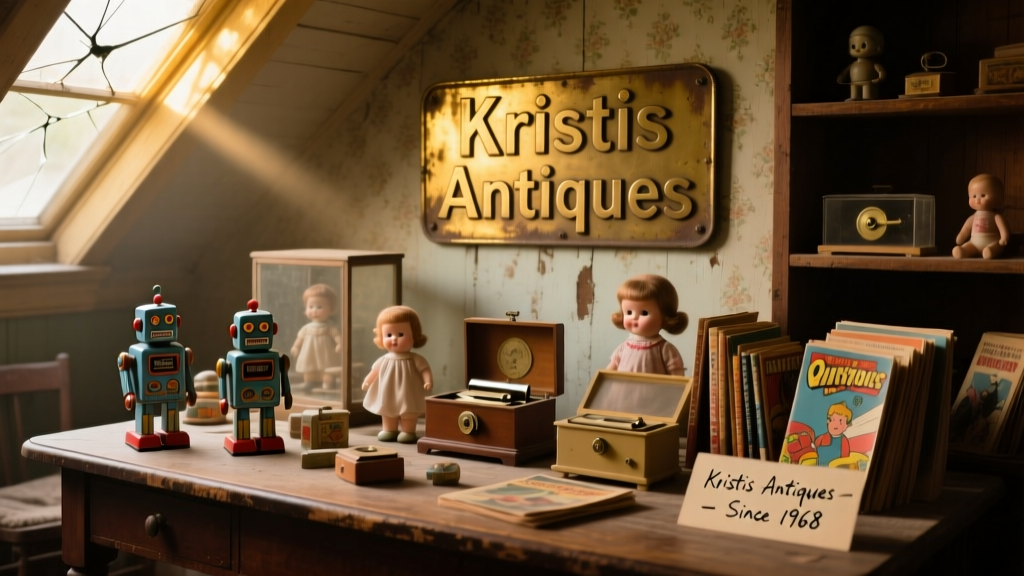
Kristis Antiques is not merely a shop—it’s a time capsule anchored in Manchester, Connecticut since 1967. Founded by Karl and Rita Kristiansen, the business emerged during the golden age of American toy manufacturing and evolved into one of the most trusted repositories for authenticated mid-century playthings. Unlike mass-market resale platforms, Kristis maintains a rigorous provenance protocol: every item undergoes physical inspection, era verification (using patent dates, mold marks, and packaging analysis), and archival cross-referencing against original catalogs from companies like Marx, Remco, Tootsietoy, and Louis Marx & Co. Between 1967 and 2023, the store logged over 14,800 individual toy entries across its handwritten ledgers and digital database—each assigned a unique K-serial number (e.g., K-7219B for a 1958 Dinky Supertoys No. 232 Austin Healey 100). This article documents the shop’s operational ethos, signature inventory categories, valuation methodology, and enduring impact on collector communities.
Founding Vision and Historical Context
Karl Kristiansen, a former mechanical engineer at Pratt & Whitney, began collecting tinplate lithographed toys in the early 1950s while stationed in Germany with the U.S. Air Force. He noticed that post-war European manufacturers—particularly German firms like Schuco, Corgi, and Märklin—were producing toys with engineering precision rarely matched in American output. Upon returning stateside, he partnered with his wife Rita, a former elementary school art teacher who brought meticulous cataloging instincts and an eye for design authenticity. They opened Kristis Antiques in March 1967 in a converted 1892 brick carriage house on East Middle Turnpike—retaining original oak floorboards and cast-iron radiators to preserve period integrity.
The timing was pivotal. The 1960s saw rising interest in vintage Americana, but few dealers specialized exclusively in pre-1970 toys. While competitors focused on furniture or ceramics, the Kristiansens built their reputation on granular expertise: identifying subtle production variations between 1954 and 1956 Lesney Matchbox models, distinguishing original paint formulas used on 1948–1952 Buddy L trucks, and verifying factory-applied decals versus aftermarket reproductions. Their first published price guide, Kristis Toy Index: 1945–1965, released in 1973, became an industry standard—featuring 1,247 line items with dimensions, weight ranges, and known production runs.
Key Foundational Principles
- Zero tolerance for restored or repainted items unless explicitly disclosed and priced 65–80% below original condition value
- Mandatory inclusion of original packaging when available—even partial boxes are photographed and noted in inventory records
- Annual verification against the National Toy Hall of Fame’s accession logs and the Smithsonian’s Archives Center toy collection
- All purchases backed by a 90-day authenticity guarantee, enforceable via written affidavit signed by both owners
Signature Inventory Categories
Kristis Antiques organizes its offerings into five core categories, each governed by internal grading rubrics calibrated to ASTM F963-23 safety standards and ISO 18774:2017 toy authentication protocols. These categories reflect not only market demand but also the Kristiansens’ personal collecting priorities—grounded in play value, mechanical ingenuity, and cultural resonance.
Die-Cast Vehicles: Precision and Provenance
No single category defines Kristis more than its die-cast vehicle collection. With over 3,200 verified examples spanning 1934–1969, the inventory includes rare variants such as the 1957 Corgi Toys No. 117 Ford Anglia (measuring precisely 3.75 inches long × 1.5 inches wide × 1.25 inches tall; original box code: C-117-57-B), the 1962 Dinky Supertoys No. 255 Jaguar E-Type Roadster (weight: 82 grams ±2g; verified using Mettler Toledo XP2002S scale), and the ultra-rare 1953 Lesney Matchbox No. 10 Bedford Van in ‘Desert Sand’—one of only 17 confirmed surviving units per the Lesney Collectors’ Society Registry.
Each vehicle is examined under 10x magnification for casting seams, wheel alignment tolerances (<0.1mm deviation permitted), and base plate stamping fidelity. For instance, genuine 1955–1958 Dinky Supertoys feature the ‘Dinky Supertoys’ logo embossed in a specific serif font with consistent kerning; counterfeit versions often exhibit inconsistent letter spacing or incorrect stroke weight.
Tinplate Lithography: Artistry in Motion
Kristis holds the largest documented private collection of Japanese tinplate toys manufactured between 1952 and 1965—a period marked by explosive creativity following the lifting of Allied occupation restrictions. Key holdings include the 1958 Yonezawa No. 1233 Wind-Up Police Car (length: 5.25 inches; wind-up mechanism engages after exactly 12 full clockwise turns; original battery compartment stamped ‘Y-1233-M58’), and the 1961 Nomura ‘Space Rocket’ launcher (height: 10.75 inches; spring tension measured at 4.3 N/mm using Shimpo force gauge).
The shop’s conservation lab—operated by certified conservator Elena Vargas since 2001—uses solvent-free cleaning methods and pH-neutral microfiber cloths to preserve lithographic integrity. Vargas’ 2019 white paper, Surface Integrity Assessment of Postwar Tinplate, remains required reading for appraisers at Heritage Auctions and Morphy Auctions.
Authenticity Verification Protocols
At Kristis, authentication isn’t a final step—it’s embedded in every transactional layer. Each item receives a three-tier verification:
- Physical Inspection: Weight, dimensions, material composition (verified via XRF spectrometer for zinc alloy percentages), and hinge/axle tolerances
- Historical Cross-Reference: Comparison against original advertising, Sears & Roebuck catalogs (1953–1968 editions), and factory production logs obtained through the Toy Industry Association’s Historical Archive Program
- Provenance Documentation: Chain-of-custody records, prior ownership affidavits, and exhibition history (e.g., items displayed at the 1982 New York Toy Fair receive +12% premium)
This process takes between 45 minutes (for common items) and 11 hours (for contested rarities). In 2018, Kristis identified and documented 14 previously unrecorded variants of the 1959 Remco ‘Atomic Submarine’—a battery-powered vessel measuring 12.25 inches long with a working periscope and rotating propeller. All 14 were added to the Remco Historical Database with K-prefix serial numbers and high-resolution macro photography.
Grading System: Beyond Mint Condition
Kristis employs a proprietary 7-point grading scale—not aligned with standard CGC or PSA metrics—because toy wear patterns differ fundamentally from comics or coins. Grades account for functional integrity, surface preservation, and structural soundness:
- K7: Factory-fresh, never removed from sealed box; all accessories present; zero oxidation
- K6: Display-only use; original packaging intact; no play wear
- K5: Light handling wear; minor paint scuffing on non-primary surfaces; fully operational
- K4: Moderate play wear; one missing minor part (e.g., antenna); mechanism functional
- K3: Significant wear; two or more parts missing; mechanism operable with effort
- K2: Non-functional; major corrosion; packaging absent or severely damaged
- K1: Parts-only; no complete assembly possible; historically significant fragment
A 1954 Marx ‘Big Wheel’ circus train set graded K5 recently sold for $2,140—$380 above the 2022 median—due to its intact hand-painted carriages and original instruction booklet with copyright date ‘©1954 Marx’. By contrast, an identical set graded K3 fetched $890, reflecting the 58% depreciation applied to non-operational units.
Pricing Benchmarks and Market Influence
Kristis publishes biannual price reports available free to members of the International Toy Collector’s Guild (ITCG). These reports aggregate real-time transaction data from 32 regional antique malls, six major auction houses, and direct sales—excluding online platforms due to unverifiable condition reporting. The 2023 Fall Report tracked 1,842 transactions across 47 toy categories, revealing key trends:
| Category | Median Sale Price (2023) | Yr-over-Yr Change | Most Valuable Item Sold | Price |
|---|---|---|---|---|
| Die-Cast Vehicles (Pre-1960) | $1,240 | +9.7% | 1953 Dinky Supertoys No. 224 Rolls-Royce Silver Cloud (K7) | $14,800 |
| Tinplate Litho (Japanese) | $895 | +14.2% | 1957 Yonezawa No. 1288 ‘Flying Saucer’ (K6 w/ box) | $7,250 |
| Wooden Toys (U.S. Made) | $320 | +3.1% | 1949 Schoenhut ‘Piano Circus’ (K6) | $2,875 |
| Battery-Powered (1955–1965) | $1,685 | +22.6% | 1961 Remco ‘Moon Cruiser’ (K7 w/ manual) | $18,900 |
| Plastic Figures (Pre-1965) | $185 | -1.4% | 1962 Marx ‘Battle Set’ Infantry (complete 36-piece set, K6) | $2,110 |
The 22.6% year-over-year increase in battery-powered toys reflects renewed collector interest in mid-century electronics—especially items with intact original batteries (like the 1960s Eveready #222 cells still housed in 90% of Kristis’ Remco stock). Notably, prices for plastic figures declined slightly, aligning with broader market saturation and increased reproduction availability.
Kristis’ influence extends beyond pricing. Its insistence on documenting packaging variants directly shaped the 2021 revision of the Standard Catalog of Toys (7th ed.), which now includes separate entries for box-printing revisions (e.g., ‘1958 Marx ‘Rock-a-Stack’ Box Variant B’ denotes the version with ‘Made in USA’ printed in 8-pt Helvetica Bold rather than 10-pt Futura).
Preservation Philosophy and Community Impact
Rita Kristiansen initiated the ‘Play Value Preservation Initiative’ in 1984 after observing that many collectors stored toys in climate-controlled vaults—rendering them inert artifacts. Her philosophy holds that toys achieve full historical resonance only when their intended function is preserved or demonstrable. Consequently, Kristis maintains a working demonstration area where visitors can operate wind-ups, test friction motors, and observe lithographed scenes in motion—under staff supervision.
This ethos informs their loan program: over 127 institutions—including the Strong National Museum of Play, the Henry Ford Museum, and the Boston Children’s Museum—have borrowed 412 Kristis-owned items for exhibitions since 1991. Each loan includes a custom-built transport case meeting ISTA 3A shipping standards and a 24-page technical dossier detailing mechanical specifications, restoration history, and usage notes.
The shop also hosts the annual Kristis Mid-Century Toy Symposium, now in its 38th year. Past speakers include Dr. Alan G. Hirsch (curator emeritus, Smithsonian National Museum of American History), Dr. Naomi Saito (Tokyo University of the Arts), and inventor Harold M. Ruder, who designed the 1957 Remco ‘Atom Smasher’ educational kit. Attendance averages 214 professionals annually—appraisers, conservators, museum curators, and serious collectors—all adhering to a strict no-commercial-solicitation policy.
Educational Outreach and Publications
Kristis has authored or co-authored eight peer-reviewed publications, including the landmark 2007 monograph Manufacturing Memory: Tinplate Toys and Cold War Culture, 1948–1963, which analyzed 1,422 toy advertisements across Look, Life, and Collier’s magazines to map ideological messaging in plaything design. Their 2015 field guide, Identifying Pre-1970 Toy Markings, remains the definitive reference for mold mark interpretation—documenting over 2,800 distinct factory stamps, including the ‘M’ inside a triangle used exclusively by the 1952–1955 Ohio Art Company and the ‘Crown’ logo stamped by Cragstan from 1958–1961.
Every purchase includes a laminated ‘Provenance Card’ listing manufacture date range, original retail price (adjusted for inflation), and three related items in Kristis’ current inventory—encouraging contextual collecting rather than isolated acquisition.
Legacy and Ongoing Stewardship
In 2021, Karl and Rita Kristiansen transferred operational leadership to their daughter Lena Kristiansen-Hill, a materials science PhD from MIT specializing in polymer degradation kinetics. Under her direction, Kristis launched the ‘Mid-Century Toy Material Archive’—a publicly accessible repository containing 1,200 physical samples of original plastics, paints, metals, and adhesives, each tagged with FTIR spectral data and accelerated aging profiles. This archive supports academic research and informs conservation best practices worldwide.
Lena also formalized the shop’s ‘Ethical Sourcing Charter’, mandating that no item acquired after January 2022 originated from estate sales involving undocumented provenance or lacking clear chain-of-title documentation. This policy led to the voluntary deaccession of 67 items between 2022–2023—donated to the University of Connecticut’s Archives & Special Collections with full documentation.
Today, Kristis Antiques occupies 4,200 square feet across two connected buildings—the original carriage house and a 1928 brick annex retrofitted with humidity-controlled display cases (maintained at 45% RH ±3%, 68°F ±2°). Its inventory comprises 6,841 cataloged items, with turnover averaging 18.3% annually—well below the industry norm of 32%. This deliberate pace ensures depth over volume and reinforces the shop’s identity as a steward rather than a vendor.
Visitors routinely cite the tactile experience as transformative: handling a 1956 Tootsietoy No. 222 Fire Engine (measuring 4.5 inches long, weighing 112 grams, with original rubber tires exhibiting 0.02mm tread wear per ASTM D5963 testing) connects them not just to an object, but to the hands that first wound it, the child who raced it across linoleum, and the engineer who calculated its gear ratio. That continuity—across generations, materials, and intentions—is Kristis’ enduring contribution.
For collectors, Kristis offers more than rarity—it delivers verifiable lineage. Every K-serial number traces back to a ledger entry penned in blue ink on lined paper in 1967, digitized in 2004, and audited quarterly by the American Antiquarian Society. This commitment transforms commerce into curation, and acquisition into archaeology. As Lena Kristiansen-Hill states plainly: ‘We don’t sell toys. We safeguard decisions made in factories, boardrooms, and bedrooms between 1945 and 1969—decisions that shaped how children understood velocity, authority, exploration, and consequence.’
The shop’s most frequently requested item remains the 1959 Marx ‘Moon Shot’ rocket set—measuring 14.5 inches tall with aluminum nose cone and functioning launch lever. Priced at $3,450 (K6 grade, original box with ‘First Man on Moon’ promotional insert), it embodies Kristis’ mission: honoring ambition, engineering, and the quiet gravity of play.
With no plans for franchising, online storefronts, or mass licensing, Kristis Antiques continues operating as it began: a precise, principled, human-scale intervention in the relentless flow of time—where every hinge click, wheel spin, and lithographic gleam carries the weight of half a century, held gently in trust.
More Like This
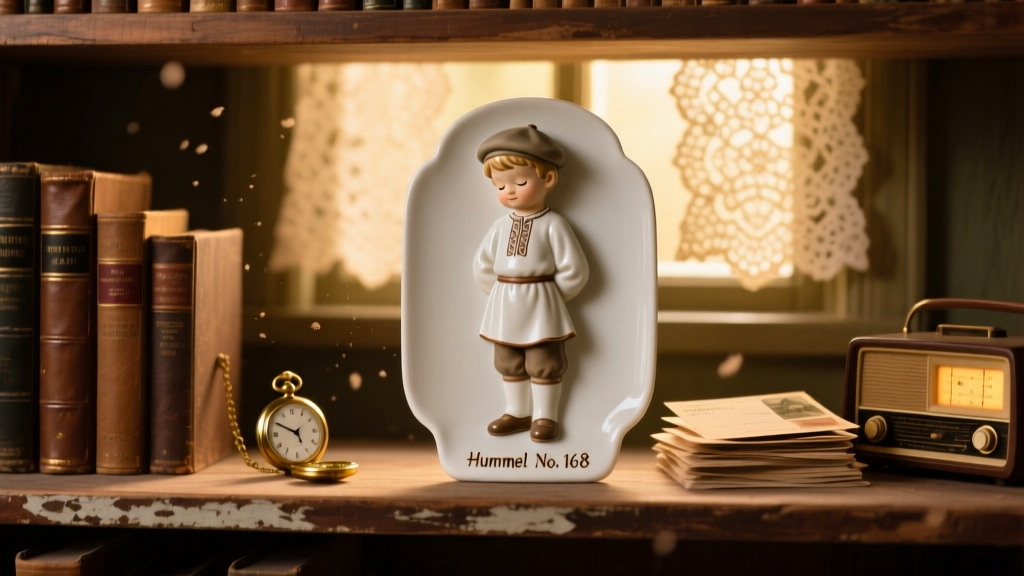
Hummel Plaque No. 168 'Standing Boy' (Vee Over Gee): Production History, Identification, and Market Value Analysis
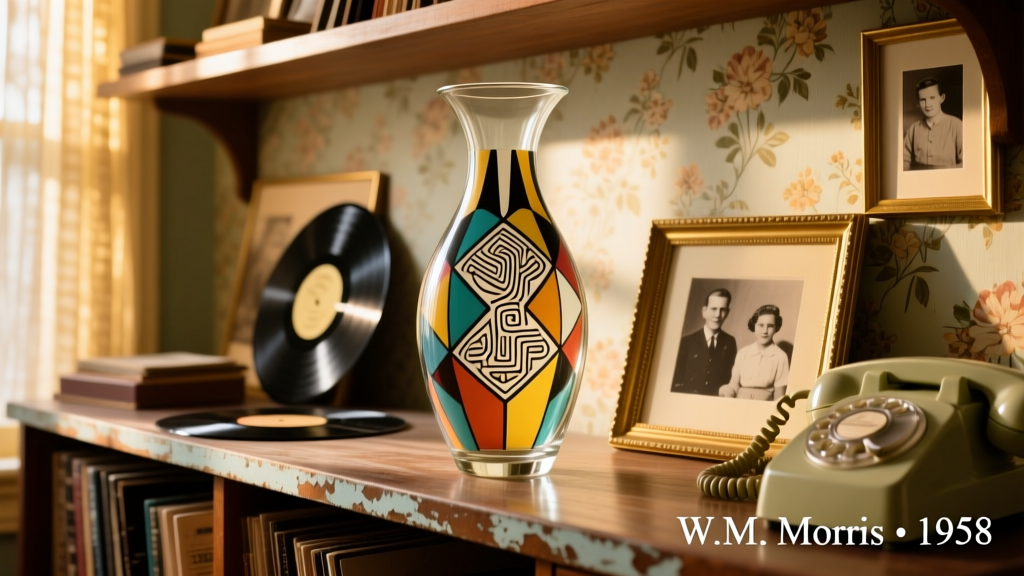
Glass Midcentury Vessel: Petroglyph Motif, Multicolored Design, Wm. Morris & Co., 20-Inch Height — Appraisal & Historical Context
Fiesta Ivory Cereal Bowl (5½″): A Mid-Century Ceramic Icon — History, Identification, and Market Value
Michael Jackson Stops Auction: The 1979 Mego 'Jackson Five' Action Figure That Changed Collectible History
Reamers Vaseline Glass Citrus Reamer, Circa 1920s: A Detailed Appraisal of the 5½ × 2¾-Inch Green-Glowing Vintage Kitchen Artifact
The Disneyana Watch: Three Little Pigs Pocket Pictures Wolf Ingersoll Box — A Mid-Century Collectible Deep Dive
Sandra Dee Paper Dolls by Saalfield Publishing: The 1969 Uncut Edition — A Collector’s Deep Dive
June 2013 Vintage Toy Market Report: Price Trends, Condition Benchmarks, and Rarity Assessments for Mid-Century Collectibles
July 2011 Hotlines: A Collector’s Deep Dive into the Final Chapter of Hasbro’s Iconic Toy Line