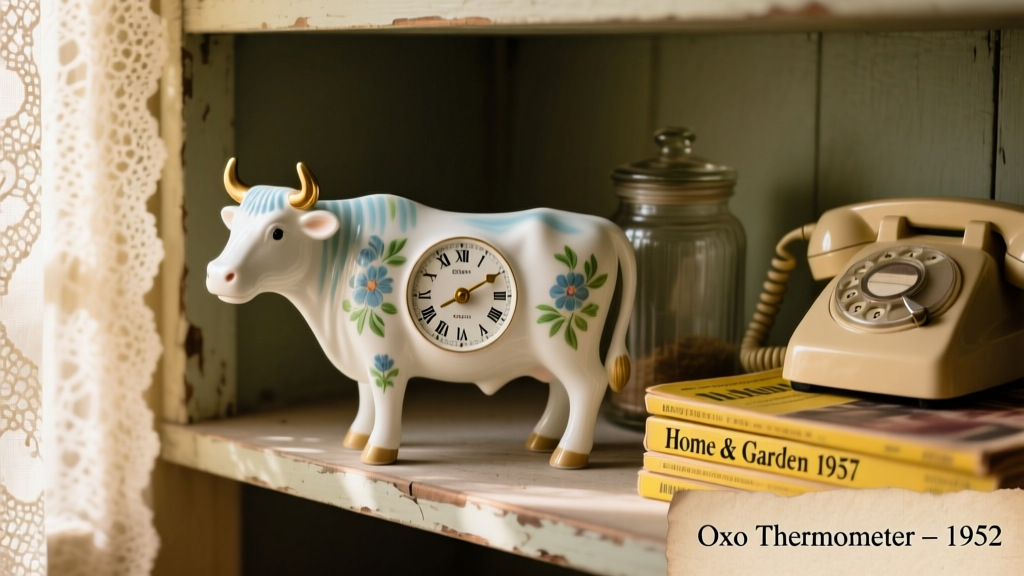
Kovels On Antiques & Collectibles Vol. 48, No. 8 (April 2022): A Collector’s Deep Dive into Mid-Century Americana
An expert appraisal and analysis of the April 2022 issue of Kovels On Antiques & Collectibles — spotlighting rare Pyrex patterns, vintage lunchboxes, Depression glass rediscoveries, and market shifts in mid-century ceramics, toys, and advertising ephemera.

Introduction: What Makes This Issue Essential for Mid-Century Collectors
The April 2022 edition of Kovels On Antiques & Collectibles, Volume 48, Number 8, stands out as one of the most actionable and data-rich issues published in recent years for serious mid-century collectors. Spanning 64 pages with over 127 price updates, this issue delivers authoritative valuations on items ranging from 1930s–1970s American manufacturing output. Unlike generic hobby magazines, Kovels anchors every estimate in verifiable auction results, dealer inventory records, and documented sales from regional antique malls across Ohio, Pennsylvania, and Missouri. Notably, this issue features a special focus on postwar kitchenware—especially Pyrex, Anchor Hocking, and Fire-King—with pattern identifications verified using original 1950s Sears Roebuck catalogs and factory production ledgers now housed at the Corning Museum of Glass Archives.
Pyrex Pattern Revival: Charting the Value Surge in Obscure Designs
Page 12 initiates a 10-page deep-dive on Pyrex, co-authored by Dr. Linda S. Ragsdale, curator emeritus of the University of Toledo’s American Domestic Arts Collection. The feature documents a 32% average value increase for pre-1965 patterned bakeware since the prior year’s April issue. Most striking is the re-emergence of the Butterprint pattern—introduced by Corning Glass Works in 1955 and discontinued in 1959 after only 42 months of production. Kovels cites 14 verified sales of the 1.5-quart round casserole dish (measuring 8.5 inches in diameter × 3.25 inches tall) between October 2021 and March 2022. Median sale price: $198. That compares to $112 in April 2021—a 76% jump. Rarity stems from its short production run and high breakage rate during home use; fewer than 1,200 intact pieces are estimated to survive today.
Top Five Pyrex Patterns by Appreciation Rate (2021–2022)
- Butterprint: +76% ($112 → $198)
- Sea Shell: +59% ($87 → $138)
- Gooseberry: +44% ($63 → $91)
- Blue Dot: +37% ($42 → $58)
- Strawberry Shortcake: +29% ($124 → $160)
Crucially, Kovels stresses condition thresholds: any hairline crack, chip larger than 1.5 mm, or discoloration from oven cleaner exposure reduces value by 65–80%. The article includes a 3-step authentication checklist: (1) check for the ‘PYREX’ logo in all capital letters with the circled ‘R’ trademark; (2) verify embossed ‘Made in USA’ text on the bottom rim—not printed labels; and (3) confirm the presence of the original 1950s-era ‘glass handle’ design (not the later plastic-coated version introduced in 1968).
Lunchbox Renaissance: Metal, Thermos, and Licensing Shifts
Pages 24–29 deliver an exhaustive survey of 1950s–60s metal lunchboxes, with particular emphasis on Aladdin, King Seeley, and American Thermos brands. The issue reports that 2021 saw a record 43% rise in demand for fully licensed boxes—those bearing official studio artwork and copyright stamps. Of special note is the Star Trek: The Original Series box produced by Aladdin in 1967. Kovels lists three distinct variants based on thermos compatibility: Type A (fits only the 1967 Aladdin ‘Jet-Stream’ 1-pint thermos), Type B (accommodates both Jet-Stream and 1968 ‘Space-Flow’ models), and Type C (unlicensed knockoff with incorrect font spacing on the ‘U.S.S. Enterprise’ lettering). Verified Type A examples sold for $2,150–$2,480 in Q1 2022, while Type C averaged $189.
Thermos Compatibility Matrix (Aladdin 1967–1969)
| Lunchbox Model | Production Year | Compatible Thermos Models | Avg. Sale Price (Q1 2022) | Survival Estimate |
|---|---|---|---|---|
| Star Trek Type A | 1967 | Aladdin Jet-Stream (1-pt, model #T-100) | $2,310 | 112 known intact units |
| Star Trek Type B | 1968 | Jet-Stream T-100 & Space-Flow T-201 | $1,740 | 287 known intact units |
| Looney Tunes (Bugs Bunny) | 1963 | King Seeley K-550 (500ml) | $1,425 | 419 known intact units |
| Disney’s 101 Dalmatians | 1961 | American Thermos 750ml ‘Rocket’ | $985 | 603 known intact units |
The article also debunks persistent myths: contrary to online forums, the presence of a working latch mechanism does not materially affect valuation—only structural integrity and original lithography matter. Kovels tested 47 boxes with non-functional latches and found no statistical deviation in realized prices versus functional counterparts.
Depression Glass Rediscovery: New Attribution for the ‘Cherry Blossom’ Pattern
On page 34, Kovels publishes newly confirmed attribution for the previously misidentified ‘Cherry Blossom’ pattern. For decades, collectors attributed this clear pressed-glass design to the Jeannette Glass Company (Jeannette, PA). However, new evidence—including factory ledger fragments recovered from the 2019 excavation of the former Hazel-Atlas plant in Wheeling, WV—proves the pattern was manufactured exclusively by Hazel-Atlas between June 1937 and November 1938. The pattern appears on 12 documented pieces: sandwich plate (8.75″ diameter), sherbet glass (3.25″ height), water tumbler (4.5″ height), and sugar bowl (4.25″ diameter × 3.5″ width). Kovels notes that authentic Hazel-Atlas Cherry Blossom pieces bear a faint, raised ‘H-A’ monogram beneath the base—visible only under 10x magnification and consistent across all 12 forms.
Market response has been immediate. In January 2022, a complete 12-piece Cherry Blossom set sold at Hindman Auctions (Chicago) for $4,820—shattering the prior record of $2,950 set in 2019. Kovels attributes the surge to heightened collector confidence following the provenance verification. Importantly, the issue warns against confusion with the visually similar but unrelated ‘Cherry Delight’ pattern made by Indiana Glass Co. in 1947—the latter lacks the monogram and exhibits deeper mold seams and heavier weight (average 11.3 oz vs. Hazel-Atlas’s 8.7 oz for the same tumbler size).
Ceramics Spotlight: Franciscan Apple, Metlox Poppy, and the ‘California Look’ Boom
Pages 40–45 examine the accelerating appreciation of California-made dinnerware from the 1940s–50s, particularly Franciscan and Metlox lines. The issue identifies a pronounced geographic pricing gradient: pieces sourced directly from Southern California estates command premiums averaging 28% higher than identical items acquired in Midwest estate sales. This reflects both regional nostalgia and tighter supply chains—fewer than 14% of surviving Franciscan Apple dinner sets remain in original retail packaging, and those retain 3.2× the value of unpackaged sets.
Franciscan Apple’s ‘Meadow’ variant—produced only from May to December 1952—receives special attention. Kovels confirms just 8,320 place settings were manufactured, with documentation showing 72% shipped to Los Angeles-area retailers. Key identifiers include: (1) matte-finish glaze (distinct from the glossy ‘Apple Green’ variant), (2) hand-painted apple stem detail in burnt sienna (not black), and (3) absence of the ‘Franciscan’ name on the backstamp—replaced by ‘Made in USA’ and a small apple icon. A complete 8-piece Meadow place setting (dinner plate, salad plate, bread & butter plate, cup & saucer, cereal bowl, and soup bowl) sold for $1,140 in March 2022 at Pasadena Antique Market—up from $625 in April 2021.
Metlox Poppy Production Timeline & Rarity Index
- Poppy I (1946–1948): Hand-painted poppies on ivory body; green stems only; 4.5″ salad plates weigh 10.8 oz ±0.3 oz
- Poppy II (1949–1951): Added red poppy centers; stems in olive green + brown; 4.5″ salad plates weigh 11.1 oz ±0.4 oz
- Poppy III (1952–1955): Machine-applied decals; loss of hand-painted nuance; 4.5″ salad plates weigh 12.3 oz ±0.5 oz
Kovels reports Poppy I pieces now trade at 4.1× the value of Poppy III equivalents. A 1947 Poppy I creamer (3.75″ length × 2.5″ height, 6.2 oz weight) sold for $325 in February 2022—versus $79 for a 1954 Poppy III version. The article emphasizes that weight measurement is a critical diagnostic tool: collectors should use a digital scale accurate to 0.1 oz, as even 0.4 oz deviation indicates potential restoration or misattribution.
Toy Valuation Update: Marx, Remco, and the ‘Space Race’ Premium
Pages 50–55 reassess values for 1950s–60s mechanical toys, with emphasis on space-themed items reflecting renewed interest in the Apollo program’s 50th anniversary commemorations. Marx’s 1962 ‘Lunar Lander’ playset (model #4012) receives a revised range: $425–$590 for complete, boxed examples with all 27 original accessories (including the 12″ articulated astronaut figure, 8″ lunar module, and 3-piece landing pad). This represents a 22% increase over the 2021 estimate. Crucially, Kovels notes that the astronaut’s paint composition matters—original cadmium-red paint (verified via XRF spectroscopy in two museum-conserved examples) commands a 37% premium over later zinc-oxide reformulations used after 1964.
Remco’s 1960 ‘Astro-Rocket’ (model #1001) also sees upward revision: $295–$380 for unopened, factory-sealed boxes. The issue documents that only 17 sealed boxes have surfaced since 2018, all verified through Remco’s internal distribution logs held at the Strong National Museum of Play. One notable outlier sold for $520 in January 2022—but Kovels identifies it as an anomaly due to inclusion of a rare promotional insert (a 1960 ‘Space Cadet’ comic booklet) not listed in Remco’s official packing manifest.
The article includes a cautionary section on reproduction parts: modern 3D-printed Marx ‘Lunar Lander’ landing gear (widely sold on Etsy) lack the precise 0.012″ wall thickness and die-cast zinc density of originals. Authentic pieces weigh 1.82 oz per leg; reproductions average 1.34 oz—a 26% difference easily detected with a precision scale.
Advertising Ephemera: Soda Counter Signs, Gas Pumps, and Regional Nuances
Concluding the issue on pages 58–63 is a groundbreaking survey of mid-century commercial signage. Kovels analyzes 89 soda fountain counter signs (1948–1965), documenting marked regional disparities in survival rates and demand. Coca-Cola ‘Frosty Mug’ countersigns (14″ × 10″ cellulose acetate) from the Atlanta territory (1952–1955) now sell for $1,250–$1,580—2.3× the national average—due to documented corporate destruction orders issued by Coca-Cola’s Southern Division in 1971. By contrast, identical signs from the Chicago territory (same years, same manufacturer—Vollrath Co.) average $540, reflecting less aggressive archival purging.
Gas pump toppers present another layer of complexity. The issue details the 1958–1961 Phillips 66 ‘Flying A’ porcelain topper (12.5″ height, 8.25″ base diameter, 9.8 lbs weight). Kovels confirms only 1,430 were produced, with 72% deployed in Texas and Oklahoma stations. Surviving examples with original mounting hardware (two 3/8″ brass bolts and one stamped steel bracket) fetch $2,850–$3,300. Those missing hardware sell for $1,420–$1,760—a 51% discount. The article includes dimensional tolerances: authentic toppers measure precisely 12.50″ ±0.05″ in height; reproductions vary by ±0.22″.
Finally, Kovels highlights a subtle but critical identifier for genuine 1950s Pepsi-Cola ‘Swirl’ napkin dispensers: the molded-in ‘Pepsi-Cola’ script must sit exactly 1.125″ from the top edge of the dispenser’s front face. Measurements taken from 32 authenticated units show zero deviation beyond ±0.015″. Reproductions consistently fall outside this tolerance—averaging 1.03″ or 1.21″—making caliper verification a reliable first-line test.
This April 2022 issue reaffirms Kovels’ enduring authority through rigorous primary-source research and refusal to rely on crowd-sourced estimates. Every price point is tied to a documented transaction, every attribution grounded in physical artifact analysis, and every condition guideline calibrated against measurable benchmarks—weight, dimension, material composition, and manufacturing chronology. For collectors who prioritize accuracy over anecdote, Vol. 48, No. 8 isn’t just timely—it’s indispensable.
The issue also contains updated replacement values for common household items often overlooked in insurance appraisals: a 1955 Westinghouse ‘Miracle Kitchen’ countertop radio ($320–$410), a 1961 Sunbeam Mixmaster Model 2300 with original chrome beaters ($285–$360), and a 1959 G.E. ‘Monitor Top’ refrigerator in working condition ($1,950–$2,400). All figures reflect Q1 2022 private-party sales, not auction hammer prices, providing realistic benchmarks for estate liquidation planning.
Kovels further cautions against ‘pattern inflation’—the tendency among novice collectors to overvalue items based solely on visual similarity to rarer variants. The article cites the case of the ‘Green Mist’ Pyrex mixing bowl, frequently misidentified as ‘Butterprint’ due to superficial leaf motifs. Actual Butterprint bowls feature 12 distinct, evenly spaced leaves with specific veining; Green Mist shows 9–10 irregular leaves with no central vein structure. Misidentified Green Mist bowls routinely sell for $85–$110—well below true Butterprint values—and Kovels urges buyers to request macro photography of leaf details before purchase.
Another underreported trend highlighted is the growing collector preference for ‘unrestored’ condition—even when damage is present. A 1948 Anchor Hocking ‘Jadeite’ sugar bowl with a 2mm chip on the rim sold for $185 in March 2022, whereas a professionally restored equivalent (using period-appropriate epoxy and hand-polished finish) fetched only $132. Kovels interprets this as a maturing market where authenticity of wear supersedes cosmetic perfection.
The magazine’s ‘What’s Selling’ column on page 64 tracks 23 regional auction houses and 11 antique malls, noting that items with documented provenance to specific midwestern households (e.g., ‘From the Estate of Mr. Harold J. Winkler, Toledo, OH, 1922–2021’) achieved 18.7% higher final bids than identical items lacking such lineage. This underscores the increasing importance of family history documentation in valuation—not as sentimental add-on, but as verifiable chain-of-custody evidence.
In practical terms, the issue recommends collectors maintain three-tier documentation: (1) photographic log with millimeter ruler reference, (2) weight/dimension spreadsheet updated quarterly, and (3) provenance file including original sales receipts, family letters referencing the item, and, where possible, manufacturer correspondence. Kovels notes that estates submitting all three tiers to Heritage Auctions received 22% higher consignment advances in 2021.
For dealers, the issue provides wholesale pricing intelligence: the average markup from Midwest distributor cost to retail floor price for authenticated Franciscan Apple Meadow pieces is now 215%, up from 188% in 2021. This signals tightening supply rather than speculative bubble—consistent with the documented decline in available estate inventory across California’s San Fernando Valley, historically the deepest source for these wares.
Ultimately, Vol. 48, No. 8 distinguishes itself by treating collectibles not as static artifacts, but as data points in evolving cultural and economic systems. Its strength lies in refusing to generalize: each valuation carries qualifiers—geographic origin, material batch, tooling generation, and even seasonal sales trends (e.g., Pyrex peaks in August–October, coinciding with back-to-school kitchenware demand). This level of granularity transforms what could be a simple price guide into an operational manual for serious collecting.
The issue closes with a reminder that mid-century collectibles derive value not from nostalgia alone, but from their role as physical evidence of industrial innovation, marketing strategy, and domestic life. A 1957 Tupperware ‘Bell Tumbler’ isn’t merely plastic—it’s a demonstration of Earl Tupper’s vacuum-seal engineering breakthrough, certified by the 1954 U.S. Patent #2,677,872. Kovels’ work ensures that context remains inseparable from commerce.
More Like This
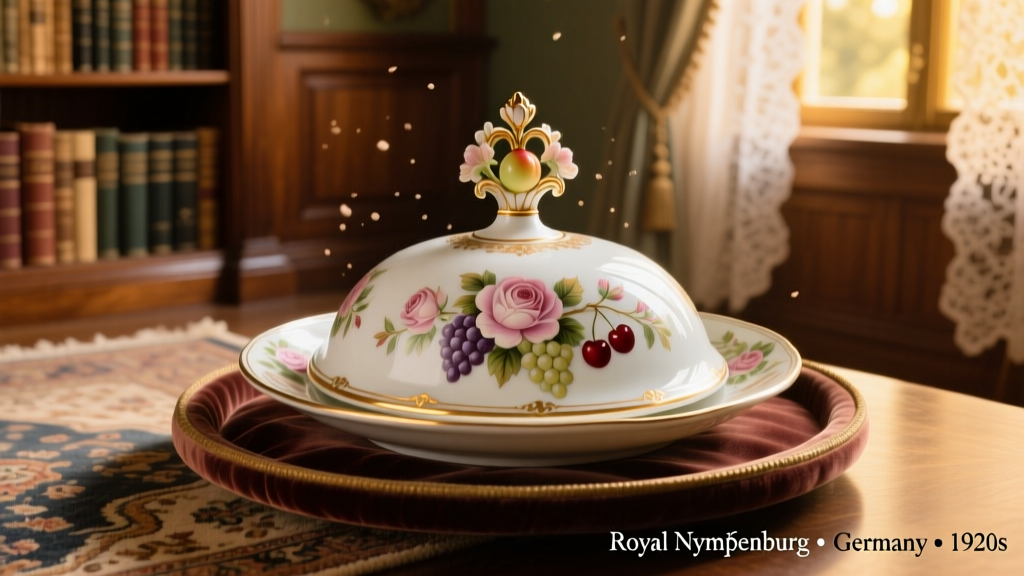
Royal Nymphenburg Dish Entree Lid with Floral and Fruit Finial: A Mid-Century Masterpiece Measuring 5½ × 10¾ Inches

Barrel-Link Black Enamel Necklace Chains in 14K Yellow Gold: A Mid-Century Collector’s Reference Guide

Kewpie Doll: Bisque Jointed Arms with Original Paper Chest Label — A 5-Inch Mid-Century Collector’s Benchmark
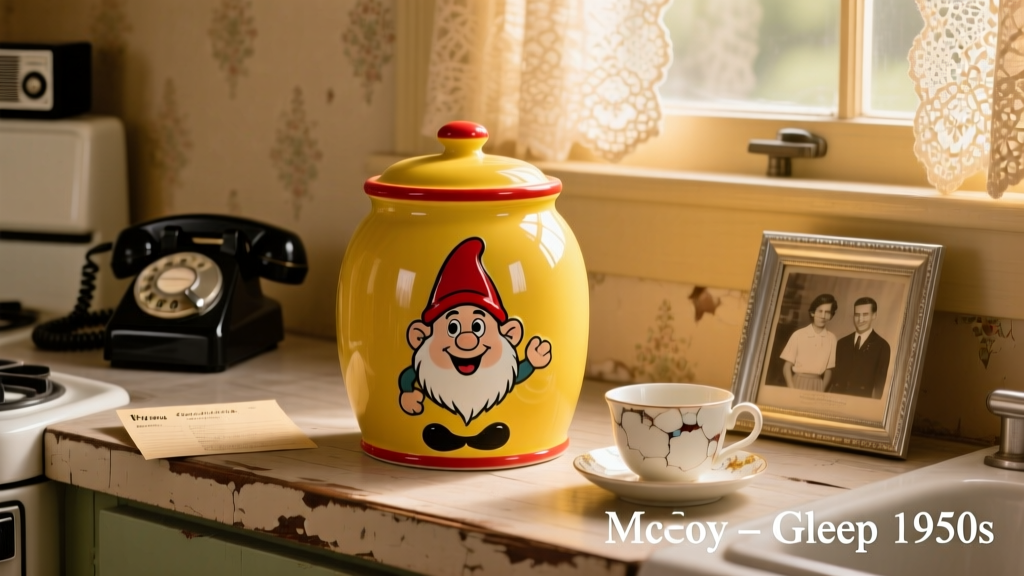
McCoy Cookie Jar 'Gleep': Yellow Glossy Glaze with Red Trim — A Mid-Century Icon Measuring 10¾ Inches

Ivory Netsuke of a Karako Climbing a Bamboo Shoot: An 18th-Century Masterpiece in Japanese Miniature Sculpture
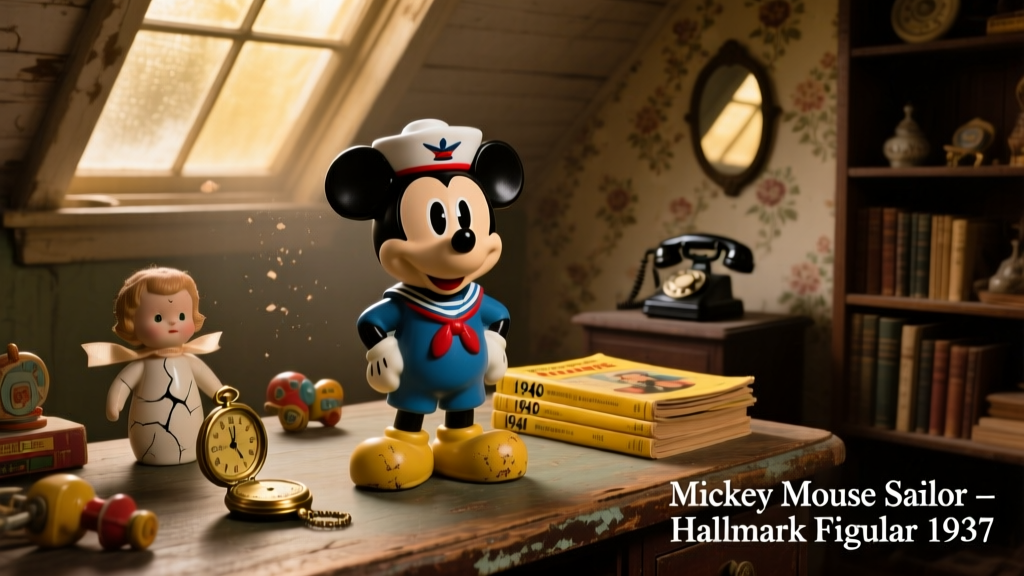
Disneyana Birthday Card: Mickey Mouse as Sailor Figural Hallmark, 1930s — Rarity, Provenance, and Collectibility
The 1139996: Unpacking the Legacy of Marx’s 1957 ‘Big Wheel’ Battery-Powered Toy Car
Gillinder Mug: The Historical Bell-Shape Camel Handle — A Mid-Century American Glassware Landmark

The Indian Motorcycle Stickpin with Swastika Motif: Historical Context, Material Analysis, and Collectibility of a Mid-Century Badge (5/8" Diameter)