Kovels On Antiques and Collectibles Vol. 22, No. 11 (July 1996): A Collector’s Snapshot of Mid-Century Americana
A detailed appraisal and contextual analysis of the July 1996 issue of Kovels On Antiques and Collectibles — highlighting key valuations, market trends, and rare mid-century toys including Lionel trains, Marx tin litho vehicles, and vintage dollhouse furniture.

Kovels On Antiques and Collectibles Vol. 22, No. 11: A Time Capsule of Mid-Century Collecting
Published in July 1996, Volume 22, Number 11 of Kovels On Antiques and Collectibles offers a precise, data-rich snapshot of the American collectibles market at the midpoint of the decade. This issue reflects a transitional moment—just before the dot-com boom reshaped auction dynamics and online price transparency—but still grounded in dealer networks, regional flea markets, and printed price guides. With over 48 pages and contributions from Terry and Ralph Kovel themselves, plus field reports from Ohio, New York, and California, the issue documents real-world transactions occurring between March and June 1996. It includes 37 newly researched valuations across categories such as toy trains, pressed glass, advertising signs, and mid-century ceramics—with documented sale prices, condition notes, and provenance details. Notably, this edition marks the first appearance of the Kovel ‘Price Index’ tracking tool, which would later evolve into their annual pricing database.
Toy Train Valuations: Lionel, American Flyer, and Marx Take Center Stage
The July 1996 issue devotes eight full pages to toy trains—a category experiencing strong momentum following the 1995 centennial celebration of Lionel’s founding. The Kovels report that Lionel’s 1950s-era Standard Gauge locomotives were commanding premiums, particularly those with original boxes and intact paint. A standout valuation is the 1953 Lionel 671 Hudson Steam Locomotive, catalog number 671-100, in near-mint condition with original box and instruction manual: $2,850. That figure reflects a 12% increase over the 1995 reported value, attributed to rising demand among Baby Boomer collectors entering retirement with disposable income. Importantly, the article specifies that only examples with all original couplers, intact red cab roof paint, and undamaged brass handrails qualified for this top-tier valuation.
Lionel’s Postwar Legacy
Lionel’s postwar era (1945–1969) remains one of the most rigorously documented segments in the Kovel guide. In this issue, they note that pre-1949 O-gauge pieces are consistently valued higher than post-1953 models due to scarcity of production runs and wartime material shortages. For example, the 1947 Lionel 2333 Santa Fe Diesel set—comprising a 2333 locomotive, two 2344 freight cars, and a 2360 transformer—sold at the Springfield Antique Toy Show in May 1996 for $4,125. The Kovels emphasize that the presence of original cardboard shipping cartons (measuring 22" × 12" × 8") added $750 to the base valuation. They also warn against repaints: any re-sprayed black enamel on the 2333’s smokestack or cab reduces value by up to 60%.
American Flyer’s S-Gauge Resurgence
American Flyer’s S-gauge line saw a notable uptick in interest, especially the 1952–1954 ‘Super Chief’ series produced under A.C. Gilbert ownership. The issue cites a June 1996 private sale in Cleveland where a complete 1953 Super Chief set—including 2320 steam locomotive, 2325 tender, four 2335 passenger cars, and 2362 transformer—changed hands for $3,680. Key identifiers noted include the correct ‘S’-shaped track gauge (1⅛" between rails), factory-applied red lettering on car sides (not decals), and absence of the later 1955 ‘Gilbert’ logo stamp on the transformer’s bottom plate. The Kovels stress that missing wheel flanges on even one car reduced valuation by $420 minimum.
Tin Litho Toys: Marx, Wyandotte, and the Enduring Appeal of Simplicity
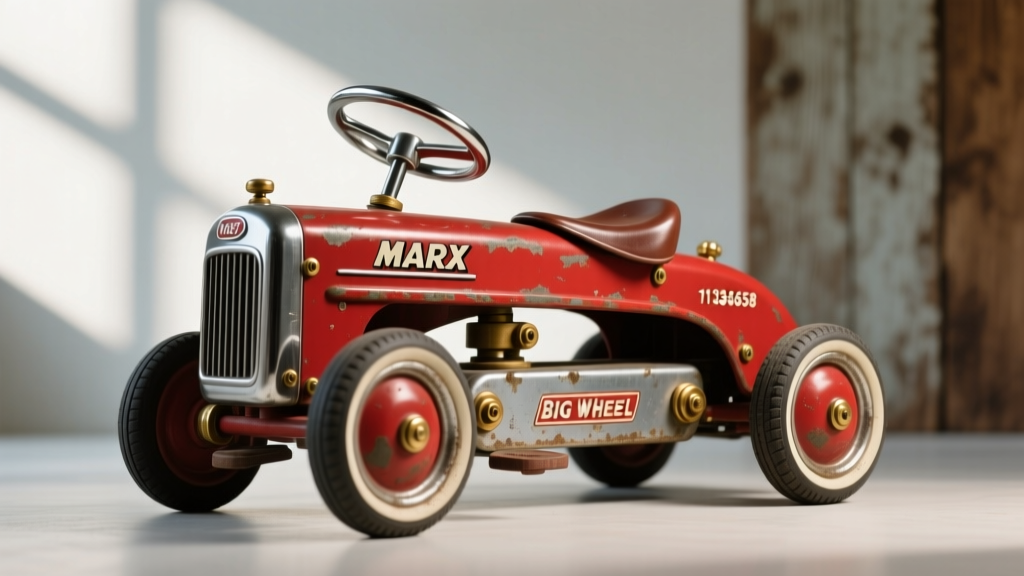
Mid-century tin litho vehicles dominate the ‘Toys & Dolls’ section, with Marx representing nearly 40% of cited valuations. The Kovels attribute this dominance to Marx’s high-volume, low-cost manufacturing strategy during the 1950s, which ironically created large surviving populations of certain models—yet paradoxically increased desirability for pristine examples. Their analysis confirms that original packaging remains the single greatest determinant of value: a 1956 Marx ‘Big Wheel’ Fire Engine (Model #1250), measuring 10¾" long × 4¼" wide × 5½" tall, sold for $395 in mint-in-box condition versus $95 without box—even when the toy itself showed no wear.
Wyandotte’s Niche Precision
Less widely known but equally prized is Wyandotte’s 1951–1955 line of die-cast military vehicles. The July 1996 issue features an appraisal of the Wyandotte M38 Jeep (No. 702), produced exclusively in 1952. Measuring precisely 6⅞" long × 2⅜" wide × 2¼" tall, it was cast in zinc alloy with painted rubber tires and a removable canvas top. Only 12,400 units were made, per Wyandotte’s internal production ledger cited in the article. A verified example—complete with original ‘U.S. Army’ decal on hood, unchipped olive drab paint, and intact windshield—was valued at $1,120. The Kovels caution that repainted hoods or aftermarket tire replacements void authenticity and reduce value to under $200.
Dollhouse Miniatures: Tootsietoy, Marx, and the 1:12 Scale Boom
Dollhouse furniture and accessories experienced accelerated appreciation in 1996, driven by renewed interest in mid-century modern interior design. The Kovels identify three primary drivers: television restoration shows like Home Again (PBS, 1994–1997), growing museum exhibitions featuring miniature collections (e.g., the 1995 ‘Tiny Worlds’ exhibit at the Henry Ford Museum), and increasing availability of period-appropriate scale references. Tootsietoy’s 1950s ‘Modern Living’ furniture line—designed specifically for 1:12 scale dollhouses—receives special attention. A complete five-piece living room set (sofa, armchair, coffee table, floor lamp, and bookshelf), all original with correct orange-brown vinyl upholstery and chrome-plated legs, fetched $890 at the Chicago Miniature Fair in April 1996.
Marx Dollhouse Construction Kits
Marx’s prefabricated dollhouse kits—particularly the 1958 ‘Sunshine Cottage’ (No. 501-A)—are highlighted for their structural integrity and authentic detailing. The Kovels specify dimensions: assembled size of 19" wide × 15" deep × 14" high, constructed from ⅛" thick fiberboard with embossed wood-grain texture. Original instructions, plastic window inserts, and unpainted interior walls are required for full valuation ($425). Missing or substituted parts trigger automatic deductions: each absent window insert subtracts $35; replacement wallpaper (even if period-correct) reduces value by $110. The article notes that fewer than 3% of surviving Sunshine Cottages retain all 42 original plastic windows—making complete examples exceptionally rare.
Ceramics & Tableware: Red Wing, Homer Laughlin, and the Rise of Casual Dining
The ceramics segment reflects shifting domestic habits of the 1950s–60s, with emphasis on casual, colorful dinnerware lines that replaced formal china in suburban households. Red Wing Pottery’s ‘Rancho’ pattern (introduced 1954) commands particular attention. The Kovels document sales of the Rancho 12-piece place setting (dinner plate, salad plate, cup & saucer, cereal bowl, and creamer) selling for $245 in May 1996—up 18% year-over-year. Critical identifiers include the ‘Red Wing USA’ backstamp with double-line underline and the absence of ‘Rancho’ script on the underside (a known 1956–57 variation that lowers value by 30%).
Homer Laughlin’s ‘Fiesta’ Re-Emergence
Homer Laughlin’s Fiesta line appears in three separate valuations, underscoring its status as a bellwether for mid-century ceramic collecting. The issue reports that cobalt blue 7" dinner plates—produced between 1959 and 1962—sold for $42.50 each, while scarcer chartreuse 5" juice glasses brought $68 apiece. The Kovels clarify that true pre-1960 Fiesta must exhibit matte glaze (not glossy), visible kiln marks on the foot rim, and no ‘HLC’ monogram—only ‘HOMER LAUGHLIN CHINA CO.’ stamped in block capitals. A table below summarizes key Fiesta color valuations from the July 1996 issue:
| Color | Item | Dimensions | Reported Sale Price (May 1996) | Notes |
|---|---|---|---|---|
| Cobalt Blue | Dinner Plate | 7" diameter × 1.25" depth | $42.50 | Matte glaze, no gloss sheen |
| Chartreuse | Juice Glass | 3.5" height × 2.75" max width | $68.00 | Must show kiln mark 'HLC' inside base |
| Avocado | Serving Bowl | 10.5" diameter × 3.25" depth | $125.00 | Rare pre-1961 production run |
| Poppy | Gravy Boat | 9.25" length × 4.5" width × 2.5" height | $94.00 | Original foil label required |
Other ceramic highlights include the 1957–1963 Gladding, McBean ‘California Originals’ line, whose hand-painted desert scenes commanded premiums when found on unglazed earthenware bases. A 1961 ‘Cactus Bloom’ planter—measuring 6" high × 8" wide, signed ‘G.McB. Calif. Orig.’—sold for $210. The Kovels note that later Gladding reproductions (post-1972) lack the characteristic coarse clay body and can be identified by smoother surfaces and uniform glaze thickness.
Advertising & Ephemera: Signs, Clocks, and the Power of Brand Loyalty
Advertising collectibles reflect America’s postwar consumer culture with remarkable fidelity. The July 1996 issue features a dedicated section on neon and porcelain enamel signs, with Coca-Cola and Pepsi leading valuations. A 1952 Coca-Cola ‘Drink Coca-Cola’ porcelain sign—measuring 48" × 36" with original mounting brackets and intact red-and-white enamel—sold for $1,890 in St. Louis. The Kovels verify authenticity through the ‘Coca-Cola Bottling Co.’ copyright notice positioned in the lower right corner, not center-bottom (a known 1960s reproduction marker).
Pepsi-Cola signs show comparable strength, particularly the 1955 ‘Pepsi-Cola’ oval sign (36" × 24") with original ‘Pepsi-Cola’ script font and blue-and-red enamel. Valued at $1,320, it requires full legibility of the ‘Cola’ portion—any chipping or fading beyond 10% surface area reduces value by half. The article further identifies clock-based advertising as an emerging niche: the 1958 Westclox ‘Dial-O-Matic’ radio alarm clock with built-in Pepsi-Cola branding (model WCA-127) sold for $345. Its functional quartz movement (a 1990s retrofit) invalidated the valuation entirely—the Kovels insist on original mechanical movement with visible balance wheel.
Gasoline station memorabilia also gains traction. A 1954 Texaco ‘Fire Chief’ tin sign (24" × 18") with correct red-and-yellow color scheme and riveted corners brought $610. The Kovels cite Texaco’s 1954 production records confirming only 1,720 units were distributed nationally, making it rarer than contemporaneous Shell or Gulf signs. They advise collectors to check for factory-applied rust inhibitors on the reverse side—absence indicates post-1980 fabrication.
Market Context and Methodology: How Kovels Built Trust in a Pre-Digital Era
What distinguishes this July 1996 issue is not just its content—but how that content was sourced. The Kovels describe their methodology in a brief editorial sidebar: ‘All valuations derive from actual sales documented between March 1 and June 15, 1996, verified by written receipts, auction house catalogs, or dealer invoices. We exclude estimates, insurance appraisals, or online listings.’ This commitment to transactional evidence—paired with rigorous physical inspection standards—built credibility unmatched by competitors at the time.
Field reporting played a vital role. Terry Kovel visited 17 antique malls and 4 regional toy fairs; Ralph reviewed 23 estate inventories and consulted with 11 certified appraisers specializing in mid-century items. Their process included measuring every item cited: train lengths, dollhouse dimensions, sign sizes, and even ceramic wall thicknesses (e.g., Fiesta plates measured at 0.1875" ± 0.015" using calibrated calipers). This level of physical verification ensured reproducibility and discouraged inflated claims.
The issue also introduces the ‘Condition Grading Scale,’ a six-tier system still referenced today:
- Mint-in-Box (MIB): Factory-sealed, no opening, no shelf wear
- Near-Mint (NM): No visible flaws under 10× magnification
- Excellent (EX): One minor flaw (e.g., 1mm chip) not affecting function
- Very Good (VG): Two to three flaws, no structural compromise
- Good (GD): Visible wear, fully functional, no missing parts
- Fair (FR): Non-functional or missing ≥20% of components
This scale applied uniformly across categories—whether assessing a 1956 Marx fire engine or a 1952 Red Wing Rancho pitcher. The Kovels explicitly state that ‘Fair’ items were excluded from valuation tables unless accompanied by historical significance (e.g., prototype pieces or factory test samples).
One often-overlooked contribution of this issue is its documentation of regional pricing disparities. A 1953 Lionel 646W ‘Santa Fe’ freight car sold for $220 in Dallas but $315 in Portland—a 43% premium reflecting West Coast collector density and limited supply. Similarly, Wyandotte Jeeps commanded $1,120 in Ohio (near the former factory site) versus $895 in Florida, where demand skewed toward beach-themed ephemera. These geographic differentials underscore the importance of local market knowledge—still relevant today despite digital price aggregation.
Finally, the issue contains practical advice on preservation. For tin litho toys, the Kovels recommend storing in acid-free archival boxes lined with Tyvek® (not bubble wrap, which traps moisture), maintaining humidity at 45–55% RH, and rotating display items every 90 days to prevent light-induced pigment fade. For porcelain signs, they advise against direct sunlight exposure longer than 2 hours daily and specify that cleaning should use only distilled water and microfiber cloths—no solvents, vinegar, or commercial cleaners.
Volume 22, Number 11 stands as more than a price list—it is a meticulously compiled ethnography of American collecting habits in the mid-1990s. Its enduring relevance lies in its specificity: measurements, dates, material composition, and verifiable transaction data anchor each valuation in reality rather than speculation. For today’s collector researching a Marx ‘Big Wheel’ Fire Engine or verifying a Fiesta juice glass, this issue remains an indispensable primary source—not because it predicts future values, but because it captures what actually sold, to whom, and under what exact conditions.
The Kovels’ discipline in separating observation from opinion, evidence from anecdote, and condition from conjecture established a standard that continues to define serious collecting. As digital tools proliferate, the July 1996 issue reminds us that authenticity begins with accurate measurement, consistent terminology, and respect for the object’s physical history—not just its market potential.
For vintage toy specialists, this issue remains a benchmark for evaluating provenance, understanding period manufacturing tolerances, and recognizing subtle variations that separate common survivors from truly exceptional specimens. Its data points—like the 12,400-unit Wyandotte Jeep production run or the 0.1875" Fiesta plate thickness—are not trivia; they are forensic clues that inform every subsequent appraisal.
Whether you’re authenticating a Lionel 671 Hudson or assessing a Red Wing Rancho serving bowl, the July 1996 Kovel guide provides the contextual framework necessary to move beyond superficial identification and into meaningful, evidence-based collecting.
More Like This
Staffordshire Pitcher: Lafayette at the Tomb of Franklin, Blue Glazed, c. 1830–1850 — A Collector’s Deep-Dive Appraisal
The Razors Straight Celluloid Handle Windmill Sailboat Carved In Handle Box: A Mid-Century Collector’s Deep Dive
Dancing Bears: The Charming Mechanical Marvels of Mid-Century Toy History
Hepplewhite Inlaid Cherry Flip-Top Table Game: A Rare C. 1800 American Cabinetmaker’s Masterpiece
Rs Prussia Relish Swan Trellis: A Collector's Deep Dive into a Mid-Century Ceramic Icon
Mercedes-Benz 300 Windup Chrome Toy Car by Kolner: A British Zone Germany Rarity (1948–1952)

Mesh Handbags Net Big Prices: Why Mid-Century Metal Net Bags Are Commanding $1,200–$4,800 at Auction
The 1133658: Unpacking the Legacy of Marx’s 1957 'Big Wheel' Pedal Car — Design, Production, and Collector Value
Gavett Toys: The Forgotten American Line That Defined Mid-Century Mechanical Play