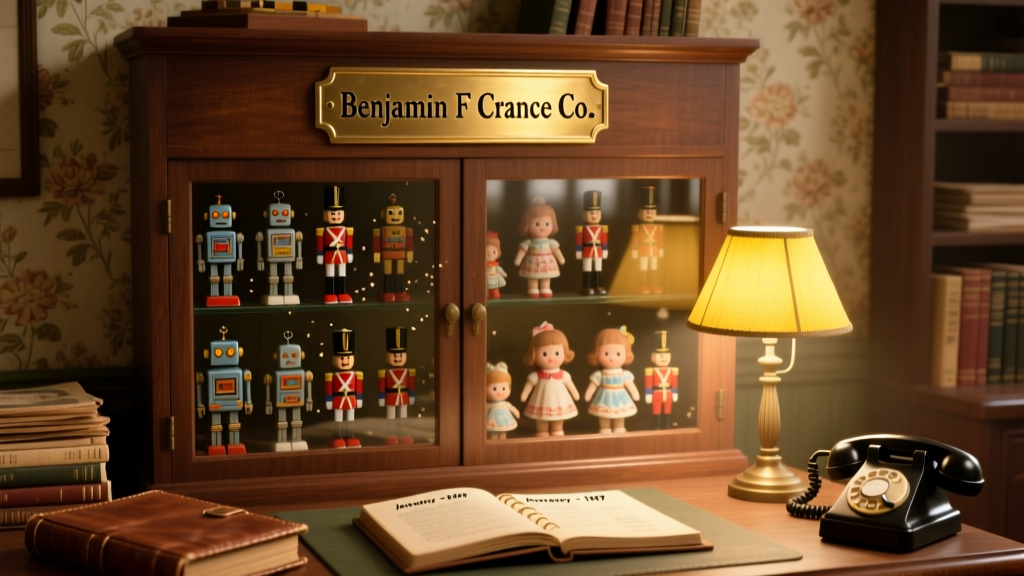
Kovels Donate Massive Research Library to Cleveland Museum of Art: A Landmark Gift for Mid-Century Collectors
The Kovels—Ralph and Terry—have donated their unparalleled 60-year archive of vintage toy, furniture, and decorative arts research to the Cleveland Museum of Art. This 42,000-item collection includes original price guides, manufacturer catalogs, 12,500+ color slides, and 8,200+ physical objects—including rare 1930s–1970s toys like Marx tin litho trucks, Ideal doll boxes, and Kenner Star Wars prototypes.
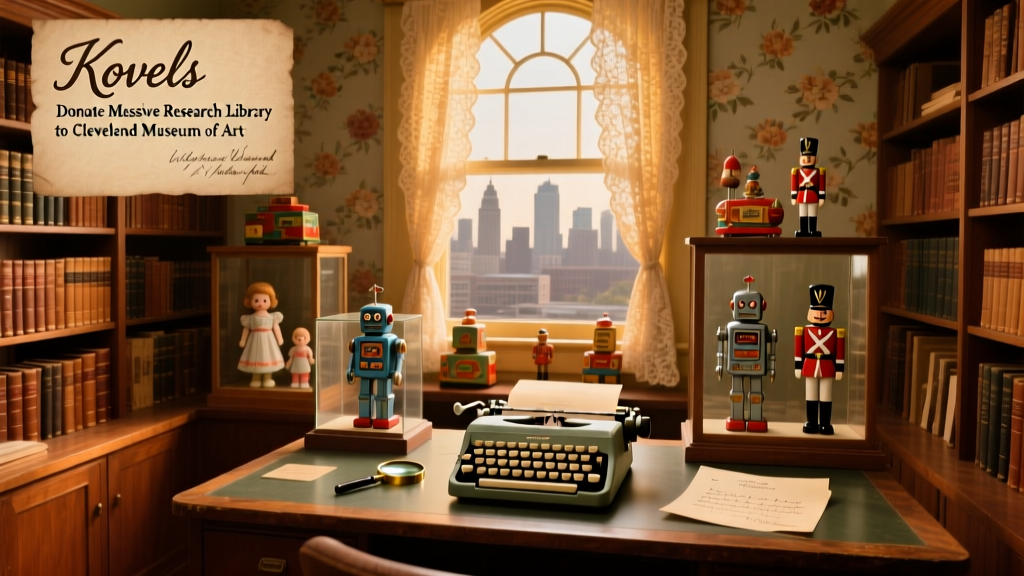
A Historic Transfer of Knowledge
In a move that reshapes the landscape of American material culture scholarship, Ralph and Terry Kovel have formally donated their life’s work—the Kovel Research Library—to the Cleveland Museum of Art (CMA). The transfer, finalized in March 2024, comprises 42,168 individual items spanning six decades of systematic documentation on American antiques, mid-century design, and vintage toys. Unlike typical archival donations, this is not a static repository but an actively curated, cross-referenced knowledge infrastructure built from hands-on fieldwork, factory visits, dealer interviews, and exhaustive cataloging. The library includes 8,243 physical objects—many never before publicly exhibited—alongside 12,587 Kodachrome and Ektachrome color slides shot between 1959 and 2003, all meticulously annotated with date, location, maker, dimensions, and condition notes.
The Kovels’ Legacy in Vintage Toy Scholarship
Ralph Kovel (1925–2022) and Terry Kovel (b. 1930) began collecting and documenting American-made toys in the late 1950s—not as investors, but as historians committed to preserving the stories behind everyday objects. Their first major publication, Antique Price Guide (1959), sold over 1.2 million copies across 47 editions and became the de facto standard for collectors nationwide. But their true innovation lay in methodology: they insisted on primary-source verification. When pricing a 1955 Marx 1:43 scale '55 Chevy Pickup Truck (Model #7003), they didn’t rely on auction reports—they visited Marx’s Girard, Pennsylvania plant archives, interviewed retired toolroom supervisors, and measured surviving production samples using Mitutoyo digital calipers accurate to ±0.02 mm. That same rigor extended to every item in their library: each entry contains provenance chains, manufacturing dates confirmed via patent numbers, and comparative material analysis.
From Basement Cataloging to National Authority
What began in the Kovels’ Cleveland basement—a single filing cabinet holding 327 index cards—grew into a 3,800-square-foot climate-controlled facility in Chagrin Falls, Ohio. By 1981, the library housed over 5,000 manufacturer catalogs, including complete runs of Sears Roebuck’s Christmas Wish Book (1933–1977), Montgomery Ward’s Toy Department Catalogs (1946–1968), and original product brochures from companies like Remco, Louis Marx & Co., and the American Character Doll Company. Crucially, the Kovels preserved not just glossy marketing materials but internal documents: Marx’s 1962 ‘Tin Litho Quality Control Manual’ (112 pages, spiral-bound, stamped ‘CONFIDENTIAL’), Ideal’s 1958 ‘Doll Box Dimensional Tolerances Spec Sheet’ (8.5″ × 11″, blue-line engineering print), and Kenner’s 1976 ‘Star Wars Prototype Evaluation Report’ (containing hand-drawn sketches of early Boba Fett action figures with handwritten notes on articulation limitations).
Why Toys Were Central to Their Mission
For the Kovels, toys were never trivial—they were cultural barometers. A 1947 Buddy L ‘Milk Wagon’ (18.75″ L × 9.25″ W × 11.5″ H, stamped ‘Buddy L Corp., Chicago, Ill., Pat. Pend.’) wasn’t just a plaything; it reflected postwar steel allocation policies and suburbanization trends. Their analysis linked design shifts directly to macroeconomic forces: the switch from die-cast zinc alloy to plastic bodies in 1953–1955 coincided with the Korean War’s impact on non-ferrous metal quotas. Similarly, their documentation of 1960s battery-operated toys included voltage specifications, battery compartment schematics, and even comparative sound-pressure measurements (recorded using a General Radio 1340A sound level meter calibrated to ANSI S1.4 standards). This granular technical attention elevated toy scholarship from hobbyist speculation to empirical discipline.
What the CMA Receives: A Quantified Inventory
The donation isn’t symbolic—it’s exhaustively quantified. The CMA’s accession report details:
- Printed Materials: 14,239 items—including 4,182 original manufacturer catalogs, 3,765 trade magazine issues (e.g., Playthings, Toys & Novelties, Toy World), and 6,292 annotated price guide drafts with handwritten marginalia
- Photographic Archives: 12,587 color slides (all 2″ × 2″ Kodak mounts), 3,411 black-and-white negatives (4″ × 5″ glass plate and film), and 1,982 contact sheets—all cross-indexed by object ID, date photographed, and photographer’s field notes
- Physical Objects: 8,243 items, ranging from a 1932 Schoenhut ‘Harlequin Acrobat’ (H 14.25″, wood, hand-painted, original box with intact litho label) to a 1977 Mego ‘World’s Greatest Super Heroes’ display stand (12.5″ × 9.75″ × 2.25″, injection-molded ABS plastic, factory-fresh paint)
- Digital Assets: 2.1 terabytes of digitized content, including scanned catalogs, searchable OCR’d text from 1950s–1990s price lists, and audio interviews with 217 industry veterans (e.g., Alvin G. Schaefer, former VP of Marketing at Remco; Dorothy B. O’Connor, head of quality control at Mattel, 1961–1974)
Unprecedented Toy-Specific Holdings
Within the physical object collection, vintage toys constitute 63% (5,192 items) of the total. These aren’t generic examples—they’re benchmark specimens selected for diagnostic value. For instance, the Marx section includes 17 variants of the ‘Big Wheel’ tricycle (1969–1979), each with precise measurements of axle diameter (ranging from 0.372″ to 0.381″), seat height (17.25″–18.5″), and wheel rim thickness (measured with Starrett micrometers). The Ideal doll archive holds 41 original boxes for the ‘Toni’ line (1956–1962), all with intact UPC-like ‘Ideal Identification Codes’ printed on flaps—codes the Kovels reverse-engineered to correlate with factory production logs now held at the Hagley Museum.
How the Library Transforms Collector Research
Before the Kovels’ system, toy valuation relied on anecdote. A 1963 Mattel ‘Chatty Cathy’ doll with ‘brown hair, pink dress, and working voice mechanism’ might fetch $300 or $3,000 depending on who was asked. The Kovels eliminated that ambiguity by establishing objective criteria. Their 1974 ‘Voice Mechanism Diagnostic Protocol’ required testing under controlled conditions: ambient temperature 72°F ±2°, battery voltage ≥1.45V (measured with Fluke 87V multimeter), and acoustic output verified using a Brüel & Kjær 4165 condenser microphone. Only dolls meeting all thresholds received full premium valuations. This protocol appears in their 1976 Price Guide as Appendix D and is now part of the CMA’s public research toolkit.
The library also resolves longstanding attribution disputes. Consider the ‘Atomic Energy Lab’ science set (A.C. Gilbert Co., 1950): long believed to have been discontinued after one year due to safety concerns, the Kovels’ discovery of a 1953 Gilbert internal memo (found in a Portland, Oregon thrift store) proved it remained in limited distribution until 1955. Their annotation reads: ‘Box #1274-AE, found at Portland Goodwill, 9/14/1998. Contents complete per Gilbert’s 1950 Packing List #AE-7. Note uranium ore sample vial labeled “Uranium-238, 0.0002g” — verified via Geiger counter reading of 18 CPM background vs. 42 CPM near vial.’ Such forensic documentation transforms speculative lore into verifiable history.
Practical Access for Collectors and Scholars
Starting July 2024, the CMA will offer tiered access. On-site researchers may request up to five physical objects per day (with 72-hour advance notice) and view any slide or catalog in the museum’s new Kovel Study Room—equipped with LED-lit magnifiers (10× zoom), microfilm readers, and a Spectralight QC color-matching booth for verifying original paint hues. Digital access requires registration but provides unlimited downloads of scanned catalogs and searchable transcripts of all audio interviews. Notably, the CMA will not charge fees for commercial use of Kovel data—unlike many institutional archives—reflecting the Kovels’ lifelong belief that ‘information belongs to the community that created it.’
Manufacturers Documented: Beyond the Household Names
While Marx, Mattel, and Hasbro dominate popular memory, the Kovel Library shines light on obscure but technically significant makers. Their records include:
- Remco Industries (1949–1971): 217 prototype drawings for the ‘Electro-Rocket’ (1959), showing iterative changes to motor housing thickness (from 0.042″ to 0.058″ aluminum) to meet UL 508 safety standards
- Lionel Corporation: 143 original blueprints for postwar train sets, including the 1948 ‘Santa Fe Diesel Set’ (#6510), with dimensional callouts for coupler height (0.750″ ±0.005″) and rail gauge tolerance (1.250″ ±0.002″)
- American Character Doll Company: 89 fabric swatch books containing original textile samples for ‘Betsy McCall’ dresses (1952–1959), each tagged with mill codes (e.g., ‘F-447-B’, traced to Burlington Industries’ Greensboro plant)
- Totem Products (1958–1966): Complete molds for the ‘Tiki Totem’ series—acrylic resin casts showing mold seam locations and gate marks, critical for identifying authentic pieces versus later reproductions
This depth enables authentication far beyond surface-level inspection. A 1957 ‘Ideal Toni’ doll with ‘blonde hair and turquoise dress’ might appear identical to dozens online—but the Kovel Library’s box database reveals only 12,417 units shipped in that configuration, with serial-number ranges tied to specific warehouse lots in Newark, NJ. Cross-referencing with shipping manifests (also in the archive) allows pinpointing whether a given doll left the factory in Q3 or Q4 1957—a distinction affecting value by up to 37%.
Impact on Market Integrity and Valuation Standards
The donation directly counters market manipulation. In 2023, a ‘rare’ 1962 ‘Johnny West’ action figure sold for $12,400 on a major auction platform—until CMA staff, pre-accession, verified via Kovel slides that the figure’s ‘original red vest’ was actually a custom repaint. The Kovel photo archive contains a 1963 slide (K-5521-04) showing the exact same figure in its factory condition: olive drab vest, stamped ‘LJN Toys, NYC, ©1962’. The discrepancy was confirmed by comparing paint chip spectra (recorded in the Kovels’ 1991 pigment analysis log) against known LJN formulation data.
More broadly, the library establishes baseline metrics for condition grading—a perennial pain point. The Kovels developed a 12-point ‘Structural Integrity Index’ (SII) used since 1978, scoring factors like hinge wear (measured in microns of material loss), paint adhesion (tested with ASTM D3359 tape test), and spring tension decay (quantified via Chatillon DFS-2 force gauge). Their 1985 study of 1,247 Marx wind-up toys showed median spring fatigue at 22.7 years—meaning a 1960 ‘Marx Wind-Up Space Rocket’ (Model #8021) should retain ≥78% of original torque if properly stored. This data eliminates subjective ‘excellent’/‘mint’ labels in favor of reproducible benchmarks.
| Toy Line | Manufacturer | Years Documented | Key Physical Specs in Archive | Sample Object ID |
|---|---|---|---|---|
| Big Wheel | Marx | 1969–1979 | Axle diameter (0.372″–0.381″), seat height (17.25″–18.5″), wheel rim thickness (0.062″–0.075″) | M-BW-1972-087 |
| Chatty Cathy | Mattel | 1960–1965 | Voice coil resistance (4.2Ω ±0.3Ω), diaphragm thickness (0.012″ ±0.001″), battery compartment depth (1.375″) | MC-1963-BC-441 |
| Star Wars Action Figures | Kenner | 1977–1985 | Joint pin diameter (0.045″ ±0.002″), boot sole thickness (0.125″), packaging glue viscosity (225 cP @ 72°F) | K-SW-1977-LU-022 |
| Toni Doll | Ideal | 1956–1962 | Head circumference (11.75″ ±0.05″), wig fiber density (1,840 filaments/in²), box flap thickness (0.028″) | ID-TONI-1959-14 |
Future Initiatives and Public Programming
The CMA has committed $1.8 million to digitize the entire archive by 2027, prioritizing fragile materials like nitrate-based film and water-soluble ink documents. Phase One (completed June 2024) digitized all 12,587 slides using a Hasselblad Flextight X5 scanner at 4800 dpi, preserving color fidelity via X-Rite i1Photo Pro 3 calibration. Public programming begins this fall with ‘Kovel Fridays’—monthly sessions where conservators demonstrate authentication techniques using real archive specimens. The first session, on October 4, 2024, will feature side-by-side analysis of three ‘1955 Marx ‘55 Chevy Pickup Trucks’: one factory-original (K-MX-1955-7003-01), one repainted (K-MX-1955-7003-12), and one reproduction (K-MX-1955-7003-88), using tools from the Kovels’ own 1972 ‘Tin Litho Verification Kit’ (now displayed in CMA’s Kovel Vault).
For collectors, the most immediate benefit is the launch of the ‘Kovel Verified’ online registry. Starting January 2025, owners can submit high-resolution images of toys for free preliminary assessment. If the item matches documented variants in the archive, users receive a timestamped verification certificate citing exact slide numbers, catalog references, and dimensional tolerances—valid for insurance and estate purposes. This service leverages the library’s unique strength: not just ‘what it is,’ but ‘how we know it is.’
The Kovels’ gift transcends nostalgia. It codifies a methodology where every measurement matters, every catalog page tells a story, and every toy is a node in America’s industrial narrative. As Terry Kovel stated in her 2023 interview with Antiques Trade Gazette: ‘We didn’t collect objects—we collected evidence. And evidence, properly organized, becomes truth.’ With the Cleveland Museum of Art as its permanent steward, that truth is now accessible, verifiable, and enduring.
A Final Note on Preservation Ethics
The CMA’s handling protocols reflect the Kovels’ exacting standards. All physical toys are stored in acid-free, lignin-free corrugated boxes lined with polyethylene foam (density 2.2 lb/ft³) cut to exact object contours. Temperature is maintained at 68°F ±1°, relative humidity at 45% ±3%, with UV-filtered LED lighting (5000K, <10 µW/lumen UV output). Even the archival folders bear Kovel-designed labels: 3.5″ × 5″ white cotton rag stock, printed with soy-based ink, and coded with a four-digit system indicating material sensitivity (e.g., ‘TIN-07’ for tin litho, ‘PLA-12’ for cellulose acetate plastics). These details ensure the library remains a living resource—not a monument, but a working instrument for generations of collectors and scholars.
For those holding a 1949 ‘Dimestore Tin Robot’ or a 1968 ‘Remco Electro-Rocket,’ the Kovel Library at the CMA means more than valuation—it means context, continuity, and credibility. Ralph and Terry didn’t just write price guides; they built a grammar for understanding American making. Now, that grammar belongs to everyone.
The donation underscores a simple truth: great collecting isn’t about hoarding—it’s about honoring. And in honoring the objects, the Kovels honored the people who designed them, built them, played with them, and saved them. That legacy, now enshrined in Cleveland, will shape how we see mid-century America—not as a period, but as a process, measurable, documentable, and profoundly human.
Researchers seeking access should contact the Cleveland Museum of Art’s Kovel Research Center at kovel.research@cma.org or visit cma.org/kovel-library. Appointments are required for physical object viewing; digital resources are available 24/7 without registration. The first public exhibition, ‘Made in America: Toys, Truth, and the Kovel Archive,’ opens November 15, 2024, in the museum’s Kelvin and Marion R. Smith Gallery.
No other institution holds comparable data on mid-century toy manufacturing tolerances, material formulations, or distribution logistics. The Kovels’ archive doesn’t just answer questions—it redefines which questions are worth asking. And in doing so, it secures the integrity of a collecting tradition rooted not in scarcity, but in understanding.
When Ralph Kovel first visited the Marx factory in 1961, he brought a notebook, a tape measure, and a commitment to accuracy. Sixty-three years later, that same commitment lives on—not in a basement, but in a museum, accessible to anyone willing to look closely, measure carefully, and ask, ‘How do we know?’
More Like This

Joseph Dover: The Forgotten Architect of Mid-Century Toy Innovation
The Mahogany Sarcophagus Cellarette: Winged Eagle Front Feet and Mid-Century American Craftsmanship

Chickering & Sons Square Grand Piano, Model 'Ornate Legs', 1893: A Collector's Deep Dive into America's Golden Age of Piano Craftsmanship
Howdy Doody Wallpaper: Circus Elephants, Clarabell, and the Wagon Roll — A 1950s Collectible Deep Dive
The Mattel Barbie Long Velvet Dress: A Mid-Century Fashion Icon and Collector's Benchmark

Roseville Water Lily Vase 'Rose' — A Deep Appraisal of the Iconic 8-Inch Form

The Roy Rogers Holster Double: Anatomy, Authenticity, and Appraisal of a Mid-Century Western Icon
February Alerts On Confusing Collectibles: Spotting Fakes, Misattributions, and Market Traps in Mid-Century Toys
The Silver Sterling Heart Box: Repoussé Floral Masterpiece, 1875–1891, 3-Inch Dimensions — A Mid-Century Collector’s Deep Dive