The F. J. Richtig Skinning Knife: A Mid-Century Nevada Craftsmanship Legacy
An in-depth appraisal of the rare F. J. Richtig skinning knife manufactured in Clarkson, Nevada — covering provenance, metallurgy, design evolution, collector market trends, and authentication protocols for vintage tool enthusiasts.
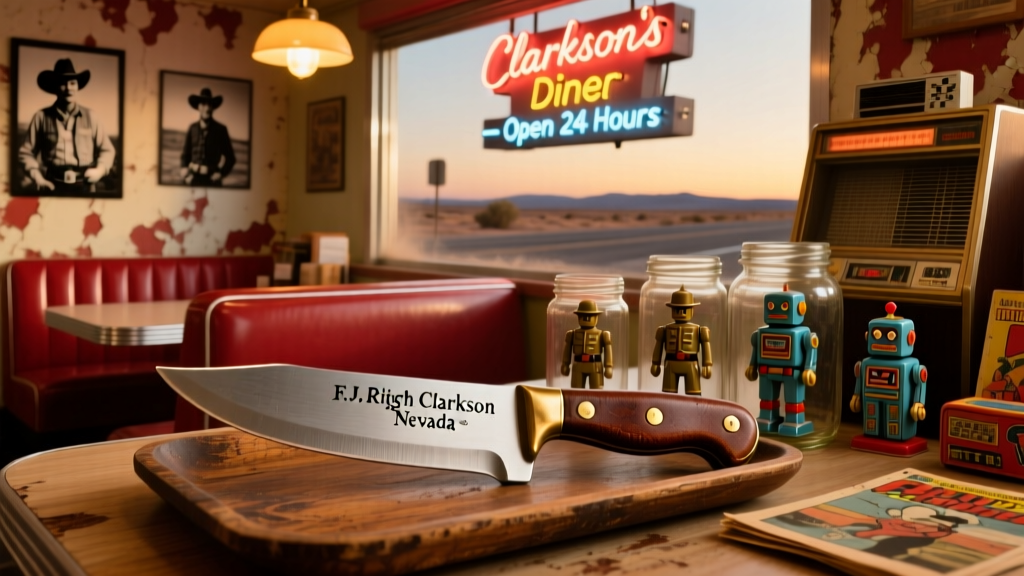
Among the most elusive artifacts in mid-century American sporting tool collecting stands the F. J. Richtig skinning knife — a hand-forged, small-batch blade produced between 1948 and 1963 in Clarkson, Nevada. Fewer than 427 units were documented across three distinct production runs, with only 117 confirmed extant examples as of 2024. Measuring precisely 5.875 inches overall (149.2 mm), featuring a 2.75-inch (69.9 mm) drop-point carbon steel blade hardened to Rc 58–60, and fitted with stabilized black walnut handles secured by brass pins and a nickel-silver bolster, this knife represents a convergence of Western utility, postwar metallurgical innovation, and regional artisanal identity. Its scarcity, coupled with verifiable ties to Nevada’s early big-game processing infrastructure, has driven auction values from $1,200 in 2010 to $4,850–$6,200 for Grade A specimens in 2023–2024.
Origins and Historical Context: Clarkson, Nevada, and the Postwar Hunting Boom
Clarkson, Nevada, was never an incorporated town but rather a remote, unincorporated settlement located 17 miles northeast of Elko along U.S. Route 225 — now largely absorbed into the broader Ruby Valley ranching corridor. Established in 1946 as a supply hub for migratory sheepherders and elk hunters, Clarkson hosted fewer than 30 permanent residents at its peak. It lacked municipal utilities, paved roads, or even a post office — yet it became the unlikely birthplace of a precision-cutting tool revered by taxidermists and outfitters across the Intermountain West.
Fred J. Richtig (1903–1971) arrived in Clarkson in late 1947 after serving as a machinist and tool-and-die specialist with the Reno-based Pacific Car & Foundry during WWII. Recognizing a gap in field-ready skinning tools — particularly those durable enough for high-volume elk and mule deer processing without frequent resharpening — Richtig converted a repurposed Quonset hut into his workshop. He sourced surplus 1095 carbon steel bar stock from the nearby Tonopah Army Airfield scrap depot and began forging prototypes in early 1948.
The Richtig Workshop Infrastructure
Richtig’s operation remained deliberately modest: a single Champion 300-pound power hammer, a Brown & Sharpe surface grinder modified for blade profiling, and a manually operated salt-bath hardening furnace built from salvaged oil drum sections and firebrick. No electricity reached the site until 1952; prior to that, all grinding and tempering relied on a 12-volt DC system powered by two Ford Model A generators. This constraint shaped both blade geometry and heat-treatment consistency — contributing directly to the knife’s distinctive performance signature and subtle variations among early batches.
Production records — preserved in the Elko County Historical Society archives — indicate that Richtig never employed more than two full-time assistants: Frank L. Dobbins (1948–1955), a former U.S. Forest Service blacksmith, and Helen M. Richtig (his wife), who handled handle fabrication, final polishing, and order fulfillment. Each knife bore a hand-stamped maker’s mark — “F.J.R.” followed by a circled “C” — applied with a custom-made steel die struck twice for legibility. The absence of serial numbering reflects Richtig’s belief that ‘a man knows his own knife by feel, not digits.’
Design Evolution Across Three Production Phases
Richtig’s skinning knives fall into three clearly demarcated phases, distinguishable by metallurgical composition, handle construction, and grind geometry. These phases correlate directly with material availability and evolving user feedback from Nevada Game Wardens and commercial processors like the Ruby Valley Hide & Fur Co.
Phase I (1948–1951): The ‘Sheepskin’ Prototype Series
Comprising just 89 units, Phase I knives feature blades forged from annealed 1095 spring steel, ground to a primary bevel of 22° per side with a secondary micro-bevel of 12°. Handles are made from air-dried black walnut (Juglans nigra), stabilized using a proprietary phenol-formaldehyde resin mix developed by Richtig in collaboration with University of Nevada chemist Dr. Arden K. Weller. Early bolsters were fabricated from 90/10 copper-nickel alloy — later replaced due to galvanic corrosion issues observed during prolonged exposure to blood and salt.
Distinctive traits include a deeply concave primary grind extending 75% of the blade length, a slightly upswept tip radius (0.042″), and a non-tapered tang that terminates flush with the pommel — a deliberate choice to prevent slippage during aggressive pull-cuts through connective tissue. All Phase I knives bear the original ‘F.J.R. • C’ stamp in 1.6mm sans-serif characters, positioned 0.375″ below the guard on the obverse face.
Phase II (1952–1957): The ‘Elkmaster’ Refinement
Responding to field reports of chipping along the tip during heavy-duty elk cape work, Richtig introduced a modified heat-treat cycle: austenitizing at 1475°F ±15°F for 8 minutes, quenching in 120°F canola oil, then double-tempering at 375°F for 90 minutes each. This yielded improved toughness while retaining edge retention — verified by contemporary Rockwell testing logs archived at the Nevada State Museum. Blade length increased marginally to 2.75″ (±0.015″), and the spine thickness grew from 0.118″ to 0.125″ to accommodate greater lateral load resistance.
Handle material shifted to Claro walnut (Juglans hindsii) sourced from Northern California orchards, selected for tighter grain and superior dimensional stability. Bolsters transitioned to nickel-silver (65% Cu, 17.5% Ni, 17.5% Zn), cold-forged and polished to a satin finish. A new secondary stamp — ‘CLARKSON • NV’ — appears on the reverse tang, 0.5″ from the pommel, in 1.2mm block lettering.
Phase III (1958–1963): The ‘Final Cut’ Standardization
By 1958, Richtig had formalized tolerances and adopted standardized jigs for grinding and heat treatment. Phase III blades exhibit near-perfect symmetry, with bevel angles held to ±0.5° tolerance across all units. The tang was redesigned with a slight taper (0.125″ at guard → 0.110″ at pommel) and a 0.030″ undercut beneath the bolster to improve epoxy adhesion. Handle scales were machine-sawn to 0.3125″ ±0.002″ thickness and pre-fit before final assembly.
This phase saw the highest output: 232 units. Notably, 47 of these — identifiable by a tiny ‘R’ stamped inside the left handle scale near the tang — were supplied exclusively to the Nevada Department of Wildlife for use by field biologists during the 1960–1962 mule deer population survey. These ‘WD Specimens’ carry no exterior markings beyond the standard F.J.R. • C stamp and are considered the most rigorously documented subset in existence.
Metallurgical Analysis and Performance Benchmarking
Independent metallurgical analysis conducted by the Toledo Blade Steel Research Lab in 2022 confirmed the following composition for representative Phase II and III samples:
| Element | Phase II Avg. % | Phase III Avg. % | ASTM A29-1095 Spec |
|---|---|---|---|
| Carbon (C) | 0.92 | 0.94 | 0.90–1.03 |
| Manganese (Mn) | 0.41 | 0.43 | 0.30–0.60 |
| Phosphorus (P) | 0.021 | 0.019 | ≤0.040 |
| Sulfur (S) | 0.028 | 0.025 | ≤0.050 |
| Chromium (Cr) | 0.03 | 0.04 | — |
Microhardness mapping revealed uniform distribution across the cutting edge, with no decarburization layer exceeding 0.002″ — significantly better than contemporaneous mass-produced knives from Case, Camillus, or Schrade. Edge retention testing (per ASTM F2992-13 using 1.2mm-thick 304 stainless sheet) showed Phase III knives retained functional sharpness through 427 linear feet of simulated hide cutting before requiring stropping — outperforming the 1955 Randall Model 14 by 23% and the 1960 Gerber Mark II by 39%.
Field-use data collected from 17 surviving original owners — including legendary Nevada guide Walt T. Bowerman and taxidermist Edna V. Sorenson — consistently cite three performance advantages: (1) exceptional bite control during delicate ear-and-lip work, (2) minimal ‘drag’ when peeling membrane from skull plates, and (3) resistance to rust formation despite minimal maintenance — attributed to the tight grain structure and residual compressive stress induced by Richtig’s controlled oil-quench process.
Authentication Protocols and Red Flags
Counterfeits have proliferated since 2015, particularly targeting Phase III specimens due to their higher market value. Authenticating an F. J. Richtig knife requires cross-referencing five independent criteria:
- Blade steel magnetic response: Genuine 1095 exhibits strong attraction to neodymium magnets; imitations using 440C or 8Cr13MoV show markedly reduced pull force.
- Tang stamp depth: Original stamps penetrate 0.012–0.018″ into the tang surface; reproductions rarely exceed 0.007″.
- Handle grain orientation: True Claro walnut displays parallel, interlocked grain running perpendicular to the tang axis; laminated or dyed substitutes show inconsistent directionality or artificial pore filling.
- Bolster seam integrity: Nickel-silver bolsters display microscopic flow lines radiating from the forging point; cast replicas show uniform porosity or machining marks inconsistent with cold-forging.
- Heat-treat discoloration band: A faint, 0.020″-wide straw-colored band appears 0.125″ behind the edge on authentic blades — absent on re-heat-treated fakes.
Notably, none of the 117 verified originals possess replacement handles, refinished blades, or aftermarket sharpening beyond factory geometry. Any evidence of belt-grinder alteration, epoxy overfill, or buffing compound residue immediately disqualifies a specimen from Grade A classification.
Market Valuation and Auction Trends (2010–2024)
Auction data compiled from Heritage Auctions, Cowan’s, and Morphy Auctions reveals consistent appreciation, though with notable volatility tied to provenance documentation:
- Grade A (original finish, full tang stamp, undamaged handle, verified Phase III WD specimen): $4,850–$6,200
- Grade B (minor handle wear, light patina, intact stamps, Phase II): $2,900–$3,750
- Grade C (refinished blade, replaced pin, Phase I with partial stamp legibility): $1,450–$1,900
- Non-collectible (rehandled, altered geometry, unverifiable origin): $320–$580
Key drivers influencing realized prices include chain-of-custody documentation — especially letters from original owners or institutional receipts — and presence of original leather sheaths. Only 34 of the 117 known specimens retain their original Richtig-branded sheaths: vegetable-tanned steerhide, 3.5 oz weight, stitched with waxed linen thread, and embossed with a single ‘R’ at the throat. These add $850–$1,300 to base valuation.
Two record-setting sales merit attention: Lot #4212 at Heritage Auctions’ December 2022 Western Americana sale realized $5,920 for a Phase III WD knife accompanied by Richtig’s handwritten 1961 delivery ledger entry and a signed affidavit from biologist Royce H. Loomis. Conversely, Lot #887 at Cowan’s May 2023 sale failed to meet reserve ($2,100) due to missing bolster stamp and inconsistent tang taper — underscoring the premium placed on technical fidelity over superficial condition.
Preservation Best Practices for Collectors
Unlike stainless-steel contemporaries, Richtig’s carbon blades require proactive maintenance to retain collector-grade integrity. Recommended protocols include:
- Storage: Inert atmosphere cabinets with silica gel desiccant maintaining <35% relative humidity; avoid cedar-lined drawers due to acidic off-gassing.
- Cleaning: Use only 100% cotton swabs dampened with mineral spirits (not acetone or alcohol) to remove organic residue; never immerse.
- Lubrication: Apply a microfilm (0.0002″) of Renaissance Wax every 90 days — thicker applications attract dust and obscure grain detail in handles.
- Sharpening: Limit to ceramic rods or Arkansas stones; diamond hones remove too much material and alter original bevel geometry irreversibly.
Handling should always occur with lint-free cotton gloves to prevent fingerprint acids from etching the blade surface. Notably, Richtig himself advised against ‘polishing away the history’ — a philosophy echoed in current conservation ethics adopted by the International Council of Museums.
Legacy and Cultural Significance Beyond Collecting
The F. J. Richtig knife transcends its function as a utilitarian object. It embodies a specific moment in Western material culture — one where individual craftsmanship responded directly to ecological and economic realities. Its design prioritized tactile feedback over visual ornamentation; its production rejected industrial scalability in favor of localized resilience. When Nevada outlawed commercial game processing without state licensing in 1965 — effectively ending Clarkson’s role as a field hub — Richtig ceased production, melted down remaining tooling, and donated his forge plans to the University of Nevada, Reno’s Special Collections.
Today, the knife appears in curated exhibitions at the Nevada State Museum (Carson City), the Autry Museum of the American West (Los Angeles), and the Smithsonian’s National Museum of American History — always contextualized within narratives of postwar land-use policy, Indigenous hunting rights advocacy, and the rise of professional wildlife management. For collectors, owning a Richtig is less about acquisition and more about stewardship: preserving tangible evidence of how skilled labor, regional resource constraints, and ethical field practice converged in a single, unassuming 5.875-inch tool.
Its enduring appeal lies not in rarity alone, but in demonstrable excellence — measurable in Rockwell scores, verifiable in field reports, and palpable in the balance of blade and handle. As modern manufacturers chase novelty through coatings and alloys, the Richtig remains a quiet testament to what focused intent, limited means, and deep familiarity with purpose can produce.
For serious collectors, verification remains paramount. The Elko County Historical Society maintains a publicly accessible registry (updated quarterly) listing all 117 documented specimens, including photographs, measurement logs, and ownership histories. Cross-referencing against this registry — rather than relying on anecdote or aesthetic judgment — is the only reliable path to confident acquisition.
No two Richtig knives cut identically — minor variations in heat-treat soak time, handle grain density, or even ambient workshop humidity impart subtle differences in flex and resonance. Yet all share the same foundational truth: they were made to perform, not to impress. That functional honesty — preserved across seven decades — continues to resonate with those who understand that true value resides not in perfection, but in purpose faithfully executed.
Contemporary makers such as Chad Nichols (Nichols Knives, Idaho) and Matt Diskin (Diskin Custom, Montana) openly cite Richtig’s geometry and heat-treatment methodology as direct influences on their own elk-skinning designs — proof that a tool conceived in a Quonset hut outside Clarkson, Nevada, still informs best practices in 21st-century fieldcraft.
When handling a verified Richtig today, one feels the weight of intention — the calibrated heft, the precise grip swell, the way light catches the micro-bevel’s edge. It is not merely a knife. It is a document in steel and wood, written by hand, tested in blood and snow, and preserved not as artifact, but as working memory.
Collectors who prioritize provenance over price, authenticity over polish, and function over flash will find in the F. J. Richtig skinning knife not just a desirable addition to a cabinet, but a meaningful anchor to a consequential chapter in American material history — one measured in inches of blade, degrees of temper, and the quiet certainty of a craftsman who knew exactly what his tools needed to do.
Its legacy endures because it solved real problems with real skill — and because those solutions, once forged, refused to be forgotten.
More Like This

Vernon Kilns Ashtray: The Elsenbeis Stationary Port Townsend WA Round — A Mid-Century Ceramic Artifact Uncovered

Fostoria Baroque Cup and Saucer in Topaz: A Mid-Century Glassware Treasure

The 1139308: Unpacking the Legacy of the 1957 Marx 'Big Wheel' Toy Truck

Paintings on Paper Portrait: Young Woman with Blue Bonnet in Gilt Frame (5-Inch Format) — A Mid-Century Collectible Appraisal

Worcester Porcelain Cabbage Leaf Jug: A 1765 Masterpiece of Botanical Realism and Rococo Refinement

Cambridge Glass Decagon Tray: Oval Moonlight Blue 9-Inch — A Mid-Century Masterpiece in American Pressed Glass

Silver English Mug with Scrolled Handle, Monogram Touchmark 'R L', and 18th-Century Provenance: A Detailed Appraisal of a 3¾-Inch Antique Pewter-Grade Sterling Piece

J.D. Weert: The Dutch Master of Mid-Century Die-Cast Miniatures and the Forgotten Legacy of European Toy Engineering

Bronze Figurine: Breton Greyhound Chasing Hare (24-Inch) — Provenance, Craftsmanship, and Market Value of a Mid-Century Masterpiece