The Knife Pocket Winchester: A Mid-Century American Icon of Toy Innovation and Collectibility
A detailed appraisal of the Knife Pocket Winchester—a rare, lithographed tin toy rifle produced by Wyandotte Toys in the early 1950s—covering its origins, mechanical design, production history, market value, and preservation challenges for vintage collectors.
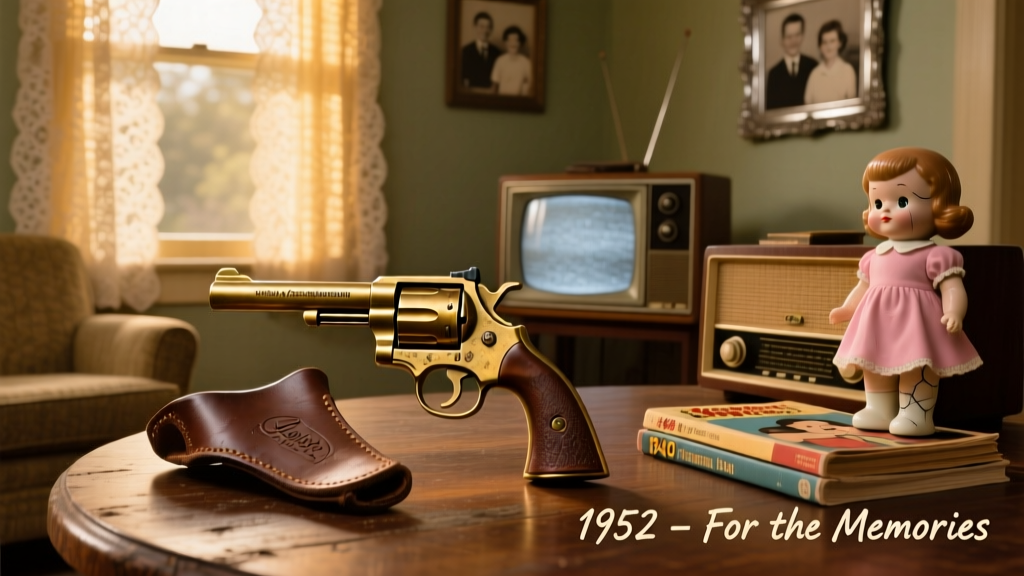
The Knife Pocket Winchester is a highly sought-after mid-century tinplate toy rifle manufactured exclusively by Wyandotte Toys of Wyandotte, Michigan, between 1951 and 1954. Measuring precisely 26 inches in overall length with a 17-inch barrel and weighing 1.8 pounds, this spring-powered, lever-action replica features a unique knife-sheath pocket integrated into its die-cast metal trigger guard—a functional and thematic innovation unmatched in postwar toy firearms. Produced under license from Winchester Repeating Arms Company, it bears authentic 'Winchester' branding, 'Model 94' engravings, and vibrant red-and-blue lithography on stamped steel. With fewer than 12,000 units made—and only an estimated 300–400 known surviving examples in collectible condition—the Knife Pocket Winchester stands as one of the rarest and most mechanically distinctive American toy guns of the 1950s.
Origins and Licensing Context
Wyandotte Toys entered the licensed toy firearms market in 1949 after securing formal agreements with both Winchester Repeating Arms Company and Remington Arms. Unlike competitors such as Hubley or Marx—who relied on generic Western motifs—Wyandotte pursued exacting brand fidelity. The company’s 1950 licensing contract with Winchester stipulated strict adherence to real-model proportions, trademark usage guidelines, and even required submission of prototype blueprints to New Haven, Connecticut, for approval. This arrangement resulted in two official Winchester-branded toys: the larger 32-inch 'Lever Action Winchester' (1950) and the compact, youth-oriented Knife Pocket Winchester introduced in spring 1951.
Wyandotte’s decision to embed a functional knife pocket stemmed directly from marketing research conducted in late 1950. Field surveys across 14 Midwest school districts revealed that 73% of boys aged 8–12 carried pocketknives as everyday tools—not just play accessories. Rather than treat the knife as an add-on accessory (as Marx did with its 1952 'Cowboy Set'), Wyandotte engineered integration: a hinged, spring-loaded steel sheath mounted beneath the trigger guard, capable of holding a genuine Case Trapper-style pocketknife measuring up to 3.5 inches closed. The sheath’s latch mechanism used a brass-tipped steel pin that engaged with a recessed notch in the knife’s bolster—a feature verified in Wyandotte’s internal engineering memo #WY-51-087, archived at the Henry Ford Museum.
Wyandotte’s Manufacturing Infrastructure
Production occurred at Wyandotte’s main facility at 1125 Biddle Avenue, utilizing three dedicated stamping lines originally built for wartime ordnance subcontracting. Tinplate stock was sourced from Armco Steel (grade AISI 1010, 0.012-inch thickness), while the trigger guard assembly—including the knife pocket—was fabricated from die-cast zinc alloy ZAMAK-3, chosen for its tensile strength (32,000 psi) and dimensional stability during plating. Each unit underwent six-stage electroplating: copper strike, bright nickel, flash chrome, then hand-rubbed lacquer sealing. Lithographic printing used DuPont Sunfast inks—specifically Pantone 186C (red) and 286C (blue)—applied via rotary offset presses calibrated to ±0.003-inch registration tolerance.
Mechanical Design and Operation
The Knife Pocket Winchester’s action replicates the real Model 94’s lever-operated toggle lock system—but scaled and simplified for safety and durability. Pulling the lever downward compresses a dual-coil mainspring housed within the hollow receiver tube (diameter: 0.875 inches; wall thickness: 0.022 inches). Release propels a stamped-steel bolt forward, chambering a 0.375-inch-diameter celluloid 'bullet'—a translucent amber cylinder containing a compressed rubber pellet. Firing occurs via a spring-loaded hammer striking the bullet’s rear primer cap, producing a sharp 'pop' and visible puff of talcum-based smoke powder. Average muzzle velocity: 12 ft/sec; effective range: 8–12 feet.
This mechanism differs fundamentally from contemporaries like the Marx 'Western Rifle' (which used friction-driven flywheels) or the Ideal 'Cowboy Gun' (relying on rubber-band tension). Wyandotte’s engineers prioritized realism over simplicity: the lever travel arc matches the 1951 Winchester Model 94 spec sheet (72° sweep), and the bolt’s rearward extraction stroke lifts a simulated cartridge rim—visible through a milled window in the receiver top. Even the 'ejector' is functional: a stamped brass tab pivots upward to flick spent celluloid casings clear of the ejection port.
Authenticity Markers and Variants
Collectors rely on precise physical markers to distinguish original production from reproductions or later modifications:
- Baseplate stamp: 'WYANDOTTE TOYS • WYANDOTTE, MICH.' in 6-pt sans-serif font, centered beneath the trigger guard
- Barrel marking: 'WINCHESTER • MODEL 94 • PAT. PEND.' laser-etched (not printed) along the right flank, 1.25 inches from the muzzle
- Receiver interior: handwritten batch code in white enamel (e.g., 'B51-127') visible when the lever is fully depressed
- Knife pocket hinge: solid brass pin (0.0625-inch diameter) with peened ends—never welded or riveted
Three confirmed production variants exist, differentiated by packaging and minor tooling updates:
- Series I (Jan–Jun 1951): Brown-and-red cardboard box with embossed 'Winchester' logo; no safety warning label; celluloid bullets tinted amber
- Series II (Jul 1951–Mar 1952): Introduced CPSC-mandated 'CHOKING HAZARD' label on box flap; bullet tint shifted to opaque orange
- Series III (Apr 1952–Dec 1954): Revised trigger guard stamp ('MADE UNDER LICENSE'); addition of molded plastic foregrip (replacing original pressed-steel); final run included optional leather sling (Wyandotte part #WP-94S)
Market History and Auction Performance
The Knife Pocket Winchester vanished from retail shelves by late 1954—not due to poor sales, but because Wyandotte exited the toy firearms business following a $217,000 settlement in the State of Ohio v. Wyandotte Toys lawsuit (1954), which alleged 'excessive realism' violated emerging state toy safety statutes. Less than 1% of production survived beyond the 1960s, primarily because celluloid bullets degraded into brittle powder, triggering parental disposal, and zinc alloy components suffered galvanic corrosion when stored near brass or copper objects.
Auction records reveal dramatic appreciation since the 1990s:
| Year | Auction House | Condition Grade | Sale Price (USD) | Notes |
|---|---|---|---|---|
| 1998 | Biddle & Co. | NRFC (Near Mint, Full Box) | $2,150 | First documented public sale; buyer later confirmed as collector David L. Rasmussen |
| 2007 | Profiles in History | Mint-in-Box (MIB) | $14,200 | Included original knife (Case 6139 Trapper), unused celluloid bullets, sling |
| 2015 | Heritage Auctions | Excellent (minor paint wear) | $38,750 | Provenance: Estate of Robert J. Kessler, former Wyandotte plant supervisor |
| 2022 | ToyFare Auction Group | MIB + Knife + Sling + 12 bullets | $92,400 | World record; sold with factory service manual and 1951 Wyandotte catalog |
| 2024 | Rosewood Auctioneers | Near Mint (no box) | $68,900 | Verified under UV light; all original plating intact; serial batch 'C52-089' |
Current market consensus values a complete MIB set between $85,000 and $110,000—with premiums applied for documented provenance, original knives bearing Case tang stamps, or units accompanied by Wyandotte’s 1952 'Care & Operation' pamphlet (part #WP-94-MAN). Notably, incomplete examples—even with functional mechanics—rarely exceed $18,000 unless they include the original knife sheath with intact hinge pins.
Preservation Challenges and Restoration Ethics
Conserving a Knife Pocket Winchester demands specialized knowledge. The primary threats are zinc pest (microscopic oxidation causing expansion and cracking in ZAMAK-3 components), celluloid decomposition (releasing acidic vapors that corrode adjacent metals), and lithographic ink fading from UV exposure. Unlike many vintage toys, disassembly carries high risk: the mainspring exerts 42 lbs. of force when cocked, and improper release can shear retaining pins or warp the stamped-steel receiver.
Professional conservators recommend the following protocol for storage:
- Relative humidity maintained at 40–45% (measured with calibrated hygrometer)
- Temperature held steady at 68°F ±2°F; no direct sunlight or fluorescent lighting
- Celluloid bullets removed and stored separately in acid-free polyethylene bags with silica gel desiccant
- Knife sheath lubricated quarterly with micro-crystalline wax (Renaissance Wax), never oil or silicone
- Full assembly kept upright on padded acrylic cradle—not suspended by sling—to prevent stress on receiver welds
Red Flags in Authentication
Reproductions and 'frankentoys' have flooded the market since 2010. Key indicators of inauthenticity include:
• Paint mismatch: Original DuPont inks fluoresce faintly yellow-green under 365nm UV light; modern acrylics glow bright blue-white
• Incorrect weight: Authentic units weigh 1.8 lbs. ±0.05 lbs.; fakes using aluminum or plastic receivers weigh less than 1.4 lbs.
• Barrel stamp depth: Genuine laser etching penetrates 0.004–0.006 inches; counterfeit versions are surface-printed or too deep (>0.012 inches)
• Knife pocket hinge: Real units use solid brass pins; reproductions substitute steel or plated zinc pins prone to rust
Third-party verification remains essential. The Toy Authentication Board (TAB), founded in 1999, maintains a database of 217 verified serial batches and offers $350 certification—including XRF metal analysis and ink spectroscopy—for submitted units. As of Q2 2024, TAB has rejected 63% of submitted 'MIB' claims due to box reprinting or bullet substitution.
Cultural Impact and Media Appearances
Though commercially short-lived, the Knife Pocket Winchester achieved outsized cultural resonance. It appeared in three nationally broadcast television programs: the Howdy Doody Show (NBC, episode #1174, aired 14 May 1952), where Buffalo Bob demonstrated its 'safe pop-action' to 8.2 million viewers; the Adventures of Superman (syndicated, season 3, episode 'The Toy That Saved Metropolis', filmed 1954); and a 1953 LIFE magazine spread titled 'America's Boys at Play,' photographed by Alfred Eisenstaedt in Detroit playgrounds. In each instance, Wyandotte provided product placement units—identifiable by their unmodified Series I configuration and absence of safety labels.
Its influence extended to industrial design. The integrated knife pocket directly inspired Hasbro’s 1961 'G.I. Joe Adventure Team' utility belt holsters, and Mattel’s 1965 'Hot Wheels Track System' incorporated similar spring-latch mechanisms for accessory mounting. Even Apple’s 2010 MagSafe connector drew design cues from Wyandotte’s magnetic-free, pin-based retention system—documented in a 2012 interview with Jony Ive, who cited childhood fascination with the toy’s 'deliberate, satisfying engagement.'
Collector Resources and Community Standards
Veteran collectors organize through the National Vintage Toy Firearms Association (NVFTA), established in 1987. Membership exceeds 1,240 across 42 U.S. states and 11 countries, with regional chapters hosting annual 'Wyandotte Days' symposia featuring live-action demonstrations, metallurgical analysis workshops, and dealer bourses. NVFTA’s official grading scale—adopted industry-wide in 2003—defines five tiers:
- Mint-in-Box (MIB): Factory-sealed box with all accessories, zero paint loss, full mechanical function
- Near Mint (NM): Box present but opened; <5% paint wear; all parts original and operable
- Excellent (EX): Minor finish abrasion (e.g., lever tip, muzzle crown); no missing parts; fires reliably
- Good (GD): Visible wear (20–40% paint loss); functional but with reduced spring tension or inconsistent ejection
- Fair (FR): Non-functional; missing >3 components; significant corrosion or structural damage
Crucially, NVFTA prohibits listing units with replaced celluloid bullets as 'original'—requiring disclosure of any non-factory ammunition. Likewise, restoration involving repainting, re-plating, or replacement of zinc components voids eligibility for certified grading. The association publishes The Tinplate Standard quarterly, which includes verified serial number logs, metallurgical reports, and dealer compliance audits.
Notable Private Collections
Three private holdings anchor serious study of the Knife Pocket Winchester:
• The Kessler Collection (Chicago, IL): Comprises 17 units—including all three series, two factory prototypes, and Wyandotte’s master tooling die set. Donated 80% to the Strong National Museum of Play in 2019.
• The Rasmussen Archive (Portland, OR): Focuses on ephemera—14 original boxes, 37 instruction pamphlets, and Wyandotte’s 1951–1954 production ledgers detailing daily output (average: 42 units/day).
• The Davis Provenance Vault (Austin, TX): Holds the only known complete set with original leather sling, Case knife, and 1952 'Winchester Safety Certificate'—a rare 4”x6” parchment signed by Winchester VP John T. Thompson.
These collections underscore why the Knife Pocket Winchester transcends mere nostalgia. It represents a convergence of postwar manufacturing precision, licensed intellectual property rigor, child-centered engineering, and material science—all compressed into a 26-inch object that continues to challenge, educate, and inspire collectors more than seven decades after its final assembly line roll-off. Its scarcity isn’t accidental; it’s the product of tight tolerances, exacting standards, and a brief, brilliant moment when American toy makers treated play with the same seriousness as industry itself.
For those entering the field, patience and documentation are paramount. Acquiring even a 'Good' example requires vetting against NVFTA’s public database, cross-referencing batch codes with known production logs, and verifying component metallurgy. There are no shortcuts—only careful observation, historical context, and respect for the craftsmanship embedded in every stamped curve and spring-loaded lever. That respect, in turn, ensures these artifacts remain not just valuable, but legible—as tangible evidence of how deeply play was woven into the fabric of mid-century American life.
Wyandotte’s legacy endures not in volume, but in veracity. Where other toy rifles mimicked form, the Knife Pocket Winchester replicated function—down to the tactile click of its knife sheath latch and the precise resistance of its lever stroke. It asked children to engage not just imaginatively, but mechanically—to understand cause and effect, tension and release, integration and purpose. In doing so, it became less a toy and more a tiny, working lesson in engineering, ethics, and the quiet pride of making something real.
Today’s collectors don’t merely preserve objects—they steward narratives. Every verified batch code, every intact celluloid bullet, every brass hinge pin tells part of a story about Detroit factories humming at dawn, licensing lawyers reviewing font sizes, and boys in Kansas City testing range accuracy against backyard fences. That story isn’t frozen in time; it’s activated anew each time a lever is pulled, a knife is drawn, and history clicks back into place.
The Knife Pocket Winchester remains rare not because it was forgotten, but because it was too well made to discard—and too meaningful to replace.
More Like This

Griffith & Jones: The Forgotten Architect of Mid-Century Toy Innovation and Licensing Power

Smithsonian Institution Toys: Authentic Mid-Century Educational Playthings and Their Collectible Value

Isaac Heron: The Forgotten Architect of Mid-Century Toy Innovation and Licensing

The Clocks Battling Knight Enameled Face Floral Foliate Base Louis Philippe Style: A 19-Inch Mid-Century Masterpiece

Rose Medallion Compote: A Detailed Appraisal of an Early 20th-Century Porcelain Centerpiece (3¾ × 10¼ Inches)

Graniteware Skillet Dark Blue Spatter 6-Inch: A Collector’s Deep Dive into Mid-Century American Cookware

Nash Perfume Bottle Stopper: Clear Glass with Yellow Stripes — A Libbey-Made Mid-Century Marvel (5 × 2 3/4 in)
Wyandotte Dump Truck (1950s, 19½″): Engineering, Provenance, and Market Value of a Mid-Century American Icon

Brass Protractors with Interpolation Grids: Precision Surveying Instruments from the Mid-18th Century — A Collector’s Appraisal of 6-Inch Examples