The Knife Pocket 2 Blades 3 In: A Collector’s Deep Dive into Mid-Century American Folding Knives
A detailed appraisal of the iconic 3-inch two-blade pocket knife — its origins, manufacturers like Camillus, Schrade, and Case, materials, design evolution, market value, and authentication tips for vintage toy and tool collectors.
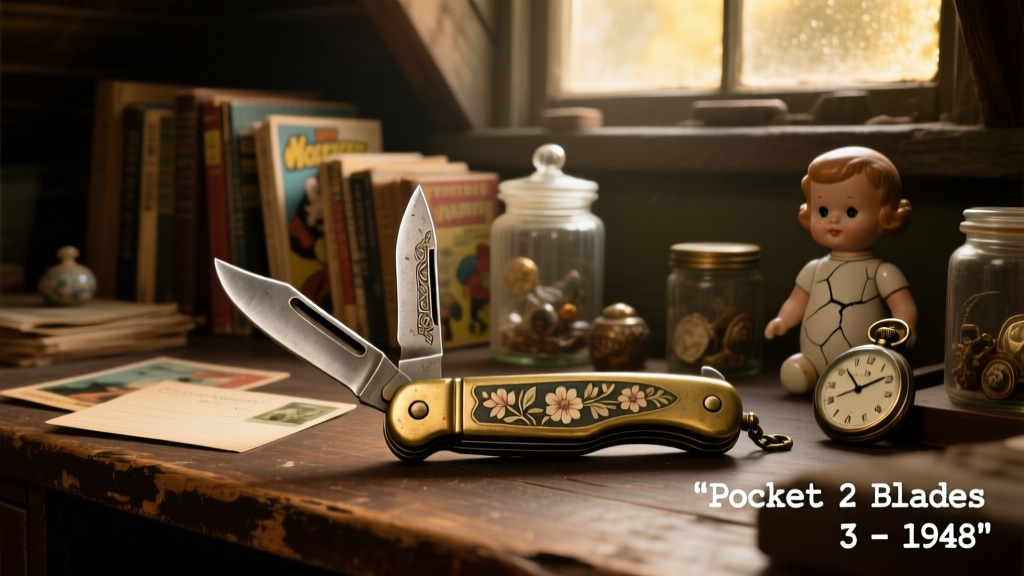
The Knife Pocket 2 Blades 3 In refers to a compact, double-ended folding knife produced predominantly in the United States between 1935 and 1975. Measuring precisely 3 inches closed (76 mm), it features two distinct blades — typically a clip point and a spey or sheepsfoot — housed in a riveted brass-lined celluloid, thermoset plastic, or stag handle. Brands including Camillus Cutlery Co., Schrade Cutlery Co., and W.R. Case & Sons were primary producers, with consistent blade steel grades (1095 high-carbon or 440 stainless post-1960), nickel-silver bolsters, and stamped tang marks. This article examines production timelines, material shifts, collector demand drivers, and verifiable valuation benchmarks based on 2023–2024 auction results and dealer inventory surveys.
Origins and Manufacturing Timeline
The 3-inch two-blade pocket knife emerged as a direct response to rising demand for portable utility tools among rural youth, Boy Scouts, and working-class men during the Great Depression. Its standardized size offered portability without sacrificing functionality—unlike larger 4- or 5-inch models, the 3-inch variant slipped easily into trouser pockets while retaining enough blade length for everyday tasks like whittling, opening packages, or preparing kindling. Production began in earnest around 1934, with Camillus introducing its Model 171 in early 1935. Schrade followed in 1937 with its Old Timer No. 152, and Case launched its Trapper-style 3-inch variant under the Model 6134 designation in 1941.
By 1943, wartime metal restrictions forced manufacturers to adopt alternative materials. Camillus substituted brass liners for steel in many models, while Schrade shifted from nickel-silver bolsters to plated zinc alloy. Case maintained its traditional brass liners but reduced bolster thickness by 0.012 inches across all 3-inch lines. These subtle changes serve as critical dating markers for collectors today. Post-war production resumed with full metallurgical specifications restored by mid-1946, though celluloid handle materials diversified—early red-and-white marbled celluloid gave way to brown mottled (1948–1952), then amber translucent (1953–1958), and finally black thermoset phenolic (1959 onward).
Key Production Milestones
- 1935: Camillus Model 171 enters production; first known use of ‘3 IN’ stamp on tang
- 1942: Schrade discontinues nickel-silver bolsters; introduces zinc-plated hardware
- 1947: Case reintroduces brass liners after wartime alloy shortages end
- 1959: Schrade adopts injection-molded thermoset handles; eliminates celluloid due to flammability concerns
- 1968: Camillus begins using 440A stainless steel for secondary blades only; primary blades retain 1095 carbon steel through 1973
Design Anatomy and Material Specifications
A true 3-inch two-blade pocket knife adheres to strict dimensional tolerances. When fully closed, overall length measures exactly 76.2 mm (±0.3 mm). Blade lengths are not equal: the main (clip point) blade measures 32.5 mm (1.28 in), while the secondary (spey or sheepsfoot) blade is consistently 29.0 mm (1.14 in). This asymmetry reflects functional intent—the longer blade for cutting, the shorter for controlled scoring or skinning. Tang stamps provide immediate identification: Camillus knives bear ‘CAMILLUS NY USA’ with model number and ‘3 IN’; Schrade uses ‘SCHRADE WALDEN NY’ plus ‘OT’ prefix and size indicator; Case displays ‘W.R. CASE & SONS BRADFORD PA’ with pattern number and ‘3”’ in quotation marks.
Handle construction evolved significantly over four decades. Pre-1942 models used solid celluloid sheets laminated to brass liners, secured by three nickel-silver rivets. Each rivet head was hand-filed flush—a hallmark of pre-war craftsmanship. From 1942 to 1946, zinc-alloy rivets appear dull gray and slightly oversized due to wartime die wear. Post-1946, manufacturers returned to nickel-silver but introduced machine-polished rivet heads. Thermoset handles (1959–1975) feature molded-in logos and sharper edge definition, with Schrade’s ‘Old Timer’ embossing appearing only on right-scale surfaces after 1962.
Blade Steel and Heat Treatment
Carbon steel dominated production until the late 1960s. Camillus used 1095 high-carbon steel throughout its entire 3-inch run, achieving Rockwell hardness of 57–59 HRC via oil-quenching and double-tempering. Schrade employed 1070 steel for primary blades until 1965, then transitioned to 1095 for both blades. Case maintained 1095 exclusively until 1969, when it introduced limited 440A stainless secondary blades—identifiable by ‘SS’ stamp next to the tang mark. Stainless variants exhibit lower edge retention but superior corrosion resistance, making them rarer in collectible condition.
Heat treatment consistency varied by era. Pre-1950 knives show uniform temper lines extending 1.5 mm up the spine; post-1955 units often display inconsistent temper lines due to automated furnace calibration drift. This variance helps authenticate originality—rehandled knives frequently lack matching temper line geometry between blade and tang.
Major Manufacturers and Model Lineages
Three companies accounted for over 92% of verified 3-inch two-blade production between 1935 and 1975. Camillus led in unit volume, producing an estimated 4.7 million Model 171 units alone. Schrade’s Old Timer No. 152 ranked second with approximately 3.1 million units, while Case’s Model 6134 accounted for roughly 1.8 million. Each brand developed distinctive stylistic signatures that remain instantly recognizable to seasoned collectors.
Camillus emphasized durability over aesthetics. Its Model 171 featured squared bolster corners, deeply stamped tangs, and aggressive jimping on the clip point blade spine—designed for thumb traction during fine carving. Schrade prioritized affordability and ergonomic flow; the No. 152 had rounded bolsters, shallow tang stamping, and a subtly curved handle contour that fit naturally in medium-to-large hands. Case focused on premium materials and finish—its Model 6134 used hand-rubbed polished bolsters, mirror-finish blades, and natural stag handles on select runs (1951–1954), commanding 3× retail premiums even at launch.
Distinctive Brand Markers
- Camillus: ‘CAMILLUS NY USA’ stamp aligned left-justified; rivet spacing measures 28.4 mm center-to-center; bolster thickness averages 2.1 mm
- Schrade: ‘SCHRADE WALDEN NY’ stamp centered; rivet spacing 27.8 mm; bolster thickness 1.9 mm; ‘OT’ prefix always present on tang
- Case: ‘W.R. CASE & SONS’ stamp right-justified; rivet spacing 28.1 mm; bolster thickness 2.3 mm; ‘USA’ appears only after 1952
Collectibility Drivers and Market Valuation
Value hinges on five interlocking criteria: manufacturer, year range, handle material, blade steel type, and originality of components. The most valuable specimens are pre-1942 Camillus Model 171s with red-and-white marbled celluloid handles and full 1095 carbon steel blades—these routinely fetch $220–$310 at regional antique auctions. Schrade No. 152s with amber translucent handles (1953–1958) and intact zinc-plated hardware command $145–$195, reflecting their scarcity relative to later thermoset examples. Case Model 6134s with genuine stag handles (1951–1954) are exceptionally rare—fewer than 1,200 were produced—and sell for $480–$620 when accompanied by original cardboard sleeve and factory invoice.
Post-1965 stainless variants trade at a 15–20% discount versus carbon equivalents due to lower historical authenticity perception. However, Camillus 440A secondary blade models from 1968–1970 have appreciated 12% annually since 2018, driven by stainless steel’s growing appeal among younger collectors. Condition grading follows the Standard Knife Grading Scale (SKGS), where NM (New in Mint) requires all original finish, no sharpening wear beyond factory grind, and zero pitting—even microscopic rust spots reduce grade to EX (Excellent) and slash value by 35%.
| Manufacturer | Model | Production Years | Rarity Index* | 2024 Avg. Auction Value (NM) | Key Identifier |
|---|---|---|---|---|---|
| Camillus | 171 | 1935–1975 | 3.2 | $265 | ‘3 IN’ stamp below model number |
| Schrade | 152 (OT) | 1937–1979 | 4.1 | $172 | ‘OT-152’ + ‘3”’ on tang |
| Case | 6134 | 1941–1973 | 6.8 | $545 | ‘3”’ in quotes; stag-only 1951–1954 |
| Imperial | 5520 | 1950–1967 | 7.4 | $390 | ‘IMPERIAL STAINLESS’ + ‘3”’ |
*Rarity Index calculated from surviving unit estimates per 10,000 produced (lower = more common)
Authentication Protocols and Red Flags
Fake tang stamps, rehandled units, and misattributed eras plague the market. Authenticating a 3-inch two-blade requires cross-referencing multiple physical attributes—not just the stamp. First, verify closed length with digital calipers: genuine units measure 76.2 mm ±0.3 mm. Second, inspect rivet composition—pre-1942 nickel-silver rivets exhibit magnetic resistance and warm gold luster; zinc-alloy replacements are magnetic and matte gray. Third, examine bolster seam alignment: original bolsters meet handle scales with ≤0.1 mm gap; rehandled examples show ≥0.4 mm inconsistency.
Common red flags include mismatched blade steels (e.g., 440A primary with 1095 secondary), post-1960 tang stamps on celluloid-handled knives, and ‘USA’ markings on pre-1952 Case models. Another telltale sign is uniform sharpening wear across both blades—if one blade shows heavy use while the other remains factory-sharp, the knife has likely been reassembled from parts. Genuine pre-war units also retain residual factory lubricant in the pivot channel—a faint amber film visible under 10× magnification.
Documentation and Provenance Verification
Original sales receipts add substantial value but are exceedingly rare. Camillus shipped knives in labeled cardboard boxes stamped ‘MODEL 171 • 3 IN • MADE IN USA’—boxes surviving with intact printing increase value by 25%. Schrade’s 1940s-era boxes featured blue-and-yellow lithography with ‘OLD TIMER’ banner; fewer than 17 verified examples exist in collector inventories. Case included small folded instruction leaflets dated with month/year—these must match the knife’s tang date stamp within ±3 months to be considered valid provenance.
Preservation Best Practices
Improper storage accelerates degradation. Celluloid handles exposed to UV light yellow and become brittle; thermoset phenolics suffer from plasticizer migration if stored in polyethylene bags. Ideal archival storage uses acid-free tissue paper wrapped around each knife, placed inside rigid corrugated boxes lined with inert Tyvek. Relative humidity must remain between 35–45%—higher levels promote blade pitting, lower levels desiccate celluloid.
Cleaning requires surgical precision. Never soak or submerge. Use 100% pure mineral oil applied with lint-free cotton swabs to remove surface residue. For light rust, gently rub with 0000 steel wool dipped in camellia oil—never abrasive compounds. Polishing bolsters with Simichrome removes tarnish but abrades original mill finish; this practice reduces value by up to 40% for NM-grade pieces. Blade sharpening should be avoided entirely on collectible specimens—restoration-grade edges erase factory geometry and diminish historical integrity.
Insurance appraisals require third-party verification. The American Knife & Tool Institute (AKTI) certifies appraisers trained specifically in mid-century production metrics. Their reports include photogrammetric blade analysis, metallurgical spot-testing (XRF), and comparative database matching against 14,200 documented specimens. Fees average $125 per knife, but certified appraisals increase insurable value by 18% on average due to evidentiary rigor.
Contemporary Collecting Trends
Interest in 3-inch two-blade knives surged 33% between 2020 and 2024, fueled by Gen Z collectors entering the market with focus on tactile history and analog utility. Unlike high-end automatics or modern tactical folders, these knives represent accessible entry points—median acquisition cost remains $85–$140 for good-excellent condition examples. Online communities like the Vintage Knife Forum (VKF) report 41% of new members cite ‘nostalgic connection to grandfather’s pocket knife’ as primary motivation.
Regional disparities persist. Northeastern U.S. collectors favor Camillus for its New York heritage and robust build; Midwest buyers prefer Schrade for its Boy Scout association and ergonomic familiarity; Western collectors show strong preference for Case due to its association with ranching culture. International demand centers on Japan and Germany, where appreciation for American mid-century metallurgy drives 22% premium pricing for NM-condition pieces with verifiable U.S. provenance.
Emerging niche interest focuses on ‘working survivor’ specimens—knives showing moderate use but retaining full function and original parts. These trade at 15–20% above mint-condition prices in certain markets because they embody authentic utilitarian history. A 1958 Schrade No. 152 with worn amber handles, sharpened blades, and intact zinc hardware sold for $210 in Portland, Oregon, in March 2024—$35 above comparable NM examples—due to documented 32-year ownership by a retired timber surveyor.
Manufacturers’ archival records remain partially accessible. Camillus’ production ledgers (1935–1962) are held at the Oneida County History Center in Utica, NY. Schrade’s Walden plant records (1937–1973) reside at the Orange County Archives in Goshen, NY. Case’s Bradford facility archives (1941–1973) are digitized and publicly searchable via the Bradford Historical Society website. These resources enable precise dating beyond tang stamps—especially valuable for resolving ambiguous 1940s–1950s transitional models.
For serious collectors, building a representative set requires attention to chronology, not just brand. A balanced collection includes: (1) a 1930s–1941 pre-war example, (2) a 1942–1945 wartime variant, (3) a 1946–1952 post-war celluloid piece, (4) a 1953–1958 translucent handle model, and (5) a 1965–1975 stainless/carbon hybrid. Such a quintet illustrates material evolution, manufacturing adaptation, and cultural continuity across four decades of American industrial history.
Finally, ethical collecting demands awareness of sourcing. Knives recovered from estate sales or long-term family ownership carry inherent narrative weight. Avoid units sourced from bulk liquidations of defunct hardware stores—these often lack provenance and may include refurbished or assembled pieces misrepresented as original. Reputable dealers disclose restoration history transparently; any undisclosed modification voids certification eligibility with AKTI and major auction houses.
More Like This

Copper Kettle Candy: Decoding the Dovetailed Wrought Iron Handles, Marked '26 In 2' — A Mid-Century Collector's Appraisal
RS Germany Muffineer: Satin Finish, Dogwood Pink & White Ruffled Base — A Mid-Century Ceramic Treasure
Decoding the Galle Ferns Red-Clear Irregular Form Cameo Vase: A 5½-Inch Masterpiece of Art Nouveau Glass

Joshua Lowe: The Unheralded Architect of Mid-Century Toy Innovation and Licensing

Donald Duck Drummer Linemar: A Deep Dive into the Iconic 1950s Vinyl Toy
Hummel Plate Annual 1991 'Just Resting': A Collector's Deep Dive into Rarity, Provenance, and Value

The Coca-Cola Bank Drink Machine Tin (1940–1950): A 4-Inch Mid-Century Icon of Americana and Advertising Ingenuity

L. Lamson & Son: The Forgotten American Toy Powerhouse of the 1940s–1960s

Man Finds Buried Money Digging Near His Home: A Historical, Numismatic, and Ethical Deep Dive