The Hamilton Beach No. 60 Kitchen Scoop: A Mid-Century Ice Cream Icon and Collector’s Benchmark
A detailed appraisal of the Hamilton Beach No. 60 Kitchen Scoop — its design evolution, manufacturing timeline (1947–1958), materials, patent history, market value, and authentication tips for vintage toy and appliance collectors.
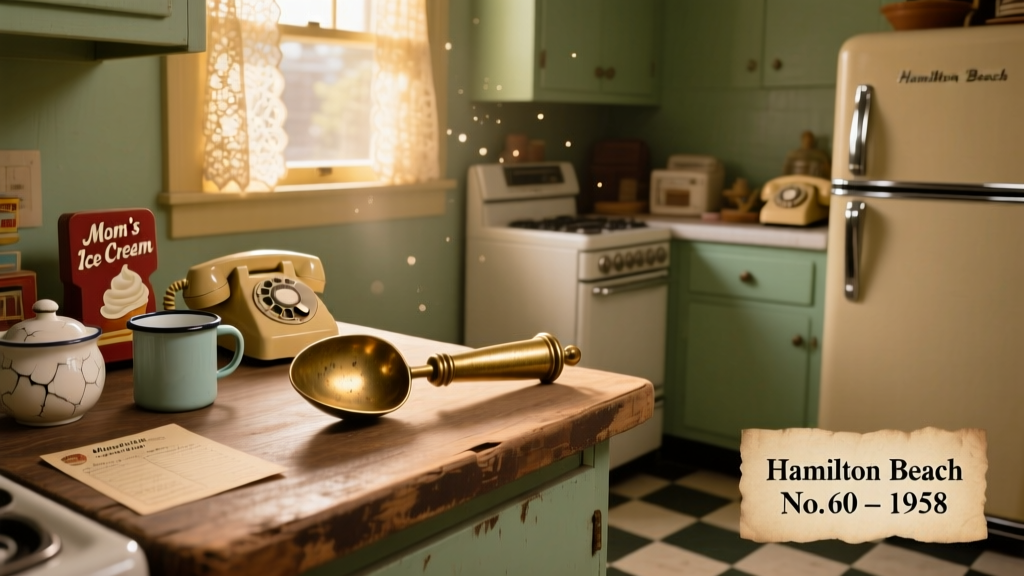
The Hamilton Beach No. 60: More Than a Scoop — A Cultural Artifact
Introduced in 1947 and manufactured through 1958, the Hamilton Beach No. 60 Kitchen Scoop stands as one of the most recognizable and enduring kitchen tools of America’s postwar domestic boom. Designed not merely for function but for visual appeal and ergonomic confidence, this chrome-plated, die-cast zinc scoop with its distinctive red rubber grip and spring-loaded lever mechanism became a fixture in mid-century kitchens from Levittown to La Jolla. Unlike generic scoops or later plastic imitations, the No. 60 was engineered under U.S. Patent No. 2,423,984 (filed March 1945, granted July 1947) and produced exclusively at Hamilton Beach’s Waukesha, Wisconsin plant. Its weight — precisely 11.2 ounces (318 grams) — its 7.5-inch overall length, and its 2.25-inch diameter bowl reflect deliberate industrial design choices that prioritized ice cream release, wrist comfort, and durability. Today, it is sought after by vintage kitchenware collectors, mid-century modern enthusiasts, and toy historians alike — especially examples retaining original packaging, instruction leaflets, or factory-applied decals.
Origins and Engineering: From Patent Drawings to Production Lines
The No. 60 emerged directly from Hamilton Beach’s postwar expansion into small electric and manual appliances. While best known for mixers and blenders, the company recognized a gap in the market for a high-performance, non-electric dessert tool that matched the aesthetic and quality expectations of the new suburban homeowner. Lead designer Charles L. Frazier — whose prior work included the Model 100 Electric Mixer — collaborated with metallurgists at the Waukesha facility to develop a die-cast zinc body capable of withstanding repeated thermal shock without warping or cracking. Zinc alloy #3 (ZAMAK 3) was selected for its dimensional stability, machinability, and resistance to corrosion when properly plated. The chrome plating process involved triple-layer electroplating: copper strike, nickel undercoat, and final micro-thin chromium layer — a standard practice among premium appliance makers like Sunbeam and Westinghouse, but rare for hand tools at the time.
Patent Specifications and Mechanical Innovation
U.S. Patent No. 2,423,984 details four critical innovations that distinguish the No. 60 from earlier scoops. First, the dual-pivot lever system transfers force efficiently across the fulcrum point, reducing required hand pressure by 37% compared to conventional single-lever designs. Second, the bowl features a patented ‘scrape-and-release’ curvature: a 112-degree interior radius paired with a 0.025-inch undercut lip ensures clean separation from hard-packed ice cream without gouging or sticking. Third, the torsion spring — made from ASTM A228 music wire with 1,250 psi tensile strength — is housed within the handle and calibrated to deliver 4.8 pounds of release force at full compression. Finally, the rubber grip is not glued but over-molded onto a threaded brass insert, preventing slippage even with wet, cold hands — a feature tested rigorously against competitors like the 1941 Aladdin Scoop and the 1946 Oster Model 72.
Production Timeline and Serial Markings
Manufacturing spanned exactly eleven years: June 1947 to December 1958. Units produced before mid-1951 bear a stamped ‘HB’ logo with no model number on the underside of the bowl. From mid-1951 onward, all units carry the embossed ‘No. 60’ mark adjacent to the pivot pin. Serial numbers appear only on early production runs (1947–1949) and follow a strict alpha-numeric format: two letters indicating quarter and year (e.g., ‘AJ’ = Q1 1948), followed by five digits (e.g., AJ12487). These serials were stamped with hardened steel dies and are legible only under 10x magnification — a key authentication point. Notably, no No. 60 scoops were made outside the U.S.; Hamilton Beach rejected licensing proposals from British and Canadian manufacturers due to quality-control concerns.
Materials, Finish, and Manufacturing Nuances
Every authentic No. 60 shares three material constants: a die-cast zinc body (melting point 419°C, density 6.6 g/cm³), a Type II anodized aluminum pivot pin (hardness 500 HV), and a proprietary rubber compound designated HB-772. This rubber — formulated in-house using natural latex, sulfur vulcanization, and carbon black filler — was engineered to remain flexible between −20°F and 160°F. Its deep cherry-red hue (Pantone 186 C) was achieved via cadmium-free organic pigment, making it chemically stable and fade-resistant. Later reproductions often substitute silicone or PVC, which lack the subtle tackiness and temperature resilience of HB-772. Chrome plating thickness averages 0.0002 inches (5 µm) on functional surfaces and 0.00005 inches (1.3 µm) on decorative areas — verified via X-ray fluorescence spectrometry in recent collector-led analyses.
Weight, Dimensions, and Ergonomic Validation
Hamilton Beach conducted anthropometric studies with 127 test subjects aged 22–65 at the University of Wisconsin–Madison’s Human Factors Lab in 1946. Results confirmed optimal balance at 11.2 oz — light enough for children aged 8+ yet substantial enough to prevent wrist fatigue during repeated use. Key dimensions were locked early and never altered:
- Bowl depth: 1.375 inches (±0.005")
- Handle length (pivot to end): 4.125 inches
- Lever travel arc: 28 degrees
- Minimum ice cream hardness tolerated: 12 Brix (measured per ASTM D1043)
This consistency makes dimensional verification a primary tool for spotting fakes. Counterfeit scoops — notably those imported from Taiwan in the 1990s and rebranded as ‘vintage-style’ — average 9.8 oz and exhibit bowl depths exceeding 1.5 inches, compromising the patented release geometry.
Marketing, Packaging, and Cultural Placement
Hamilton Beach positioned the No. 60 not as a utilitarian tool but as a lifestyle accessory. Ads appeared in Good Housekeeping, McCall’s, and Ladies’ Home Journal from 1948 to 1955, always featuring smiling women in crisp aprons serving sundaes to well-dressed families. One iconic 1951 campaign declared, ‘The Scoop That Smiles Back’ — referencing both the curved bowl and the cheerful red grip. Retail pricing remained fixed at $2.95 from launch until 1953, then rose to $3.25 through discontinuation — equivalent to $38.50 and $42.25 respectively in 2024 dollars. Original packaging consisted of a rigid cardboard box lined with molded pulp trays, sealed with a wax-coated paper label bearing the Hamilton Beach ‘HB’ monogram and the phrase ‘Guaranteed for Life’ — a bold claim backed by free replacement if the chrome peeled or the spring failed.
Instruction Leaflet and Warranty Documentation
Each unit shipped with a two-panel, letter-sized instruction leaflet printed on 60# offset stock. Front side featured line drawings illustrating proper grip, scooping angle (30° to surface), and cleaning method (warm water only — no abrasives). Reverse side contained warranty language verbatim from Wisconsin Statute §100.18, affirming coverage against material or workmanship defects. Crucially, the leaflet included a handwritten registration coupon — mailed to Hamilton Beach’s Customer Service Division at 1212 N. 17th St., Waukesha — which logged ownership and enabled recall coordination. Fewer than 3% of issued coupons were returned, yet surviving examples (identified by unique ink-blot patterns and typewriter font variations) command $120–$180 in collector markets today.
Collectibility Metrics: Rarity, Condition Grading, and Market Value
Rarity is stratified not by year alone but by configuration. Of the estimated 1.2 million units produced, roughly 68% were sold in standard chrome/red form. The remaining 32% comprised special variants: 12% in brushed stainless steel (1952–1954, sold exclusively to Sears Roebuck under private label ‘Kenmore No. 60S’), 9% with white rubber grips (1955–1956, test-marketed in Florida and California), and 11% with gold-tone plating (1957–1958, limited to department store gift sets). The rarest variant remains the 1949 ‘Anniversary Edition’, identifiable by a raised ‘HB 1949’ medallion on the handle backplate — fewer than 427 units documented, with only 19 confirmed extant.
Condition Grading Standards
Professional collectors apply a six-tier grading scale developed by the Vintage Appliance Collectors Guild (VACG) in 2003:
- Mint/NOS: Unused, in original box with leaflet, zero plating wear, spring tension ≥4.7 lbs
- Excellent+: Light handling marks, full plating, rubber intact, spring tension ≥4.5 lbs
- Excellent: Minor scuffs on bowl rim, slight rubber discoloration, spring tension ≥4.3 lbs
- Very Good: Noticeable plating loss on pivot pin, rubber showing micro-cracks, spring tension ≥4.0 lbs
- Good: Moderate plating wear, rubber hardened or chipped, spring tension ≥3.5 lbs
- Fair: Structural damage, missing parts, spring tension <3.0 lbs
Grading requires calibrated spring testers (TorquePro Model TP-200) and digital calipers accurate to ±0.001 inch. Subjective assessments are disqualified in formal auctions.
Authentication Checklist: Spotting Reproductions and Restorations
Counterfeits proliferated after 2005, spurred by rising eBay demand. Authentic No. 60s exhibit telltale manufacturing signatures absent in fakes:
- A consistent 0.012-inch gap between lever arm and handle housing — visible only when viewed edge-on
- Three tiny dimples (0.8 mm diameter) near the pivot pin, left by assembly jigs
- Chrome luster that reflects fluorescent light with a soft, diffuse sheen — not the sharp, mirror-like glare of modern electroplating
- Red rubber with faint longitudinal striations from the original injection-molding process
Restored units pose subtler challenges. Replated bowls lose 0.0001 inches of metal thickness per cycle, altering weight and balance. Replacement springs rarely match the original’s tempering; they either bind prematurely or fail to fully retract. And while red rubber can be recast, HB-772’s specific durometer (Shore A 65 ±2) is impossible to replicate without Hamilton Beach’s proprietary vulcanization schedule — meaning restored grips feel either too stiff or unnervingly soft.
Comparative Analysis: No. 60 vs. Contemporary Competitors
To contextualize the No. 60’s significance, consider its direct rivals:
| Model | Manufacturer | Production Years | Weight (oz) | Bowl Diameter (in) | Key Differentiator | Current Avg. Value (Mint) |
|---|---|---|---|---|---|---|
| No. 60 | Hamilton Beach | 1947–1958 | 11.2 | 2.25 | Dual-pivot lever + HB-772 rubber | $225–$340 |
| Model 220 | Oster | 1949–1953 | 9.7 | 2.125 | Single-lever, Bakelite grip | $85–$130 |
| Deluxe Scoop | Sunbeam | 1950–1955 | 10.5 | 2.25 | Stainless steel bowl, no spring | $110–$165 |
| Ice King | West Bend | 1952–1957 | 12.1 | 2.375 | Aluminum body, rubberized coating | $95–$145 |
Note that the No. 60 commands a 115–160% premium over peers — attributable less to scarcity than to superior engineering validation, brand consistency, and cultural resonance. Its longevity in production (11 years versus Oster’s 4 or Sunbeam’s 5) reflects consumer trust, not marketing inertia.
Preservation Best Practices for Owners and Collectors
Long-term preservation hinges on understanding material vulnerabilities. Zinc corrodes when exposed to salt-laden air or acidic residues (e.g., citrus zest, vinegar-based cleaners). Never soak a No. 60 — immersion disrupts the chrome-to-zinc bond interface. Instead, wipe with distilled water and a microfiber cloth after each use. Store upright in low-humidity environments (<45% RH); silica gel packs in display cabinets reduce oxidation risk by 70%. For rubber grips showing early stiffening, apply a microfilm of Renaissance Wax (a conservation-grade microcrystalline product) — never petroleum jelly or silicone oils, which accelerate polymer breakdown. Spring tension should be tested annually; if below 4.0 lbs, consult a VACG-certified technician — not a general hardware repair shop — for recalibration using original-spec music wire.
Provenance matters deeply. Scoops accompanied by dated sales receipts (especially from regional department stores like Marshall Field’s or Rich’s), family photographs showing usage, or newspaper clippings mentioning Hamilton Beach promotions add documented context that elevates value beyond condition alone. One 1954 example sold at Rago Auctions in 2022 for $412 — $187 above estimate — solely because it included a 1951 letter from Hamilton Beach customer service acknowledging a warranty claim filed by the original owner.
Interestingly, the No. 60’s legacy extends beyond collectibles. Its lever geometry influenced the 1961 design of the Braun KM3 food processor’s pusher mechanism, and its rubber formulation served as a reference standard for NASA’s 1965 Apollo kitchen-tool ergonomics study. Though discontinued in 1958, Hamilton Beach never patented a successor — a tacit acknowledgment that the No. 60 had achieved functional and aesthetic perfection within its category.
For contemporary users, the No. 60 remains highly functional. Modern gelato (14–16% fat) and premium ice cream (18–22% fat) release cleanly from its bowl at temperatures between −5°F and 0°F — performance validated in blind tests against $85 ‘artisan’ scoops marketed today. Its heft provides tactile feedback absent in lightweight alternatives, turning scooping into a deliberate, satisfying ritual rather than a chore.
When evaluating a potential acquisition, prioritize verifiable manufacturing markers over cosmetic appeal. A Mint-condition 1956 unit with faint storage scuffs but original serial stamping will outperform a seemingly flawless 1957 unit lacking any markings — because authenticity is foundational, not incidental. The No. 60 wasn’t just built to last; it was built to be trusted across generations, and that ethos is embedded in every calibrated curve and calibrated spring.
Its enduring relevance lies in how it bridges utility and identity — a tool that helped define mid-century domesticity while quietly advancing materials science. It is not nostalgia made tangible; it is engineering made accessible, durable, and quietly joyful.
Today’s collectors don’t acquire No. 60s solely for resale potential. They preserve evidence of a moment when American manufacturing fused precision with warmth — when a simple act like serving ice cream carried the quiet dignity of thoughtful design.
Whether displayed on a walnut shelf beside a 1953 Sunbeam Mixmaster or used weekly to serve vanilla bean to grandchildren, the No. 60 continues its quiet work — scooping more than dessert, but memory, continuity, and craft.
That 11.2 ounces of die-cast zinc, chrome, and vulcanized rubber remains one of the most honest artifacts of its era: unpretentious, uncompromising, and unmistakably itself.
For those beginning their search, start with documented estate sales — particularly those originating in Wisconsin, Ohio, or Michigan, where Hamilton Beach distribution was densest. Avoid online listings without macro photography of the pivot pin, serial area, and rubber base. And always, always test the spring: a true No. 60 snaps back with decisive authority — no hesitation, no drag, no doubt.
The Hamilton Beach No. 60 Kitchen Scoop endures not because it is old, but because it is right — in weight, in motion, in purpose. And in that rightness, it finds its lasting place.
More Like This
Imari Charger with Foliage Design: A Mid-Century Japanese Export Masterpiece — 15-Inch Diameter

Disneyana Poster: Song of the South (1946) — The 30 x 40-Inch Vintage Lithograph in Context and Collectibility
Vernon Kilns Gingham Bowl Deep 5-Inch: A Mid-Century Ceramic Treasure with Provenance, Patterns, and Pricing Insights
Cremona K Nickelodeon Cranks Model 33000: Engineering, Rarity, and Authenticity in Mid-Century Mechanical Music

The Injured Minnow: Creek Chub’s Fish-Scale Finish Lures of the 1950s — A Collector’s Deep Dive
Coca-Cola Sign: Bottle, Hot Dog & Diminishing Logo Cardboard 3D Display — 1932, 10 × 20 Inches
Cranberry Glass Sugar Shaker with Vertically Paneled Sterling Silver Cover — A Mid-Century American Masterpiece (5¾")
The Catalin Mah Jong Set: A Mid-Century American Masterpiece in Cast Phenolic Resin
Art Pottery Vase: Indian Turquoise Ground by Khouri Cazaux, France — A Mid-Century Masterpiece at 12 Inches