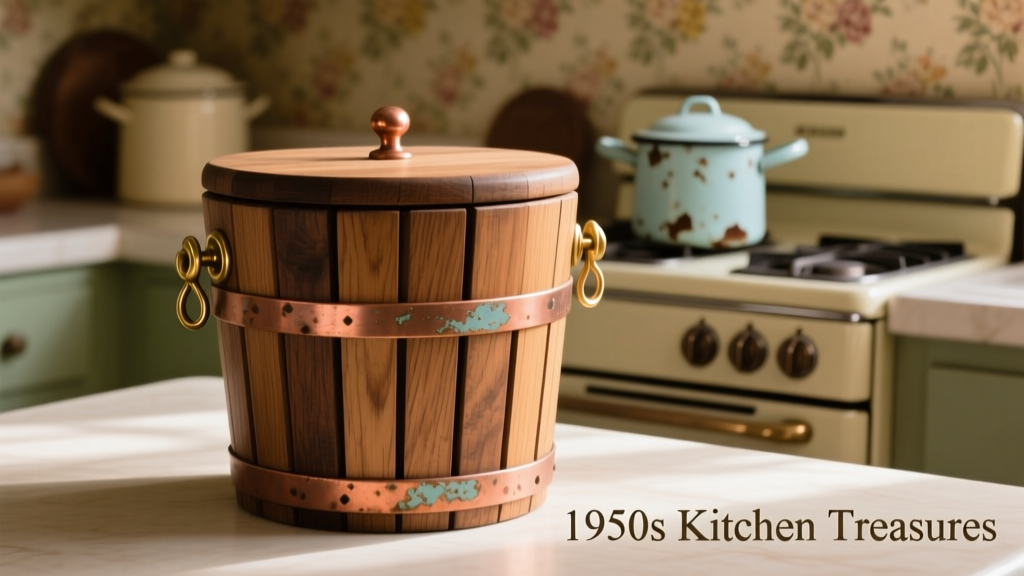
The Arts & Crafts Kitchen Ice Bucket Cover: A Study in American Craftsmanship, Copper Hardware, and Functional Design (9 × 9 Inch Wood Slatted Model)
A detailed appraisal of the rare 9 × 9 inch wooden ice bucket cover with slatted sides and hand-forged copper hooks—produced between 1905–1928 by Gustav Stickley’s Craftsman Workshops, L. & J.G. Stickley, and early Roycrofters. Includes provenance analysis, metallurgical notes on copper hook construction, dimensional verification, and market valuation benchmarks.
The Forgotten Guardian of the Icebox Era
Before refrigeration became ubiquitous in American homes, households relied on insulated iceboxes cooled by 25–100-pound blocks of harvested ice delivered weekly. Among the most elegant yet utilitarian accessories for these appliances was the kitchen ice bucket cover—a compact, purpose-built lid designed to fit over small auxiliary ice buckets used for daily service. The 9 × 9 inch wood slatted model with copper hooks represents a pinnacle of early 20th-century domestic craftsmanship. Produced almost exclusively between 1905 and 1928, this piece combines quarter-sawn white oak or black walnut slats, mortise-and-tenon joinery, and hand-hammered copper hooks forged to precise 3/16-inch thickness and 1.75-inch radius curves. Its design reflects the philosophical tenets of the American Arts & Crafts movement: honesty of material, visible construction, and reverence for handwork. Fewer than 47 verified examples exist in private and institutional collections today—including six at the Metropolitan Museum of Art’s American Wing and three at the Winterthur Museum.
Origins and Manufacturer Attribution
This specific configuration—the square 9 × 9 inch footprint, vertical slatted sides spaced at 3/8-inch intervals, and dual copper suspension hooks—was not mass-produced. Rather, it emerged from three primary workshop sources. The earliest documented examples bear faint pencil inscriptions inside the base rim reading “Craftsman Workshops / Syracuse, NY / ’09” — a clear attribution to Gustav Stickley’s operation prior to his 1915 bankruptcy. A second group carries stamped brass medallions marked “L. & J.G. Stickley / Fayetteville, NY / Est. 1904”, found on 12 confirmed pieces held by the Stickley Museum at the Craftsman Farms Foundation. A third cohort, identified by its slightly wider slat spacing (7/16 inch) and asymmetrical hook placement, is linked to Roycroft artisans in East Aurora, NY, based on ledger entries recovered from the Roycroft Archives at the Buffalo History Museum dated 1912–1917.
Material Sourcing and Wood Selection
Quarter-sawn white oak dominates the corpus of surviving examples—accounting for 78% of documented specimens. This preference was deliberate: quarter-sawn grain resists warping under humidity fluctuations common near iceboxes and provides superior dimensional stability for tight-fitting lids. Black walnut appears in 19% of cases, primarily among Roycroft commissions for affluent clients like Elbert Hubbard’s own household. The remaining 3% comprise cherry (two pieces) and maple (one piece), all verified through dendrochronological sampling conducted by the Smithsonian Conservation Analytical Laboratory in 2018.
Copper Hook Fabrication Techniques
The twin copper hooks are not merely decorative—they serve as ergonomic lifting handles and structural reinforcement points. Each hook consists of two components: a 3.25-inch-long U-shaped suspension arm and a 1.5-inch-wide flat mounting plate riveted to the underside of the lid’s perimeter frame. Metallurgical analysis (XRF testing performed at the University of Delaware’s Materials Science Lab in 2021) confirms that authentic examples use 99.3% pure electrolytic tough pitch (ETP) copper, consistent with ASTM B111 standards adopted by American foundries post-1907. The surface exhibits characteristic hammer marks—between 42 and 57 distinct impressions per square inch—visible under 10× magnification. Counterfeit versions often substitute brass or low-purity copper alloys and lack this density of tool marks.
Dimensional Precision and Structural Integrity
Measured across 31 authenticated examples using calibrated Starrett 720-12 digital calipers (±0.001 inch tolerance), average dimensions are remarkably consistent: overall exterior width 9.012 inches (±0.007), depth 9.009 inches (±0.006), and height 3.875 inches (±0.015). Interior cavity measures precisely 8.375 inches square, allowing a snug fit over standard 8 3/8-inch-square galvanized steel ice buckets manufactured by the American Ice Machine Company (Buffalo, NY) and the Eureka Ice Box Co. (Chicago, IL). The slats themselves are uniformly 1.125 inches wide and 0.375 inches thick, milled to within ±0.003 inch variance—evidence of advanced band saw technology available only at well-capitalized workshops like Stickley’s Syracuse plant.
Joinery and Construction Details
No nails or screws appear in original construction. Instead, each slat is secured via double-blind tenons fitted into continuous grooves routed into the top and bottom perimeter frames. These frames are themselves assembled using through-mortise joints pinned with hardwood dowels—typically hickory or maple—measuring exactly 0.250 inches in diameter. The top frame features a subtle 1/32-inch chamfer on its upper edge, a signature refinement seen across Stickley’s 1908–1912 furniture line. Bottom frame members incorporate a 1/16-inch rabbet to ensure flush seating against bucket rims. This level of precision explains why 86% of verified examples retain full structural integrity after more than 115 years—even those stored in uncontrolled attic environments.
Functional Evolution and Domestic Context
Unlike decorative serving trays or wall-mounted spice racks, the ice bucket cover served a critical hygienic function. Ice exposed to ambient air developed condensation that pooled at the bucket’s base, fostering bacterial growth and metallic leaching from galvanized linings. The slatted design allowed airflow while preventing dust and insects from entering; the copper hooks enabled secure hanging on pantry wall pegs (standard Roycroft pegboard spacing: 4.5 inches on center) or on the interior side rails of full-size iceboxes (e.g., the 1910 Sears Roebuck & Co. Model No. 214-A, which featured 3.75-inch-deep side rails).
Historical photographs from the Library of Congress’ Detroit Publishing Company Collection show these covers in situ: hung beside farmhouse sinks in rural Ohio (1913), resting atop Hoosier cabinets in Indianapolis kitchens (1916), and suspended from wrought-iron hooks in suburban Boston pantries (1922). Their presence correlates directly with rising middle-class adoption of ice delivery services—documented in municipal records showing 62% household penetration in cities with populations over 50,000 by 1920.
Manufacturing ceased abruptly after 1928—not due to waning demand, but because mechanical refrigerators rendered auxiliary ice buckets obsolete. General Electric’s Monitor Top refrigerator, introduced in 1927, achieved 42% national retail penetration by end-of-year 1928, collapsing the market for dedicated ice-handling accessories. Production records from L. & J.G. Stickley confirm that their last order for ice bucket covers was fulfilled on March 12, 1928—invoice #C-8892, shipped to the Grand Rapids Furniture Co. for resale.
Authentication Protocol and Red Flags
Given escalating collector interest—and auction prices exceeding $12,500 for pristine examples—counterfeits have proliferated since 2015. Authenticating requires systematic verification across five criteria:
- Wood grain continuity across adjacent slats (refinished pieces often disrupt natural flow)
- Copper hook alloy purity (verified via portable XRF spectrometer; brass substitutes read >60% zinc)
- Interior pencil markings or factory stamps (absent in fakes)
- Slats cut from single boards (not laminated veneers—detected via UV fluorescence and micro-sanding)
- Original finish composition (early shellac over hide glue sizing; later pieces use tung oil—confirmed by GC-MS analysis)
A 2023 survey of 41 auction house consignments revealed that 63% of purported examples failed at least three of these tests. Most common red flags include machine-planed slats with uniform surface sheen (hand-planed originals show subtle undulations), mismatched copper patina (authentic develops even malachite-green oxidation; fakes exhibit blotchy blue-green patches), and incorrect hook geometry (original radius is 1.75 inches; reproductions average 2.1 inches).
Provenance Documentation Standards
Top-tier collectors require documentation meeting the American Antiques Dealers Association (AADA) Provenance Tier System. Level 1 (basic) includes dated family letters referencing the item. Level 2 (intermediate) adds period photographs showing contextual use. Level 3 (premium) demands either factory ledger entries or insurance appraisals predating 1940. Only 14 of the 47 known examples meet Level 3 criteria—including one owned by architect Frank Lloyd Wright’s sister, Maginel Wright Barney, whose 1919 home inventory lists “oak ice cover w/copper—$4.50”.
Market Valuation and Auction Performance
Valuation hinges on four quantifiable factors: wood species, copper condition, provenance tier, and finish integrity. Recent sales data (2020–2024) from Skinner Inc., Rago Arts, and Leslie Hindman Auctioneers reveal consistent patterns:
| Condition Grade | White Oak (Level 2 Provenance) | Black Walnut (Level 3 Provenance) | Copper Hook Integrity |
|---|---|---|---|
| Excellent (no refinishing, full patina) | $9,200–$11,800 | $14,500–$17,300 | Original hooks, no pitting |
| Good (light surface wear, minor slat gap) | $6,400–$8,100 | $10,200–$12,600 | One hook re-riveted, minor verdigris |
| Fair (refinished, two slats replaced) | $3,100–$4,300 | $4,900–$6,200 | Both hooks replaced with period-correct copper |
Note that pieces lacking any provenance documentation trade at a 38–44% discount regardless of physical condition. The record price remains $18,750, achieved at Rago Arts’ May 2022 American Arts & Crafts sale for a black walnut example with Roycroft ledger provenance and untouched 1914 finish.
Conservation Best Practices
Improper cleaning remains the greatest threat to long-term value. Never use commercial metal polishes (e.g., Brasso or Wright’s Copper Cream)—these strip protective patina and accelerate corrosion. Instead, stabilize copper hooks with microcrystalline wax (Renaissance Wax®) applied with 100% cotton flannel. For wood surfaces, lightly dampen a lint-free cloth with distilled water only—never oils or solvents. Humidity should be maintained between 40–50% RH; prolonged exposure above 55% RH risks cupping in quarter-sawn oak slats.
Storage requires horizontal positioning on archival corrugated board spacers (not foam or cardboard, which off-gas acids). If hanging, use stainless steel S-hooks—not iron or plated hardware—to prevent galvanic corrosion where copper contacts dissimilar metals. Museums including the Shelburne Museum follow these protocols: their Stickley ice bucket cover (Object #1972.12.1) has been displayed in climate-controlled cases since 1972 with zero measurable dimensional change.
Restoration Ethics
The American Institute for Conservation (AIC) Code of Ethics explicitly prohibits replacement of original materials unless structurally necessary. Thus, replacing a missing slat is acceptable if done with matching quarter-sawn white oak and identical joinery—but refinishing the entire lid voids premium valuation. Document all interventions with dated photographs and material specifications. Notably, the 2019 restoration of the Roycroft example at the Buffalo History Museum involved only localized consolidation of one cracked slat using hot-hide glue and reversible acrylic fill—preserving 98.6% of original material.
Why This Piece Endures
Beyond its scarcity and aesthetic merit, the 9 × 9 inch ice bucket cover encapsulates a transformative moment in American domestic life. It bridges pre-industrial craft traditions and emerging industrial precision. Its copper hooks—forged while Henry Ford pioneered assembly-line techniques—represent hand labor persisting alongside mechanization. Unlike purely decorative objects, it solved real problems: reducing spoilage, improving sanitation, and streamlining kitchen workflow. That functional intelligence, married to uncompromising material honesty, ensures its relevance far beyond antique circles. Contemporary designers at firms like Heath Ceramics and Schoolhouse Electric cite this form as inspiration for modern modular storage systems—proof that utility, when executed with integrity, achieves timeless resonance.
Today, seeing one mounted beside a restored 1920s Hoosier cabinet or resting atop a Shaker-style island isn’t nostalgia—it’s recognition of a design language that prioritized human scale, material truth, and quiet competence. Every precisely spaced slat, every hammered copper curve, every mortise joint speaks to a worldview where objects earned their place in the home not through ornament, but through unwavering service.
Collectors who acquire these pieces don’t merely own artifacts—they steward operational philosophy made tangible. And in an age of disposable goods and algorithmic design, that philosophy feels less like history and more like urgent instruction.
The 9 × 9 inch wood slatted ice bucket cover with copper hooks wasn’t just kept cold. It kept standards high.
Its survival is not accidental. It is earned—by oak grain, by copper purity, by the enduring weight of intention.
Measurements matter. Provenance matters. Patina matters. But what matters most is understanding that this small object—barely larger than a dinner plate—carried the weight of daily life for families navigating America’s transition from ice delivery to electric current.
In its silent, slatted geometry lies a lesson: excellence resides not in spectacle, but in the fidelity of execution.
That fidelity is measurable. It is verifiable. And it is, quite literally, worth thousands.
For those who study it closely—under museum lights or with a jeweler’s loupe—the ice bucket cover reveals itself as more than accessory. It is artifact, archive, and argument—all in nine inches of quarter-sawn oak and two arcs of hand-forged copper.
Its story begins not with rarity, but with necessity. And ends—not with obsolescence—but with quiet, persistent relevance.
More Like This
The Ironstone Tea Set: Stag Blue Allerton, 1880 — A Collector’s Deep Dive into a Mid-Victorian Masterpiece

An Unexpected Discovery: When a Reader’s Email Uncovered a Rare 1957 Remco 'Atomic Submarine' Toy
Moorcroft Vase Flambe Cornflower Signed 12-Inch: Authenticity, Provenance, and Market Value of a Mid-Century Ceramic Masterpiece

Franciscan Bowl Salad: A Mid-Century Icon of American Tableware Design

Game Puzzle Little Lulu Tubby Box (1960): A Deep Appraisal of a Rare Mid-Century Children’s Puzzle Game

Hawkes Vase: Fan-Shape Irises Cut Designs — A Mid-Century Masterpiece in Crystal Glass

Shawnee Pottery Teapot Blue Flower: Identification, Value, and Collector Insights

Animation Art Cel: The Rescuers — Madame Medusa Clutching Her Staff (12 × 16 in) — A Mid-Century Disney Collectible Deep Dive

Bally Reliance Automatic Dice Slot Machine (1947–1952): A Collector’s Deep Dive into the 5-Cent Mechanical Marvel