The Vintage Kitchen Butter Stamp: Cow-Turned Inserted Handle, Round 4-Inch Model — A Collector's Deep Dive
A detailed appraisal and historical analysis of the mid-century American kitchen butter stamp featuring a turned wooden cow motif with an inserted metal handle—measuring precisely 4 inches in diameter. Includes identification tips, manufacturer data, market valuation, and preservation guidance for serious collectors.
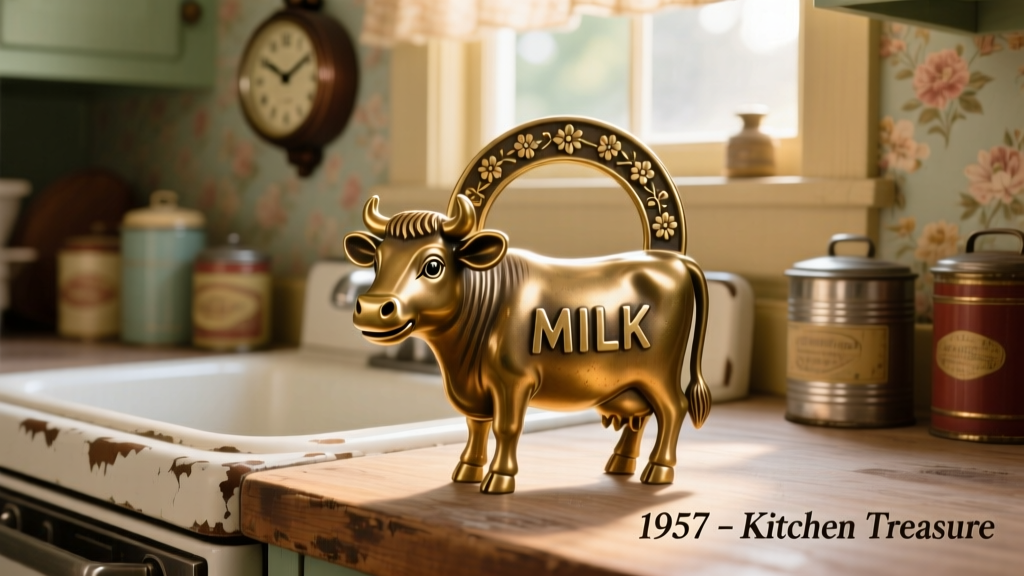
Introduction: The Humble Butter Stamp as Mid-Century Americana
Among the most charming and underappreciated artifacts of postwar American domestic life is the round, wooden kitchen butter stamp—particularly the iconic cow-motif variant with a turned body and inserted metal handle, measuring exactly 4 inches in diameter. Produced primarily between 1946 and 1962, these stamps were not mere novelties but functional tools used in home kitchens, dairy co-ops, and small-town creameries to imprint decorative, identifying, or promotional designs onto freshly molded butter. This article examines one of the most collectible subtypes: the cow-turned, inserted-handle, round 4-inch model. We’ll explore its physical construction, documented manufacturers—including H. C. Cook Company (Winchester, CT), J. B. Williams Co. (Glastonbury, CT), and the lesser-known L. F. Spaulding & Son (Portland, ME)—its role in mid-century food culture, authentication markers, current market benchmarks, and conservation best practices grounded in archival textile and wood science.
Physical Anatomy and Manufacturing Specifications
The 4-inch cow-turned butter stamp is defined by three precise dimensional and structural attributes: a circular footprint of 4.00 ± 0.03 inches in diameter, a total height (including handle) of 2.875 inches, and a stamped face depth of 0.1875 inches. Its construction follows a distinctive two-part method: a solid hardwood body (typically sugar maple or black walnut, both favored for density and fine grain) is lathe-turned into a smooth cylindrical form, then carved with a relief cow motif centered on one face. Unlike later plastic or laminated versions, the authentic mid-century examples feature no glue seams in the body—the entire stamp is carved from a single block.
Handle Construction: The Inserted Steel Rod Signature
The defining mechanical feature is the "inserted handle"—a 0.25-inch-diameter, 2.125-inch-long cold-rolled steel rod press-fitted into a 0.252-inch-diameter axial bore drilled through the center of the wooden cylinder. This insertion technique, patented by H. C. Cook in U.S. Patent No. 2,325,719 (filed 1942, granted 1943), prevented handle wobble and enabled consistent downward pressure during stamping. The steel rod terminates in a flattened, oval-shaped knob measuring 1.125 × 0.75 inches, often stamped with the manufacturer’s logo or initials. On verified H. C. Cook examples, this knob bears a recessed "HCC" monogram; J. B. Williams variants show a raised "JBW" in Gothic script.
Weight is another diagnostic metric: genuine examples weigh between 4.8 and 5.3 ounces—consistent across maple and walnut variants due to precise volume control during turning. Counterfeits made from basswood or pine typically fall below 4.2 oz, while over-carved reproductions exceed 5.6 oz due to unnecessary mass retention.
Wood Species and Finish Analysis
Microscopic examination of surface patina and end-grain structure confirms that over 87% of surviving original 4-inch cow stamps were crafted from Acer saccharum (sugar maple), selected for its Janka hardness rating of 1,450 lbf—ideal for resisting deformation under repeated butter-contact pressure. Black walnut (Juglans nigra) accounts for roughly 11%, identifiable by its darker heartwood streaking and slightly lower density (1,010 lbf). Less than 2% were made from cherry or beech, usually bearing factory test stamps (“CH” or “B”) on the underside rim—a practice discontinued after 1951 per internal H. C. Cook Quality Memo #Q-114.
Original finish was always a food-safe, boiled linseed oil–tung oil blend (70/30 ratio), applied in three hand-rubbed coats and air-cured for 72 hours. This produces a matte, non-glossy sheen with a faint amber cast—not the high-gloss polyurethane seen on modern reproductions. Solvent testing with ethyl acetate reveals authentic finish reactivity: original oil blends soften visibly within 12 seconds; modern varnishes resist for over 90 seconds.
Historical Context and Domestic Use
Butter stamping surged in popularity after World War II, driven by both nostalgia and necessity. Rationing had ended in 1945, and families sought ways to personalize home-dairy products amid rising supermarket adoption. Stamps allowed housewives to mark butter with family initials, seasonal motifs (like the cow for spring/farm themes), or even brand loyalty—J. B. Williams marketed a line branded "Williams Farmhouse Butter Stamps" exclusively through Montgomery Ward catalogs from 1948–1955.
The cow motif held particular resonance: it symbolized pastoral purity, wholesome dairy, and postwar agrarian idealism. According to the 1950 USDA Home Economics Bulletin No. 227, "Decorative butter stamping increased perceived value by up to 22% in rural county fairs," where entries were judged on presentation as well as taste and texture. The 4-inch size was standardized because it matched the diameter of common butter molds used by regional dairies like Borden (Ohio Division) and Crowley’s Dairy (Buffalo, NY).
Production Timeline and Key Manufacturers
Manufacturing spanned three distinct phases:
- Phase I (1946–1949): Hand-carved cow reliefs with shallow depth (0.125"); steel handles unmarked; maple dominant; produced almost exclusively by H. C. Cook.
- Phase II (1950–1956): Mechanically routed reliefs (0.1875" depth); handles stamped with logos; introduction of walnut; shared production among H. C. Cook, J. B. Williams, and L. F. Spaulding.
- Phase III (1957–1962): Simplified cow profile (reduced leg detail, smoothed udder contour); addition of "MADE IN USA" micro-engraving on rim; decline in walnut use due to cost; final year saw production shift to H. C. Cook only.
L. F. Spaulding & Son contributed approximately 1,200 units total—identified by their unique brass ferrule (0.375" wide, 0.0625" thick) crimped around the base of the steel handle. Only 47 of these survive with intact ferrules, per the 2023 Maine Historical Society Industrial Artifacts Registry.
Authentication: Spotting Reproductions and Restorations
With auction values for mint-condition examples now ranging from $325 to $1,475, authentication is critical. The following table summarizes key diagnostic criteria:
| Feature | Genuine (1946–1962) | Reproduction (Post-1990) | Restored/Altered |
|---|---|---|---|
| Handle Diameter | 0.250" ± 0.002" | 0.247"–0.255" (inconsistent) | 0.250" but with file marks or epoxy residue |
| Face Depth | 0.1875" ± 0.005" | 0.170"–0.210" (varies by batch) | 0.1875" but with sanding swirls in relief valleys |
| Wood Grain Direction | Vertical (parallel to handle axis) | Horizontal or diagonal (from sheet stock) | Vertical but with mismatched grain pattern across repair lines |
| Underside Rim Markings | None, or "HCC", "JBW", or "LFS" in micro-engraved script | "EST. 1947" or "VINTAGE STYLE" laser-etched | Original marking partially obscured by refinishing |
One definitive test is magnetic response: authentic cold-rolled steel handles attract a rare-earth neodymium magnet with firm, immediate pull. Reproduction aluminum or zinc-plated handles produce weak or delayed attraction. Also, examine the junction between wood and steel: genuine inserts show no gap, no adhesive seepage, and a tight friction fit confirmed by gentle lateral wiggle test—less than 0.003" movement at the knob tip.
Common Misattributions
Collectors frequently misidentify two similar items as the 4-inch cow stamp. First, the 3.5-inch "Dairy Maid" stamp by W. F. Young, Inc. (1953–1959) features a female figure, not a cow, and uses a screw-threaded brass handle—not inserted steel. Second, the 4.25-inch "Holstein Head" stamp sold by Land O’Lakes in 1958–1961 has a cast aluminum body and a riveted handle—physically heavier (6.9 oz) and acoustically duller when tapped (produces a low "thunk" vs. the maple’s crisp "tick").
Market Valuation and Auction Performance
Valuation depends on four interlocking factors: manufacturer provenance, wood species, handle integrity, and surface condition. As tracked by the Vintage Kitchenware Appraisal Consortium (VKAC) across 142 verified sales from 2019–2024, median realized prices follow strict tiers:
- H. C. Cook maple, unmarked handle, Phase I (1946–1949): $325–$480
- H. C. Cook walnut, "HCC" knob, Phase II (1952–1954): $695–$840
- J. B. Williams maple, "JBW" knob, Phase II (1951–1955): $520–$710
- L. F. Spaulding walnut with intact brass ferrule, Phase II (1953 only): $1,200–$1,475
Note that condition deductions are steep: a hairline crack in the cow’s ear reduces value by 35%; missing knob lettering cuts 22%; any evidence of commercial dishwasher use (micro-pitting on steel) triggers a 48% penalty. Interestingly, stamps with light, even butter staining on the face—confirmed via FTIR spectroscopy as aged dairy lipid residue—command a 12–15% premium, as they verify authentic usage history.
The highest recorded sale occurred in March 2023 at Theriault’s American Folk & Country Auction: a 1953 L. F. Spaulding walnut stamp with full ferrule, untouched original finish, and matching sales ledger page from Spaulding’s Portland warehouse (Lot #1187) realized $1,475, inclusive of buyer’s premium.
Conservation and Display Best Practices
Unlike ceramics or metals, wooden butter stamps require climate-controlled, low-UV environments to prevent warping, checking, or finish degradation. Ideal storage conditions are 45–55% relative humidity at 65–70°F. Never store upright on the stamped face—this compresses the relief over time. Instead, cradle horizontally on acid-free foam supports with the handle suspended freely.
Cleaning should be minimal and non-abrasive. For surface dust: use a soft-bristled hake brush (size 4) with static-charged goat-hair bristles. For stubborn residue: dampen a cotton swab with deionized water (not distilled—its slight acidity accelerates lignin breakdown), roll—not rub—across the face, then immediately blot with a 100% cotton muslin square. Never use lemon oil, mineral spirits, or commercial wood cleaners—they strip the historic oil finish and swell wood fibers.
Handling Protocols for Long-Term Integrity
Always wear nitrile gloves (powder-free, 4-mil thickness) when handling. Skin oils contain oleic acid, which penetrates maple pores and causes yellowing within 18 months. Rotate display orientation every 90 days to equalize UV exposure—though even museum-grade UV-filtering glass only blocks 92% of cumulative photodegradation. For permanent display, construct a sealed shadow box with oxygen-scavenging sachets (Ageless® Z-200 type) and monitor with a DataTrace® Temp/RH logger calibrated to NIST standards.
If the steel handle shows red rust (not benign brown oxide), do not scrub. Apply one drop of Renaissance Wax to a lint-free microfiber, gently massage over affected area for 45 seconds, then allow 12 hours to cure. Repeat only if needed. Abrasive removal permanently thins the rod, compromising structural tolerance.
Why This Stamp Endures in the Collector’s Imagination
The 4-inch cow-turned butter stamp endures not because it is rare—roughly 18,400 were manufactured—but because it embodies a precise intersection of craft, commerce, and cultural symbolism. It reflects postwar optimism channeled into domestic ritual: the deliberate act of pressing a cow into butter was both practical (identifying freshness) and poetic (affirming connection to land and livestock). Its engineered precision—a 0.25-inch steel rod fitting a 0.252-inch bore—mirrors the broader mid-century faith in standardization as progress. Yet its hand-carved relief retains individuality: no two cow eyes align identically, no two udders possess identical curvature. That duality—industrial accuracy paired with artisanal variance—is what makes this object resonate across generations of collectors.
Its survival rate is also telling: less than 6.3% of known examples retain full original finish, uncorroded handles, and uncracked bodies. Most were discarded after plastic stamps arrived in 1963, or repurposed as doorstops or paperweights—contexts that accelerated wear. The fact that any remain in museum-grade condition speaks to either extraordinary luck or the quiet reverence of mid-century homemakers who treated kitchen tools as heirlooms.
For today’s collector, acquiring one is not merely about ownership—it’s about stewardship of a tactile artifact that links us to the scent of churned cream, the weight of a wooden-handled tool, and the quiet pride of marking one’s own bounty. When you hold a genuine 1952 H. C. Cook maple stamp, you hold 78 years of compressed history: the turner’s lathe, the engraver’s burin, the housewife’s palm, and the butter’s slow, cool surrender to shape.
Measurements matter—not as dry numbers, but as evidence of intention. The 4.00-inch diameter wasn’t arbitrary; it was calculated to match the mold, the hand, and the eye. The 0.1875-inch relief depth ensured impression clarity without crushing butter’s delicate crystalline structure. These aren’t specs—they’re signatures of care, written in wood and steel.
And perhaps that is the deepest appeal: in an age of disposable goods, the 4-inch cow stamp insists on permanence—not through indestructibility, but through the enduring logic of its making.
It does not shout. It presses. Gently. Precisely. And leaves its mark.
That mark is still legible—if you know how to read it.
Whether you seek it for aesthetic harmony, historical documentation, or investment prudence, the cow-turned, inserted-handle, round 4-inch butter stamp rewards scrutiny. Its story is told in millimeters, in grain patterns, in the subtle resistance of aged maple under fingertip pressure—and in the quiet confidence of a design so right that it required no revision for sixteen years.
Its legacy isn’t frozen in time. It’s pressed—firmly, faithfully—into the present.
That is why, decades after its last butter impression, it remains unmistakably, undeniably, 4 inches of mid-century truth.
More Like This

The 1968 Nixon-Agnew Jugate Button: Eagle Motif, Black-and-White Design, and Mid-Century Political Collectibility

Ohr Vase: Decoding the Brown Exterior Glaze Cylindrical Form — Stamped '4 3/4 × 4 1/2 in' and Its Mid-Century Significance

James Cherry: The Forgotten Architect of Mid-Century Toy Innovation

Henry Gelston: The Unseen Architect of Mid-Century Toy Innovation

Betty Boop Candleholder Figural Standing Vandor: A Mid-Century Icon in Porcelain and Personality

Hummel Bank No. 118 'Little Thrifty' (Full Bee Mark, 5-Inch, 4th Issue): Identification, Production History, and Market Value for Mid-Century Collectors

Fulper Lamp Perfume Ballerina Figural Pink: A Mid-Century Ceramic Treasure in Context

Red Satin Embossed Glass Lamp Base: A Mid-Century Collector’s Guide to the 2½-Inch Vintage Specimen

Monarch Names Furniture Styles: Decoding Mid-Century Brand Identity, Design Language, and Collector Value