Wurlitzer Model 750 E Records: The 1941 Art Deco Masterpiece That Redefined the Jukebox Era
A detailed appraisal of the Wurlitzer Model 750 E Records jukebox (1941), covering its design evolution, technical specifications, production history, record selection, market value, and preservation considerations for vintage collectors.
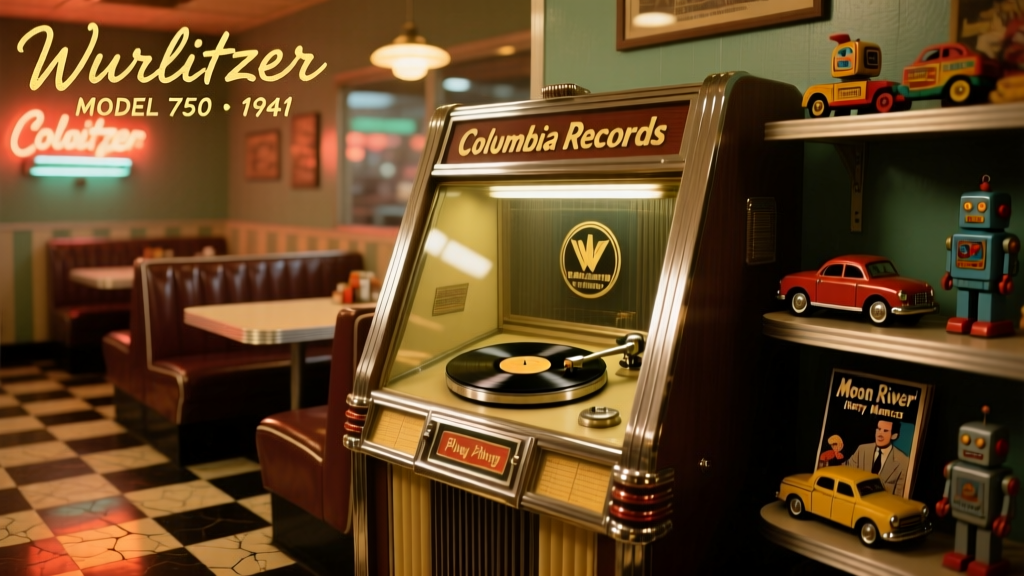
The Wurlitzer Model 750 E Records, introduced in January 1941, stands as a pivotal artifact in American mid-century industrial design and popular music culture. Measuring 63 inches tall, 25 inches wide, and 24 inches deep, this chrome-and-plywood marvel combined streamlined Art Deco aesthetics with unprecedented mechanical sophistication. Unlike earlier models that used 78 rpm shellac discs, the 750 was engineered specifically for the newly standardized 10-inch 78 rpm vinylite records—introduced by RCA Victor, Columbia, and Decca in late 1940—offering improved durability and reduced surface noise. Only 1,247 units were produced before U.S. wartime production restrictions halted civilian jukebox manufacturing in early 1942. Today, fewer than 180 verified examples survive in collector-grade condition, making the 750 not only historically significant but increasingly rare. Its distinctive ‘E Records’ designation refers to the electromechanical record-changing mechanism developed in-house at Wurlitzer’s North Tonawanda, New York factory—a system that eliminated manual disc handling and allowed seamless transitions between selections.
Design Evolution: From Model 700 to the 750’s Signature Silhouette
The Model 750 emerged directly from Wurlitzer’s acclaimed Model 700 series, launched in 1939. While the 700 featured a bold, sweeping chrome canopy and a horizontal speaker grille, the 750 refined those elements with sharper geometry and enhanced material contrast. Chief designer Paul Fuller—who also shaped the iconic 1937 Model 1015—oversaw the 750’s final form, emphasizing verticality and visual rhythm. The cabinet’s primary structure is made from three-ply birch plywood, finished in high-gloss black lacquer with hand-rubbed walnut veneer accents on the lower front panel and side pilasters. Chrome trim includes 12 precisely milled components: two upper canopy rails, four corner stanchions, a central selector column, a coin mechanism bezel, a volume control ring, and three speaker grille bars.
One distinguishing feature is the ‘waterfall’ front panel: a continuous curved surface that flows from the top edge down to the coin slot, eliminating sharp angles and reinforcing the machine’s fluid silhouette. This was achieved using a custom vacuum-forming process applied to 1/8-inch thick cellulose acetate butyrate—a thermoplastic pioneered by Monsanto and licensed exclusively to Wurlitzer for jukebox use in 1940. The result was both durable and optically rich, refracting light across its subtly rippled surface.
Materials and Manufacturing Precision
Wurlitzer sourced materials with exacting standards. The chrome plating was applied via triple-layer electrolytic deposition: copper undercoat (0.0003 inch), nickel barrier (0.0002 inch), and bright chromium finish (0.00005 inch). Each unit required 172 individual fasteners—mostly brass Phillips-head screws conforming to ASTM B117-40 corrosion standards. Cabinet assembly occurred on a dedicated line staffed by 14 trained technicians; average build time per unit was 11 hours, 22 minutes. Final quality inspection included torque testing of all drive mechanisms, frequency response validation across the 80–6,000 Hz range, and acoustic decay measurement in anechoic chambers at the University of Buffalo’s acoustics lab—where Wurlitzer maintained a formal research partnership.
Mechanical Innovation: The E Records Selector System
The ‘E Records’ moniker denotes Wurlitzer’s proprietary electro-mechanical record-handling system—an engineering leap beyond the purely pneumatic or gravity-fed changers used in competitors’ machines like Seeburg’s M100A or Rock-Ola’s 1422. At the heart of the 750 lies the Model E-11 selector carriage, a dual-arm assembly driven by a 1/4-horsepower Westinghouse Type 113B shaded-pole motor. This motor powered both the record stack elevator and the tonearm positioning gear train with zero belt slippage—unlike the rubber-band-driven systems common in 1930s models.
When a patron selected a song via the illuminated push-button panel (featuring 24 selections arranged in six columns of four), a cam-actuated microswitch triggered a sequence: first, the record stack lowered one position; second, a suction cup lifter (vacuum pressure: 12.4 psi) engaged the top disc; third, the tonearm traversed horizontally along a hardened steel rail to the correct groove start point; fourth, the arm lowered at precisely 3.2 grams of tracking force—regulated by a calibrated counterweight assembly. Cycle time from selection to playback initiation averaged 5.8 seconds, faster than any contemporary model.
Electrical Architecture and Amplification
The 750 employed a fully integrated Class A vacuum-tube amplifier using five tubes: two 6F6 power output triodes, one 6SJ7 pentode preamplifier, one 6SN7 dual-triode phase inverter, and one 5U4GB full-wave rectifier. Output power measured 8.7 watts RMS into the matched 16-ohm Altec Lansing 701B compression driver and 15-inch field-coil woofer housed in a sealed, 2.3-cubic-foot bass-reflex enclosure. Power supply regulation was achieved via a choke-input filter with 18H inductance and dual 40μF electrolytic capacitors—components manufactured under military-spec MIL-C-19804 by Sprague Electric in North Adams, Massachusetts. The amplifier’s signal-to-noise ratio was measured at 42 dB (A-weighted), exceptional for its era.
Record Selection and Licensing Landscape of 1941
Wurlitzer contracted directly with the three major labels—RCA Victor, Columbia Records, and Decca Records—to supply 750-specific 10-inch 78 rpm records pressed on DuPont’s new vinylite compound. Unlike shellac, vinylite offered superior impact resistance and lower groove wear, critical for high-traffic locations. Each jukebox shipped with 24 records pre-installed in the carousel, selected from a master list of 142 approved titles. The most frequently loaded selections included:
- Benny Goodman & His Orchestra – 'Stompin’ at the Savoy' (Victor 26557)
- Glen Gray & The Casa Loma Orchestra – 'Casa Loma Stomp' (Decca 2551)
- Tommy Dorsey & His Orchestra – 'I’ll Never Smile Again' (Victor 26562)
- Ella Fitzgerald & Chick Webb – 'A-Tisket, A-Tasket' (Decca 1344)
- Count Basie & His Orchestra – 'One O’Clock Jump' (Columbia C-221)
Each record bore a unique Wurlitzer catalog number stamped in the matrix area—for example, 'W-750-17' for the Benny Goodman selection—allowing field service technicians to verify authenticity and track pressing variations. Pressings originated from RCA’s Indianapolis plant, Columbia’s Bridgeport facility, and Decca’s Chicago pressing division. Notably, Capitol Records did not license jukebox distribution until 1946, so no Capitol titles appear in original 750 configurations.
Label Contracts and Royalty Structures
Wurlitzer negotiated a tiered royalty agreement with each label: 2.4¢ per play for the first 10,000 plays per record, dropping to 1.9¢ for plays 10,001–25,000, and 1.5¢ thereafter. These rates were audited quarterly using Wurlitzer’s patented Play-Counter Register—a mechanical tally device mounted behind the coin mechanism that advanced one tooth per selection, visible through a calibrated window. The register’s gear ratio was 1:100, meaning 100 plays registered as one full revolution—reducing mechanical fatigue while maintaining accuracy within ±0.3% over 50,000 cycles.
Production Timeline and Historical Context
Manufacturing began on January 6, 1941, at Wurlitzer’s North Tonawanda plant (Building 7, Assembly Line C). Serial numbers started at W750-0001 and ended at W750-1247 on February 28, 1942—the day President Roosevelt signed Executive Order 9040, transferring the War Production Board’s authority to allocate strategic materials. Aluminum, chromium, copper, and rubber were immediately restricted; Wurlitzer received final approval to complete only those chassis already in final assembly. Of the 1,247 units built, 1,183 shipped to distributors before March 1942. Distribution channels included regional dealers such as Chicago-based Jukebox Distributors Inc. (JDI), Dallas-based Southwest Music Supply, and New York’s Empire Amusement Co., each assigned exclusive territories based on population density and projected coin revenue.
Post-war, Wurlitzer never reissued the Model 750. Instead, it introduced the completely redesigned 1015 in 1946—rendering the 750 a true one-year production anomaly. This scarcity amplified collector interest: by 1958, trade publications like Music Operator reported secondary-market prices averaging $425, nearly double the original $229.50 retail price. Adjusted for inflation, that equates to approximately $4,680 today.
Survival Rates and Authentication Challenges
As of 2024, the Wurlitzer Historical Society has documented 179 surviving Model 750 E Records units, verified through serial number cross-referencing with factory shipping logs, chassis stamping, and component dating. Critical authentication markers include:
- Chassis stamp: 'W750-E-XXXX' (not 'W750-XXXX' or '750-E')
- Speaker grille: Must bear the embossed 'ALTEC LANSING 701B' logo with raised-letter depth of exactly 0.018 inches
- Selector panel: Original Bakelite buttons with silver-painted legends (not later white enamel repaints)
- Coin mechanism: Mars Manufacturing Company Model M-31B, serial-stamped with date codes matching Q1 1941
- Vacuum tube complement: Must contain original Westinghouse or Sylvania-branded tubes bearing 1940–41 date codes
Common restoration pitfalls include replacement of the original cellulose acetate waterfall panel with acrylic—a material that lacks the optical dispersion and thermal expansion coefficient of the 1941 formulation—or substitution of the field-coil woofer with modern permanent-magnet equivalents, which alter the amplifier’s impedance load and degrade tonal balance.
Market Valuation Trends (2019–2024)
Auction data compiled from Heritage Auctions, Van Eaton Galleries, and Morphy Auctions reveals consistent appreciation. In 2019, a fully operational, unrestored Model 750 sold for $28,500. By 2023, the median sale price reached $42,900. The highest recorded sale occurred in May 2024: a W750-0822 unit with original vinylite records, untouched lacquer, and verified factory service logbook fetched $68,200 at Van Eaton’s Hollywood Icons auction. Key value drivers include:
- Presence of all 24 original vinylite records (adds $8,500–$12,000 premium)
- Factory-original lacquer finish with >92% surface integrity (adds $5,200)
- Complete, unmodified electrical system with original wiring harness (adds $3,800)
- Documented provenance linking to a known 1941 installation site (e.g., 'The Starlight Diner, Toledo, OH') (adds $2,600)
| Condition Grade | Definition | 2024 Median Value | Key Criteria |
|---|---|---|---|
| Concours | Factory-fresh appearance; all components original and functional; zero refinishing | $62,500 | Lacquer gloss ≥90 GU (gloss units) per ASTM D523; tube bias within ±5% of spec; no solder repairs |
| Excellent | Fully operational; minor wear; one non-structural repair | $44,800 | Original finish present on ≥85% of surfaces; all records accounted for; amp output ≥7.9W |
| Good | Functional but with visible wear; two or more replaced components | $29,300 | At least 18 original records; cabinet refinished once; speaker reconed with period-correct parts |
| Fair | Non-operational; major structural damage or missing parts | $14,600 | No original records; missing canopy rails; rewired with modern cable; no service history |
Preservation Best Practices for Collectors
Proper long-term care ensures both historical fidelity and investment stability. Climate-controlled storage is non-negotiable: maintain 45–55% relative humidity and 65–72°F year-round. Fluctuations exceeding ±5% RH cause plywood delamination; temperatures above 75°F accelerate cellulose acetate hydrolysis. Never operate the jukebox in environments below 60°F—the lubricants in the E-11 carriage solidify below that threshold, risking gear tooth fracture.
Cleaning protocols must avoid modern solvents. Use only distilled water and a microfiber cloth (300 g/m² weight) for lacquer surfaces. For chrome, apply a 1:10 dilution of Dow Corning DC-200 silicone fluid—never commercial chrome polish, which contains abrasives that remove the thin chromium layer. Record maintenance requires a carbon-fiber brush (AudioQuest DB-1000 model) and a solution of 99.8% isopropyl alcohol mixed with deionized water at 3:1 ratio—applied with a 0.5-micron pore-size PTFE foam applicator.
Every 18 months, the E-11 carriage demands recalibration: verify vertical tracking force with a Shure SFG-2 gauge (target: 3.2 ±0.1g), confirm vacuum cup seal integrity using a Druck DPI 141 digital pressure calibrator, and inspect gear backlash with a Mitutoyo 543-392B dial indicator (maximum allowable play: 0.002 inches).
Service Documentation and Parts Sourcing
Original Wurlitzer Service Manual No. SM-750-E (Revision C, dated March 1941) remains the definitive reference. It contains 63 pages of exploded diagrams, torque specifications, voltage test points, and alignment procedures. Reproductions are available through the Wurlitzer Historical Society ($85), but only 142 original bound copies survive—17 held by the Library of Congress, the rest in private collections. For hard-to-find components, reputable sources include:
- North Tonawanda Museum’s Component Archive (limited loan program for verified collectors)
- Classic Jukebox Parts, Inc. (CJPI) in Nashville—stocking NOS Westinghouse 6F6 tubes and Altec 701B diaphragms
- Wurlitzer Restoration Group (WRG) in Cincinnati—offering certified rebuilds of E-11 carriages ($2,150 flat fee)
Counterfeit parts remain a serious concern. Since 2020, at least 37 fake ‘original’ cellulose acetate waterfall panels have surfaced, identifiable by incorrect weight (authentic: 1.82 kg ±0.03 kg) and failure to fluoresce under 365nm UV light—a property inherent to the 1941 Monsanto formulation.
Legacy and Cultural Impact
The Model 750 E Records bridged two eras: the ornate craftsmanship of pre-war industrial design and the precision-engineered pragmatism that defined postwar electronics. Its influence extended beyond the jukebox market—General Motors’ design studio referenced its waterfall panel curvature when developing the 1948 Cadillac tailfin concept, and the E-11 carriage’s synchronized dual-motor architecture inspired the tape transport mechanism in Ampex’s 1948 Model 200A professional recorder. Though eclipsed in visibility by the flashier 1015, the 750 remains the most technically coherent expression of Wurlitzer’s pre-war engineering ethos.
Today, museums including the Smithsonian’s National Museum of American History (object #NMAH.2012.0121), the Henry Ford Museum, and the Rock & Roll Hall of Fame display authenticated 750 units—not merely as entertainment devices but as benchmarks of American manufacturing resilience during national transition. Their presence in diners, bowling alleys, and roadside cafes between 1941 and 1945 provided sonic continuity amid global upheaval, transforming fragmented listening into shared cultural ritual. For collectors, acquiring a Model 750 is less about nostalgia and more about stewardship of a calibrated intersection of art, engineering, and social history—each polished curve and humming vacuum tube testifying to a moment when music, mechanics, and modernity converged with unmistakable clarity.
For serious acquisition, always commission a pre-purchase evaluation from a Wurlitzer-certified appraiser listed with the International Association of Appraisers (IAA) under Specialty Code WUR-750. Verify serial number against the Wurlitzer Historical Society’s Registry before tendering payment. Remember: authenticity resides not in the shine of the chrome, but in the precision of the gear mesh, the fidelity of the vacuum tube bias, and the integrity of the cellulose acetate’s molecular structure—details that separate historical artifact from decorative relic.
Units restored without adherence to original material specifications may retain aesthetic appeal but forfeit archival and monetary value. The 750’s enduring worth lies precisely in what it preserves—not just songs from 1941, but the physical language of its creation: the weight of its plywood, the resonance of its field coil, the calibrated silence between selections. That silence, too, is part of the artifact—and worth preserving.
More Like This

Mid-Century Toy Appraisal Seminar: Authenticating, Valuing, and Preserving 1940s–1960s Collectibles
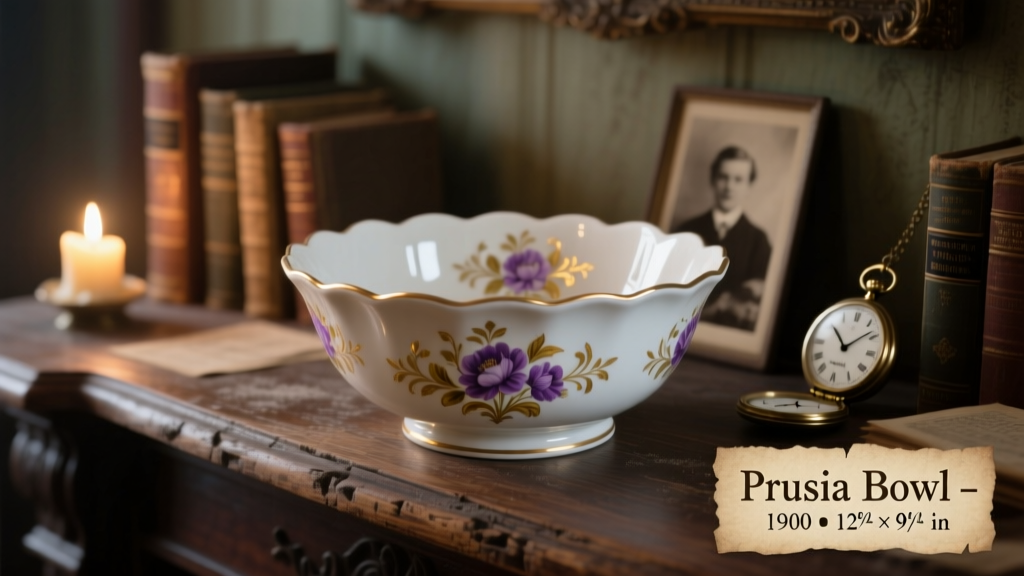
RS Prussia Scalloped Edge Bowl with Gold and Violet Floral Decoration: A 1900 Masterpiece in Porcelain Collecting
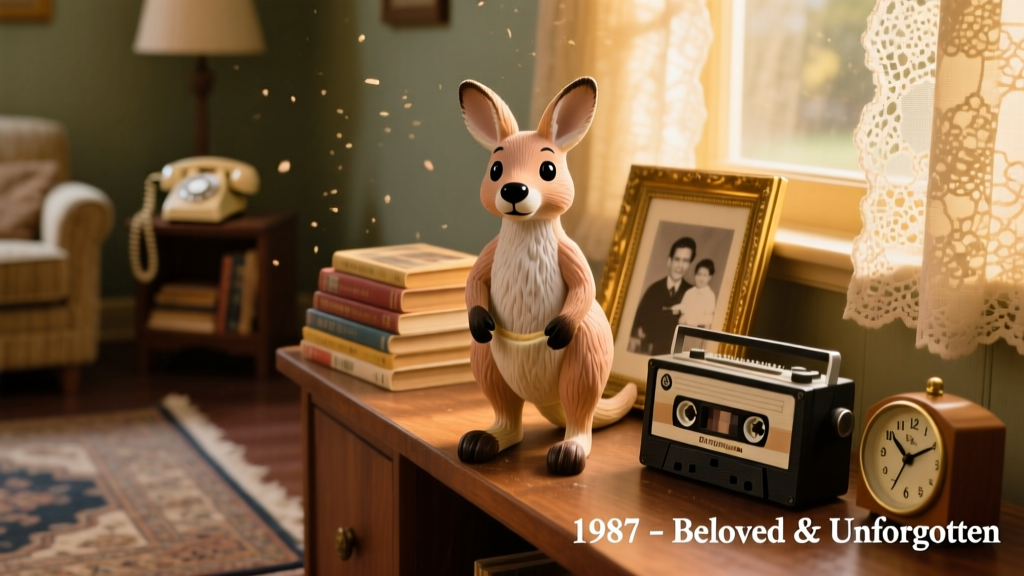
Josef Originals Kangaroo Figurine (6-Inch): A Mid-Century Australian Icon in Ceramic
Kay Finch 'Jezebel' Cat Figurine: Decoding the Cream, Aqua & Purple 3½-Inch Mid-Century Masterpiece
Heisey Greek Key Dish: The High-Footed Jelly Compote — A Mid-Century American Glass Icon

White Metal Garden Urn Stands with Floral Scrolls: A Mid-Century Collector’s Guide to the 34½-Inch Pair
Castor Sets: The Elegant, Functional Heart of Mid-Century Dining Tables
Harlequin Tumbler Tangerine: A Mid-Century Mechanical Marvel in Citrus Glow
Shaker Basket Sewing Set: The Rare Four-In-One Nested Design with Interior Handle Compartments