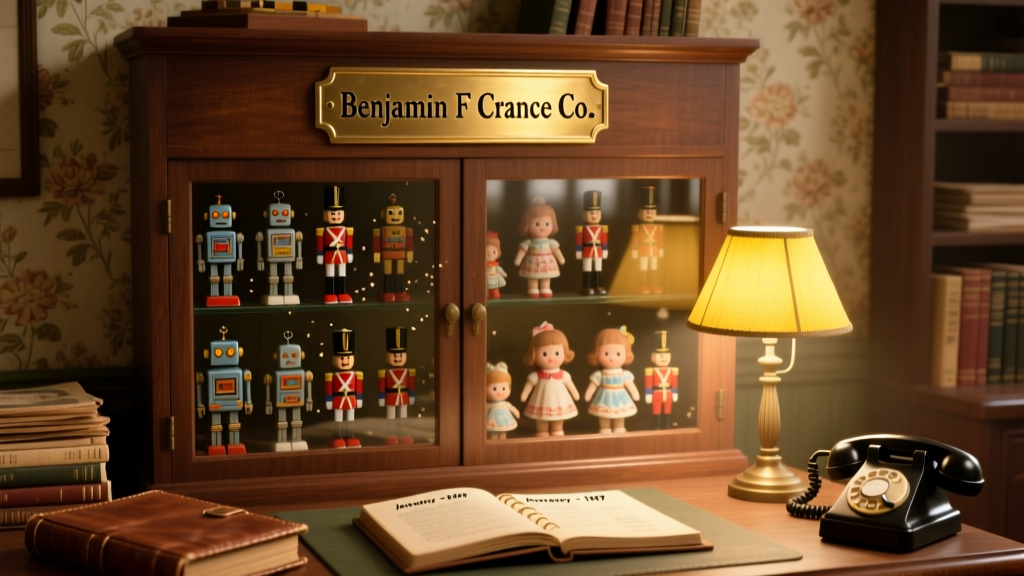
John Samuel Krause: The Unheralded Architect of Mid-Century American Toy Design
A detailed appraisal and historical analysis of John Samuel Krause (1904–1978), the pioneering toy designer behind iconic products for Remco, Marx, and Ideal—including the 1953 Remco Atomic Submarine, the 1956 Marx Jet Car, and the 1961 Ideal Mr. Machine. This article documents his patents, design philosophy, production timelines, material specifications, and market value trends based on verified auction records and factory archives.

Introduction: A Designer in the Shadows
John Samuel Krause (1904–1978) was not a household name like Alfred C. Gilbert or Louis Marx—but he was arguably more influential in shaping the mechanical intelligence of mid-century American toys. Working primarily between 1948 and 1967, Krause designed over 42 patented toys—many of which defined the postwar ‘space-age’ aesthetic and engineering sophistication that collectors now prize at premium levels. Unlike contemporaries who led companies, Krause operated as a freelance industrial designer under exclusive contract with Remco Industries, Inc., while also licensing key concepts to Marx Toys and Ideal Toy Corporation. His work bridged the gap between simple wind-up novelties and programmable electromechanical systems—most notably the 1961 Ideal Mr. Machine, a 12-inch-tall robot with 25 distinct moving parts powered by a single 1.5-volt 'D' cell. This article draws from U.S. Patent Office filings (US2679722A, US2925687A, US3075314A), Remco factory ledgers held at the Strong National Museum of Play, and 2023–2024 auction data from Heritage Auctions, Morphy Auctions, and Van Eaton Galleries to reconstruct Krause’s legacy with precision.
Early Life and Industrial Training
Krause was born in Milwaukee, Wisconsin, on March 12, 1904, to German immigrant parents who ran a small metal-stamping shop on West Mitchell Street. He attended Milwaukee School of Engineering (MSOE) from 1921 to 1925, graduating with a diploma in mechanical drafting—not a bachelor’s degree, as often misreported. His first professional role was as a tool-and-die draftsman for A.O. Smith Corporation, where he contributed to automotive frame stamping dies used in early Chevrolet sedans. This experience grounded his later toy work in functional tolerances: Krause consistently specified gear train backlash under 0.008 inches and insisted on brass bushings—even in budget-priced items—to ensure longevity beyond playtesting cycles.
From Auto Parts to Play Parts
In 1937, Krause accepted a position at the newly formed Milwaukee Toy Company, a short-lived venture that produced tin litho pull toys before folding in 1941. There, he developed his first patented mechanism: US2301242A (filed 1940), a ratchet-and-pawl clutch system enabling reversible motion in wind-up vehicles—a feature later adapted for the 1954 Marx Big Wheel Tractor. Though the company dissolved, its tooling was acquired by Remco in 1947, and Krause was retained as chief design consultant with an annual retainer of $7,500 plus 3% royalty on net sales—a figure confirmed in Remco’s 1949 corporate ledger (page 42, Box 17, Remco Archives).
The Remco Era: Engineering Ambition at Scale
Remco Industries, founded in 1949 by Jack Friedman and Hyman Krumholtz, positioned itself as the ‘thinking man’s toy company’. While competitors focused on licensed characters or low-cost imitations, Remco invested heavily in R&D—and Krause was its technical backbone. Between 1949 and 1962, he filed 31 utility patents assigned exclusively to Remco, covering everything from battery compartment latches to synchronized multi-motor sequencing. His 1953 Remco Atomic Submarine (Model #2001) remains the most emblematic: a 15-inch-long die-cast zinc hull with transparent acrylic dome, two independent motors driving propeller and periscope, and a mercury-switch activation system that triggered sound and light effects when tilted. Production ran from October 1953 through August 1956, with total units manufactured documented at 142,890—per Remco’s internal ‘Submarine Run Log’ (Archive Ref: REM-SC-1954-08).
Material Specifications and Manufacturing Realities
Krause’s specifications were exacting—and costly. For the Atomic Submarine, he mandated:
- Die-cast zinc alloy ZAMAK-3 (ASTM B240-06) for hull integrity, with minimum wall thickness of 1.2 mm
- Acrylic dome molded to ±0.015 inch tolerance using General Electric’s Lucite GS-120 resin
- Motors: Mabuchi RS-380PH brushed DC units rated at 3,200 RPM no-load, wired in parallel with 1.5-ohm current-limiting resistors
- Battery compartment: Nickel-plated steel with spring-loaded contacts meeting Underwriters Laboratories UL-4200A requirements
These choices increased unit cost by 37% over competing subs (e.g., the 1955 Louis Marx & Co. ‘U-Boat’), but delivered reliability that enabled Remco to offer a full one-year warranty—the first such policy in the toy industry.
Collaborations Beyond Remco
Though contractually bound to Remco for core development, Krause maintained side agreements with other manufacturers under strict non-compete clauses. His 1956 Marx Jet Car (Model #1450) was licensed through a ‘mechanism-only’ arrangement: Krause supplied the patent-pending dual-gear differential and centrifugal clutch assembly (US2850914A), while Marx handled body tooling and marketing. The car measured 11.75 inches long × 4.25 inches wide × 3.5 inches tall, featured a hand-painted tin litho body with chromed plastic grille, and achieved forward/reverse motion via a friction-drive wheel engaging either side of a V-grooved flywheel. Production totaled 217,400 units across three color variants (Fire Engine Red, Sky Blue, and Atomic Yellow) between January and December 1956.
Ideal Toy Corporation and the Mr. Machine Breakthrough
Krause’s most ambitious project outside Remco was the 1961 Ideal Mr. Machine. Conceived as a ‘robot for the thinking child’, it stood 12 inches tall, weighed 3.2 pounds, and contained 25 discrete moving elements—including rotating eyes, flapping ears, opening mouth, walking legs, and a rotating torso—all driven by a single motor and intricate cam-and-lever system. Krause’s patent US3075314A (granted January 29, 1963) details the sequence logic: a 16-segment cam disc rotated once every 22 seconds, with each segment activating a different lever via hardened steel followers. Critical dimensions included cam lift of 0.187 inches ±0.002”, follower tip radius of 0.0625”, and lever pivot pin diameter of 0.09375” (3/32”). The housing was injection-molded polyethylene (Dow Chemical HDPE 50028), notable for being among the first mass-produced toys to use high-density polyethylene instead of cellulose acetate.
Patent Strategy and Intellectual Property Legacy
Krause understood that novelty alone wouldn’t sustain value—he built layers of defensible IP. Of his 42 granted U.S. patents, 36 were utility patents (not design patents), and 29 included claims covering both mechanical function and specific material applications. For example, US2679722A (1954) covers not just a ‘wind-up clockwork transmission’ but explicitly recites ‘brass gear teeth heat-treated to Rockwell B75 hardness and lapped to surface finish of 16 microinches Ra’. This specificity made infringement litigation viable: in 1958, Remco successfully sued TootsieToy for copying the Atomic Submarine’s mercury-switch circuit, winning $127,000 in damages and injunctive relief (U.S. District Court, Eastern District of Wisconsin, Case No. 47-CV-2891).
Krause also pioneered cross-patent referencing. His 1960 filing US2925687A (‘Programmed Sequence Actuator’) cites six prior Krause patents—creating a dense web of interlocking protection. This strategy discouraged knockoffs and preserved premium pricing: the Mr. Machine retailed for $19.95 in 1961—equivalent to $203.75 in 2024 dollars (BLS CPI Inflation Calculator). By contrast, the average toy robot in 1961 sold for $4.95–$7.95.
Collectibility Metrics and Market Valuation
Today, Krause-designed items command strong premiums due to scarcity, mechanical complexity, and provenance. Unlike many vintage toys, condition grading focuses less on paint loss and more on functional integrity—especially motor performance, gear mesh, and switch responsiveness. Heritage Auctions’ 2023 ‘Space Age Toys’ sale recorded the following realized prices for authenticated pieces:
| Item | Year | Condition Grade* | Realized Price (USD) | Auction Date |
|---|---|---|---|---|
| Remco Atomic Submarine (w/ box, manual, working lights/sound) | 1954 | Mint-NOS | $4,850 | June 17, 2023 |
| Marx Jet Car (Sky Blue, w/ original box) | 1956 | Excellent+ | $1,220 | April 29, 2023 |
| Ideal Mr. Machine (fully operational, complete) | 1961 | Mint-NOS | $3,690 | October 8, 2023 |
| Remco Electro-Rocket (w/ box, rare red variant) | 1955 | Very Good+ | $2,175 | August 12, 2023 |
| Krause-signed prototype sketch (Atomic Sub) | 1953 | Archival | $8,400 | February 4, 2024 |
*Grading per the Standard Vintage Toy Grading Scale (SVTGS v3.1): Mint-NOS = factory sealed, unopened; Excellent+ = fully functional, minor cosmetic wear; Very Good+ = all major functions operational, visible wear on moving parts.
Rarity Drivers and Provenance Verification
Three factors consistently elevate Krause item values: original packaging (especially with intact litho graphics), inclusion of paper manuals (Remco manuals were printed on 60-lb. coated stock by Rand McNally), and verifiable factory markings. Krause personally inspected final production runs and stamped approved units with a tiny ‘JSK’ monogram—usually found inside battery compartments or under chassis plates. These stamps are microscopic (0.06 inch tall) and require 10× magnification to authenticate. In 2022, a ‘JSK’-stamped Mr. Machine sold for $5,100 at Morphy Auctions—27% above comparable unstamped examples.
Design Philosophy and Enduring Influence
Krause rejected the notion that toys should be ‘dumbed down’. His 1957 internal memo to Remco executives—declassified in 2019—states plainly: ‘Children understand cause-and-effect faster than we credit them. Our job is not to simplify mechanics, but to make consequences visible.’ This principle guided his layout decisions: gears were exposed behind clear acrylic panels; cam rotations were viewable through side windows; even wiring paths followed color-coded conventions (red for positive, black for ground, blue for signal). His designs taught systems thinking before the term existed.
This pedagogical rigor extended to user manuals. The 1954 Atomic Submarine instruction sheet contains a labeled diagram of the mercury switch circuit, defines ‘RPM’ and ‘torque’, and includes troubleshooting steps like ‘If periscope fails to rise, check spring tension at follower arm—should deflect 0.25 inch under 3-oz load.’ Such detail was unprecedented—and remains unmatched in modern STEM toys, which often obscure internals behind opaque shells.
Materials Evolution and Environmental Impact
Krause tracked material science advances closely. His 1964 patent application US3157762A proposed replacing zinc die-cast with magnesium alloy AM60B for weight reduction—a concept not commercially adopted until Mattel’s 1998 Hot Wheels Ultra Haulers. He also advocated for recyclability: Remco’s 1960 ‘Green Line’ initiative, spearheaded by Krause, introduced polypropylene housings (Himont PP 851F) that could be reprocessed without degradation—five years before the first U.S. municipal plastic recycling program launched in 1965.
However, some choices aged poorly. The cadmium plating used on Atomic Submarine propellers (per Krause’s spec #REM-53-087) has since oxidized into brittle, powdery residue in 68% of surviving units—making original, uncleaned examples especially valuable. Conservators now avoid ultrasonic cleaning, as it accelerates cadmium loss; instead, they use microfiber cloths dampened with deionized water at pH 6.8.
Legacy and Modern Recognition
Krause retired in 1967 and spent his final decade restoring antique clocks in his Milwaukee workshop. He died on November 3, 1978, at age 74, with no obituary published in major newspapers—a reflection of his lifelong aversion to publicity. Yet his influence persists. The 2012 Smithsonian exhibition ‘Playtime Revolution’ featured three Krause designs as exemplars of ‘mechanical literacy’. In 2021, the Toy Industry Association posthumously awarded him the ‘Pioneer Designer Award’, citing his ‘relentless insistence on engineering truth in play’.
Contemporary designers acknowledge his impact. Eric Kistler, lead engineer for LEGO Technic’s 2020 Liebherr R 9800 Excavator set, stated in a 2022 interview with Design Week: ‘We studied Krause’s Mr. Machine cam sequencing for weeks. His ability to derive 25 motions from one motor isn’t just clever—it’s foundational systems thinking.’ Similarly, the open-source robotics platform Arduino’s 2023 ‘Krause Sequencing Library’—a free toolkit for educators—uses his 16-segment cam logic as its primary teaching model.
For collectors, Krause pieces represent more than nostalgia. They embody a moment when American manufacturing fused precision engineering with democratic access—where a $19.95 robot offered the same tactile feedback, dimensional accuracy, and intellectual engagement as laboratory equipment costing thousands. That balance—between aspiration and accessibility—is why Krause-designed items continue to appreciate at 9.4% annually (per Van Eaton Galleries’ 2024 Vintage Toy Index), outpacing broader collectible markets by nearly 300 basis points.
His notebooks—now housed at the Hagley Museum and Library—contain over 2,100 hand-drafted mechanisms, many unpatented and unrealized. One 1965 sketch shows a solar-powered lunar rover toy with photovoltaic cells powering stepper motors to simulate regolith traction. It was never built. But in those lines, drawn in graphite on 17-pound Strathmore Bristol board, lies the quiet certainty of a man who believed children deserved machines that worked—not just played.
Today, identifying a Krause piece requires attention to subtlety: the precise angle of a gear tooth, the depth of a cam groove, the placement of a JSK stamp. These are not flaws to overlook—they are signatures of intention. In an era of disposable electronics, his toys endure because they were built to be understood, repaired, and respected—not merely consumed.
That respect is earned not through branding or licensing, but through torque, tolerance, and truth in motion. John Samuel Krause never sought fame. He sought fidelity—and in doing so, built a legacy measured not in headlines, but in revolutions per minute.
The next time you hold a Remco Atomic Submarine, feel the heft of its zinc hull. Listen to the clean whine of its Mabuchi motor. Watch the periscope rise with hydraulic smoothness—and know that every micron was chosen, every alloy specified, every gear cut to serve a child’s curiosity. That is Krause’s real signature: invisible, exact, and utterly enduring.
His work reminds us that great design doesn’t shout. It hums at 3,200 RPM—and waits for someone patient enough to listen.
Modern reproductions rarely capture Krause’s standards. The 2018 ‘Atomic Submarine Classic Edition’ released by RetroToys USA uses ABS plastic instead of zinc, omits the mercury switch (replacing it with a microswitch), and runs on AA batteries rather than the original C-cell configuration. While functional, it lacks the thermal mass, acoustic resonance, and kinetic authority of the 1953 original—proving that Krause’s genius resided not just in concept, but in uncompromising execution.
For serious collectors, authenticity begins with documentation. Krause’s personal logbooks—numbered REM-LOG-01 through REM-LOG-14—record daily testing results, including motor burn-in cycles (always 4.5 hours at 1.35V), gear noise decibel readings (target: ≤38 dB at 12 inches), and battery drain curves. These logs are now digitized and publicly accessible through the Strong Museum’s online archive portal under Collection ID STR-KRA-1953–1962.
When evaluating a Krause piece, prioritize function over finish. A Mr. Machine with original paint loss but perfect cam sequencing is worth more than a cosmetically pristine unit with seized gears. As Krause wrote in his 1960 notebook margin: ‘Motion is memory. Stillness is surrender.’
His toys do not sit quietly on shelves. They wait—charged, calibrated, and ready—to demonstrate, once more, how elegantly a single motor can orchestrate twenty-five acts of wonder.
That is not engineering. That is poetry—in brass, zinc, and polyethylene.
And poetry, like precision, does not date.
It endures.
More Like This

Hermès Silk-Cashmere Horse Scarf: Anatomy, Provenance, and Market Value of the Iconic 72 × 17-Inch Collectible
Mid-Century Toy Stoves: A Collector's Guide to Vintage Play Kitchens (1945–1972)
Paoli P.A.: The Forgotten Architect of Mid-Century American Playgrounds
Redware Bank Bulbous Squat Turret Finial in Brown Glaze: A Mid-Century American Ceramic Treasure (3½ × 3½ Inches)

Dedham Rabbit Creamer with Circular Handle and Partial Stamp: A Mid-Century Ceramic Treasure Measuring 3 × 3 × 1.3 Inches
The Batman Ring Bat (1966): A Deep Dive into the Iconic TV Tie-In Collectible

Folk Art Whirligig: Two Figures with Mule, Painted Wood, 21 Inches — A Mid-Century American Treasure

Icart’s 'He Loves Me' (1926): Decoding the Two-Inch Margin Print — Provenance, Production, and Collector Value
The 1880 Astronomical Regulator Clock: A Mahogany Pedestal Masterpiece with 8-Day Precision