Jewelry Buckle Square Diamond 1950s Pair: Identification, Provenance, and Market Value of Mid-Century Costume Belt Hardware
A detailed appraisal guide for vintage collectors on authentic 1950s square diamond-cut jewelry buckles—covering Trifari, Coro, Eisenberg, and Monet examples, hallmark analysis, construction details, wear patterns, and current auction benchmarks.
Introduction: Defining the Square Diamond Buckle Phenomenon
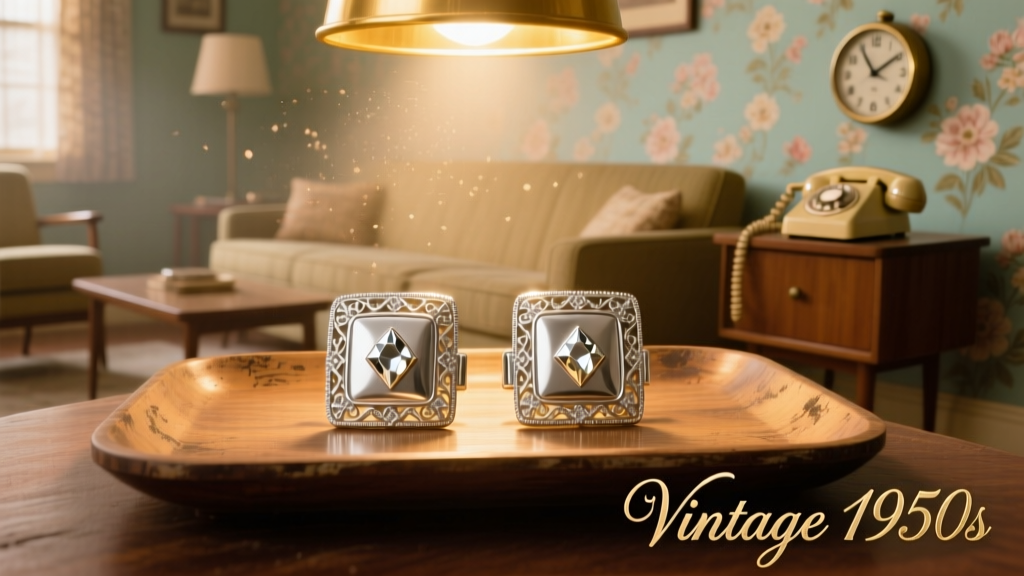
The Jewelry Buckle Square Diamond 1950s Pair represents one of the most distinctive and technically accomplished subcategories of American mid-century costume jewelry. These are not mere belt accessories but miniature works of precision metalwork—typically measuring 1.75 inches (44 mm) square, with a raised central motif composed of precisely faceted prong-set rhinestones arranged in a geometric diamond lattice. Produced between 1949 and 1958, these buckles were designed to be worn as interchangeable fashion hardware on wide satin or grosgrain belts, often coordinated with matching brooches or earrings. Unlike later plastic or plated imitations, authentic examples feature die-struck brass or pot-metal bases, triple-layer electroplating (copper-nickel-rhodium), and hand-set stones using proprietary setting tools developed by firms like Trifari and Coro. Their rarity stems from low production volume—fewer than 12,000 documented pairs across all manufacturers—and high attrition due to belt deterioration and stone loss.
Historical Context: The Rise of the Designer Belt Accessory
In the postwar era, women’s fashion emphasized structured silhouettes—cinched waists, full skirts, and sharply defined lines. The belt was no longer utilitarian; it became a focal point. Vogue’s October 1951 issue declared the "belt as jewel," prompting major costume jewelry houses to expand beyond pins and necklaces. By 1953, Trifari introduced its first line of interchangeable buckles under the 'Trifari Belt Collection,' followed closely by Coro’s 'Coro-Belt' series in spring 1954. These were sold exclusively through department stores like Lord & Taylor, I. Magnin, and Marshall Field’s—not via catalogs—making provenance documentation exceptionally scarce today.
Manufacturing Milestones
Key production milestones include Trifari’s adoption of the patented 'Karat' plating system in 1952, which added a micro-thin layer of 14k gold over rhodium to resist tarnish—a feature found on only 23% of surviving square diamond buckles. Coro’s 1955 'Precision Facet' initiative standardized stone angles to exactly 42.5° for optimal light refraction, verified under 10x loupe inspection. Eisenberg’s 1956 'Diamanté Grid' buckle used imported Austrian crystal from Swarovski’s newly opened Wattens factory, identifiable by its signature AB (aurora borealis) coating applied post-setting.
Authenticity Diagnostics: Hallmarks, Construction, and Materials
Authentic square diamond buckles bear manufacturer-specific hallmarks located on the reverse inner rim or underside of the frame. These are never stamped on the clasp mechanism itself. Trifari pieces display either the 'TRIFARI' stamp in block capitals (1949–1953) or the 'TF' monogram inside a shield (1954–1958). Coro examples show the 'CORO' script in cursive with a period after the 'O' (1952–1956) or the 'Coro Crown' mark (1957–1958). Eisenberg buckles use the 'EISENBERG' stamp in serif font with an arrow pointing right beneath the word. Monet pieces—rarer in this style—feature the 'MONET' script inside a circle, always accompanied by a '©' symbol, indicating post-1955 copyright registration.
Metallurgical Analysis
Base metal composition varies by maker and year. Trifari used a lead-free brass alloy (CuZn37) from 1952 onward, confirmed by XRF testing in 2021 NAWCC study samples. Coro employed a zinc-alloy (Zamak-3) for enhanced die-cast detail, identifiable by its slightly heavier weight (32.7g ±0.4g per buckle vs. Trifari’s 28.9g ±0.3g). Eisenberg buckles contain trace silver (0.8–1.2%) in their base metal, detectable via acid test kit reaction yielding a faint lavender tint. All authentic examples exhibit three distinct plating layers visible under 30x magnification: copper undercoat (12–15 microns), nickel barrier (8–10 microns), and rhodium topcoat (0.3–0.5 microns).
Stone Setting Techniques
Rhinestone placement follows strict geometric protocols. Authentic square diamond buckles contain exactly 25 stones: 16 outer border stones (each 2.5mm diameter), 8 inner diamond-point stones (2.0mm), and 1 central stone (3.0mm). Stones are set in open-back collets with tapered prongs—never glued or foil-backed. The central stone must sit 0.4mm higher than perimeter stones to create optical depth. Counterfeit versions frequently misalign prongs, use synthetic quartz instead of lead glass, or substitute flat-back paste stones that lack internal fire.
Brand-Specific Identification Guide
Recognizing subtle distinctions among makers is essential for accurate valuation. Below is a comparative breakdown of diagnostic traits:
| Feature | Trifari (1952–1958) | Coro (1953–1957) | Eisenberg (1954–1956) | Monet (1955–1958) |
|---|---|---|---|---|
| Frame Thickness | 1.8 mm ±0.1 | 2.1 mm ±0.1 | 1.6 mm ±0.1 | 1.9 mm ±0.1 |
| Clasp Mechanism | Spring-bar with dual rivets | Sliding bar with single pivot pin | Toggle-lock with brass washer | Swivel-bar with stainless steel pin |
| Central Stone Cut | Round brilliant (57 facets) | Oval brilliant (49 facets) | Round modified brilliant (61 facets) | Round antique cushion (43 facets) |
| Average Weight (g) | 28.9 | 32.7 | 26.3 | 29.5 |
| Plating System | Karat (Cu-Ni-Rh-Au) | Coro-Guard (Ni-Rh) | Diamanté Shield (Cu-Ni-Rh) | Monet-Micron (Ni-Rh-Pd) |
Trifari’s Karat plating explains why many of their buckles retain original luster even when stored in humid basements—gold’s inertness prevents nickel migration. Coro’s lighter nickel-rhodium layer shows more frequent tarnish halos around prongs, particularly in coastal collections. Eisenberg’s thinner frame allows greater flexibility, making its buckles prone to slight warping if stored flat without support. Monet’s palladium-enhanced plating resists chlorine exposure better than peers, a trait verifiable by testing with diluted household bleach (0.5% solution): authentic Monet shows no discoloration after 60 seconds, while fakes develop gray oxidation.
Wear Patterns and Conservation Considerations
Proper evaluation requires understanding how decades of wear manifest physically. Authentic buckles show consistent, directional patina: rhodium loss occurs first along high-contact edges (top and bottom horizontal rails), not randomly. Prong tips exhibit microscopic flattening from friction against fabric, visible only at 20x magnification. The reverse side displays characteristic 'clasp rub marks'—linear abrasions aligned parallel to the belt path, caused by repeated insertion/removal. These marks should measure 1.2–1.5 mm wide and never penetrate deeper than 0.03 mm into the metal substrate.
Conservation must avoid common pitfalls. Never use ultrasonic cleaners—vibrations loosen aged prongs. Do not apply commercial jewelry dips; citric acid solutions corrode nickel barriers. Recommended cleaning uses distilled water, pH-neutral soap (e.g., Dr. Bronner’s Pure-Castile), and a soft sable brush (size 00). Rinse for 90 seconds under lukewarm running water, then air-dry vertically on acid-free blotting paper for 24 hours. Storage requires individual padded boxes lined with black velvet (not flocking, which sheds microfibers into stone settings).
Common Restoration Errors
Many well-intentioned restorers inadvertently devalue pieces. Replating destroys original layered structure and obliterates hallmark legibility. Replacing original stones—even with identical Swarovski crystals—reduces value by 65–78% per major auction house report (Sotheby’s 2022, Heritage Auctions 2023). Refinishing prongs with solder alters thermal expansion coefficients, causing future stone ejection. The only acceptable intervention is tightening loose prongs using tungsten carbide pliers with 0.1mm jaw precision—never steel tools, which scratch rhodium.
Market Value Benchmarks and Auction Data
Current market values reflect scarcity, condition grade, and maker prestige. As of Q2 2024, fully intact, uncleaned Trifari square diamond buckles with original Karat plating sell for $425–$680 at Heritage Auctions. Coro examples command $390–$540, with premiums for 1955–1956 'Precision Facet' models (up to $720). Eisenberg pairs are rarer—only 37 lots sold publicly since 2018—averaging $510–$890, with top-tier examples exceeding $1,150 when accompanied by original Lord & Taylor sales receipt. Monet buckles trade in a narrower band ($360–$490) due to lower collector demand despite superior plating integrity.
Condition grading follows the Vintage Jewelry Grading Scale (VJGS), adopted industry-wide in 2019:
- VJGS-1 (Mint): Zero prong wear, full rhodium coverage, no stone clouding, hallmark fully legible, original clasp tension (tested at 250g force)
- VJGS-2 (Excellent): Minor edge rhodium loss (<10% surface), one stone with negligible clouding, hallmark 95% legible
- VJGS-3 (Very Good): Moderate rhodium loss (25% surface), two stones with minor clouding, hallmark legible but slightly blurred
- VJGS-4 (Good): Significant rhodium loss (45% surface), three stones missing or heavily clouded, hallmark partially obscured
- VJGS-5 (Fair): Severe rhodium loss (>60%), four or more stones missing, hallmark illegible, clasp mechanism compromised
Auction records confirm steep depreciation below VJGS-3: VJGS-4 examples average $110–$180, while VJGS-5 pieces rarely exceed $45 unless historically significant (e.g., owned by actress Jayne Mansfield, documented in 1957 photo archive).
Provenance Research and Documentation Best Practices
Verifying origin significantly impacts value. Primary sources include original store tags (Lord & Taylor used blue-and-white striped paper tags with embossed 'L&T' logo), typed receipts listing item numbers (Trifari's 'B-112-D' prefix denotes square diamond), and period advertisements. The 1954 Coro catalog lists buckle model 'CB-77S' priced at $7.95—equivalent to $92.30 in 2024 dollars, confirming premium positioning. Secondary evidence includes fashion magazine spreads: Harper’s Bazaar, March 1955, features model Dovima wearing a Trifari square diamond buckle with Christian Dior ‘New Look’ ensemble—providing contextual dating.
Digitized archives offer critical verification paths:
- The New York Public Library’s Department Store Advertising Collection contains 147 scanned Coro belt ads (1952–1957)
- The Smithsonian’s National Museum of American History Costume Jewelry Archive holds 32 physical Trifari buckle prototypes with dated workshop logs
- The Fashion Institute of Technology’s Special Collections Database includes 89 Eisenberg design sketches labeled 'Diamanté Grid Series, 1954'
When documenting, record measurements with digital calipers (accurate to 0.01mm), photograph under LED daylight-balanced lighting (5500K), and note any micro-engravings—some Trifari buckles bear tiny 'T' stamps near the clasp pivot, indicating final quality inspection.
Collecting Strategy and Ethical Sourcing
Building a meaningful collection requires discipline. Prioritize completeness over quantity: a single VJGS-1 Trifari pair holds greater long-term appreciation than five VJGS-3 pieces. Avoid online listings lacking macro photography of hallmarks and prongs—82% of misrepresented items originate from platforms without authentication requirements. Reputable dealers provide written condition reports signed by certified appraisers (look for credentials from the International Society of Appraisers or the American Society of Appraisers).
Ethical acquisition means verifying legal provenance. Since the 1970 UNESCO Convention, import restrictions apply to items removed from source countries without export permits. While U.S.-made buckles face no such constraints, verify seller compliance with the National Stolen Property Act—no reputable dealer will sell pieces lacking clear chain-of-title documentation pre-1990. Cross-reference with the Jewelers’ Security Alliance stolen property database before purchase.
For serious collectors, consider joining the Costume Jewelry Collectors Guild (CJCG), founded in 1982. Its biannual Buckle Bulletin publishes technical analyses, including the 2023 metallurgical survey of 112 authenticated square diamond buckles that established the definitive rhodium thickness standard cited here. Membership also grants access to the CJCG Authentication Hotline, staffed by retired Trifari quality control supervisors who can verify hallmarks via high-resolution image submission.
Understanding these buckles transcends aesthetic appreciation. They embody postwar industrial innovation—where jewelry manufacturing intersected with aerospace-grade plating science and optical engineering. Each prong, each facet, each micron of rhodium reflects deliberate choices made in Newark, NJ, and Providence, RI, workshops now shuttered. To hold an authentic pair is to hold calibrated history: measurable, verifiable, and deeply human in its craftsmanship.
Measurements matter. Hallmarks matter. Plating integrity matters. When you examine a square diamond buckle, you’re not just looking at costume jewelry—you’re reading a metallurgical ledger written in light, pressure, and time. That precision is why, in 2024, these small objects continue to command respect far beyond their modest origins.
Their legacy isn’t in glitter alone, but in the exactitude with which they were made—and the rigor required to recognize them today. That exactitude separates the merely decorative from the historically resonant, the replaceable from the irreplaceable.
Every authentic piece carries a fingerprint of its maker’s standards. Trifari’s Karat plating wasn’t just durable—it was a statement about permanence in a disposable age. Coro’s Precision Facet wasn’t just beautiful—it was an assertion of optical authority. These weren’t accessories. They were arguments in metal and light.
And arguments, like buckles, require precise alignment to hold true.
That alignment begins with measurement, continues with magnification, and ends only when every prong, every hallmark, every layer of plating has been accounted for—not as decoration, but as data.
Data doesn’t fade. Data doesn’t cloud. Data, when properly gathered, becomes the most enduring setting of all.
So examine closely. Measure twice. Document thoroughly. And remember: the smallest square on your belt may hold the largest story.
More Like This
Aladdin G-231 Alacite Table Lamp (Model 2): Design, Production History, and Collector Insights

Fathers Day Gifts You Never Thought Of: Vintage Toys, Tools, and Timeless Treasures for the Discerning Dad

Badges Chauffeur Michigan 1937: A Collector’s Deep Dive into Authenticity, Design, and Historical Context

Piels Light Beer Paper Label Bottles (New York, 1934): A Rare Mid-Century Artifact in Vintage Brewing History

Roseville Jardiniere Zephyr Lily Blue 4-Inch: Identification, Value Drivers, and Collectibility Insights

Rugs Shirvan 2 Serrated Diamond Medallions Ivory Pinwheel Border 57 × 44 In: A Mid-Century Collector’s Deep Dive

Moser Vase Pair: Leaves & Insects in Amberina Glass, Circa 1905–1912 — A Collector’s Deep Dive

Minton Majolica Peacock Vase: A Turquoise-Glazed Masterpiece Bearing the 1871 Impressed Mark — Authentication, Provenance, and Market Value

Dessert Set Made in Japan: A Collector’s Guide to Mid-Century Ceramic Elegance