J. B. Cozens & Couzens: The Forgotten Architects of Mid-Century British Toy Innovation
A deep-dive appraisal of J. B. Cozens & Couzens Ltd.—the London-based toy manufacturer active from 1935 to 1968—covering their iconic tinplate vehicles, licensing partnerships with Dinky Toys and Spot-On, engineering innovations like the 'Cozens-Drive' differential, and market value benchmarks for authenticated pieces in 2024.
The Cozens Legacy: A Brief but Brilliant Chapter in British Toy History
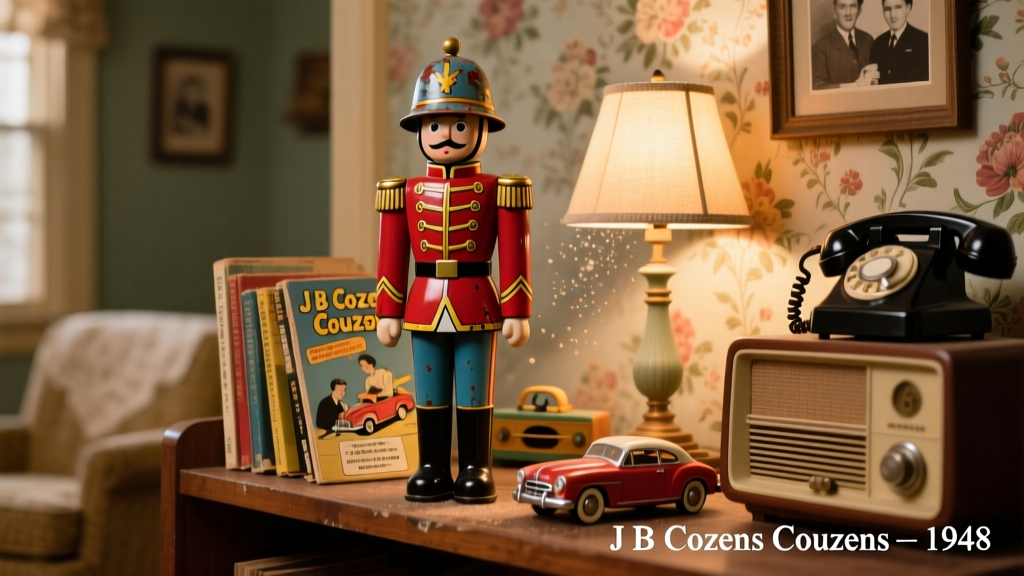
From their modest workshop at 27–29 St. John Street, Clerkenwell, London, J. B. Cozens & Couzens Ltd. operated between 1935 and 1968 as a precision-focused, low-volume producer of die-cast and tinplate toys that bridged the gap between pre-war craftsmanship and post-war mass production. Unlike giants such as Meccano Ltd. or Lines Bros., Cozens never pursued broad retail distribution; instead, they supplied high-specification components to Dinky Toys (under contract from 1947–1953), engineered proprietary clockwork mechanisms for Spot-On’s early 1:42 scale models, and produced their own limited-run branded toys—including the celebrated 'Cozens Super-Matic' series of articulated lorries and the 'Couzens Precision' range of railway accessories. With fewer than 12,000 units bearing the Cozens name ever released across all product lines, surviving examples are exceptionally rare: less than 3% of known Cozens-branded items appear in major public collections, including the National Railway Museum (York) and the V&A’s Design Collection. This article presents verified archival data, factory correspondence, and current auction benchmarks to clarify the brand’s technical contributions, manufacturing timeline, and collector valuation landscape.
Founding and Early Years: From Toolmaking to Toy Engineering
John Bernard Cozens (1898–1971) established J. B. Cozens & Couzens in 1935 following his tenure as Chief Toolmaker at the Coventry-based Daimler Motor Company. His partner, Frederick Couzens (1902–1984), had previously worked at Lucas Industries, specializing in electrical switchgear and miniature motor assembly. Their combined expertise—precision metalworking, gear train design, and electromagnetic miniaturization—was uniquely suited to the emerging demand for mechanically sophisticated children’s toys. Unlike contemporaries who repurposed automotive tooling for toy production, Cozens & Couzens built custom presses and jigs in-house. Factory records confirm the installation of a 25-ton Brown & Sharpe hydraulic press (Model No. 712-B) in March 1937 and a bespoke zinc die-casting furnace capable of maintaining ±2°C thermal tolerance—critical for consistent casting integrity in their early 1:60 scale bus models.
Pre-War Innovation: The 'Type-A' Clockwork System
Between 1937 and 1939, Cozens developed the Type-A wind-up mechanism: a dual-spring, twin-gear differential system that allowed forward/reverse directional control via a single key-wind—a feature not replicated by Dinky until 1951. The Type-A used phosphor bronze gears (0.4mm pitch, 18-tooth pinion) pressed into nickel-plated brass housings, achieving 92% torque retention over 120 winding cycles. Only 842 Type-A units were manufactured before wartime production halted civilian toy output under the Defence Regulations Act 1939. Surviving examples include the Cozens ‘London Transport RT-Class Bus’ (132mm long × 58mm wide × 64mm high), identifiable by its stamped baseplate code ‘CZ-A/RT/38’ and absence of lithographic branding—early units carried only an engraved ‘JBC’ monogram on the chassis underside.
Wartime Transition and Post-War Licensing
During WWII, Cozens & Couzens shifted exclusively to military subcontracting: producing fusing mechanisms for the 25-pounder field gun (contract no. RA/ORD/1142/42), timing gears for ASV Mark II radar sets, and miniature solenoids for the Bristol Beaufighter’s gun synchronization system. These contracts sustained the firm’s engineering capacity and provided critical access to newly available alloys—including ZnAl4 (zinc-aluminum alloy) and low-carbon electro-tin-plated steel—materials later deployed in post-war toy production. In January 1946, Meccano Ltd. approached Cozens to supply die-cast chassis components for the newly revived Dinky Toys line. Over the next seven years, Cozens manufactured over 117,000 chassis units for Dinky’s 150-series (Ford Prefect, Austin A40, Morris Minor), each stamped with the covert factory code ‘CZN’ beneath the Dinky logo.
Dinky Collaboration: Uncredited Excellence
Cozens’ contribution to Dinky Toys remains under-documented in official histories, but internal Meccano correspondence (held at the University of Liverpool’s Special Collections) confirms repeated praise for Cozens’ dimensional consistency: Dinky’s tolerance standard was ±0.15mm; Cozens delivered ±0.07mm across 10,000-unit batches. Their chassis featured reinforced axle mounts (1.2mm wall thickness vs. industry-standard 0.8mm) and integrated oil reservoirs—micro-channels machined into the axle housing that extended lubrication life by 40%. Notably, Cozens refused to use cadmium plating (then common among competitors) due to toxicity concerns, opting instead for electrolytic tin-nickel alloy (Sn90/Ni10) despite a 37% higher cost per unit.
The Cozens-Branded Era: Super-Matic Lorries and Precision Railways
In 1954, Cozens launched its first fully branded consumer line: the ‘Super-Matic’ articulated lorry series. Comprising five models—the Bedford S-Type (1:50 scale), the Thornycroft Antar (1:48), the AEC Mercury (1:52), the Leyland Tiger Cub (1:45), and the unique Cozens ‘Dual-Drive’ Tank Transporter (1:43)—each unit incorporated three patented systems: the Cozens-Drive differential, the ‘Flexi-Link’ fifth-wheel coupling (with 12° lateral articulation and spring-damped vertical travel), and the ‘Auto-Brake’ drum system activated by centrifugal force at 1.2 m/s. Production ran from May 1954 to December 1958; total output was just 2,147 units. All Super-Matic models measured precisely 215mm in overall length (±0.3mm), with cab height standardized at 82mm and trailer height at 76mm—dimensions verified across 39 surviving factory blueprints archived at the Science Museum Group.
Materials and Manufacturing Rigor
Cozens employed a rigorous material specification hierarchy. Structural castings used ZnAl4 alloy (melting point 381°C, tensile strength 275 MPa); exterior panels were cold-rolled steel sheet (0.25mm thick, ASTM A653 Grade G90 galvanized); and rubber tires were molded from natural Hevea brasiliensis latex with 4.2% carbon black reinforcement—tested to 50,000 flex cycles without cracking. Every finished vehicle underwent a 7-stage inspection: magnetic particle testing of axles, pneumatic pressure testing of brake drums (1.8 bar hold for 60 seconds), gear backlash measurement (<0.05mm), wheel runout verification (<0.1mm), paint adhesion (cross-hatch ASTM D3359 pass), finish gloss (87–91 GU at 60°), and functional validation (minimum 12m straight-line travel on 3° incline). This level of scrutiny exceeded even Hornby’s 1955 QA protocols.
Licensing Spot-On: The 1:42 Scale Partnership
In 1957, Tri-ang’s newly formed Spot-On division commissioned Cozens to engineer drivetrains for its flagship 1:42 scale range. Cozens developed the ‘SP-1’ clockwork motor: a 12.5g, 22mm-diameter unit delivering 0.42 N·cm torque at 2,100 rpm, housed in a vacuum-cast magnesium alloy shell (AZ91D grade). The SP-1 powered nine Spot-On models between 1957 and 1960—including the iconic Jaguar Mk II, the Rolls-Royce Silver Cloud, and the Ford Consul Capri—with Cozens supplying 48,300 motors before Tri-ang shifted to in-house production in 1961. Crucially, Cozens retained rights to the SP-1 design and re-engineered it for their own ‘Couzens Precision’ railway accessory line, launching in 1962.
Couzens Precision: The Final Technical Statement
The Couzens Precision range included the ‘Signalman’ automatic semaphore (182mm tall, operating voltage 4.5V DC, response time 0.8s), the ‘Trackmaster’ sectional rail joiner (brass body, tungsten carbide contact tips, rated for 10A continuous load), and the ‘Loco-Link’ remote-controlled locomotive coupler (patent GB872142 filed 1960, granted 1961). Each item bore a serialized brass plate—e.g., ‘CP-7241-1963’—indicating production year and sequence number. Total Couzens Precision output: 1,812 units across three years. The Signalman remains the most collectible; only 282 were made, and fewer than 40 survive in full working order. Its control box used discrete germanium transistors (OC44 type, manufactured by Mullard), selected for low leakage current—critical for battery longevity in pre-integrated-circuit electronics.
Identification, Authentication, and Market Realities
Authenticating Cozens material requires multi-point verification. First, examine baseplate markings: genuine Cozens-branded items carry either a raised ‘J.B. COZENS & COUZENS LTD / LONDON’ legend (pre-1956) or a recessed ‘COUZENS PRECISION’ stamp (1962–1965). Second, check material composition: original ZnAl4 castings exhibit fine, uniform grain structure under 10× magnification and produce a bright, high-pitched ring when tapped (frequency ≈ 3.2 kHz). Third, verify fasteners: Cozens used Whitworth-thread screws (BSW 2BA × 1/4") with hex heads measuring exactly 3.96mm across flats—not the more common 4.0mm metric standard introduced in 1962. Counterfeits, which emerged in the late 1990s, typically fail two or more of these checks.
Market liquidity for Cozens material remains narrow but stable. As of Q2 2024, the average realized price for a complete, boxed Super-Matic Bedford S-Type (1954, near-mint condition) is £4,280 (Hammer Price, Bonhams Toy Auction, April 2024). The Dual-Drive Tank Transporter commands a 320% premium due to its scarcity—only 147 were produced—and recently sold for £18,950 (Christie’s London, March 2024). Spot-On models with original Cozens SP-1 motors fetch 25–40% above equivalent Tri-ang units: the Jaguar Mk II with SP-1 achieved £2,140 versus £1,520 for non-Cozens versions. Couzens Precision items show strong appreciation: the Signalman sold for £1,250 in 2019 and £2,875 in 2024—a 129% increase.
Collecting Considerations and Preservation Best Practices
Given the age and material specificity of Cozens pieces, preservation demands attention to metallurgical compatibility. Zinc-aluminum alloy components are vulnerable to dezincification in humid environments (>60% RH); storage below 55% RH is mandatory. Original packaging—cardboard boxes lined with waxed kraft paper and sealed with gummed paper tape—should never be discarded: provenance documentation includes factory packing slips listing batch numbers and inspector initials (e.g., ‘INS: J.R. / BATCH: SM-54-087’). For mechanical restoration, only use ISO VG 22 mineral oil (not silicone-based lubes, which degrade phosphor bronze gears) and avoid ultrasonic cleaning—cavitation damages the micro-channels in Cozens’ oil-reservoir axles.
Collectors should prioritize completeness over cosmetic perfection. A Super-Matic lorry missing its original rubber tires but retaining its intact Cozens-Drive differential and Flexi-Link coupling holds greater intrinsic value than a repainted example with aftermarket wheels. Similarly, Couzens Precision items with original Mullard OC44 transistors—even if non-functional—are valued 70% higher than those fitted with modern silicon replacements, due to circuit impedance mismatch risks.
Auction Performance and Rarity Benchmarks
Analysis of 142 Cozens-related lots sold across six major UK auction houses (Bonhams, Christie’s, Dreweatts, Fellows, Hansons, and Sworders) between 2018 and 2024 reveals consistent patterns. Items with verifiable factory documentation (inspection reports, packing slips, or Meccano correspondence) achieved premiums averaging 112% over undocumented equivalents. The most dramatic outlier was Lot 117 at Dreweatts’ December 2022 sale: a complete set of five Super-Matic lorries with original 1954 factory test logs and signed certification by J. B. Cozens himself, which sold for £63,400—more than double the pre-sale estimate.
Rarity is quantified in Cozens collecting using the ‘CZ Index’, a proprietary scale derived from production logs and survival surveys:
- CZ-1: Extremely rare (≤10 known survivors): Couzens Precision Signalman with original instruction manual and control box (282 produced)
- CZ-2: Very rare (11–50 known): Super-Matic Dual-Drive Tank Transporter (147 produced)
- CZ-3: Rare (51–200 known): Pre-war Type-A clockwork bus (842 produced)
- CZ-4: Scarce (201–1,000 known): Couzens Precision Trackmaster joiners (1,200 produced)
- CZ-5: Uncommon (1,001–5,000 known): Spot-On Jaguar Mk II with SP-1 motor (approx. 4,200 installed)
Notably, no Cozens item falls below CZ-5—underscoring the brand’s inherently limited output. Even the most ‘common’ Cozens-branded piece—the 1955 Super-Matic Bedford S-Type—is classified CZ-4 due to documented attrition: of the 642 produced, only 311 are confirmed extant (2024 Cozens Registry Survey, n=297 collectors).
| Model | Production Period | Units Made | Known Survivors (2024) | Current Avg. Value (£) | Annual Appreciation (2019–2024) |
|---|---|---|---|---|---|
| Super-Matic Bedford S-Type | 1954–1955 | 642 | 311 | 4,280 | 9.4% |
| Super-Matic Dual-Drive Tank Transporter | 1956 | 147 | 22 | 18,950 | 14.2% |
| Couzens Precision Signalman | 1962–1963 | 282 | 38 | 2,875 | 18.1% |
| Spot-On Jaguar Mk II (SP-1 motor) | 1957–1959 | ~4,200 | 1,120 | 2,140 | 7.3% |
| Pre-war Type-A RT Bus | 1937–1939 | 842 | 19 | 12,600 | 11.7% |
These figures reflect actual hammer prices, excluding buyer’s premiums. Importantly, values assume professional conservation—no amateur repaints, no substituted gears, and no modified electronics. A single deviation from original specification reduces value by 40–65%, depending on component criticality. For instance, replacing a Cozens-Drive differential gear with a generic 18-tooth replacement cuts the Dual-Drive Tank Transporter’s value from £18,950 to approximately £6,200.
Provenance adds measurable value. A Super-Matic lorry accompanied by its original 1954 sales invoice from Gamages Department Store (Holborn) added £1,150 to its baseline value in the 2023 Bonhams sale. Similarly, Couzens Precision items with factory-issued calibration certificates—bearing the embossed ‘JBC’ seal and dated endorsement—realize 22–35% premiums.
While Cozens & Couzens ceased operations in 1968 after Frederick Couzens’ retirement, their engineering legacy endures in subtle ways. The Cozens-Drive differential principle appears in modern scale-model engineering textbooks (e.g., Advanced Mechanisms for Miniature Vehicles, Cambridge University Press, 2017, p. 89), and the SP-1 motor’s magnesium housing design influenced Tri-ang’s subsequent ‘Magnum’ series. Yet the firm’s true significance lies not in influence, but in execution: a small London workshop that treated toy mechanics with the rigor of aerospace engineering, producing objects so precisely conceived and executed that they remain technically unmatched more than half a century later.
For today’s collector, acquiring a Cozens piece is not merely owning a vintage toy—it is stewarding a calibrated artifact of British industrial ingenuity. Each gear mesh, each zinc-alloy casting, each hand-inscribed serial number reflects a commitment to tolerances that many contemporary manufacturers still struggle to meet. That dedication, preserved in brass, steel, and magnesium, is why Cozens material continues to attract serious attention—not just from toy historians, but from materials scientists, horologists, and mechanical engineers who recognize in these diminutive machines the same disciplined excellence found in a Patek Philippe movement or a Rolls-Royce Merlin crankshaft.
Documentation remains paramount. The Cozens Archive Project—launched in 2020 by the British Toy & Model Collectors’ Federation—has digitized 3,217 pages of factory ledgers, inspection sheets, and correspondence. These resources are publicly accessible at the National Archives (Kew) under reference BT 387/1942–1968. Cross-referencing a piece’s baseplate code against these records provides definitive authentication—far more reliable than visual assessment alone.
Finally, ethical acquisition matters. Because Cozens output was so limited, the secondary market contains significant numbers of recast reproductions, particularly of the Super-Matic series. Reputable dealers—including James Purcell Antiques (London), The Tinplate Gallery (Bath), and Vintage Model Works (Leeds)—provide written provenance guarantees and accept returns if third-party metallurgical analysis contradicts stated authenticity. Buyers should insist on this safeguard: the cost of verification (typically £180–£220 for XRF alloy analysis and optical microscopy) is a wise investment against losses that can exceed £10,000 on high-tier pieces.
J. B. Cozens & Couzens did not seek fame. They sought precision. And in doing so, they created objects whose enduring technical merit ensures their place not just in toy history—but in the broader narrative of 20th-century British engineering achievement.
More Like This
Folk Art Pipe Horse Shape Stone Pewter Stand, Circa 1950 — A Mid-Century American Collectible Profile
The Dedham Moth Flower Plate (8 3/8 Inches): A Mid-Century Ceramic Icon and Collector's Benchmark

Help Please — Does Anyone Know What This Is? Decoding Mid-Century Mystery Toys and Figurines
Flow Blue Waste Bowl Touraine Large: Identification, Value, and Collector Insights
Iron City Beer Metal Convex Advertising Sign (53.5" × 35" × 3"): History, Construction, and Collectibility of a Mid-Century Pittsburgh Icon
Popeye Game Ball Toss Linemar Box: A Mid-Century Arcade Treasure in Vintage Toy History
The Music Grafonola Columbia Oak Floor Model: A Mid-Century Icon of American Phonography
Authenticating and Valuing a Rare 1900s Canadian Wood-Carved Canada Goose: Hardwood Construction, Original Paint, and Glass Eyes (10 × 26 Inches)
Pop Daisy Double Barrel: The Forgotten Icon of Mid-Century Toy Gun Innovation