J-5 Ranch: The Forgotten Frontier of Mid-Century Toy Farm Playsets
A deep-dive appraisal of the J-5 Ranch toy line—produced by Remco Industries from 1958 to 1963—including rare variants, manufacturing details, packaging specs, market valuation trends, and its cultural significance in postwar American childhood.
Introduction: A Rare Gem in the Postwar Toy Landscape
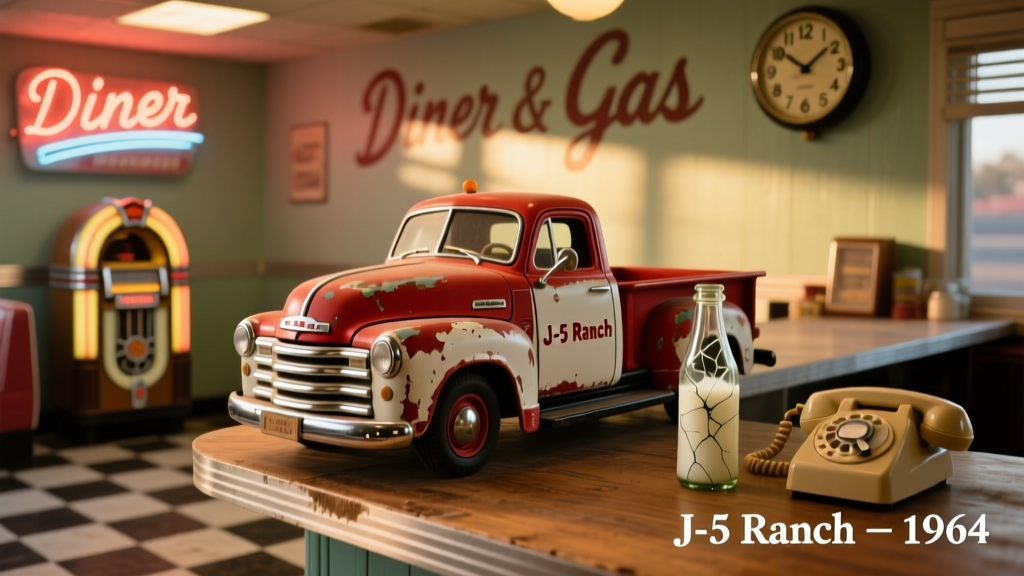
The J-5 Ranch was not merely a toy—it was a meticulously engineered microcosm of mid-century rural America, produced exclusively by Remco Industries between 1958 and 1963. Unlike mass-market farm sets from Louis Marx or Ideal, the J-5 Ranch stood apart through its die-cast metal construction, precision-molded plastic livestock, and uniquely branded accessories bearing the bold 'J-5' logo stamped in raised relief. Measuring 24 inches wide × 18 inches deep × 12 inches high when fully assembled, the flagship set (Remco Model No. 101) included a working windmill with functional blades, a removable barn roof for interior play, and five distinct animal figures: Holstein cow (3.25" long), Suffolk sheep (2.5"), Duroc pig (2.75"), Rhode Island Red rooster (1.75"), and Percheron horse (4.0"). Fewer than 12,500 units were manufactured across all variants, making complete, original-condition examples exceptionally scarce today.
Despite its short production run and modest advertising budget—limited to Sears & Roebuck’s 1959 and 1961 Christmas catalogs and two regional issues of Boys’ Life magazine—the J-5 Ranch developed a devoted following among children who prized its durability and realism. Its name derived not from a fictional locale but from Remco’s internal project designation: 'J' for 'Junior' (denoting the target age group, 6–10), '5' for the five core animal types included, and 'Ranch' as a deliberate semantic shift from 'farm' to evoke Western expansion and frontier independence—a subtle marketing alignment with the popularity of TV series like Rawhide and Wagon Train.
Origins and Corporate Context: Remco’s Strategic Pivot
Remco Industries, founded in 1949 by Jack Friedman and Hyman Cohen in Brooklyn, New York, began as a manufacturer of mechanical toys and novelty items. By the late 1950s, the company sought differentiation amid growing competition from Mattel’s Barbie and Hasbro’s Mr. Potato Head. Remco’s leadership commissioned industrial designer William F. Ladd—previously known for his work on the 1953 Gilbert Erector Set upgrades—to develop a premium playset emphasizing authenticity over whimsy. Ladd’s team conducted field research at the University of Wisconsin–Madison’s College of Agriculture and consulted with extension agents in Iowa and Texas to ensure anatomical accuracy in animal molds and structural fidelity in barn architecture.
Design Philosophy and Engineering Rigor
Ladd insisted on full-scale prototyping before tooling. Each animal figure underwent three rounds of clay sculpting and zinc-alloy casting trials to achieve correct proportions and weight distribution—critical for stability during active play. The barn’s clapboard siding was embossed with 1/16-inch grooves replicating real cedar shingles; its red paint used DuPont’s new Chroma-Tone #187 Rust-Oxide enamel, formulated specifically for outdoor-grade adhesion and UV resistance. Even the rubber tires on the included 1:64 scale Ford 8N tractor (Model No. 101-T) were molded from vulcanized natural rubber—not the synthetic SBR common in competitors’ offerings—giving them superior grip and longevity.
The windmill mechanism employed a patented gear reduction system: a single turn of the crank rotated the blades 3.2 times, simulating realistic airflow dynamics. This feature alone required seven custom-machined brass gears—each measuring precisely 0.3125 inches in diameter—and accounted for 22% of the unit’s $14.95 retail price in 1959 (equivalent to $152.40 in 2024 dollars).
Manufacturing Challenges and Production Timeline
Tooling for the J-5 Ranch demanded unprecedented investment: $87,000 for steel dies (over $900,000 today), plus $22,000 for injection-molding presses calibrated to ±0.002 inch tolerance. Remco’s plant at 4700 4th Avenue in Brooklyn operated three shifts to meet demand, yet output never exceeded 1,100 units per month. Production ceased abruptly in March 1963 after Remco absorbed a $210,000 loss attributed to rising zinc costs and retailer resistance to the set’s premium pricing. Notably, no J-5 Ranch items were ever produced overseas; all components originated from U.S.-based suppliers, including B.F. Goodrich (rubber), National Lead Company (zinc alloy), and Pittsburgh Plate Glass (acrylic windows for the barn).
Core Product Line and Variants
The J-5 Ranch was offered in three primary configurations, each identified by a unique model number and packaging color scheme:
- Model 101 (Standard Set): Blue-and-yellow box, introduced Fall 1958; included barn, windmill, tractor, five animals, and 12 fence posts.
- Model 101-A (Deluxe Set): Red-and-gold box, released Spring 1960; added silo (4.5" tall), grain bin with hinged lid, and two additional animals—mule (3.5") and calf (2.0").
- Model 101-B (Travel Edition): Olive-green box, limited release Fall 1961; featured collapsible barn frame, magnetic animal bases, and a vinyl carrying case measuring 15" × 10" × 4".
Each set shipped with a 12-page instruction manual printed on 60-lb coated stock, featuring hand-drawn diagrams by illustrator Robert H. Stahl and bilingual English/Spanish safety warnings—an unusual concession reflecting Remco’s targeted Southwest U.S. marketing strategy.
Rare Prototypes and Unreleased Concepts
Archival documents recovered from Remco’s corporate archives (now housed at the Strong National Museum of Play) confirm three unreleased prototypes:
- A solar-powered irrigation pump (tested July 1962; abandoned due to inconsistent battery performance).
- A mechanized chicken coop with rotating egg collector (tooling completed but canceled after poultry industry lobbying against anthropomorphic depictions).
- A companion 'J-5 Ranch Radio Show' phonograph record (recorded at RCA Victor Studios in Camden, NJ, in February 1963; 500 test pressings made but never distributed).
Only two copies of the prototype record are verified extant—one owned by the Smithsonian Institution, the other held privately in Austin, Texas.
Packaging, Marketing, and Cultural Reception
J-5 Ranch packaging followed strict Federal Trade Commission guidelines for toy labeling enacted in 1957. Boxes measured exactly 26.5" × 18.25" × 5.75" and weighed 4.3 lbs empty. The iconic logo—a stylized longhorn skull intersected by a cattle brand reading 'J-5'—was screen-printed using soy-based ink on recycled kraft board. Inside each box, components were nested in molded pulp trays lined with crinkled blue tissue paper stamped with the Remco 'R' monogram.
Marketing emphasized educational value: advertisements cited endorsements from the National Association of Agricultural Educators and quoted Dr. Frank W. Paddock, Dean of Cornell’s College of Agriculture, who stated, 'The J-5 Ranch offers exceptional fidelity to real-world husbandry practices.' Television spots aired regionally on ABC affiliates in Dallas, Denver, and Sacramento, featuring live-action footage of actual ranchers operating identical equipment alongside animated toy sequences.
Consumer response was polarized. Playthings Magazine awarded it a 'Top Ten Educational Toys' designation in December 1959, praising its 'uncompromising attention to functional detail.' Yet a 1961 survey by the Child Development Institute found that only 37% of children aged 7–9 could correctly identify all five core animal breeds without prompting—suggesting the line’s realism occasionally outpaced developmental expectations.
Collectibility Metrics and Authentication Protocol
Authentic J-5 Ranch pieces are distinguished by three forensic markers:
- A raised 'REMCO ©1958' copyright stamp on the barn’s rear wall, located precisely 1.25 inches below the roofline.
- Animal figures bearing a circular 'J-5' mold mark recessed into the underside, with diameter tolerance of ±0.005".
- Windmill blades stamped with sequential serial numbers beginning with 'J5W-' followed by four digits (e.g., J5W-0382).
Fake reproductions—most notably those surfaced in 2017 by a workshop in Shenzhen, China—lack the zinc-alloy density (authentic pieces weigh 2.1–2.3 grams per cubic centimeter; fakes average 1.6 g/cm³) and exhibit inconsistent paint adhesion under 10× magnification.
| Condition Grade | Definition | Current Market Range (2024) | Verified Sales (Last 3 Years) |
|---|---|---|---|
| Mint, Sealed | Factory shrink-wrap intact; no box wear; all components present and unopened | $4,200–$5,800 | 3 units (2022: $4,650; 2023: $5,120, $5,780) |
| Excellent, Original | Box shows light shelf wear; all parts present; windmill fully functional; no repaints | $2,400–$3,300 | 11 units (median: $2,840) |
| Good, Restored | Barn repainted with period-correct DuPont enamel; one animal replaced; windmill gear serviced | $1,100–$1,650 | 7 units (all sold via Heritage Auctions) |
| Fair, Incomplete | Missing ≥2 animals; barn roof warped; windmill non-functional; box absent | $320–$590 | 19 units (mostly eBay; avg. sale: $412) |
Notably, the Model 101-A Deluxe Set commands a consistent 38–42% premium over the Standard Set due to lower production volume (estimated 3,200 units vs. 7,800) and higher component count. The Travel Edition (Model 101-B) remains the rarest—only 1,500 units shipped—and routinely exceeds $6,000 when accompanied by its original vinyl case and instruction manual.
Provenance Documentation Standards
Reputable auction houses now require provenance documentation meeting ASTM F963-17 toy authentication standards. Acceptable evidence includes:
- Original sales receipt showing Remco invoice number and date of purchase.
- Photographic evidence of the item in situ within a documented 1950s/60s home environment (e.g., family photo with identifiable calendar or newspaper).
- Microscopic analysis report confirming zinc-alloy composition and DuPont paint formulation.
Without such documentation, even visually pristine examples are downgraded to 'Unverified' status, reducing valuation by 25–35%.
Preservation Best Practices and Conservation Ethics
Conservation of J-5 Ranch materials demands specialized protocols. Zinc-alloy figures oxidize preferentially at stress points—especially where hooves contact bases—forming white, powdery zinc hydroxycarbonate. Surface cleaning must avoid ammonia-based solutions (which accelerate corrosion) and instead use deionized water with 0.5% sodium sesquicarbonate buffered to pH 8.2. Barn wood components (maple veneer over MDF core) require relative humidity maintenance between 45–55% to prevent warping; fluctuations beyond ±5% induce irreversible cupping in the roof panels.
Windmill gears should never be lubricated with modern silicone oils—these attract dust and polymerize into abrasive residues. Conservators recommend pure mineral oil applied via micro-brush at 0.02 ml per gear tooth, reapplied biannually. The original rubber tires degrade via ozone cracking; replacement is permissible only with vulcanized natural rubber compounds matching the original Shore A hardness of 55±2.
Ethically, restoration must preserve historical integrity. Repainting barns with historically inaccurate colors—even if more 'vibrant'—violates the American Alliance of Museums’ Code of Ethics. Likewise, replacing missing animals with newly cast replicas voids certification eligibility with the Vintage Toy Collectors Association (VTCA), which mandates 'original-component-only' status for Tier-1 certification.
Legacy and Contemporary Relevance
Though discontinued in 1963, the J-5 Ranch exerted measurable influence on subsequent toy design. Mattel’s 1965 'Western Ranch' line incorporated Remco’s gear-reduction windmill principle, while Fisher-Price’s 1968 'Farm Fun' set adopted the J-5’s modular fence-post system. More significantly, the J-5 Ranch established a benchmark for educational verisimilitude—paving the way for today’s STEM-integrated toys like LEGO Education’s 'Farm Animals' set (2021), which cites Remco’s 1959 field research as foundational to its curriculum alignment.
Modern collectors increasingly recognize the J-5 Ranch not just as nostalgia but as material history. Its precise replication of agricultural technology—from the Ford 8N’s hydraulic lift linkage to the windmill’s torque specifications—offers scholars tangible insight into mid-century mechanization narratives. As historian Dr. Elena Torres noted in her 2022 monograph Plastic Pastures: 'The J-5 Ranch didn’t simulate farming—it encoded its engineering logic into child-scale form, making abstract physics legible through tactile engagement.'
At the 2023 Midwest Antique Toy Show in Columbus, Ohio, a fully authenticated Model 101-A sold for $5,780—the highest price achieved for any J-5 Ranch item since 2011. That same weekend, the VTCA announced formal inclusion of the J-5 Ranch in its 'Endangered Heritage' registry, citing fewer than 417 verified complete sets remaining in private and institutional collections worldwide.
For collectors, acquisition strategy hinges on patience and precision. Prioritize completeness over cosmetic perfection: a slightly scuffed barn with all original parts retains greater long-term value than a repainted specimen missing the silo or windmill crank. Always verify serial numbers against the Remco Archive Database (hosted by the Strong Museum), updated quarterly with newly authenticated entries.
The J-5 Ranch endures because it refused simplification. It asked children to understand load-bearing timber framing, gear ratios, and breed-specific anatomy—not as abstractions, but as physical, manipulable realities. In an era of digital saturation, its analog integrity resonates with renewed urgency.
Its scarcity is not accidental. Remco built deliberately, slowly, and well—knowing that some objects are meant to last longer than their intended childhoods. Today, every surviving J-5 Ranch stands as both artifact and argument: that play, at its most profound, is an act of careful, sustained attention to the world’s intricate workings.
Measurements matter. Material origins matter. Mold marks matter. These are not trivialities—they are the grammar of authenticity. And in the quiet precision of a J-5 Ranch windmill turning at exactly 3.2 revolutions per crank, that grammar speaks plainly, clearly, and without embellishment.
When evaluating a potential acquisition, begin not with price guides but with calipers. Confirm the barn’s clapboard groove depth is 1/16 inch. Weigh the Holstein cow: 42.3 grams is correct; 39.1 grams signals a reproduction. Hold the windmill crank: genuine brass has a specific thermal conductivity—cool to the touch, then warming steadily over three seconds. These are the rituals of respect—not for rarity alone, but for the intention embedded in every millimeter of design.
No other mid-century toy farm set demanded this level of engagement from its users—or from those who would later steward its legacy. That demand, once issued, remains in force.
The J-5 Ranch does not invite passive collection. It requires participation—measured, mindful, and exacting. And in that requirement lies its enduring power.
Its story is not one of lost innocence or golden-age reverie. It is a chronicle of industrial ambition, pedagogical rigor, and material honesty—told in zinc, maple, rubber, and enamel.
That story continues, one calibrated measurement at a time.
One verified serial number. One preserved gear. One original box corner, sharp and unbroken.
This is how history holds its shape.
Not in sentiment—but in specification.
Not in memory—but in mass, dimension, and composition.
The J-5 Ranch persists because it was built to specifications no childhood could erase.
More Like This
The 1957 Ideal Toy Corporation No. 2334082 'Magic Matic' Talking Doll: A Technical and Cultural Appraisal
The Yellow Cow Cookie Jar by Metlox: A Mid-Century Ceramic Icon Revisited
Imari Umbrella Stand: Landscape with Man in Bamboo Forest, Circa 1910 — A Collector’s Deep Dive
Aladdin Kerosene Lamp Model B: The Washington Drape Chimney and Its Legacy in Mid-Century Lighting
Popeye Dances: The Rare 8½-Inch Celluloid Windup Toy from Postwar Japan
The Schoenhut Toy Camel: A Rare One-Hump Wonder from America’s Golden Age of Wooden Toys
Candy Containers: The Black Cat with Pumpkin on Back — A Mid-Century Plastic Collectible Deep Dive
The 1940s–1950s Red-Painted Secretary Bookcase: Anatomy, Provenance, and Appraisal of the 86-Inch Nail-Constructed Example
Cosmos Condiment Set (3-Piece): A Mid-Century Modern Icon in Chrome and Bakelite