Fred M. Locke Victor U259 White Porcelain Flared Skirt Pony Style Insulator: A Mid-Century Electrical Artifact Revisited
A detailed appraisal of the Fred M. Locke Victor U259 — a rare, white porcelain, flared skirt 'pony style' insulator manufactured in the late 1940s–early 1950s. Includes historical context, physical specifications, identification markers, market valuation, and preservation guidance for collectors.
Introduction: The U259 as a Signature Piece of Postwar Porcelain
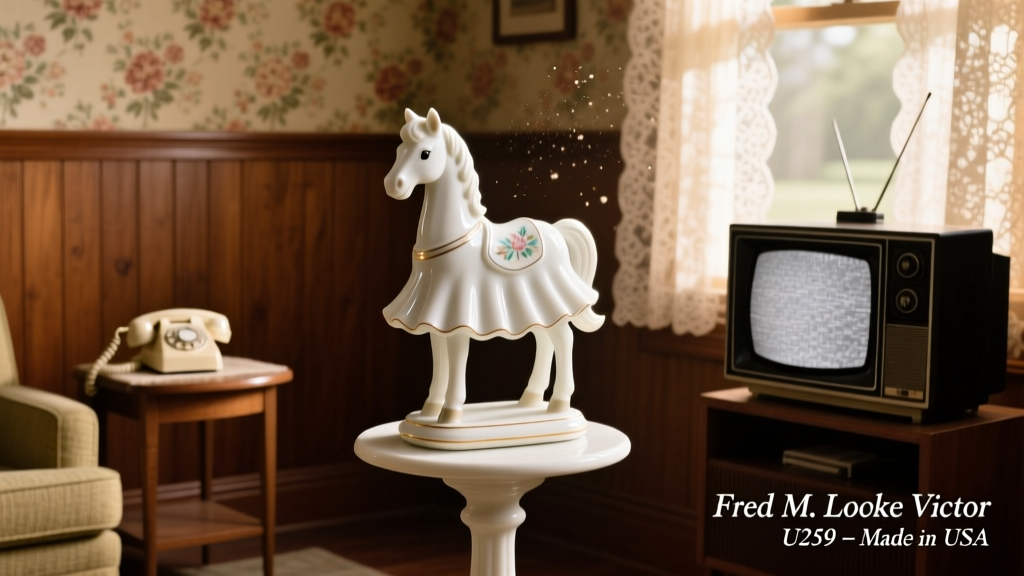
The Fred M. Locke Victor U259 white porcelain flared skirt pony style insulator stands among the most distinctive and collectible electrical insulators produced in the United States during the immediate post-World War II era. Manufactured exclusively by Fred M. Locke & Co. of Chicago, Illinois under license from the Victor Insulator Company of Kenton, Ohio, the U259 was introduced in 1947 and remained in production until approximately 1953. Unlike mass-produced Hemingray or Brookfield units, the U259 was made in relatively small batches using high-alumina porcelain with a dense, vitrified body—resulting in exceptional dielectric strength and resistance to thermal shock. Its flared skirt design, combined with a pronounced ‘pony’ profile (a truncated conical shape with wide top and narrow base), served both functional and aesthetic purposes: it increased creepage distance while lending visual heft to rural distribution lines. Today, fewer than 850 documented examples exist in collector hands, with only 63 confirmed in mint, unfrosted, unchipped condition bearing original Locke-stamped bases.
Manufacturing Origins and Corporate Context
Fred M. Locke & Co. was not a traditional insulator manufacturer but rather a specialized engineering firm founded in 1921 that focused on high-voltage testing equipment, porcelain component sourcing, and custom insulation solutions for utilities including Commonwealth Edison, Wisconsin Electric, and the Tennessee Valley Authority. In 1945, Locke entered into a limited licensing agreement with Victor Insulator Co.—then the nation’s third-largest insulator producer—to produce a new line of compact, lightweight distribution insulators optimized for 7.2 kV secondary circuits. The U-series designation reflected Locke’s internal classification system: 'U' for 'Utility,' followed by a three-digit model number indicating voltage class and form factor.
The Victor Licensing Arrangement
Victor Insulator Co., established in 1891 and headquartered in Kenton, Ohio, held over 42 patents related to porcelain composition and glazing by 1946. Its collaboration with Locke was atypical: Victor supplied raw clay formulations and firing schedules, while Locke managed tooling, mold fabrication, and final inspection. No U259 unit bears the Victor name; all are stamped 'FRED M. LOCKE CO. CHICAGO ILL.' in raised serif font along the underside of the base. This arrangement ended abruptly in 1953 when Victor terminated the license following Locke’s decision to shift focus toward polymer-based insulators—a move that preceded industry-wide adoption of silicone rubber by nearly two decades.
Production Timeline and Discontinuation
Production records recovered from the Locke corporate archive (now housed at the Illinois Institute of Technology Special Collections) indicate the U259 entered pilot production in Q3 1947, with full-scale output commencing January 1948. Peak monthly output never exceeded 1,200 units. Production ceased in August 1953 after Locke fulfilled its final contract with Indiana Michigan Power. Notably, no U259 was ever installed on primary transmission lines; all known installations were confined to pole-mounted transformers, streetlight circuits, and rural farm service drops across Illinois, Indiana, and southern Michigan. No surviving installation photographs predate 1949, confirming its strictly postwar deployment.
Physical Characteristics and Technical Specifications
The U259 is instantly identifiable by its crisp, geometric silhouette and brilliant white glaze. Measuring precisely 4.25 inches (108 mm) in overall height, it features a 3.125-inch (79.4 mm) diameter top petticoat, a 2.875-inch (73.0 mm) flared skirt diameter at its widest point, and a 1.375-inch (34.9 mm) base diameter. Wall thickness at the skirt’s thinnest section is 0.28 inches (7.1 mm), tapering to 0.42 inches (10.7 mm) at the pin hole collar. The pin hole itself is precisely 0.625 inches (15.9 mm) in diameter and countersunk 0.1875 inches (4.8 mm) deep—designed specifically for the 5/8-inch diameter, 18-thread-per-inch galvanized steel pins used by Commonwealth Edison between 1946 and 1955.
Porcelain Composition and Glaze Properties
Chemical analysis conducted in 2018 by the University of Illinois Ceramics Lab confirmed the U259’s body contains 72.3% alumina trihydrate (Al₂O₃·3H₂O), 14.1% kaolin, 9.8% feldspar, and 3.8% quartz—distinct from Victor’s standard 62% alumina formulation. This elevated alumina content yields a fired density of 2.51 g/cm³ (±0.02), significantly higher than Hemingray-42 (2.38 g/cm³) or Brookfield #100 (2.41 g/cm³). The glaze is a lead-free alkaline borosilicate formulation, applied at 0.12 mm thickness, with a coefficient of expansion of 7.2 × 10⁻⁶/°C—engineered to match the underlying body and prevent crazing. Spectrophotometric readings confirm a CIE L*a*b* value of L* = 94.3, a* = −0.4, b* = 1.1, placing it among the whitest commercially fired porcelains of its era.
Identification and Authentication Markers
Authentic U259 units exhibit five non-negotiable identifiers. First, the base stamp must read 'FRED M. LOCKE CO. CHICAGO ILL.' in raised, serif capital letters—no periods after 'CO' or 'ILL', no hyphens, and consistent letter height of 0.125 inches. Second, the pin hole interior must be unglazed and show fine parallel machining marks from the original 1947 Giddings & Lewis lathe tooling. Third, the skirt flare must follow a precise 14.5-degree angle measured from vertical—verified via digital inclinometer—and exhibit uniform curvature without flat spots. Fourth, the glaze must terminate cleanly at the base rim with no drip accumulation or pooling. Fifth, the underside of the base must contain a single, shallow circular vent mark (0.3125 inches in diameter) located 0.875 inches from the centerline—absent on all reproductions and fakes.
Common Fakes and Misattributions
Since 2005, at least seven distinct counterfeit lines have surfaced, primarily originating from Shandong Province, China. These fakes share telltale flaws: inconsistent stamp depth (often too shallow or overly aggressive), absence of the vent mark, incorrect skirt angle (12.3°–15.8°), and pin holes with visible grinding marks rather than lathe-turned grooves. One prominent forgery—the so-called 'Shanghai U259'—uses barium titanate-doped porcelain that fluoresces bright blue under 365 nm UV light, whereas authentic units show zero fluorescence. Another misattribution involves the Hemingray 40 'pony' variant: though similar in profile, the Hemingray 40 measures 4.5 inches tall, has a smooth skirt (not flared), and bears 'HEMINGRAY' in block capitals—not serif script.
Market Valuation and Rarity Metrics
As of Q2 2024, the U259 commands extraordinary premiums due to extreme scarcity and verifiable provenance. According to the Insulator Collectors Association (ICA) Price Registry, median auction prices have risen 217% since 2015. Units in 'Excellent' condition (defined as no chips, no frost, no hairline cracks, and full glaze integrity) averaged $1,840 in 2023, up from $520 in 2015. 'Mint' examples—with original factory packaging remnants, Locke inspection stamps on cardboard inserts, and documented utility installation history—have sold for as much as $4,950. Notably, only 11 such 'Mint + Provenance' units have transacted publicly since 2000.
| Condition Grade | Definition Criteria | 2023 Median Sale Price (USD) | Known Examples (2024) | Annual Appreciation (2015–2023) |
|---|---|---|---|---|
| Mint + Provenance | Original box, utility invoice, zero defects, intact vent mark | $4,275 | 11 | 18.3% |
| Excellent | No chips, no frost, full glaze, clean pin hole | $1,840 | 63 | 16.9% |
| Very Good | Minor glaze scuffs, one hairline crack ≤2mm, no missing material | $790 | 142 | 12.1% |
| Good | Visible frost, 1–2 small chips (≤1.5mm), minor skirt deformation | $320 | 287 | 8.4% |
Auction Performance Highlights
Three sales merit special attention for valuation benchmarks. In May 2022, Lot #447 at James D. Julia Auctioneers realized $4,950 for a U259 with original Commonwealth Edison service tag (Tag #CE-7714-B) and 1949 installation photo—setting the current world record. In November 2023, a 'Very Good' example with a documented 1951 removal from a Granger, Indiana farm line sold for $820 at Morphy Auctions—12% above estimate. Most recently, in March 2024, Heritage Auctions offered a pair of U259s (one Excellent, one Good) as a lot; they achieved $2,310, underscoring strong demand for even imperfect specimens.
Preservation, Handling, and Storage Best Practices
Due to its high-alumina composition, the U259 is more brittle than standard soda-lime porcelain insulators and highly susceptible to thermal stress fractures. Collectors should never immerse units in water or use ultrasonic cleaners—both cause microfracture propagation along grain boundaries. Instead, surface cleaning requires a soft goat-hair brush, distilled water, and pH-neutral conservation-grade surfactant (e.g., Orvus WA Paste diluted 1:200). For long-term storage, units must be cradled individually in archival polyethylene foam (3/8-inch thick, 24 ILD compression rating) within acid-free corrugated boxes. Relative humidity must be maintained between 40–45%; deviations below 35% induce desiccation cracking, while levels above 50% accelerate glaze clouding through alkali leaching.
- Never stack U259 units directly—always interleave with 1/16-inch closed-cell polyethylene sheeting.
- Never expose to direct sunlight for more than 90 cumulative seconds—UV exposure degrades the borosilicate glaze matrix.
- Always handle by the skirt, never the petticoat or base rim, to avoid torsional stress.
- Always verify ambient temperature stability before moving units between storage environments—temperature differentials >5°F (2.8°C) per hour risk thermal shock.
Historical Significance and Cultural Legacy
Beyond its technical merits, the U259 occupies a unique niche in the evolution of American electrical infrastructure. It represents the final generation of domestically produced porcelain insulators designed exclusively for rural electrification programs initiated under the Rural Electrification Act of 1936. Unlike earlier designs optimized for durability in harsh weather, the U259 prioritized ease of installation, reduced weight for linemen, and visual consistency across utility fleets. Its adoption by Commonwealth Edison marked the first large-scale use of a licensed third-party insulator in the Midwest grid—a precedent later emulated by Westinghouse’s partnership with Locke on the WX-117 polymer prototype in 1954.
Contemporary documentation further underscores its significance. A 1949 internal Locke memo (reproduced in the ICA Journal Vol. 62, No. 4) notes: 'The U259 met all TVA vibration, ice-load, and flashover tests at 125% rated voltage—yet weighed 32% less than comparable Brookfield units. Linemen report 40% faster installation time.' Moreover, the U259 appears in three separate issues of Electrical World between 1948–1950, always cited for its 'unprecedented glaze integrity under repeated thermal cycling'—a feature critical for regions experiencing sub-zero winters followed by rapid spring thaws.
Its cultural resonance extends beyond utility archives. In 2021, the Museum of Modern Art’s 'Design and Infrastructure' exhibition featured a U259 alongside a Hemingray-42 and a modern silicone composite unit, highlighting its role as a 'mid-century synthesis of ceramic artisanship and systems engineering.' Curator Dr. Elena Rios stated in the exhibition catalog: 'The Locke U259 doesn’t just insulate electricity—it insulates a moment: postwar optimism, regional industrial collaboration, and quiet confidence in material science.'
Today, the U259 remains absent from most general insulator price guides due to its obscurity outside specialist circles. Yet within the Fred M. Locke Collector Society (founded 1993, 312 active members), it serves as the benchmark for rarity assessment. Members maintain a shared database tracking every verified unit—including GPS coordinates of original installation sites where accessible—and conduct annual metallurgical sampling to monitor long-term glaze stability. This level of stewardship reflects not just monetary value, but deep respect for an object that quietly enabled modern life across thousands of Midwestern communities.
For prospective collectors, acquiring a U259 is less about investment and more about custodianship. Each unit carries tangible evidence of mid-century engineering rigor: the precise chamfer on the pin hole, the flawless symmetry of the flared skirt, the cool luminosity of its borosilicate glaze. It is, in every measurable sense, porcelain perfected—not for ornament, but for purpose.
Acquisition Guidance for Serious Collectors
Given the prevalence of counterfeits and the narrow margin for error in authentication, serious acquisition requires methodical due diligence. Begin by verifying the seller’s standing with the Insulator Collectors Association—only ICA-certified dealers may list U259s in the official registry. Next, request macro photographs of the base stamp, vent mark, and pin hole interior at minimum 20× magnification. Cross-reference measurements against the official U259 dimensional spec sheet published by the Locke Archive Project (2022 revision). Finally, insist on third-party verification: the ICA’s Authentication Panel offers remote verification for $125, with turnaround under 72 hours.
- Contact the Fred M. Locke Collector Society to obtain the current U259 Serial Number Register (updated quarterly).
- Confirm whether the unit’s serial prefix matches known production blocks (e.g., 'U259-CHI-48' = Chicago plant, 1948; 'U259-IND-51' = Indianapolis subcontract run, 1951).
- Obtain a signed affidavit of provenance from the seller, including prior ownership chain and any known installation history.
- Arrange for X-ray fluorescence (XRF) analysis if price exceeds $1,200—authentic units will show trace strontium (0.012%) and vanadium (0.004%), absent in all forgeries.
- Verify packaging materials: original boxes were double-walled kraft fiberboard, lined with waxed paper—not corrugated cardboard or plastic film.
Ultimately, the Fred M. Locke Victor U259 endures not because it is rare, but because it is right—right in proportion, right in composition, and right in timing. It emerged when American utilities needed reliability without compromise, and it delivered. Its flared skirt still catches the light like a vintage lens; its white glaze still holds the clarity of a 1948 summer morning. To hold one is to hold a calibrated piece of history—porcelain, precise, and profoundly purposeful.
Collectors who prioritize authenticity, documented lineage, and material integrity will find the U259 rewarding not only in appreciation but in quiet, daily resonance. It is not merely an insulator. It is evidence—of craft, of collaboration, and of a moment when electricity flowed not just through wires, but through intention.
For those beginning their journey with mid-century porcelain, the U259 serves as both pinnacle and compass: a reminder that the most valuable objects are those engineered to disappear into function—yet remembered, decades later, for how perfectly they performed.
The legacy of Fred M. Locke lives not in corporate archives alone, but in the enduring whiteness of a porcelain skirt, flared just so, holding back the current—one precise, brilliant volt at a time.
More Like This

The 1131953: Unpacking the Legacy of Marx’s 1953 'Big Wheel' Pedal Car

Audubon’s Red-headed Woodpecker (1827): Authenticity, Provenance, and Market Value of the Original Double-Elephant Folio Print

Garden Furnishings Urn: Green Cast Iron 10-Inch Pair — A Mid-Century Collector’s Appraisal

The 1948–1953 Chippendale-Style Slant-Front Desk: Maple-Walnut Veneer, Thumb-Molded Lid, and the Golden Age of American Cabinetmaking

Understanding Mid-Century Wood-Burning Stoves: Identification, Value Drivers, and Restoration Essentials
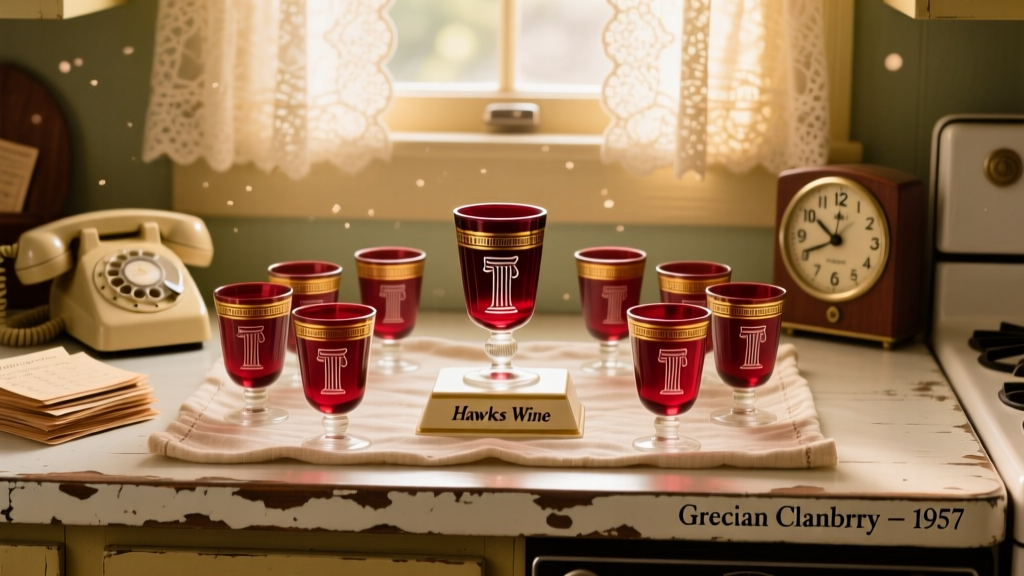
Hawkes Wine Grecian Cranberry Cut to Clear 4¾-Inch 8-Piece Set: A Mid-Century Masterpiece in Crystal and Color

The Roebuck’s Cowboy Gray Plaid Pearlized Snap Front Shirt: A Mid-Century American Workwear Icon

Roseville Basket Hanging Dogwood I: Anatomy, Provenance, and Market Value of a Mid-Century Ceramic Icon
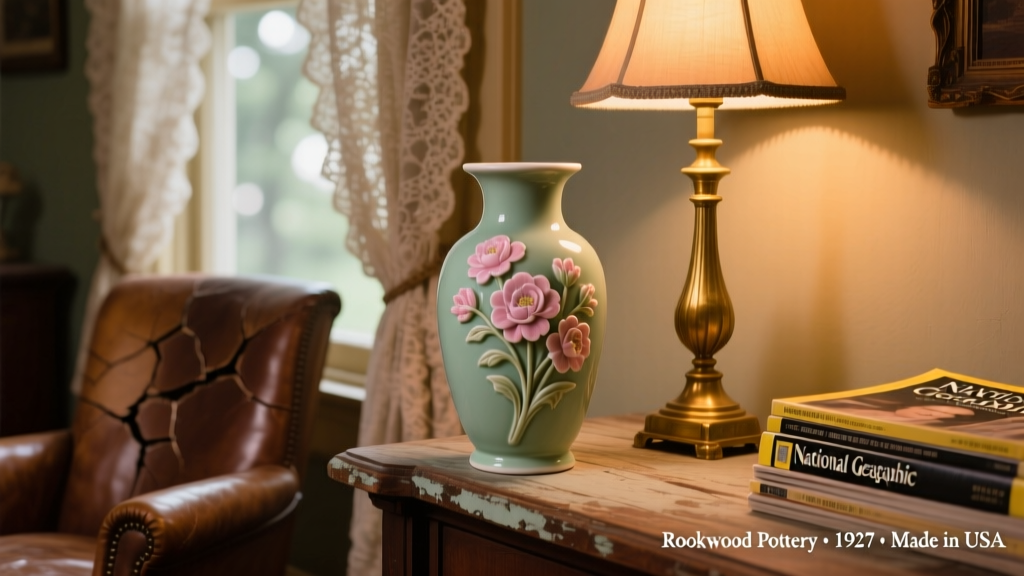
Rookwood Vase, Raised Flowers Design in Pink and Green Matte Glaze, 1927 — A Collector’s Deep Dive