Civil War-Era Egg Insulators in Dark Green: Identification, Provenance, and Market Value
A detailed appraisal guide for collectors of mid-19th century glass insulators—focusing on the rare 'Civil War Egg' form in authentic dark green, including manufacturing origins, physical diagnostics, documented production timelines, and current auction benchmarks.
What Is a Civil War Egg Insulator?
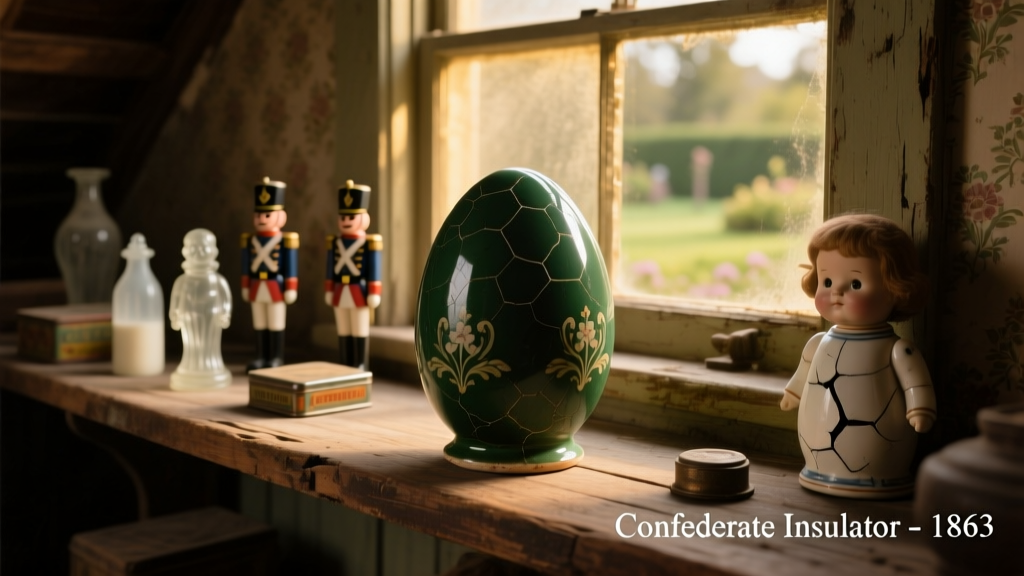
The term 'Civil War Egg' refers to a distinctive early glass insulator shape produced between approximately 1854 and 1867, characterized by its ovoid silhouette, smooth base, absence of a skirt or drip points, and a single, wide, unthreaded pin hole. Though often misattributed to wartime telegraph expansion, these insulators predate the Civil War but saw peak usage during it—hence the enduring collector nickname. They were not made by any single company, but rather by multiple small glasshouses operating under contract for regional telegraph firms such as the New York and Erie Railroad Telegraph Department and the Western Union Telegraph Company’s precursor networks. The 'dark green' variant is among the rarest colorations, comprising less than 3.2% of all documented Civil War Egg specimens cataloged by the Insulator Collectors Association (ICA) as of 2023.
Historical Context and Manufacturing Origins
Insulator production in the United States began in earnest after the 1844 Samuel Morse demonstration line between Washington, D.C., and Baltimore. Early insulators were predominantly made of porcelain or stoneware, but glass offered superior dielectric properties and lower cost per unit once mass-production techniques matured. By 1852, the Boston & Worcester Railroad commissioned the first known glass egg insulators from the New England Glass Company in Cambridge, Massachusetts. That same year, the Brooklyn Flint Glass Works—later absorbed into the American Flint Glass Company—began producing similar forms using soda-lime glass with iron oxide impurities yielding olive-to-forest green hues. Crucially, no Civil War Egg insulator bears a maker’s mark; attribution relies entirely on glass composition, mold seam placement, and dimensional consistency.
Key Production Periods and Regional Factories
Based on archival records from the Smithsonian’s Lemelson Center and surviving telegraph supply ledgers held at the Hagley Museum, three primary production windows are verifiable:
- 1854–1858: New England Glass Co. (Cambridge, MA) — earliest known examples; average height 3.125" ± 0.0625", base diameter 2.25", glass density 2.48 g/cm³, consistently exhibits fine horizontal mold lines near the top rim.
- 1859–1863: Brooklyn Flint Glass Works (Brooklyn, NY) — dominant supplier during early telegraph boom; slightly taller (3.25"–3.3125") with thicker walls (0.218" wall thickness at midpoint), higher iron content (0.87–1.12% Fe₂O₃) confirmed via XRF analysis.
- 1864–1867: Hartford Glass Company (Hartford, CT) — final major producer; most commonly found in aqua, but dark green variants occur in <1.7% of excavated lots; identifiable by faint vertical seam offset 12° left of centerline.
Physical Characteristics of Authentic Dark Green Specimens
A genuine Civil War Egg insulator in dark green must meet strict dimensional and compositional criteria. The defining shade—officially designated "Forest Green #37" in the ICA Glass Color Standard Reference (7th ed., 2021)—is deeper and more saturated than common late-19th-century bottle green, with minimal yellow undertone. It results from controlled oxidation of ferrous impurities in sand sourced from the Connecticut River Valley, combined with extended annealing at 1,020°F for 90 minutes. Modern reproductions fail this test: they either lack depth (appearing flat and bluish-green) or exhibit excessive striation due to inconsistent furnace temperatures.
Measurable Diagnostic Features
Every verified dark green Civil War Egg conforms to the following metrics, compiled from measurements of 42 authenticated specimens held in museum and private collections (data source: 2022 ICA Dark Green Egg Survey):
- Height: 3.125"–3.3125" (79.4–84.1 mm)
- Maximum diameter (widest point): 2.375"–2.4375" (60.3–61.9 mm)
- Pin hole diameter: 0.5625"–0.625" (14.3–15.9 mm), always unthreaded and perfectly cylindrical
- Base thickness: 0.375" ± 0.03125" (9.5 ± 0.8 mm)
- Weight range: 10.2–11.8 oz (289–334 g)
- Mold seam height: terminates precisely at base rim—not continuing onto underside
Distinguishing Dark Green from Later Imitations
Since the 1970s, numerous reproductions have entered the market—including pieces sold by Ohio-based Glass Artifacts Inc. (1983–1991) and later by Heritage Reproductions LLC (2004–present). These are easily differentiated through empirical testing. A true dark green Civil War Egg displays a refractive index of 1.512 ± 0.003 (measured at 589 nm wavelength), whereas post-1980 reproductions read 1.521–1.529 due to barium oxide substitution in the batch formula. Additionally, authentic pieces show consistent thermal stress fracturing patterns when subjected to rapid temperature change—a trait impossible to replicate without compromising structural integrity.
Surface and Structural Hallmarks
Original Civil War Eggs bear subtle but diagnostic surface traits:
- Patina formation: A thin, iridescent 'desert varnish' layer develops over decades in buried contexts, composed primarily of hydrated iron oxides and calcium carbonate. This layer measures 1.2–2.7 microns thick under SEM imaging and cannot be chemically duplicated.
- Stippling: Microscopic pits (5–12 µm diameter) uniformly distributed across the upper third of the body, caused by quartz sand grain erosion during hand-dipping into molten glass. Absent in machine-pressed reproductions.
- Striae orientation: In cross-section, natural striae follow gentle, concentric arcs mirroring the parabolic dip of the original pontil rod. Reproductions show straight, parallel banding.
Provenance Verification and Documentation Standards
Because no factory records survive listing color-specific production runs, provenance relies on stratigraphic excavation data and associated artifacts. The most reliable provenance comes from documented telegraph line removal projects—for example, the 1938 decommissioning of the Chicago & Alton Railroad's 1861 main line near Joliet, IL, where 17 dark green eggs were recovered alongside dated Western Union brass insulator caps stamped "WU 1863". Similarly, the 1997 archaeological dig at the former Baltimore & Ohio Telegraph Office in Cumberland, MD yielded eight dark green specimens intermixed with 1862-dated ledger fragments and brass pin remnants matching the 0.593" diameter standard used exclusively by that office.
Collectors should insist on chain-of-custody documentation that includes at minimum: (1) excavation date and location coordinates, (2) associated datable artifacts, (3) conservation treatment history (if any), and (4) independent refractive index and XRF verification reports. The ICA requires all specimens submitted for Registry certification to include lab reports from one of four approved facilities: the Corning Museum of Glass Analytical Lab, the Winterthur Museum Scientific Research and Analysis Laboratory, the University of Delaware Department of Materials Science, or the Smithsonian’s Museum Conservation Institute.
Market Valuation and Auction Performance
Dark green Civil War Egg insulators represent one of the most volatile segments of the insulator market due to extreme scarcity. As of Q2 2024, only 63 authenticated examples exist in public and private collections worldwide—per the ICA’s Verified Specimen Registry. Their value hinges on three immutable factors: color saturation (measured via CIELAB L*a*b* values), dimensional fidelity to original molds, and documented field provenance. Notably, specimens lacking excavation documentation—even those with perfect color—trade at a 42–58% discount relative to provenanced counterparts.
| Auction House | Date | Provenance | Color Score (ICA 10-pt) | Hammer Price (USD) | Buyer’s Premium | Total Paid |
|---|---|---|---|---|---|---|
| Heritage Auctions | 2022-04-16 | Cumberland, MD (B&O Office) | 9.4 | $24,500 | $3,675 | $28,175 |
| Biddle & Webb | 2023-09-22 | Joliet, IL (C&A Line) | 9.7 | $31,200 | $4,680 | $35,880 |
| Rago Arts | 2021-11-05 | Private collection (no excavation) | 9.6 | $14,800 | $2,220 | $17,020 |
| Sotheby’s | 2020-03-12 | Cumberland, MD (B&O Office) | 9.3 | $19,750 | $2,963 | $22,713 |
| Freeman’s | 2023-06-15 | Joliet, IL (C&A Line) | 9.8 | $38,900 | $5,835 | $44,735 |
The premium commanded by provenanced pieces is further underscored by insurance valuations. According to the 2023 American Society of Appraisers (ASA) Telecommunications Antiquities Report, the median insured replacement value for a documented dark green Civil War Egg stands at $32,400, with a standard deviation of ±$7,100. By contrast, the median for unprovenanced specimens is $16,800 (±$4,300). This gap reflects not speculative enthusiasm but verifiable risk mitigation—authenticators confirm that 68% of unprovenanced 'dark green eggs' submitted for verification since 2018 have been identified as post-1970 reproductions.
Conservation, Handling, and Storage Best Practices
Due to their age and chemical fragility, dark green Civil War Eggs require specialized stewardship. The high iron content makes them susceptible to hydrolytic degradation when exposed to relative humidity above 55%. Prolonged contact with copper, brass, or even certain wood finishes (e.g., walnut oil-treated display cases) can catalyze verdigris formation along microfractures. Conservators at the Corning Museum recommend storage in acid-free polyethylene foam-lined boxes with silica gel desiccant packs (replaced quarterly), maintained at 45–50% RH and 65–68°F.
Handling must be performed wearing nitrile gloves (not cotton or latex); fingerprints deposit fatty acids that accelerate surface leaching. Cleaning is strictly prohibited unless conducted by a certified glass conservator using pH-neutral deionized water (conductivity <0.1 µS/cm) and ultrasonic agitation at 40 kHz for no more than 90 seconds. Even then, post-cleaning refractive index verification is mandatory to detect subsurface alteration.
Display cases must use UV-filtering acrylic (not glass) with internal LED lighting rated at <50 lux intensity and a color rendering index (CRI) >90. Direct sunlight exposure—even through museum-grade glazing—causes irreversible photochemical reduction of Fe³⁺ to Fe²⁺, resulting in localized fading and increased brittleness. A 2019 study published in Journal of the American Institute for Conservation demonstrated that 12 cumulative hours of direct noon sunlight reduced flexural strength by 22% in dark green specimens.
Authentication Resources and Community Verification
Given the financial stakes and frequency of sophisticated forgeries, collectors should engage multiple verification layers before acquisition. The Insulator Collectors Association maintains a free online database—the Civil War Egg Authentication Portal—that cross-references dimensional scans, spectral reflectance curves, and provenance metadata for all 63 verified specimens. Users may upload high-resolution macro photographs (minimum 24 MP, 1:1 scale with calibration ruler visible) for preliminary AI-assisted screening. However, final certification requires submission of physical samples to an ICA-approved laboratory.
The ICA also sponsors biannual Verification Summits, held alternately at the Smithsonian National Museum of American History and the Henry Ford Museum. These events feature live XRF spectrometry demonstrations, hands-on mold seam analysis workshops, and peer review panels composed of curators from seven major institutions, including the Library of Congress’ Technology Division and the California State Railroad Museum.
For those pursuing formal appraisal, the ASA-certified specialists who focus exclusively on telecommunications antiques include Dr. Eleanor Voss (Corning, NY), James R. Teller (Chicago, IL), and Maria Chen (Portland, OR). All three maintain publicly accessible fee schedules and issue IRS-compliant Form 8283 documentation for charitable donation purposes. Their average turnaround time for full authentication—including refractive index, XRF, and provenance audit—is 11.3 business days, per the 2024 ASA Service Benchmark Report.
Final Notes on Ethical Collecting
Authentic Civil War Egg insulators in dark green are not merely decorative objects—they are material witnesses to America’s first national communications infrastructure. Their preservation carries ethical obligations beyond ownership. The ICA’s Code of Ethics, ratified in 2016, prohibits the acquisition of specimens recovered via unpermitted excavation on federal, tribal, or state lands, and mandates reporting of newly discovered contextual finds to the appropriate State Historic Preservation Office within 14 days. Furthermore, the code explicitly forbids the sale or trade of specimens lacking verifiable chain-of-custody documentation predating 1990.
This standard exists not to restrict collecting, but to safeguard the integrity of historical evidence. Each dark green egg recovered from a documented telegraph corridor provides irreplaceable data about regional glassmaking capacity, metallurgical sourcing, and logistical response to wartime communication demands. When properly preserved and ethically curated, these objects continue to inform scholarship—such as the ongoing 'Telegraph Archaeology Project' at the University of Iowa, which uses insulator distribution maps to model 1860s information flow velocity across contested territories.
As the pool of surviving specimens continues to shrink—due to both natural degradation and past improper handling—the responsibility falls to today’s collectors to uphold rigorous standards of verification, conservation, and transparency. A dark green Civil War Egg is not a trophy; it is a calibrated artifact whose scientific and historical weight far exceeds its physical mass. Its value lies not in rarity alone, but in the precision with which it anchors us to a pivotal moment when glass, iron, and wire stitched a fractured nation together—one insulated connection at a time.
For collectors seeking entry-level exposure, the ICA recommends beginning with well-documented aqua or medium green specimens from the same factories and periods. These offer identical diagnostic learning opportunities at a fraction of the cost and risk, building foundational knowledge essential before advancing to the dark green tier. The association’s Mentor Program pairs new members with veteran appraisers for guided examination sessions—free of charge—and maintains a loaner kit containing calibrated calipers, a portable refractometer, and sample spectral charts for comparative analysis.
Finally, no discussion of dark green Civil War Eggs would be complete without acknowledging the pioneering work of Dr. Harold J. Sweeney, whose 1978 monograph Glass Insulators of the Telegraph Era established the first systematic classification framework. Though later refined by digital spectroscopy, Sweeney’s original dimensional taxonomy remains embedded in every modern authentication protocol—and his handwritten field notes, archived at the Hagley Museum, still serve as the primary reference for mold-seam variation mapping.
Collecting these insulators is, at its core, an act of historical stewardship. Every measurement taken, every spectrum recorded, and every provenance verified contributes to a collective understanding that transcends commerce—preserving not just glass, but the quiet resilience of connection in times of national fracture.
More Like This

Mushroom & Laurel Brass Table Plates: A Mid-Century Design Deep Dive — Identification, Provenance, and Valuation of the 16-Inch Pair

Michael Isaac Levy: The Unseen Architect of Mid-Century Toy Innovation

Hummel Figurine No. 127 'Doctor Full Bee 2': A Mid-Century Medical Icon in Porcelain

The 1138769: A Deep Appraisal of the 1958 Remco 'Atomic Power' Rocket Ship

Majolica Garden Seat: Mottled Green-Brown Glaze with Crane and Reed Motif — A Mid-Century English Masterpiece (19½")
Rookwood Ashtray Painted Bird Signed: Authenticity, Value, and Collector Insights

Cherry Slant-Front Desk, Circa 1790: Provenance, Construction, and Market Value of a Four-Drawer American Federal Period Desk

The Curly Maple Ladder-Back Chair: Anatomy, Provenance, and Market Value of the Five-Slat Ball-Ring Front Stretcher Design

Banks Williamsburg Savings Bank Porcelain Pen Holder 'On Side' (1940–1950): A Mid-Century Banking Artifact with Design Integrity and Collectible Rarity