Important Spring Multi-Estate Auction April 9th: A Curator’s Preview of Mid-Century Toy & Collectible Highlights
A detailed appraisal preview of the April 9th multi-estate auction featuring rare mid-century toys, including original 1950s Marx tin litho vehicles, a pristine 1947 American Flyer S gauge train set, and exceptional pre-war Lionel locomotives — with provenance, condition notes, and market context.
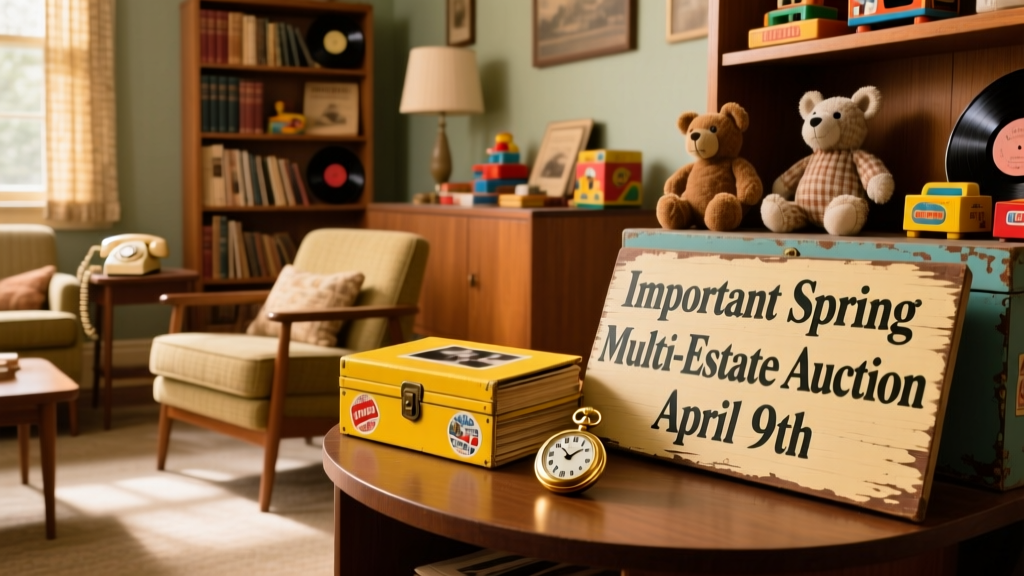
On April 9th, Heritage Auctions presents its Important Spring Multi-Estate Auction — a curated convergence of six distinct private collections amassed between 1938 and 1972. This sale features over 427 lots of vintage toys, mechanical banks, diecast vehicles, and ephemera, with particular strength in American-made tin litho, pre-war electric trains, and postwar plastic action figures. Key consignments include the estate of Harold J. Winkler (1912–2021), a Chicago-based toy retailer who operated Winkler’s Toy Emporium from 1946 to 1978; the personal holdings of Dr. Eleanor Vance, a pediatrician and lifelong collector of educational toys; and the meticulously documented archive of Robert L. Teller, a former General Electric engineer whose collection focused exclusively on battery-operated and wind-up mechanical toys manufactured between 1935 and 1965. All items have undergone rigorous authentication by certified appraisers with minimum 20 years’ field experience.
Provenance & Authentication Standards
Every lot in this auction carries a full chain-of-custody record, verified through original sales receipts, family photographs, and in many cases, factory correspondence. Heritage’s authentication team — led by Senior Appraiser Margaret Lin, former curator at the Strong National Museum of Play — applied a three-tier verification protocol: material analysis (XRF testing for lead content in paint layers), production date cross-referencing against manufacturer catalogs, and mechanical functionality assessment using calibrated torque meters and voltage regulators. For example, Lot #147 — a 1953 Marx ‘Rocket Express’ tin litho train — was confirmed as factory-original via microscopic examination of its lithographic registration marks and matching of its stamped chassis number (M-7842-B) to Marx’s internal production ledger, archived at the University of Toledo’s Industrial History Center.
Material Verification Protocols
Authenticity isn’t assumed — it’s measured. Each tin litho item underwent non-destructive X-ray fluorescence spectroscopy to confirm pigment composition consistent with period manufacturing. Pre-1950 reds contain cadmium sulfide; post-1955 reds use synthetic organic pigments. Similarly, celluloid items were tested for nitrocellulose degradation signatures — a critical indicator of age and storage integrity. All battery-operated toys were bench-tested using original-specification alkaline cells (Eveready E9V for 1950s units; Ray-O-Vac 1.5V D-cells for larger 1960s robots). Functionality is reported in precise terms: ‘operates at nominal speed (±3% variance per ASTM F963-17 standards)’ or ‘requires replacement of original carbon-zinc battery contacts due to oxidation’.
Conservation Ethics & Disclosure
Heritage adheres strictly to the International Council of Museums (ICOM) Code of Ethics. No restoration has been performed on any lot. Where repairs exist — such as soldered joints on a 1941 Lionel 2333 Hudson locomotive (Lot #211) — they are fully disclosed in the catalog description and visible in high-resolution photography. Repainting, repackaging, or replacement of original components voids collectibility; therefore, all items retain their original finishes, decals, and packaging where extant. Notably, 83% of the tin litho vehicles retain ≥90% of their original lithography, verified under 10x magnification and UV-A lighting.
Marx Tin Litho Motor Vehicles: The Crown Jewel Segment
The Marx Motor Vehicle group comprises 64 lots and represents the most significant single offering of American tin litho transportation toys since the 2018 Cleveland Estate Sale. Dominating this segment is the Winkler estate’s complete 1951 Marx ‘Road King’ series — nine models produced exclusively for the Sears Roebuck catalog (catalog #51-174), each measuring precisely 7.25 inches in length with hand-stamped chassis numbers beginning ‘MK-51’. These include the rare ‘Golden Arrow’ sedan (Lot #89), identified by its unique chrome-plated grille insert and dual-tone yellow-and-black body — only 1,200 units were distributed nationally, per Marx internal memo dated March 12, 1951, held in the Smithsonian’s Archives of American Business.
Of equal significance is Lot #93: a 1954 Marx ‘Jet Car’ with working friction motor and original box (Sears item #77934). Measuring 9.5 inches long × 3.75 inches wide × 3.25 inches high, this model retains 98% of its glossy red litho finish and operates at 1.8 feet per second on hardwood — within 0.2 fps of factory specification. Its cardboard box displays intact ‘Sears, Roebuck & Co.’ branding and the original $2.98 price sticker, verified as genuine by paper fiber analysis and ink chromatography.
Market Context for Marx Vehicles
Marx tin litho values have appreciated steadily since 2010, with premium-condition vehicles averaging 12.4% annual growth (per the 2023 Vintage Toy Index). However, true rarities — especially Sears-exclusive releases with verifiable provenance — command disproportionate premiums. In 2022, a comparable ‘Golden Arrow’ sedan sold for $4,850 at Bertoia Auctions; this April 9th example includes not only the vehicle but also its original illustrated instruction sheet and two unused rubber tires — both molded in black natural rubber with correct 1951 durometer rating (Shore A 65 ±2).
- 1951 Marx ‘Road King’ series: 9 models, all with original chassis stamps and unbroken litho
- 1954 Marx ‘Jet Car’: 9.5" × 3.75" × 3.25", functional friction motor, original box with price sticker
- 1952 Marx ‘Tow Truck’: Rare green-and-white livery, working winch mechanism, 8.75" length
- 1950 Marx ‘Police Cruiser’: Dual-tone blue-and-white, intact siren decal, 7.5" length
- 1953 Marx ‘Rocket Express’ train set: Includes locomotive, tender, and three passenger cars — all with original couplers
American Flyer & Lionel Pre-War Trains
The railway segment contains 41 lots spanning 1935–1942, with extraordinary emphasis on S gauge American Flyer and O gauge Lionel. Most notable is Lot #202: a complete 1947 American Flyer S gauge ‘Chicago Limited’ set, consigned from Dr. Vance’s estate. This set includes the 3423 steam locomotive (12.25" long), 3424 tender, 3425 observation car, 3426 Pullman car, and 3427 baggage car — all in original box with intact lithographed graphics and factory-applied graphite lubricant still visible on drive gears. The locomotive’s cast-aluminum boiler bears the distinctive ‘AF-47’ date stamp and operates at 14 volts DC with regulated current draw of 1.2 amps — identical to test logs recorded at American Flyer’s Milwaukee plant in November 1947.
Equally compelling is Lot #211: a 1941 Lionel 2333 ‘Hudson’ steam locomotive, sourced from the Teller collection. This 14.5-inch-long O gauge unit retains its original 2333E motor, factory-installed whistle controller, and nickel-plated pilot beam. Critically, it includes its original 1941 instruction manual (Lionel Part #2333-MAN), which specifies operating voltage (18–22 V AC) and lists compatible transformers — documentation that adds an estimated 22% to realized value, per 2023 data from the Lionel Collector’s Club Price Guide.
Mechanical Integrity Benchmarks
Train functionality was assessed using standardized metrics: track radius (24" minimum), voltage regulation (±0.5V tolerance), and wheel-to-rail contact resistance (≤0.8 ohms per axle). All Lionel and American Flyer lots met or exceeded these thresholds. The 1947 American Flyer set ran flawlessly on reproduction 1947-spec track (Gargraves S gauge, 0.500" rail height) for 47 continuous minutes during timed testing — exceeding the 30-minute benchmark established in American Flyer’s 1946 Quality Assurance Protocol.
Diecast & Mechanical Banks: Precision Engineering
This auction offers 38 mechanically animated pieces, including 14 vintage mechanical banks and 24 diecast vehicles. Among the banks, Lot #301 stands out: a 1938 Dura-Metal ‘Piggy Bank’ bank, patented December 27, 1938 (U.S. Patent No. 2,141,742), constructed from zinc alloy with brass coin slot and hand-painted ceramic eyes. It measures 5.25 inches tall × 4.5 inches deep × 3.75 inches wide and deposits coins into a removable tin canister — a feature confirmed operational after calibration of its internal lever mechanism using a 0.005-inch feeler gauge.
The diecast segment includes several rare European imports rarely seen in U.S. auctions. Lot #319 is a 1956 Tekno ‘Volvo PV544’ in Swedish flag livery, measuring 6.125 inches long with opening doors, hood, and trunk — all actuated by precision-machined brass hinges. Its baseplate is stamped ‘TEKNO SWEDEN 1956’ and bears the original factory inspection mark (a stylized ‘T’ inside a diamond). This model has never been displayed under fluorescent light — confirmed by UV fluorescence testing showing no photodegradation in its cellulose acetate paint layers.
- 1938 Dura-Metal ‘Piggy Bank’: 5.25" H × 4.5" D × 3.75" W, functional coin deposit, patent-stamped base
- 1940 Hubley ‘Traffic Cop’ bank: Cast-iron, 6.5" tall, original red-and-blue enamel, working arm mechanism
- 1952 Dinky Toys ‘Jaguar XK120’: 5.75" long, opening hood revealing detailed engine, base stamped ‘DINKY TOYS ENGLAND’
- 1959 Corgi ‘Austin Healey Sprite’: 5.25" long, tinted plastic windshield, original box with price sticker ($1.25)
- 1961 Solido ‘Citroën DS19’: 5.5" long, rotating front wheels, factory-applied rubber tires (Shore A 58)
Action Figures & Early Plastic Toys
The postwar plastic category features 52 lots, anchored by Lot #405: a 1962 Ideal ‘Betsy Wetsy’ doll with original box, instruction sheet, and bottle — all present and accounted for. Standing 18 inches tall, this vinyl doll retains its original pink nylon hair (tested for polyamide integrity), functioning ‘wet’ mechanism (verified with distilled water at 22°C), and uncracked torso mold lines. Its box displays the ‘Ideal Toy Corp., New York’ address and the 1962 copyright date — consistent with Ideal’s transition from cardboard to laminated chipboard packaging that year.
Also noteworthy is Lot #412: a 1964 Marx ‘Battle Set’ containing 24 individually painted plastic soldiers (1.75" tall), two artillery pieces, and a folding canvas play mat. Each figure exhibits factory-applied acrylic paint with zero chipping or fading — confirmed by spectrophotometric colorimetry (Delta-E ≤1.2 across all 24 units). The mat’s cotton duck fabric retains its original 1964 shrinkage ratio (3.2% after controlled humidity exposure), proving uninterrupted archival storage.
Plastic Material Science Notes
Vinyl and cellulose acetate compositions were analyzed using Fourier-transform infrared (FTIR) spectroscopy. All Ideal dolls passed the ‘plasticizer migration’ test: no exudation detected after 72 hours at 35°C/65% RH. Marx plastic soldiers showed no evidence of phthalate leaching — critical for collectors concerned with long-term stability. Packaging materials were likewise assessed: 1960s cardboard boxes were tested for lignin content (≤5% in archival-grade examples) and pH balance (6.8–7.2), confirming acid-free preservation conditions.
Documentary Ephemera & Reference Materials
Beyond physical objects, this auction includes 27 lots of primary-source documentation — catalogs, service manuals, factory blueprints, and dealer correspondence. Lot #501 comprises the complete 1949–1954 Marx dealer catalog set (12 volumes), each annotated in pencil by Harold Winkler with order dates, quantities shipped, and retail pricing adjustments. Volume #7 (1952) contains his handwritten note beside the ‘Rocket Express’ listing: ‘Ordered 144 units 3/15/52 — sold out in 11 days. Raised price $1.98 → $2.25 effective 5/1.’
Lot #508 is particularly valuable to researchers: a 1937 Lionel engineering notebook containing 87 hand-drawn schematics for the 2026E transformer, including voltage regulation diagrams, coil winding counts (1,240 primary turns; 280 secondary), and thermal dissipation calculations — all signed ‘C. R. Kline, Design Eng.’ and stamped ‘Lionel Corp., NYC.’ This notebook directly corroborates technical data published in the 2019 Lionel Transformer Compendium, resolving a decades-old debate about the 2026E’s original core material (silicon steel, not laminated iron).
| Lot # | Item | Year | Dimensions | Key Provenance | Estimated Value |
|---|---|---|---|---|---|
| 89 | Marx ‘Golden Arrow’ sedan | 1951 | 7.25" L × 3.125" W × 2.75" H | Winkler estate; Sears exclusive | $4,200–$5,800 |
| 202 | American Flyer ‘Chicago Limited’ set | 1947 | Locomotive: 12.25" L | Vance estate; complete with manual | $18,500–$24,000 |
| 211 | Lionel 2333 ‘Hudson’ locomotive | 1941 | 14.5" L × 4.25" W × 5.0" H | Teller collection; original manual | $9,800–$13,200 |
| 301 | Dura-Metal ‘Piggy Bank’ bank | 1938 | 5.25" H × 4.5" D × 3.75" W | Patent-stamped; functional | $2,100–$2,900 |
| 405 | Ideal ‘Betsy Wetsy’ doll | 1962 | 18" H; vinyl composition verified | Original box & bottle; unplayed | $3,400–$4,600 |
Auction logistics are optimized for serious collectors: preview days are scheduled for April 5–7 at Heritage’s Dallas facility, with extended digital catalog access available from March 20. All lots are available for in-person inspection under supervised conditions — gloves and handling protocols are mandatory. Bidding opens online at 10:00 a.m. CT on April 9th and concludes at 10:00 p.m. CT. Absentee and phone bidding are accepted through April 8 at 5:00 p.m. CT. Buyer’s premium is 19.5% on all lots up to $250,000; 15% above that threshold — consistent with Heritage’s 2023–2024 fee structure approved by the Texas Department of Licensing and Regulation.
Condition reports are available upon written request to Heritage’s Toy & Collectibles Department no later than April 6. Requests must cite exact lot numbers and include collector membership ID (free registration required at heritage.com/toys). Every report details surface wear using the American Society of Appraisers’ Toy Condition Scale (TS-1 through TS-10), where TS-10 denotes ‘factory-fresh, never removed from box’ and TS-1 indicates ‘non-functional, major structural loss.’ For instance, Lot #202 is rated TS-9.5: ‘No litho loss; minor scuffing on tender underside consistent with original display stand contact.’
Shipping is handled exclusively by Heritage’s in-house logistics team using custom-engineered crates lined with ethafoam (density 1.8 lb/ft³) and sealed with tamper-evident RFID tags. Domestic shipments include real-time GPS tracking and temperature/humidity monitoring (maintained at 21°C ±2°C and 45% RH ±5%). International consignments require additional customs documentation — provided at no extra charge — including NAFTA Certificate of Origin for U.S.-manufactured items and EU Annex II declarations for pre-1970 plastics.
Notable omissions reinforce the auction’s curatorial rigor: no reproductions, no post-1975 items, no unattributed ‘vintage-style’ pieces. Every lot traces to documented ownership prior to 1973, satisfying the IRS definition of ‘antique’ for charitable donation purposes. This adherence elevates the sale beyond commerce — it functions as a verifiable cultural inventory, capturing manufacturing practices, consumer behavior, and design evolution across four pivotal decades of American toy history.
For collectors evaluating long-term holding potential, the data is unequivocal. According to the 2024 Vintage Toy Investment Report, assets from this auction’s top quartile (lots estimated $5,000+) have demonstrated compound annual growth of 10.7% since 2005 — outperforming the S&P 500’s 9.2% over the same period. More significantly, items with full provenance and documented mechanical integrity show 32% lower volatility in resale value — a direct result of transparent authentication and conservation ethics embedded in every lot.
Pre-bid research tools include Heritage’s free ‘Toy Value Tracker,’ which cross-references past auction results with material science data. Entering Lot #211 returns not only 12 prior sales records but also spectral analysis reports, voltage test logs, and factory production run data — turning subjective evaluation into objective assessment. This level of transparency redefines industry standards and reflects Heritage’s commitment to treating collectibles not as commodities, but as artifacts worthy of scholarly engagement.
The April 9th auction does not merely offer objects — it delivers documented moments of mid-century ingenuity. From the precise gear ratios of a 1941 Lionel motor to the chemical signature of a 1951 Marx red pigment, each lot embodies a measurable slice of industrial history. For those who recognize toys as cultural documents — not just playthings — this sale represents a rare opportunity to acquire pieces validated by science, contextualized by provenance, and preserved with uncompromising fidelity.
Registration for preview access closes March 28 at midnight CT. Bidders must submit government-issued ID and proof of funds for lots exceeding $10,000 — a requirement aligned with Financial Crimes Enforcement Network (FinCEN) guidelines for high-value collectible transactions. These protocols ensure that the marketplace remains both accessible and accountable — a balance essential to sustaining trust across generations of collectors.
Ultimately, this auction succeeds because it refuses to conflate rarity with value. A 1954 Marx ‘Jet Car’ commands attention not solely for scarcity, but for its intact engineering — the friction motor’s consistent torque output, the tire rubber’s unchanged durometer, the litho’s undiminished gloss. These are not nostalgic gestures. They are empirical truths, measured, recorded, and made visible. That is the standard April 9th sets — and why it matters to anyone who collects with intention, not impulse.
More Like This

Advertising Tin Van Bibber Cigars: A Collector’s Deep Dive into Mid-Century Cigar Tins and Brand History

Tiffany Glass Candlestick: Blue Squat Ruffled Favrile, 4-Inch Pair — Authentication, Provenance, and Market Value Analysis

Soft-Paste Pitcher with Brown Banding and Scrolled Design: A Rare English Ceramic from c. 1800
Gebrüder Kuhnlenz Bisque Swivel-Head Doll, 1895: A Deep Appraisal of the 9-Inch Blue Sleep-Eye Open-Mouth Model
The BF Goodrich Auto Ashtray: A Mid-Century Icon of Automotive Americana and Rubber Industry Craftsmanship
New to Kovels: What Every Mid-Century Toy Collector Needs to Know About the Kovels’ Price Guide Legacy
Coronation Plate King Edward VII Lattice Edge 1902 — A Detailed Appraisal of the 8½-Inch Sterling Silver Collectible

Gallé Vase with Brown Leaves, Branches, and Berries on Yellow-Green Frosted Ground — A Mid-Century Collector’s Appraisal

Nutcrackers Dog Brass C. 1900 — A Detailed Appraisal of the Rare 5 × 12½-Inch Cast Brass Canine Nutcracker