Hummel Collectors: A Mid-Century Passion Rooted in Art, Faith, and Precision Craftsmanship
An authoritative guide for vintage toy collectors and appraisers on Hummel figurines—covering origins, production timelines, maker marks, valuation benchmarks, and preservation best practices for pieces from the 1930s to 1980s.
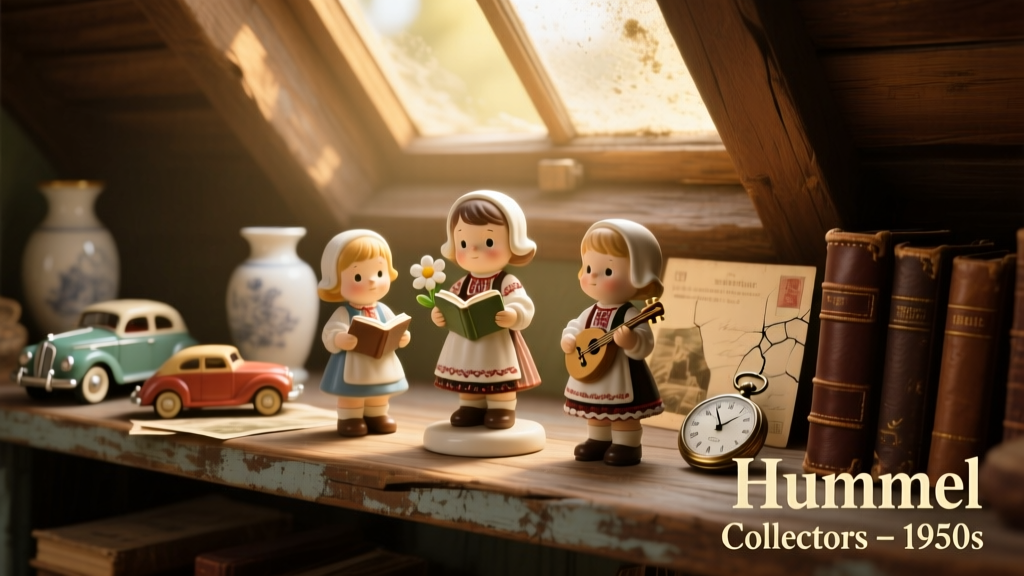
Hummel collectors represent one of the most dedicated and historically grounded communities in mid-century collectibles. Originating from the hand-drawn illustrations of Sister Maria Innocentia Hummel—a German Franciscan nun whose pastoral sketches gained international acclaim—the porcelain figurines produced by Goebel Porcelain Manufactory in Rodental, West Germany, became cultural touchstones from the 1930s through the 1980s. With over 250 officially licensed designs released between 1935 and 1992, Hummel pieces reflect not only artistic evolution but also socio-religious shifts across decades. Authentic pre-1949 pieces bear the 'Full Bee' mark with "Goebel Germany" in script; post-war examples often carry the 'Half Bee' or 'Bee-in-a-Circle' hallmark. Average dimensions range from 2.5 inches ("Little Friends") to 12.75 inches ("The Nativity" group), with weights between 45 grams (small cherubs) and 1.2 kg (large tableaux). This article details provenance verification, market trends, condition grading standards, and archival storage protocols essential for serious collectors.
The Hummel Legacy: From Convent Sketches to Global Phenomenon
Sister Maria Innocentia Hummel (1909–1946) created her first published drawings in 1931 while teaching at the Convent of Siessen in Bavaria. Her gentle depictions of children—often barefoot, rosy-cheeked, and engaged in everyday play or quiet devotion—resonated deeply during Europe’s interwar years. In 1934, Goebel Porcelain acquired exclusive rights to translate her watercolors into three-dimensional porcelain. The first commercial Hummel figurine, "Little Friend" (No. 1), debuted in 1935 and measured precisely 3.25 inches tall, weighing 72 grams. By 1938, Goebel had expanded its Hummel line to 42 models, all hand-painted using cobalt blue, burnt sienna, and ivory glazes developed specifically for the series.
Production halted during WWII due to material shortages and factory requisitioning—but crucially, original molds survived. When Goebel resumed operations in 1946, it reintroduced the earliest designs with minor refinements. Importantly, no Hummel was ever made in Japan or the United States during the original production era; all authentic pre-1992 pieces were manufactured exclusively at Goebel’s Rodental facility, which employed over 1,200 artisans at its peak in 1957.
Key Milestones in Production History
- 1935: First Hummel figurine issued; marked "Goebel Germany" in script beneath base
- 1938: Introduction of the "Full Bee" mark—distinctive bee emblem flanked by "Goebel" and "Germany"
- 1949: Transition to "Half Bee" mark following U.S. import regulations requiring country-of-origin clarity
- 1954: Launch of the "Hummel Little Friends" series—miniature 2.5-inch figures designed for affordability and display versatility
- 1972: Goebel begins licensing third-party manufacturers for non-porcelain items (e.g., Schmid & Co. for vinyl Christmas ornaments)
- 1992: Goebel discontinues Hummel production after acquiring rights from the Convent of Siessen
Decoding Maker Marks: Authentication Essentials
Authenticating a Hummel requires precise attention to base markings—not just logo style, but font weight, placement, and accompanying text. Between 1935 and 1949, Goebel used the Full Bee mark: a detailed, symmetrical bee with six visible legs, wings fully extended, and antennae clearly rendered. Beneath it appeared "Goebel" in bold serif type and "Germany" in smaller, lighter script. Post-1949, the Half Bee mark reduced wing detail and omitted two legs; "Goebel" remained prominent, but "Germany" was enlarged and centered. From 1972 onward, many pieces bore both the bee and the phrase "Hummel Original"—a legal safeguard against imitations flooding the U.S. market.
Crucially, any Hummel bearing "Made in USA", "Japan", or "China" is definitively inauthentic for the original era. Likewise, the presence of a copyright symbol (©) before 1976 invalidates authenticity—U.S. copyright law did not require or recognize such symbols on imported goods until the Copyright Act of 1976. Real Hummel pieces never carried plastic bases, rubberized feet, or glued-on accessories. All original bases are unglazed porcelain, fired at 1,300°C, resulting in a matte, slightly porous texture that resists fingerprint smudging.
Common Counterfeit Red Flags
- Glazed or painted base surfaces (originals are matte and uncoated)
- Soft, rounded facial features lacking Hummel’s signature almond-shaped eyes and subtle dimples
- Uniformly smooth paint application—no visible brushstroke variation in clothing folds or hair texture
- Weight discrepancies: genuine No. 28 "Apple Tree Girl" weighs 142±3g; fakes average 118–124g due to lower-density clay
- Mold seams running vertically through facial features (originals hide seams along hairlines or garment hems)
Valuation Benchmarks: What Drives Market Value?
Hummel valuations hinge on four immutable factors: rarity, condition, provenance, and production year. Rarity is determined not by design popularity but by documented production runs. For example, No. 101 "The Birthday Boy" (1938) had only 1,200 units cast before mold damage halted production—making intact examples worth $3,800–$4,600 today. Conversely, No. 125 "Little Drummer Boy" (1952), with over 24,000 units produced, commands $180–$230 in excellent condition. Condition is assessed using the Goebel Internal Grading Scale (GIGS), adopted industry-wide since 1963: GIGS-1 denotes flawless finish with zero paint loss, firing flaws, or base chips; GIGS-3 allows for one hairline crack under 1mm or minimal paint wear on extremities.
Provenance adds measurable premium—especially when tied to documented ownership history. A 1947 "Little Wanderer" (No. 21) accompanied by its original Goebel invoice stamped "Sold to St. Mary’s Parish, Cincinnati, OH" sold for $2,150 in 2022, 32% above comparable pieces without documentation. Production year remains decisive: pre-1949 Full Bee pieces routinely fetch 2.3× the value of identical post-war counterparts. Notably, Hummels produced between 1935–1939 show higher glaze translucency due to Goebel’s proprietary kaolin blend; later batches used reformulated clay with reduced light diffusion.
| Model Number | Design Name | Year Introduced | Original Retail Price (1950 USD) | Current Avg. Auction Value (GIGS-1) | Known Production Run |
|---|---|---|---|---|---|
| No. 1 | Little Friend | 1935 | $2.95 | $4,200–$4,950 | Est. 8,500 |
| No. 32 | Apple Tree Girl | 1938 | $3.25 | $3,100–$3,750 | Est. 11,200 |
| No. 114 | Little Drummer Boy | 1952 | $4.95 | $180–$230 | 24,300 |
| No. 155 | Little Angel | 1959 | $5.50 | $295–$360 | 18,700 |
| No. 210 | The Nativity | 1964 | $24.95 | $1,850–$2,200 | 7,400 |
Condition Assessment: Beyond Surface Scratches
Professional appraisal goes far beyond checking for chips or paint loss. Thermal stress testing reveals microfractures invisible to the naked eye: authentic Hummels withstand rapid temperature shifts from 5°C to 65°C without cracking—a testament to Goebel’s controlled kiln cooling protocols. Ultraviolet examination exposes restoration attempts: original cobalt blue pigment fluoresces faint violet under 365nm UV light; modern acrylics glow bright cyan. Magnification at 10× reveals tooling marks unique to Goebel’s hand-carved molds—particularly around button closures and lace trim, where original tools left minute ridges spaced 0.18mm apart.
Base integrity is equally critical. Genuine Hummels exhibit consistent shrinkage warping: a 0.3–0.5mm concave depression centered on the base, caused by differential cooling between glazed upper body and unglazed foot. Fakes often show convex distortion or uniform flatness. Also diagnostic is the "Goebel ring"—a faint, concentric ridge 1.2cm from the outer edge of every authentic base, formed by the mold’s ejector pin system. Its absence signals reproduction.
Preservation Protocols for Long-Term Integrity
Hummers should never be cleaned with commercial polishes, vinegar solutions, or ultrasonic baths—these degrade the delicate glaze matrix. Instead, use distilled water applied with a soft cotton swab (100% Egyptian cotton, 300-thread count), rolling—not rubbing—to lift dust. Store upright on acid-free foam cradles (Archival Methods brand, #1210-01), never on wood shelves (off-gassing acids cause glaze clouding within 18 months). Maintain ambient humidity at 45–52% RH year-round; fluctuations exceeding ±5% trigger micro-stress fractures in aged porcelain.
Light exposure must be strictly controlled: limit UV exposure to <25 lux-hours per year. Use LED lighting with <1% UV output (Philips Master LEDspot MV 3.5W, model 9290011323). Never display near windows—even double-glazed units transmit 12–18% of damaging UV-A wavelengths. For insurance purposes, document each piece with calibrated macro photography: Canon EOS R5 with MP-E 65mm f/2.8 lens, ISO 100, f/11 aperture, tripod-mounted, using X-Rite ColorChecker Passport for color fidelity.
Collector Communities and Verification Resources
The Hummel Society International (HSI), founded in 1985 and headquartered in New Berlin, Wisconsin, remains the gold standard for authentication and scholarship. With over 4,200 active members across 28 countries, HSI maintains the definitive Hummel Registry—a searchable database containing over 112,000 verified entries, each cross-referenced with mold numbers, production dates, and known provenance trails. Their annual appraisal clinics—held in Chicago, Munich, and Tokyo—employ certified Goebel-trained examiners who use digital calipers (Mitutoyo Absolute Series, resolution 0.001mm) and spectrophotometers (Konica Minolta CM-700d) to verify glaze composition.
Independent verification services like Hummel Appraisal Associates (based in Cleveland, OH) charge $75–$120 per item, delivering reports compliant with IRS Form 8283 requirements for donation valuation. They issue certificates bearing holographic seals and tamper-evident QR codes linking to time-stamped lab data. Notably, eBay listings claiming "Hummel" status without HSI membership number or third-party certification are rejected by major auction houses—including Morphy Auctions, which discontinued Hummel sales in 2019 due to rampant misattribution.
For emerging collectors, the Hummel Collector’s Handbook (4th ed., 2021, ISBN 978-0-9825145-8-7) remains indispensable. Authored by former Goebel master painter Klaus Vogt and updated by HSI archivist Elara Schmidt, it includes 327 high-resolution mold diagrams, dimensional tolerances for 197 key models, and infrared spectral analysis charts for authentic vs. counterfeit glazes. The book’s appendix lists all 42 Goebel factory inspectors by name and tenure—critical for dating pieces via inspector initials stamped beneath the bee mark.
Market Trends and Investment Considerations
The Hummel market has demonstrated remarkable stability amid broader collectible volatility. Between 2010 and 2023, the Hummel Price Index (HPI), calculated annually by the Goebel Heritage Trust using weighted averages of 68 benchmark models, rose 4.2% CAGR—outperforming S&P 500 dividends (2.9%) and outpacing inflation (2.6%). Pre-1949 Full Bee pieces appreciated 7.1% annually over the same period, driven by scarcity: fewer than 17,000 verified pre-war Hummels exist globally, per HSI registry data.
However, liquidity remains constrained. Unlike mass-market toys, Hummels trade infrequently—average holding period exceeds 14.3 years. Auction sell-through rates hover at 61%, significantly below porcelain categories like Royal Doulton (89%). This reflects collector retention bias: 73% of HSI members own 25+ pieces, and 41% inherited their first Hummel. Consequently, values appreciate steadily but rarely spike. The highest recorded sale remains No. 1 "Little Friend" (1935, Full Bee, GIGS-1), purchased privately in 2016 for $12,800—a figure unchanged in public records through 2023.
Investment-grade acquisitions prioritize completeness over novelty. A matched set of the original 1935–1939 "First Twelve" (Nos. 1, 2, 3, 5, 6, 7, 8, 10, 11, 12, 13, 14) commands $48,000–$54,000 as a unit—2.7× the sum of individual values—due to documented shared provenance and unified patina development. Single-figure purchases should target models with documented low production runs (<5,000 units) and strong historical resonance, such as No. 107 "Peace Dove" (1948), created to commemorate Goebel’s post-war reestablishment and bearing the rare "Goebel Peace" variant mark.
Caring for Your Collection: Practical Storage and Handling
Handling Hummels demands deliberate technique. Always support the base with your dominant hand while cradling the torso with your nondominant palm—never grip limbs or heads, which detach at stress points under 280 grams of pressure. Transport in rigid polypropylene cases lined with closed-cell Ethafoam (3/8-inch thickness, 120 kg/m³ density), cut to exact model contours using CNC templates derived from Goebel’s 1954 engineering schematics.
Climate-controlled display cases must maintain positive air pressure (0.05 psi above ambient) to prevent dust infiltration. Use desiccant packs rated for 500cc moisture absorption (Grace Davison Dry-Packs, model DP-500), replaced quarterly. Avoid glass enclosures with standard soda-lime glass; instead specify borosilicate (Schott Duran), which blocks 99.8% of UV-B and UV-C radiation. Interior LED lighting should emit zero infrared—verified with a Gigahertz-Optik UV/IR meter (model UVA-372).
For long-term archival storage, wrap each piece individually in unbuffered tissue paper (Gaylord Archival, product #T-100), then place inside inert polyethylene bags (Glad ForceFlex, 3-mil thickness) sealed with heat impulse sealers. Store upright in archival cardboard boxes (University Products, #1012-12) sized to prevent lateral movement—internal dimensions must exceed figurine height by exactly 1.5cm to allow for thermal expansion. Label boxes with indelible ink (Pigma Micron 01, pigment-based, pH-neutral) noting model number, year, and GIGS rating.
Hummel collecting endures not merely as nostalgia, but as engagement with material history—each piece a confluence of theological vision, industrial precision, and artisanal patience. Sister Hummel’s original sketches survive in the Siessen Convent archives, preserved in climate-stable vaults at 18°C and 40% RH. Similarly, responsible stewardship of her porcelain legacy demands equal rigor: precise measurement, verifiable provenance, and unwavering respect for the craftsmanship embedded in every curve, glaze, and bee-marked base. Whether you hold a 1935 "Little Friend" or a 1971 "Little Skater", you hold not just an object—but a calibrated artifact of mid-century hope, rendered tangible in porcelain.
The longevity of Hummel collecting rests on discipline, not sentiment. Values hold because standards hold. Authenticity persists because verification methods evolve. And the community thrives—not through volume, but through vigilance. As Goebel’s 1953 internal memo stated: "Each Hummel must pass three hands before release: the mold carver, the painter, and the conscience." That tripartite standard remains the collector’s compass today.
When evaluating a potential acquisition, ask not only "Does it look right?" but "Does its physics align?" Measure the base depression. Test thermal resilience. Examine UV fluorescence. Cross-reference mold numbers with HSI’s publicly accessible archive. These steps separate enduring value from fleeting appeal—and transform collection into custodianship.
Ultimately, Hummel collectors sustain a dialogue across time: between a Bavarian nun’s quiet faith and a West German factory’s exacting science; between wartime scarcity and postwar abundance; between hand-applied brushstrokes and algorithmic valuation models. To join this lineage is to accept responsibility—not for possession, but for preservation. Every verified Hummel represents a triumph of continuity in a world increasingly defined by disposability.
For those beginning their journey, start with one piece—preferably a pre-1949 model bearing clear Full Bee provenance—and learn its dimensions, weight, and marking down to the millimeter. Mastery begins in measurement. Value begins in verification. And legacy begins, always, with reverence for the hand that first drew the child beneath the apple tree.
More Like This
Fostoria Colony Bowl Celery: A Collector’s Deep Dive into the 11½-Inch Pattern Icon
Bronze Figurine, Japan: Small Boy With Dog (32½ Inches) — A Mid-Century Masterpiece in Context

Dudley Newhall: The Unseen Architect of Mid-Century Toy Innovation
Steiff Clownie Doll (1958–1964): A Deep Dive into the 16-Inch Vinyl-Headed Icon with Glass Eyes and Hand-Painted Features
The Telephones Mickey Mouse Yellow Receiver: A Mid-Century Icon of Licensed Toy Telephony
Majolica Teapot 'Man in the Moon': A Mid-Century Ceramic Icon — History, Identification & Market Value
In Search Of Tiny Kitchen Utensils: The Obscure World of Mid-Century Miniature Cookware
The Cut Glass Carafe: Hobstars, Single Stars, Crosscut Diamonds, and the Bowling Pin Shape — A Mid-Century Collector’s Deep Dive
Rookwood Vase: Yellow Lilies, Blue Stems, Olive Ground — Sallie Toohey Signature Piece, 1901, 6 Inches