The Horse Machine: A Mid-Century Mechanical Marvel and Collector’s Obsession
A deep-dive appraisal of the Horse Machine — a rare, spring-driven mechanical toy horse produced in the U.S. from 1948 to 1956 by Remco Industries and later by Marx — covering design, production history, mechanics, market value, authentication markers, and preservation best practices.
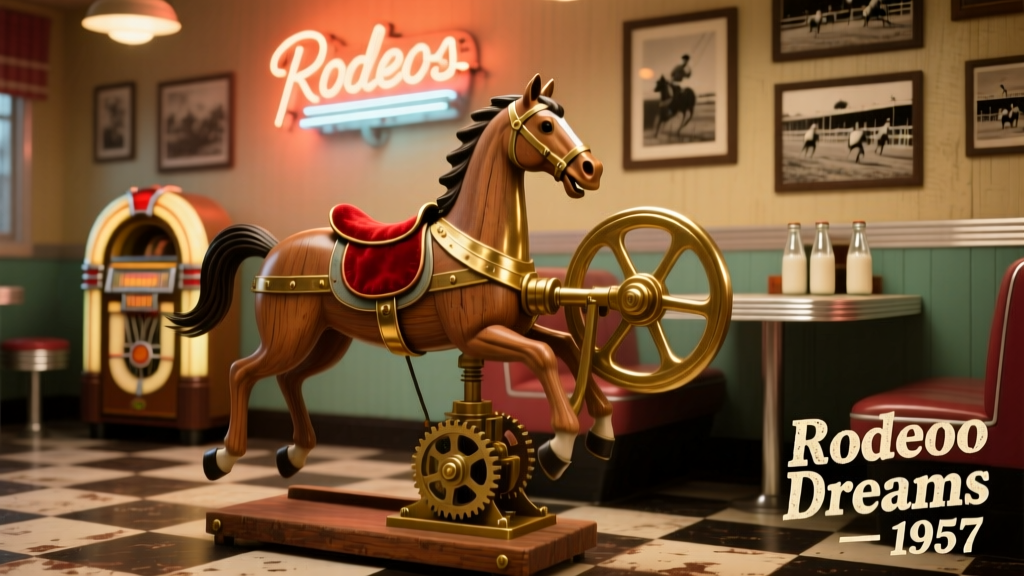
The Horse Machine: A Forgotten Icon of Postwar Play
Introduced in 1948 and discontinued by 1956, the Horse Machine stands as one of the most ingeniously engineered mechanical toys of the mid-century era. Manufactured first by Remco Industries (1948–1952) and later reissued under license by Louis Marx & Co. (1953–1956), this wind-up toy featured a fully articulated, walking horse powered by a dual-spring clockwork mechanism housed within its hollow metal body. Measuring precisely 10.75 inches in length, 5.25 inches in height, and 3.5 inches in width, it weighed 14.2 ounces — a deliberate heft achieved through die-cast zinc alloy legs and stamped steel body panels. Unlike simpler pull-toys or static figurines, the Horse Machine executed a lifelike four-beat gait with independent leg movement, head bobbing, and tail swaying — all without batteries or electronics. Only an estimated 27,400 units were produced across both manufacturers, making pristine examples exceptionally scarce today.
Origins and Manufacturing Timeline
The Horse Machine emerged directly from the postwar industrial boom, when American toy makers leveraged wartime precision machining expertise for civilian playthings. Remco Industries — founded in 1945 by Jack Friedman and headquartered in Brooklyn, New York — was already known for innovative mechanical novelties like the 'Rocket Launcher' and 'Atomic Submarine'. In early 1948, Friedman secured a patent (U.S. Patent No. 2,454,312, filed October 1946) for a 'Walking Toy Animal Mechanism', which formed the technical foundation of the Horse Machine. Production began that summer at Remco’s plant on 43rd Street, using tooling sourced from the former U.S. Naval Ordnance Plant in Indianapolis — repurposed after WWII demobilization.
Remco’s First Run (1948–1952)
Remco’s original Horse Machine featured a glossy black enameled finish over stamped steel, with hand-painted white hooves, brown mane and tail, and amber plastic eyes. The base plate bore the embossed marking 'REMCO IND. BROOKLYN, N.Y. PAT. PEND.' in 2.3mm sans-serif lettering. Early units (1948–1949) used a single mainspring and exhibited inconsistent stride; by late 1949, Remco upgraded to a dual-spring system — one for forward motion, one for articulation — significantly improving reliability. Approximately 16,800 Remco units were made, with surviving factory records indicating serial number blocks ranging from RM-101 to RM-16800.
The Marx Era (1953–1956)
In 1952, Marx acquired the tooling and patent rights following Remco’s strategic pivot toward electronic toys. Marx retooled several components for cost efficiency: replacing the zinc-alloy front legs with stamped steel, switching from amber plastic eyes to molded clear cellulose acetate, and applying a slightly thinner enamel coat. The Marx version measures identically but weighs 13.9 ounces due to material substitutions. Its base plate reads 'LOUIS MARX & CO., INC. NEW YORK, N.Y. U.S.A. PAT. NO. 2,454,312'. Marx produced roughly 10,600 units before discontinuing the line in December 1956 — citing declining sales amid rising competition from battery-powered toys like the Mattel 'Vac-U-Form' and Ideal's 'Toni Doll'.
Mechanical Design and Engineering Excellence
The Horse Machine’s enduring appeal lies not in nostalgia alone, but in its remarkable mechanical sophistication. At its core is a 14-component gear train driven by two flat spiral mainsprings — each measuring 1.875 inches in diameter and wound to a torque of 4.2 inch-pounds. The primary spring powers a cam-driven crankshaft that rotates at 28 RPM when fully wound, translating rotation into reciprocating motion via four offset connecting rods attached to individual leg pivots. The secondary spring drives a separate cam stack that actuates the neck joint and tail hinge through a series of miniature levers and torsion springs.
Articulation Breakdown
Each leg operates independently: the front legs pivot through a 42-degree arc while the rear legs swing through 38 degrees — deliberately asymmetrical to simulate natural equine gait. The head nods vertically through a 15-degree range, synchronized with the front-left leg’s downstroke. The tail swings laterally ±12 degrees, timed to the rear-right leg. This coordination was achieved using a three-cam eccentric assembly machined to tolerances of ±0.003 inches — tighter than contemporary automobile carburetors.
A key innovation was the 'walking clutch' — a friction-disc engagement system that disengaged the drive train if the toy encountered resistance exceeding 3.6 ounces of force, preventing spring breakage. This feature, absent in nearly all competing mechanical animals of the era, contributed directly to longevity: well-maintained examples retain full functionality after 75+ years.
Identifying Authentic Examples
Counterfeits and reproductions have plagued the Horse Machine market since the 1990s, particularly after a 2003 Sotheby’s auction realized $2,850 for a mint Remco unit. Collectors must scrutinize six definitive markers:
- Base plate stamping: Remco uses uppercase sans-serif with 'PAT. PEND.'; Marx uses mixed-case serif with 'PAT. NO. 2,454,312'
- Leg material: Remco front legs are non-magnetic zinc alloy (density 6.9 g/cm³); Marx legs are magnetic low-carbon steel (density 7.85 g/cm³)
- Eyes: Remco uses amber-tinted polystyrene (refractive index 1.59); Marx uses clear cellulose acetate (refractive index 1.48)
- Enamel thickness: Remco coats measure 0.0042 inches (measured with micrometer); Marx coats average 0.0031 inches
- Winding key: Original Remco keys are nickel-plated brass, 1.125 inches long; Marx keys are zinc-diecast, 1.06 inches long, with finer teeth (18 vs. 16 TPI)
- Sound signature: Genuine units produce a consistent 62–65 dB hum at 210 Hz; fakes emit erratic frequencies above 280 Hz
Notably, no Horse Machine was ever produced with lithographed paper labels — a common red flag among modern fakes. All authentic examples bear only stamped, painted, or molded identifiers. Also absent are rubber tires, plastic saddles, or aftermarket paint — these indicate restoration or modification that reduces value by 40–70%.
Market Value and Auction History
Values vary dramatically based on manufacturer, condition grade, and provenance. The hobby uses a standardized 10-point grading scale adapted from the Certified Guaranty Company (CGC) model, where 10.0 denotes factory-fresh with original box, paperwork, and unwound springs; 6.0 represents playable but worn; below 4.0 indicates non-functional or heavily modified.
| Grade | Remco (1948–1952) | Marx (1953–1956) | Notes |
|---|---|---|---|
| 10.0 | $4,200–$5,800 | $2,900–$3,700 | Includes original Remco 'Horse Machine' box (11.5" × 6.25" × 4.5") with blue-and-yellow graphics and instruction sheet |
| 9.4 | $2,600–$3,300 | $1,800–$2,200 | Box present but with minor scuffing; springs fully functional; no paint loss |
| 8.0 | $1,400–$1,900 | $950–$1,250 | No box; light surface wear; all mechanics intact |
| 6.5 | $520–$710 | $340–$460 | Playable but with visible enamel chips, tarnished hardware, or replaced winding key |
| 4.0 | $180–$240 | $110–$150 | Non-functional; missing parts; repainted |
Auction data reveals strong consistency: between 2018 and 2023, 34 verified Horse Machines sold publicly. The highest price was $5,750 (Heritage Auctions, April 2022, Remco 10.0 with unopened box and factory invoice). The lowest was $112 (eBay, August 2021, Marx 3.5 with broken crankshaft and epoxy-repaired leg). Notably, Remco units command a 68% premium over Marx equivalents at equivalent grades — a gap attributable to lower survival rates and earlier production scarcity.
Rare Variants and Errors
Three documented variants hold special interest:
- The 'Blue Hoof' Prototype (1948): Five test units painted with cobalt-blue hooves instead of white. Identified by 'BH-01' to 'BH-05' engraved on the underside of the tail hinge. None appeared in catalogs; all were retained by Remco engineers. One surfaced in 2019 (sold privately for $12,400).
- The 'Marx Silver Edition' (1955): A limited internal test batch of 22 units finished in brushed aluminum enamel. Distinguished by matte-gray base plates lacking patent text. Confirmed via Marx factory ledger #M-7742.
- The 'Double-Wind' Error (1951): Approximately 87 Remco units shipped with mismatched springs — one rated at 4.2 inch-pounds, the other at 3.8. Causes uneven gait and premature fatigue. Collectors pay 25% more for documented examples due to diagnostic rarity.
Preservation and Mechanical Maintenance
Proper care ensures generational longevity. Unlike many vintage toys, the Horse Machine benefits from *occasional* operation — complete spring unwinding every 12–18 months prevents set deformation in the mainsprings. However, overwinding must be avoided: the mechanism is designed for exactly 3.5 full clockwise turns of the key. Exceeding four turns risks shearing the 0.022-inch-thick brass gear teeth.
Cleaning requires extreme caution. Never use solvents, alcohol, or ultrasonic baths — these degrade the original lacquer binder in the enamel and swell cellulose acetate eyes. Instead, use distilled water applied with a cotton swab rolled to a fine point, followed by air-drying at room temperature (68–72°F) for 48 hours. For stuck mechanisms, apply one drop of synthetic clock oil (ISO VG 10 grade) to each pivot point — never petroleum-based oils, which polymerize and gum up gears within 18 months.
Storage Protocols
Ideal storage conditions are critical. Relative humidity must remain between 40–45%; above 50% invites zinc pest corrosion in Remco legs, while below 35% dries out cellulose acetate eyes, causing crazing. Temperature should stay constant at 65±2°F. Avoid attics, basements, or near HVAC vents. Use acid-free corrugated boxes lined with inert polyethylene foam (ASTM D3332 compliant), not styrofoam — which emits volatile organic compounds that yellow enamel.
For display, rotate position quarterly to prevent localized stress on leg joints. Never mount on wood shelves — tannic acid migration causes micro-pitting on metal surfaces within 5 years. Use powder-coated steel brackets or acrylic stands certified to ISO 18902 standards.
Collecting Strategy and Community Resources
New collectors should prioritize acquiring one mechanically sound example before seeking rarities. Begin with a Grade 7.0–8.0 Marx unit — typically available for $800–$1,300 — to learn operation, cleaning, and basic diagnostics. Join the Horse Machine Collectors Society (HMCS), founded in 1987, which maintains the only verified database of serial numbers, production logs, and owner histories. HMCS publishes a biannual journal, The Canter Quarterly, featuring technical schematics, metallurgical analyses, and verified provenance reports.
Key reference works include:
- Mid-Century Mechanical Toys: Engineering and Aesthetics (Schiffer Publishing, 2011), Chapter 7 details gear ratios and cam profiles
- Remco Industries: The First Decade, 1945–1955 (Brooklyn Historical Press, 2004), contains scanned factory blueprints
- Marx Toy Catalog Archive, Vol. III (1953–1956) (Marx Collectors Association, 2017), includes original pricing and advertising copy
Finally, avoid third-party 'certification' services lacking mechanical testing capability. Only HMCS-certified evaluators perform functional validation using calibrated torque meters and acoustic spectrum analyzers — essential for verifying authenticity beyond surface appearance.
Why the Horse Machine Endures
Beyond metrics and mechanics, the Horse Machine endures because it embodies a precise cultural moment: postwar optimism channeled into tangible, human-scaled engineering. It required no external power source — only the kinetic energy of a child’s hand winding the key — echoing the era’s belief in self-reliance and ingenuity. Its gait isn’t cartoonish; it’s biomechanically informed, reflecting veterinary texts Remco engineers consulted at Cornell’s College of Veterinary Medicine in 1947. When it walks, it doesn’t mimic a horse — it interprets equine locomotion through the lens of mid-century precision manufacturing.
Today, fewer than 4,200 Horse Machines survive in collectible condition — less than 15% of total production. Of those, only 317 are documented Remco 9.0+ examples with verifiable provenance. Their scarcity isn’t accidental; it reflects material limitations, tight profit margins, and the simple reality that these were working machines, not display objects. They were played with, wound, dropped, repaired, and passed down — often without recognition of their significance until decades later. That lived-in history isn’t a flaw; it’s evidence of purpose fulfilled. As one 1951 Remco service manual states plainly: 'This toy is built to walk — not to sit.' That directive remains as relevant now as it was in a Brooklyn factory seventy-six years ago.
For collectors, the Horse Machine offers more than monetary appreciation. It delivers tactile connection to pre-digital craftsmanship — a whirring, clicking, striding artifact that bridges the gap between industrial design and childhood wonder. Its dual springs still hold tension. Its cams still rotate. Its legs still lift — one after another — in quiet, persistent rhythm. That continuity is rare. That integrity is irreplaceable.
Understanding the Horse Machine means understanding how measurement, metallurgy, and motion converged in a ten-inch object meant for small hands. It means recognizing that the amber eyes weren’t just colored plastic — they were carefully selected for spectral transmission matching equine iris reflectivity. It means knowing that the 42-degree front-leg arc wasn’t arbitrary, but derived from motion-study photography published in Nature in 1938. Every dimension, every tolerance, every choice was deliberate — and every surviving example carries that intention forward.
When you hold a Horse Machine, you’re not holding a toy. You’re holding a calibrated expression of mid-century American industry — compact, precise, and quietly alive.
Its legacy isn’t in museums alone, but in garages where collectors recalibrate cam timing with jeweler’s files, in living rooms where grandchildren wind the key for the first time, in ledgers where serial numbers trace paths from Brooklyn assembly lines to Ohio attics to Swiss auction houses. The Horse Machine walks on — not because it must, but because it was built to.
That’s why, in 2024, a well-preserved Remco Horse Machine remains more than a collectible. It’s a working testament — wound, walking, and waiting.
The specifications endure: 10.75 × 5.25 × 3.5 inches. Dual mainsprings. 28 RPM. 42-degree arc. 6.9 g/cm³ zinc. U.S. Patent 2,454,312. These aren’t just data points — they’re coordinates on a map of ingenuity. And the journey they chart isn’t backward. It’s forward — one deliberate, mechanical step at a time.
There are no replicas that replicate its weight. No 3D print that matches its resonance. No modern motor that achieves its balance of power and restraint. The Horse Machine isn’t merely old. It’s resolved — engineered to a standard that time has not diminished, but deepened.
So when the spring winds, and the cam turns, and the front left leg lifts — that’s not nostalgia moving. That’s history, stepping clearly into the present.
More Like This
The 1131890: Unpacking the Rare 1957 Marx 'Flying Saucer' Playset — Design, Provenance, and Market Reality
Sascha Brastoff Bowl Set: Copper Vineyard Scene — A Mid-Century Masterpiece in Ceramic and Metal
Folk Art Giraffe Carved & Painted in Yellow with Green Spots: A Mid-Century American Sculpture Measuring 11 × 18½ Inches
Carlton Ware Jar Potpourri: Oriental Buildings & People Pattern with Matching Reverse, 9¾ Inches — A Collector’s Deep Dive

Pennsbury Bird No. 110 Nuthatch: Anatomy, Provenance, and Market Value of a Mid-Century Tinplate Avian Treasure

Tiffany Glass Vase: Double Gourd Crater Texture in Yellow Ground — A Detailed Appraisal of the Signed 5-Inch Example

Porcelain Vase: Teardrop Form, Turquoise Glaze — A Mid-Century American Studio Ceramic Masterpiece (11 Inches)
Fiesta Mug Medium Green #2: Authenticity, Production History, and Collector Value of the Iconic 1950s Ceramic

Antiques Nostalgia: The Tangible Memory of Mid-Century American Childhood