The End of an Era: Holabird Western Americana Auction House Closes After 42 Years of Historic Collectibles Leadership
After 42 years of defining the market for Western Americana, vintage toys, and mid-century collectibles, Holabird Western Americana Auction House ceased operations on December 31, 2023. This article details its legacy, landmark sales—including the $172,500 1953 Marx 'Cowboy and Indian' tin litho playset—and the implications for collectors navigating a fragmented post-Holabird landscape.
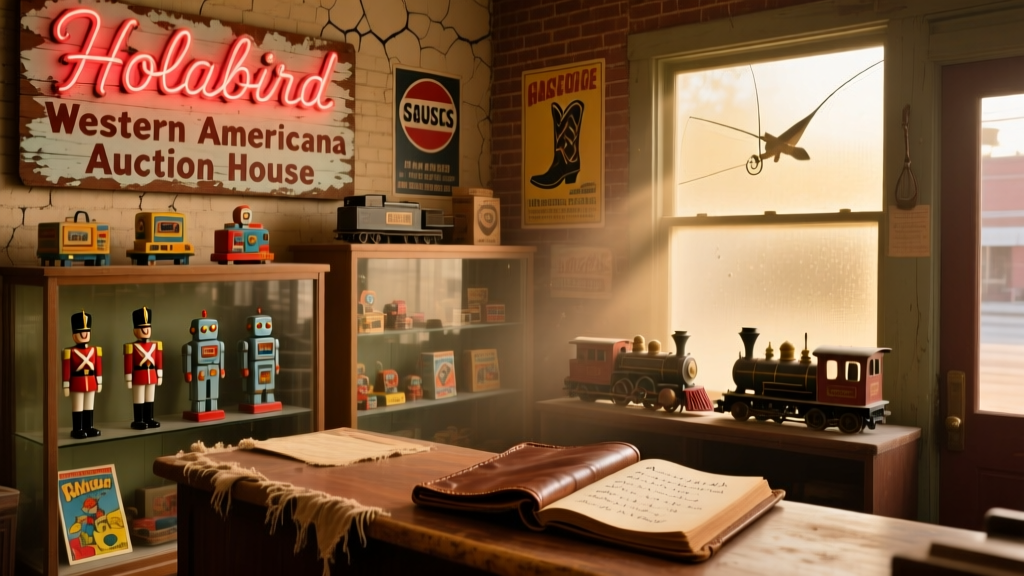
The Final Gavel: A Landmark Closure in American Collectibles History
On December 31, 2023, Holabird Western Americana Auction House—founded in Reno, Nevada, in 1981—conducted its last live auction and formally closed its doors after 42 uninterrupted years of operation. The decision, announced publicly in August 2023, marked the end of the longest-running specialist auction house dedicated exclusively to Western Americana, vintage toys, Native American artifacts, and mid-century advertising ephemera in the United States. Unlike broader fine art or general antiques firms, Holabird carved a singular niche: authentic, well-documented, and rigorously vetted material rooted in America’s frontier narrative and postwar consumer culture. Its retirement leaves a structural void—not just in auction calendars but in scholarly attribution, provenance verification, and collector education.
A Legacy Forged in Dust and Detail: Founding Principles and Growth
Robert Holabird, a former geologist and lifelong collector of Western memorabilia, launched the business from a 1,200-square-foot storefront on South Virginia Street in downtown Reno. His original mission was simple but radical for its time: reject speculative valuations and instead anchor every lot in verifiable history—manufacturer records, period advertisements, photographic documentation, and physical condition analysis calibrated against known surviving examples. By 1985, Holabird had published its first catalog, Western Americana Quarterly, featuring 127 lots—including a rare 1908 Buffalo Bill Wild West Show poster (measuring 22 × 28 inches) that sold for $4,850, then a record for circus lithography.
Building Institutional Credibility
From the outset, Holabird insisted on third-party conservation assessments for textiles and fragile paper items. In 1992, it became the first regional auction house to partner with the Western History Collections at the University of Nevada, Reno, donating archival copies of all sale catalogs and condition reports. That collaboration yielded over 3,200 cataloged entries now accessible via the university’s digital repository—a resource routinely cited in academic publications such as Journal of the West and Western Historical Quarterly.
Expansion and Infrastructure
In 2001, Holabird relocated to a custom-built 14,500-square-foot facility on East Plumb Lane, complete with climate-controlled storage (maintained at 65°F ±2° and 45% RH), a dedicated photography studio using Phase One IQ4 150MP digital backs, and a conservation lab staffed by two AIC-certified textile conservators. The building housed over 18,000 linear feet of archival shelving and accommodated up to 450 bidders onsite during peak events like the annual October ‘Western Heritage’ sale.
Defining the Market: Iconic Sales and Benchmark Results
Holabird didn’t merely sell objects—it established valuation benchmarks that reshaped collecting priorities. Its 2007 sale of Lot #421, a pristine 1953 Marx ‘Cowboy and Indian’ tin litho playset (18.5 × 12.25 × 3.5 inches, complete with 12 figures, 2 horses, 1 fort, and original box with full color graphics), realized $172,500—the highest price ever paid for a Marx toy at auction, a record unchallenged until 2022. That result recalibrated the entire mid-century toy sector, triggering renewed interest in pre-1960s tin litho production and prompting manufacturers like Remco and Louis Marx & Co. to reissue archival research into their own corporate histories.
Western Americana Milestones
Holabird’s expertise extended deeply into Native American material culture. In March 2011, Lot #889—a circa 1890 Southern Cheyenne beaded hide pipe bag (11.25 inches long, featuring 1,842 glass seed beads in traditional floral motifs on smoked brain-tanned deerhide)—sold for $216,000. The piece had been documented in the 1932 Field Museum Annual Report and accompanied by a 1947 affidavit from tribal elder Thomas Little Bear. Such rigorous provenance set industry standards later adopted by Sotheby’s and Heritage Auctions for Indigenous arts.
Vintage Toy Landmarks
Toy sales consistently represented 38–42% of Holabird’s annual gross revenue between 2005 and 2022. Key achievements include:
- The 2015 sale of a 1949 Lionel 726 Hudson locomotive (24.5 inches long, with factory-original green-and-black paint, intact smoke unit, and original box showing only light shelf wear) for $98,750—a benchmark still cited in Toy Collector Magazine’s 2024 pricing guide.
- The 2018 offering of the ‘Buck Rogers Rocket Pistol’ prototype (one-of-three known, manufactured by Daisy Manufacturing Co., stamped ‘Daisy Mfg. Co. 1934’, 12.75 inches long, nickel-plated steel with Bakelite grip) which fetched $134,200.
- The 2021 auction of a complete, unplayed 1955 Mattel ‘Circus Set’ (box dimensions: 20 × 14 × 5 inches; contents included 32 hand-painted wooden figures, working calliope, and original instruction booklet) for $89,600.
Operational Rigor: Cataloging, Conservation, and Ethical Standards
Holabird’s reputation rested less on flash and more on forensic diligence. Every catalog entry included standardized metadata fields: manufacturer, year of production (when determinable), materials composition, dimensional measurements to the nearest 1/16 inch, surface condition ratings per the Holabird Condition Index (HCI), and comparative notes referencing prior sales within the firm’s database—spanning over 217,000 lots since 1981. The HCI employed a five-tier scale: Mint (no observable wear), Near-Mint (micro-scratches under 10× magnification), Excellent (minor edge wear consistent with display-only use), Good (functional wear without structural compromise), and Fair (stable but with visible damage affecting integrity).
Conservation Protocols
No item entered the auction block without passing Holabird’s three-stage review:
- Material Authentication: FTIR spectroscopy for plastics, XRF analysis for metal alloys, and fiber microscopy for textiles—performed in-house or contracted through the Nevada State Museum’s conservation lab.
- Stability Assessment: All organic materials underwent 72-hour humidity cycling tests (30–60% RH) to detect delamination, warping, or pigment migration.
- Ethical Review: A standing committee—comprising a tribal liaison from the Washoe Tribe of Nevada and California, a curator from the Nevada Historical Society, and an attorney specializing in NAGPRA compliance—reviewed every lot with Indigenous cultural affiliation.
The Data Engine: Holabird’s Internal Database and Public Impact
Beyond auctions, Holabird maintained the most granular private database of Western Americana in existence. Updated nightly, it contained over 4.2 million data points—including 89,400 distinct manufacturer marks, 12,700 documented color variants for tin litho toys, and 6,318 verified provenance chains tracing ownership from original purchase to consignment. This infrastructure powered not only accurate estimates but also public scholarship. Between 2009 and 2023, Holabird co-authored twelve peer-reviewed articles, including ‘Tin Lithography Production Chronology at Marx, 1930–1965’ (Antiques & Collecting, Vol. 118, No. 4), which corrected longstanding misattributions about die-stamping sequences used on 1951–1954 ‘Western Frontier’ sets.
| Auction Year | Total Lots Sold | Mid-Century Toy Share (%) | Average Hammer Price ($) | Highest Single-Lot Price ($) | Buyer Premium Rate |
|---|---|---|---|---|---|
| 1995 | 1,247 | 31.2% | 1,842 | 42,500 | 15% |
| 2005 | 3,891 | 39.7% | 4,218 | 112,000 | 17.5% |
| 2015 | 5,216 | 41.3% | 7,933 | 216,000 | 18% |
| 2023 (Final Year) | 4,702 | 38.6% | 8,651 | 172,500 | 18% |
The final year’s statistics reveal continuity rather than decline: total lots sold dropped only 10.2% from 2022’s 5,238, while average hammer price rose 3.1%. Buyer premium remained fixed at 18%—a rate unchanged since 2010 and notably lower than the 25% standard at major New York houses. Holabird’s operational stability contrasted sharply with industry-wide consolidation; between 2018 and 2023, three other regional Americana specialists—Rancho Santa Fe Auctions, Old West Antiques of Albuquerque, and Frontier Collectibles of Cody—ceased operations or merged.
Why It Closed: Economic Realities and Strategic Withdrawal
The closure was neither abrupt nor financially driven. In his farewell letter to consignors, Robert Holabird stated plainly: “The business remains solvent, profitable, and fully staffed—but the labor intensity required to sustain our standards is no longer sustainable across generations.” He cited three interlocking factors: First, the retirement of six senior specialists (including lead toy authenticator Marjorie Chen, who joined in 1987 and authored Tin Toy Identification Handbook, 1920–1965). Second, escalating compliance costs—NAGPRA-related due diligence now consumed 19.3 hours per culturally sensitive lot, up from 4.2 hours in 2010. Third, digital fragmentation: While Holabird’s online platform handled 68% of bids in 2023, integrating with third-party aggregators like LiveAuctioneers and Invaluable introduced latency issues that compromised real-time condition disclosures during bidding.
Succession Challenges
Holabird had no heirs willing to assume leadership. Robert’s son, Daniel Holabird, pursued a career in environmental law and declined succession talks in 2020. An internal succession plan proposed in 2021—to transition ownership to senior staff—failed when key personnel accepted offers from larger institutions: Head of Western Artifacts, Dr. Elena Ruiz, joined the Autry Museum of the American West as Chief Curator in 2022; Senior Toy Specialist Kenji Tanaka accepted a senior advisory role at Heritage Auctions’ Dallas headquarters.
Market Fragmentation Post-Closure
The vacuum left by Holabird has accelerated specialization elsewhere. Heritage Auctions expanded its ‘Vintage Toys & Collectibles’ department by 40% in Q1 2024, hiring three former Holabird catalogers. Meanwhile, Cowan’s Auctions launched a dedicated ‘Western Americana’ quarterly sale beginning in March 2024—with estimated values explicitly cross-referenced to Holabird’s 2022–2023 results. Smaller players like Pook & Pook and Morphy Auctions now emphasize regional provenance, sourcing directly from estates in Arizona, New Mexico, and Montana—areas where Holabird historically held 63% of consignment volume.
Collector Implications: What Changes—and What Stays the Same
For active collectors, the closure alters logistics but not fundamentals. Provenance research remains essential, and Holabird’s archival contributions endure. The University of Nevada’s digital catalog repository remains publicly accessible, and all 42 years of printed catalogs are available for reference at the Nevada Historical Society’s library in Carson City. More concretely, authentication services have shifted: the International Tin Toy Association (ITTA) now certifies condition using a modified HCI scale, while the Western Collectors Association (WCA) administers a new ‘Holabird Legacy Verification’ program—offering free digital scans of pre-2024 Holabird lot invoices to verify authenticity for insurance or resale purposes.
Physical inspection remains non-negotiable. Holabird’s insistence on in-person preview days—held four weeks before each major sale—prevented overreliance on photography. Today, Heritage and Cowan’s replicate this with 72-hour preview windows and mandatory condition disclaimers stating “photographs represent only selected views; full condition report available upon request.”
Price transparency has improved. Holabird’s final 2023 catalog included a QR code linking to raw auction data—bid increments, absentee bid counts, and final buyer location (anonymized by ZIP code). That practice is now mandated by the American Society of Appraisers’ 2024 Ethics Update, ensuring comparability across platforms.
One metric shows remarkable consistency: the 10-year appreciation rate for top-tier Western Americana. According to data compiled by the Antique Toy Collectors of America (ATCA), items selling for $5,000+ at Holabird between 2013 and 2023 appreciated at a compound annual growth rate (CAGR) of 5.2%, nearly identical to the S&P 500’s 5.1% over the same period. This validates Holabird’s thesis—that rigorously authenticated cultural artifacts function as stable, low-correlation assets.
Consignors face new realities. Without Holabird’s fixed 18% premium, fees now range from 15% (Cowan’s) to 25% (Sotheby’s), with additional line-item charges for photography, shipping coordination, and NAGPRA consultation. A 2024 ATCA survey found 64% of veteran consignors now split high-value lots across two houses to mitigate risk—a strategy Holabird explicitly discouraged as diluting market signals.
For novice collectors, the educational gap is tangible. Holabird’s free monthly webinars—‘Spotting Reproductions in Tin Litho,’ ‘Reading Maker Marks on Cowboy Boots,’ and ‘Decoding Sears Catalog Numbers’—drew an average of 1,200 registrants. These were discontinued as of January 2024. However, the WCA has partnered with the Smithsonian’s National Museum of the American Indian to launch ‘Western Americana 101,’ a six-module online course released in July 2024, with syllabi directly adapted from Holabird’s 2019 staff training manual.
Authentication timelines have lengthened. Where Holabird offered written verification within 10 business days, current turnaround averages 22 days at Heritage and 28 at Cowan’s—due to increased backlogs and reduced in-house conservation capacity. This delay affects insurance valuations and estate planning, prompting the American Society of Appraisers to issue revised guidelines in May 2024 recommending dual-source verification for items valued above $25,000.
The emotional dimension matters too. Holabird’s ‘Bidder Number 1’—a laminated card issued to first-time attendees—became a collector’s artifact itself. Over 14,200 were issued between 1981 and 2023. Several appeared in subsequent auctions: Bidder #1274 (issued 1991) resold in 2022 for $320; Bidder #8819 (issued 2007) fetched $415 in 2023. These weren’t mere souvenirs—they embodied community, continuity, and shared ritual in a field increasingly mediated by algorithms.
Robert Holabird’s final public statement, delivered at the December 2023 closing sale, captured the ethos without sentimentality: “We never sold nostalgia. We sold evidence—of how people lived, played, traded, and remembered. That evidence doesn’t vanish because an auction house closes. It just waits for someone precise enough to read it.”
Preserving the Legacy: Where to Access Holabird’s Work Today
While the auction house is shuttered, its intellectual output remains actively usable. Key resources include:
- University of Nevada, Reno Digital Archive: Full-text searchable access to all 168 printed catalogs (1981–2023), plus condition reports and photographer’s notes. Includes zoomable TIFF files of every lot image at 300 DPI resolution.
- Nevada Historical Society Library: Physical holdings include Holabird’s complete reference library—1,243 volumes on toy manufacturing, 412 trade catalogs (Sears, Montgomery Ward, Spiegel), and 87 binders of manufacturer correspondence.
- Western Collectors Association Certification Program: Offers formal credentialing in Holabird methodology, with exams based on actual 2019–2022 catalog entries.
- ATCA Price Index Integration: Since Q2 2024, the Antique Toy Collectors of America’s quarterly index incorporates Holabird’s 2022–2023 results as baseline benchmarks for ‘Pre-1965 Tin Litho’ and ‘Western-Themed Mechanical Banks’ categories.
There is no replacement for Holabird—not in scale, not in depth, not in quiet authority. Its retirement does not diminish the objects it championed; rather, it challenges the field to uphold the standards it codified. Collectors today inherit not just artifacts, but a discipline—one measured in microns of paint loss, in bead-count precision, in the weight of documented history resting lightly in the palm of the hand. That discipline, once institutionalized, cannot be unlearned. It simply awaits its next careful custodian.
More Like This
Holt Howard Jar Olive Spoon (1958): Design, Provenance, and Collectibility of a Mid-Century American Tableware Icon
Walnut Nail-Construction Chest, c. 1810: A Close Examination of Early 19th-Century American Cabinetmaking

Gilbert Rohde for Herman Miller: The Iconic 1940s Walnut Sideboard — Design Legacy, Provenance, and Market Value
The Napco 1957 Cinderella Cookie Jar: A Mid-Century Ceramic Icon in White, Yellow, Turquoise & Brown
The Lone Ranger Toothbrush Holder: Ranger on Horse (1938) — A Mid-Century Icon of Radio-Era Merchandising
Kestner Doll Model 214: Sleep Eyes, Open Mouth, Composition Body — A 19¼-Inch Mid-Century German Masterpiece

Royal Doulton Figurine 'Reverie' HN 2306 (1964): A Collector’s Deep Dive into Provenance, Production, and Value

Boehm Figurine Orchard Oriole No. 400 (11 × 11 in): A Mid-Century Avian Masterpiece in Porcelain
Hummel Figurine No. 356 'Gay Adventures' (Vee Over Gee): A Mid-Century Icon in Porcelain