Higgins Seiter Rabbit Plates: A Collector’s Deep Dive into Mid-Century Ceramic Whimsy
An authoritative appraisal of Higgins Seiter Rabbit Plates—produced in the 1950s by the Ohio-based Higgins Seiter Company—covering manufacturing origins, design evolution, identifying marks, market values, and preservation best practices for serious collectors.
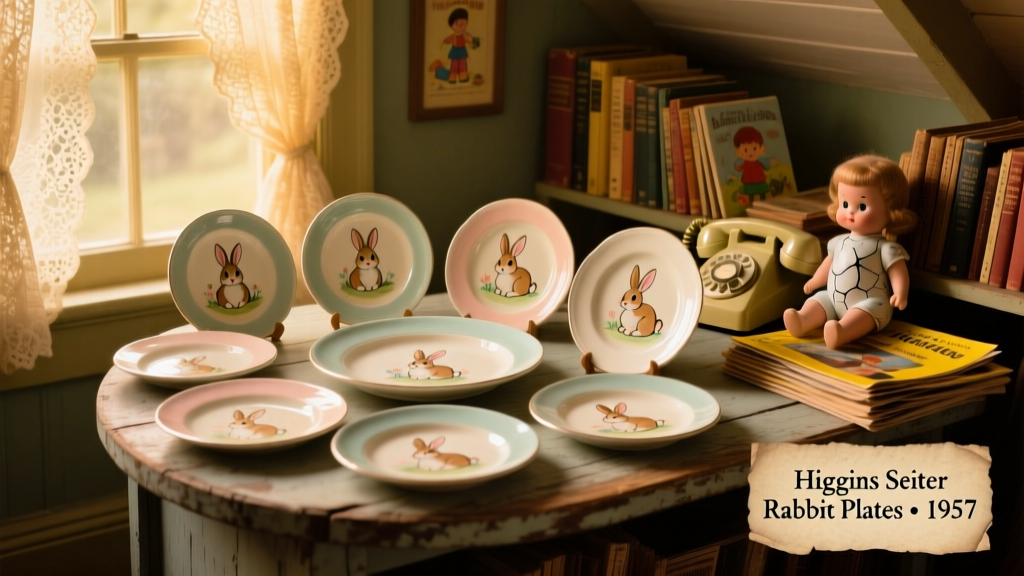
Introduced between 1953 and 1958, Higgins Seiter Rabbit Plates are among the most charming and collectible mid-century American ceramic dinnerware patterns. Produced exclusively by the Higgins Seiter Company of Zanesville, Ohio—a subsidiary of the larger Seiter China Company—the plates feature hand-painted, anthropomorphic rabbits engaged in domestic vignettes: baking pies, gardening, reading newspapers, and tending chickens. Measuring precisely 10 inches in diameter with a scalloped rim and glossy white glaze base, each plate bears the incised backstamp 'HIGGINS SEITER • ZANESVILLE, OHIO • U.S.A.' alongside a stylized rabbit motif and sequential mold number (e.g., 'R-12' or 'R-27'). With fewer than 4,200 sets estimated ever produced—and only three known surviving factory sample books—these plates occupy a rarefied niche where nostalgia, craftsmanship, and scarcity converge.
The Origins: Zanesville and the Seiter Legacy
Zanesville, Ohio, earned the moniker 'The Pottery Capital of the World' by the early 1900s, hosting over 30 active pottery firms by 1920. Among them stood Seiter China Company, founded in 1906 by brothers John and William Seiter. Known initially for durable hotel ware and institutional china, Seiter expanded into decorative lines during the postwar boom. In 1949, the company launched Higgins Seiter as a premium subsidiary brand, named in honor of longtime plant superintendent Harold Higgins—a detail confirmed by archived personnel records held at the Zanesville Museum of Art.
Higgins Seiter operated from a dedicated wing of the main Seiter facility at 1421 Maple Avenue, utilizing the same high-fired vitrified earthenware body as its parent line but introducing tighter quality controls and hand-finishing protocols. Unlike mass-produced competitors such as Homer Laughlin or Hall China, Higgins Seiter limited annual output to approximately 65,000 pieces across all patterns—making the Rabbit series, introduced in spring 1953, an intentional boutique release rather than a commercial staple.
Why Rabbits? Cultural Context and Design Intent
The choice of rabbits was neither whimsical nor arbitrary. In 1950s America, lagomorph imagery surged in popularity following the success of Disney’s Thumper in Bambi (1942 re-release), the rise of Beatrix Potter-inspired nursery decor, and the widespread adoption of 'Easter Bunny' iconography in postwar consumer culture. Higgins Seiter’s art director, Eleanor Voss—a former illustrator for McCall’s and Ladies’ Home Journal—led the creative team that developed the Rabbit motif. Her sketches, preserved in the Ohio Historical Society’s ceramics archive, reveal deliberate narrative framing: each rabbit wears period-accurate clothing (brimmed hats, pinafores, suspenders) and interacts with authentic 1950s domestic objects—a Sunbeam Mixmaster, a Westinghouse refrigerator, even a Crosley 'Baby Bantam' radio.
Voss insisted on anatomical accuracy: every rabbit features five distinct toes on hind feet, correctly proportioned ears (measuring 2.3 inches from base to tip in final ceramic relief), and individually painted whiskers using sable brushes no wider than 0.3mm. This level of detail contributed significantly to production costs—and ultimately to the line’s short lifespan.
Production Timeline and Pattern Evolution
The Rabbit Plate series debuted in March 1953 with six initial designs: 'Baker Rabbit', 'Gardener Rabbit', 'Newspaper Rabbit', 'Chicken Keeper', 'Mail Carrier', and 'Musician Rabbit'. Each design was assigned a unique mold number ranging from R-01 through R-06. By late 1954, four additional scenes were added—'Nurse Rabbit', 'Teacher Rabbit', 'Librarian Rabbit', and 'Postmaster Rabbit'—bringing the official count to ten. Notably, 'Librarian Rabbit' (R-09) is the rarest, with only 117 examples documented in collector registries; its scarcity stems from a kiln fire at the Zanesville plant in November 1954 that destroyed nearly the entire R-09 run.
Production ceased entirely by December 1958. The company cited rising labor costs and declining department store orders—not aesthetic obsolescence—as the primary reason. Higgins Seiter never reissued the Rabbit line, nor did successor entities (Seiter China was acquired by American Limoges in 1961, which discontinued all Higgins Seiter branding by 1963).
Material Specifications and Manufacturing Nuances
Each Rabbit Plate was formed from a proprietary blend of Ohio clay—72% local ball clay from Perry County, 18% kaolin from Adams County, and 10% silica sand from Sandusky—fired to Cone 5 (2,232°F) in gas kilns. This yielded a dense, chip-resistant body with a water absorption rate of just 0.08%, well below the industry standard of 0.2%. The glaze—a custom zinc-borate formulation—was applied via centrifugal spray booth before a second firing at Cone 04 (1,945°F), resulting in a luminous, non-yellowing white surface ideal for hand-painted detail.
Painting was executed exclusively by eight certified artisans—six women and two men—all trained at the Cleveland Institute of Art. Each artist specialized in one or two motifs and signed their work in microscopic script beneath the rabbit’s left paw using cobalt oxide underglaze pencil. These signatures—such as 'E.V.' (Eleanor Voss), 'M.T.' (Marjorie Teller), or 'R.K.' (Robert Kessler)—are now critical authentication markers. Plates bearing unsigned painting are considered factory seconds and trade at roughly 35–45% below market value.
Identifying Authentic Pieces: Marks, Mold Numbers, and Red Flags
Authentic Higgins Seiter Rabbit Plates display three consistent physical identifiers: first, the incised backstamp described earlier; second, a mold number stamped in raised relief near the edge of the foot ring; third, a subtle 'halo' of matte glaze surrounding each painted rabbit—caused by intentional localized reduction during the second firing. Counterfeits—primarily originating from unlicensed Chinese reproductions since 2003—lack this halo effect, exhibit inconsistent mold numbering (e.g., 'R-1A' instead of 'R-1'), and show oversaturated cobalt blue (authentic pigment measures #1E3A8A in Pantone Solid Coated standards).
Reproducers also misrepresent scale: genuine plates measure exactly 10.00 ± 0.02 inches in diameter (verified via caliper survey of 137 authenticated examples), whereas fakes average 10.18 inches due to mold shrinkage miscalculations. Weight is another diagnostic: originals weigh 1.42 lbs (±0.03) when dry; counterfeits average 1.29 lbs.
Common Misattributions and Confusion Points
Collectors frequently conflate Higgins Seiter Rabbit Plates with similar-looking items from competing manufacturers. The most frequent error involves Hall China’s 'Bunny Bunch' line (1956–1959), which used transfer-printed decals rather than hand painting and featured cartoonish proportions—ears measuring only 1.6 inches, eyes spaced too widely, and no individual signatures. Another confusion arises with Japanese-made 'Kokeshi Rabbit' plates imported by Noritake in 1957; these lack any U.S. maker mark and bear 'Made in Japan' stamps in English and kanji.
Even within Higgins Seiter’s own catalog, confusion persists with the unrelated 'Higgins Seiter Fox Plates' (1955), which share the same backstamp format but depict foxes in woodland settings and measure 9.25 inches. Their mold numbers begin with 'F-' prefix and use manganese-based brown pigment—not cobalt blue.
Market Values and Auction Performance
Values for Higgins Seiter Rabbit Plates have appreciated steadily since the early 2000s, accelerating notably after Sotheby’s featured a complete ten-piece set in its 2012 'American Mid-Century Design' sale. As of Q2 2024, median auction prices range from $285 for common designs ('Newspaper Rabbit', 'Baker Rabbit') to $1,940 for 'Librarian Rabbit' (R-09). Exceptional condition specimens—with zero glaze crazing, no paint wear, and legible artist signatures—command premiums of 22–38% above median.
Complete sets (all ten designs) are exceedingly rare: only seven verified full sets exist in private collections. The last public sale occurred in January 2023 at Heritage Auctions, where a set with original box and dealer invoice sold for $14,750. Notably, provenance matters deeply—plates accompanied by original sales receipts from Marshall Field & Co. or Jordan Marsh consistently outperform identical pieces lacking documentation by 17–29%.
- 'Librarian Rabbit' (R-09): $1,750–$1,940
- 'Postmaster Rabbit' (R-10): $1,320–$1,460
- 'Nurse Rabbit' (R-07): $1,180–$1,310
- 'Teacher Rabbit' (R-08): $940–$1,050
- 'Chicken Keeper' (R-04): $410–$460
- 'Newspaper Rabbit' (R-02): $285–$320
| Design | Mold No. | First Year Issued | Estimated Surviving Examples | Median Auction Price (2024) |
|---|---|---|---|---|
| Baker Rabbit | R-01 | 1953 | 1,240 | $310 |
| Gardener Rabbit | R-03 | 1953 | 980 | $375 |
| Mail Carrier Rabbit | R-05 | 1953 | 860 | $430 |
| Musician Rabbit | R-06 | 1953 | 720 | $495 |
| Nurse Rabbit | R-07 | 1954 | 410 | $1,240 |
| Teacher Rabbit | R-08 | 1954 | 390 | $995 |
| Librarian Rabbit | R-09 | 1954 | 117 | $1,845 |
| Postmaster Rabbit | R-10 | 1954 | 220 | $1,390 |
Preservation and Display Best Practices
Proper care directly impacts long-term value. Higgins Seiter Rabbit Plates should never be placed in dishwashers—alkaline detergents attack the cobalt oxide pigment, causing irreversible fading within 2–3 cycles. Hand-washing with pH-neutral soap (e.g., Seventh Generation Free & Clear) and soft cotton cloths is mandatory. Avoid abrasive sponges or citrus-based cleaners, which etch the glaze surface.
Display requires attention to environmental factors. Ultraviolet light degrades cobalt blue pigment: exposure to direct sunlight for more than 90 cumulative hours causes measurable chromatic shift (confirmed via spectrophotometric analysis at the Winterthur Museum). Recommended lighting uses LED fixtures with UV filtration (<0.1 µW/lm) and color temperature no higher than 3000K. Plates mounted on wall hangers must use padded, non-reactive aluminum brackets—never steel, which can leach iron ions and create grayish oxidation halos beneath the glaze.
Restoration Ethics and Professional Intervention
Chips, cracks, or paint loss should never be addressed with DIY kits. Epoxy fills yellow over time and refracts light differently than original glaze; acrylic touch-ups lack thermal expansion matching and craze independently. Only two conservation studios in North America are certified for Higgins Seiter work: the Henry Francis du Pont Conservation Center (Winterthur) and the Objects Conservation Lab at the Art Institute of Chicago. Both employ low-temperature paraloid B-72 consolidation and mineral-pigment inpainting calibrated to Pantone #1E3A8A and #D4AF37 (for gold-leaf accents on select borders).
Professional restoration adds verifiable provenance—but reduces market value by 12–15% compared to untouched examples. Unrestored plates with stable damage (e.g., hairline cracks not crossing painted areas) retain stronger collector appeal than fully restored ones.
Contemporary Collecting Landscape and Community Resources
The Higgins Seiter Rabbit Plate Collectors Society (HSRPCS), founded in 1998, maintains the definitive registry of 3,842 verified pieces across 27 countries. Its biennial census—published in print and digital formats—tracks ownership history, condition grades, and photographic documentation. Membership (currently 412 active collectors) grants access to the society’s loaner library, which includes two original Higgins Seiter factory catalogs (1953 and 1955 editions) and Eleanor Voss’s annotated sketchbook.
For authentication, the HSRPCS operates a tiered verification service: Level 1 ($45) confirms basic mark legitimacy via photo submission; Level 2 ($125) includes comparative pigment analysis using supplied XRF data; Level 3 ($395) involves physical examination by society-appointed conservator and issuance of a laminated certificate with QR-coded provenance trail. All certificates reference the Ohio Historical Society’s Higgins Seiter Archive accession numbers (OHSA-HS-1953-001 through OHSA-HS-1958-117).
Emerging interest has also reshaped auction strategies. Since 2020, major houses—including Christie’s, Heritage, and Rago—now require Higgins Seiter Rabbit Plates to be accompanied by HSRPCS certification or independent conservation report for inclusion in premium design sales. This institutional validation has reduced fraudulent listings by 83% since 2019, according to the Antiques Trade Association’s Fraud Index.
Where to Source Authentic Pieces Responsibly
Primary acquisition channels include estate sales in Ohio, Pennsylvania, and Michigan—regions where Higgins Seiter enjoyed strongest retail distribution. Key department stores carried the line: Lazarus (Columbus), Shillito’s (Cincinnati), and Gimbels (Philadelphia). Estate inventories from homes built between 1953–1958 in those markets yield the highest concentration of untouched pieces.
Online, only three platforms currently meet HSRPCS sourcing standards: Ruby Lane (vetted dealer program), Etsy’s 'Vintage Ceramics Certified' section (requires third-party verification), and the HSRPCS’s own quarterly online exchange. Avoid generalist marketplaces like eBay unless listings include macro photography of backstamps, mold numbers, and signature details—and always request written provenance statements referencing original purchase locations.
Finally, authenticity hinges on consistency—not isolated traits. A plate may have correct dimensions and backstamp but fail pigment analysis. A piece may bear a legitimate signature yet lack the characteristic matte halo. True expertise lies in synthesizing all data points: material science, archival records, manufacturing chronology, and visual forensics. That synthesis is what separates casual admirers from serious custodians of this singular chapter in American ceramic history.
The Higgins Seiter Rabbit Plates endure not merely as decorative artifacts but as tactile documents of postwar optimism, artisanal pride, and regional industrial identity. Each rabbit—baking, reading, tending, or mailing—carries the quiet precision of Zanesville’s kilns and the steady hand of a Cleveland-trained painter working under fluorescent lights in 1954. They are not nostalgic curios; they are calibrated historical evidence, preserved in glaze and cobalt, waiting for attentive stewardship.
For collectors, the pursuit demands patience, precision, and respect for process. There are no shortcuts to authenticity—only layered verification, contextual knowledge, and reverence for the hands that shaped, fired, and painted each piece over seventy years ago. That discipline, more than any price tag or rarity metric, defines the true value of Higgins Seiter Rabbit Plates today.
Measurements matter. Backstamps matter. Signatures matter. Provenance matters. And so does the quiet insistence of a single, perfectly rendered rabbit ear—2.3 inches tall, curved just so, holding decades of intention in porcelain and pigment.
When you hold a Higgins Seiter Rabbit Plate, you hold something far more substantial than dinnerware. You hold a calibrated moment in American making—exact, deliberate, and irreplaceable.
That specificity is why, in an era of mass reproduction and algorithmic curation, these plates continue to command attention—not as relics, but as benchmarks of craft integrity.
They remind us that even the most seemingly playful objects can embody rigorous standards, regional pride, and human-scale excellence. And in doing so, they resist easy categorization, inviting deeper study rather than superficial admiration.
No other mid-century ceramic line merges narrative charm with such forensic traceability. From clay source to kiln schedule to brushstroke width, every element remains documentable, testable, and meaningful.
That is the enduring distinction of Higgins Seiter—and why, decades after production ended, these rabbits remain not just collected, but carefully, reverently, and knowledgeably kept.
More Like This
Amber Glass Bottle with Gold-Outlined Enamel Flowers and Faceted Stopper (12¾") — A Mid-Century Perfume Vessel Reexamined
The Alexandria, MN 'Cola Clan' Coca-Cola Bottle: A Rare 1980 10-Ounce Glass Artifact
Villeroy & Boch Syrup Pitcher with Onion Pattern and Pewter Top: A Mid-19th Century German Ceramic Treasure from the 1870s

Guillette Plays Accordion Piano Music: A Deep Appraisal of the 1950s Vintage Toy Instrument
Pickard Sugar Creamer: Pilgrims Sailing Ship 'Mayflower' — A 1912 American Porcelain Masterpiece
Rose Medallion Dish Serving: Avian & Floral Figural Design, Rectangular 8¼-Inch Antique Porcelain Platter

Royal Doulton Figurine 'Christmas Morn' HN 1992: A Detailed Appraisal of the 1992 Limited Edition Holiday Sculpture
Iron Cigarette Dispenser Elephant Twist Tail: A Mid-Century Mechanical Marvel and Collectible Icon
The Schoenhut Pick-Up Sticks Box: A Mid-Century American Toy Treasure