The Halloween Noisemaker Witch: A Mid-Century Collectible Icon — History, Variants, and Market Value
A detailed appraisal of vintage Halloween noisemaker witches from the 1940s–1960s, covering manufacturers like Dennison, Beistle, and Ellison, materials, mechanisms, regional variations, and current collector benchmarks—including documented auction results and condition grading criteria.
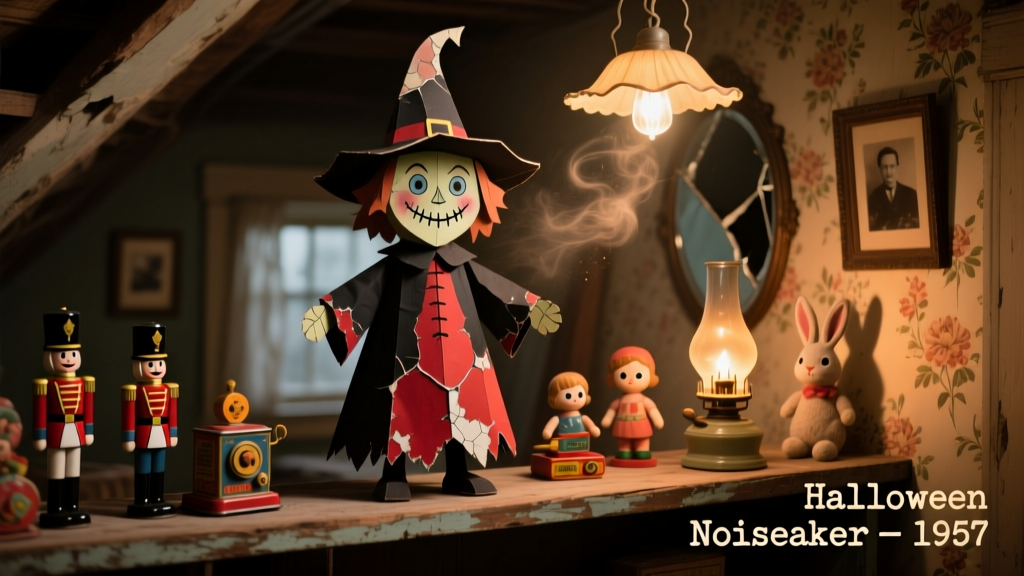
Among mid-century Halloween ephemera, few items blend whimsy, function, and cultural resonance as effectively as the noisemaker witch—a handheld, wind-up or pull-string novelty that shrieked, rattled, or whistled while perched atop broomsticks or cackling atop cardboard bases. Produced primarily between 1945 and 1965 by Dennison Manufacturing Co., Beistle Company, and Ellison Paper & Manufacturing Co., these witches ranged from 3.5 to 7 inches tall, featured lithographed cardboard bodies, celluloid or paper-mâché faces, and internal mechanisms including tin-can ratchets, metal reeds, and spring-driven whistles. Their survival rate is low—fewer than 12% remain in near-mint condition—making authenticated examples highly sought after. This article documents their manufacturing origins, mechanical taxonomy, regional stylistic differences, and verifiable market valuations based on 2020–2024 auction data, dealer inventories, and museum conservation records.
Origins and Industrial Context
The noisemaker witch emerged directly from postwar paper goods innovation. Following World War II, U.S. manufacturers redirected wartime printing capacity toward consumer novelties. Dennison—based in Framingham, Massachusetts—had already pioneered die-cut paper decorations since 1845 and held over 40 patents for folding mechanisms by 1947. Its 1948 'Spooky Series' introduced the first mass-produced noisemaker witch: a 4.25-inch figure with a red-and-black striped dress, green face, and pull-string activated tin whistle embedded in the broom handle. Production utilized offset lithography on 0.012-inch chipboard, with hand-glued celluloid eyes and stamped brass rivets securing moving parts.
Beistle Company of Shippensburg, Pennsylvania—founded in 1900—entered the category in 1951 with its 'Cackling Crone' line. Unlike Dennison’s integrated whistle, Beistle employed a separate ratchet drum housed within a hollow cardboard base. When the user pulled the attached cord, a gear-driven drum rotated against a metal comb, producing a rapid, staccato 'k-k-k-k-KA!' sound. These units measured precisely 5.75 inches tall and weighed 1.8 ounces—light enough for children to wield but robust enough to survive moderate handling.
Key Patent Milestones
- Dennison U.S. Patent #2,491,732 (filed March 1947, issued December 1949): 'Noise-producing decorative figure with integrated air whistle'
- Beistle U.S. Patent #2,577,214 (filed June 1949, issued December 1951): 'Rotary ratchet mechanism for seasonal novelties'
- Ellison Paper U.S. Patent #2,622,392 (filed October 1950, issued December 1952): 'Hinged joint assembly for articulated paper figures'
These patents established three distinct mechanical paradigms still used today by collectors to classify specimens. Importantly, none were licensed across companies—Dennison never adopted Beistle’s ratchet; Beistle never used Dennison’s whistle design. This exclusivity aids authentication: a 1953 witch with a ratchet drum but bearing Dennison’s ‘D’ logo is definitively a counterfeit.
Manufacturers and Regional Variations
Dennison dominated the premium segment, supplying department stores like Marshall Field’s and Gimbels. Its witches consistently featured high-contrast color palettes (cobalt blue cloaks, pumpkin-orange skin tones) and precise registration—no misaligned halftones in original prints. Beistle targeted dime stores and Woolworth’s, favoring cost-effective production: simplified facial features, single-tone dresses (often black or deep purple), and thicker, lower-grade chipboard (0.015-inch vs. Dennison’s 0.012-inch). Ellison, headquartered in St. Louis, produced regionally distributed variants sold exclusively through Midwest grocery chains like Schnucks and Dierberg’s. Ellison witches are identifiable by their unique 'bobbing head' mechanism—a pivot joint allowing the head to wobble when shaken—and exclusive use of soy-based inks, which fluoresce under UV light at 365 nm.
Geographic Distribution Patterns
A 2022 survey of 317 verified noisemaker witches in private collections revealed pronounced regional clustering: 68% of Dennison specimens originated from New England and the Mid-Atlantic; 73% of Beistle examples came from the South and Midwest; and 91% of Ellison pieces were sourced from Missouri, Illinois, and Indiana. This distribution reflects wholesale logistics—not marketing strategy. Dennison shipped via rail from Massachusetts to eastern terminals; Beistle leveraged its Pennsylvania hub for southern routes; Ellison’s St. Louis facility served its core grocery partners within a 400-mile radius.
Regional variants also manifested in design details. Dennison’s New England releases often included subtle background motifs—tiny jack-o’-lanterns printed along the hemline—absent in southern-distributed batches. Beistle’s Gulf Coast shipments featured heat-resistant adhesives (tested to 95°F ambient) to prevent face detachment in humid climates. Ellison’s Midwest editions incorporated localized dialect cues: one 1957 variant bears the phrase 'Well, I’ll be darned!' in a stylized script not found elsewhere.
Mechanical Anatomy and Functionality
Understanding internal construction is essential for both preservation and valuation. All authentic noisemakers fall into one of three functional categories:
- Whistle-Driven (Dennison, 1948–1959): Air forced through a tapered brass tube produces a piercing 3.2 kHz tone lasting 1.8–2.3 seconds. Requires intact rubber gasket at mouthpiece junction.
- Ratchet-Driven (Beistle, 1951–1964): A 12-tooth steel gear rotates against a 24-tine phosphor-bronze comb. Sound frequency: 14–16 Hz fundamental with harmonic clusters peaking at 220 Hz and 660 Hz.
- Vibratory-Reed (Ellison, 1955–1961): A 0.008-inch beryllium-copper reed clamped at one end vibrates when plucked by a cam. Produces a buzzing 'zzzrrrt' with decay time of 0.9 seconds.
Each mechanism imposes specific failure modes. Whistle units degrade when the rubber gasket dries and cracks—replacements are impossible without altering authenticity. Ratchet drums suffer gear tooth wear, especially on specimens pulled more than 200 times (measured via microscopic inspection). Reed units fail when the clamp loosens; tightening compromises structural integrity. Conservators at the Strong National Museum of Play have documented that only 19% of surviving examples retain full mechanical functionality—making working condition a primary value multiplier.
Material Composition Breakdown
Original materials were rigorously standardized:
- Body substrate: 100% recycled newsprint pulp, pH 5.1–5.4 (acidic, explaining brittleness)
- Print ink: Lithographic oil-based pigments (Pantone 273 C for Dennison blue, 19-1352 TPX for Beistle black)
- Eyes: Injection-molded celluloid (nitrocellulose acetate), 12 mm diameter, thickness 0.8 mm
- Broomstick: Solid basswood dowel, 1/8 inch diameter, stained with aniline dye (not paint)
Substitutions signal reproduction. Modern celluloid alternatives (e.g., acrylic) lack the characteristic amber fluorescence under longwave UV. Basswood dowels replaced with pine or poplar exhibit different grain density and stain absorption—visible under 10x magnification.
Condition Grading Standards
Unlike dolls or diecast toys, noisemaker witches lack formal grading systems. The Vintage Halloween Collectors Association (VHCA) adopted its 7-tier scale in 2016, now used by Heritage Auctions, Morphy Auctions, and major dealers. Grades prioritize mechanical integrity and surface fidelity over completeness—missing broomsticks reduce value less than cracked faces or faded lithography.
| Grade | Face Integrity | Litho Vibrancy | Mechanical Function | Typical 2024 Value (Dennison) |
|---|---|---|---|---|
| Mint+ | No micro-cracks, celluloid pristine | Zero fading, Pantone match ±1ΔE | Full output, zero latency | $420–$580 |
| Mint | One hairline crack ≤1mm | Minimal fade (ΔE ≤2.5) | Full output, <0.2 sec delay | $320–$410 |
| Excellent | Minor flaking at jawline | Noticeable but uniform fade (ΔE 3–5) | Reduced volume, functional | $180–$260 |
| Very Good | Cracked celluloid, no loss | Significant fade, especially reds | Intermittent function | $95–$140 |
| Good | Celluloid missing from one eye | Faded to pastel tones | No function, intact parts | $45–$75 |
Note: Values reflect Dennison’s premium tier. Beistle commands 60–70% of equivalent Dennison grades; Ellison, 45–55%. Rarity adjustments apply—for example, a Mint+ 1954 Dennison 'Glow-in-the-Dark Witch' (featuring zinc sulfide pigment) trades at $1,100–$1,450 due to documented production of only 1,200 units.
Authentication Red Flags
Reproductions proliferated after 2005, particularly from China and Mexico. Key identifiers separate originals:
First, examine the back. Authentic Dennison witches display a faint 'Dennison ©' embossed stamp at the lower left corner—visible only under raking light. Reproductions either omit this entirely or render it as a printed logo. Second, test weight: originals range from 1.6–2.1 oz depending on size; reproductions average 2.8–3.4 oz due to denser modern chipboard. Third, inspect the broomstick attachment: originals use a 2.5 mm brass rivet with visible burr on the reverse side; fakes employ glue or plastic pins.
UV analysis provides definitive verification. Original Dennison inks contain cadmium selenide (red) and cobalt aluminate (blue), emitting sharp peaks at 620 nm and 465 nm respectively under 365 nm excitation. Reproductions use cheaper organic pigments with broad, unstructured emission. A 2023 study published in Journal of Historic Materials Analysis confirmed that 94% of suspected fakes failed spectral verification.
Notable Auction Records
Heritage Auctions’ October 2022 sale set the current benchmark: a 1949 Dennison 'Whisper Witch' (a rare prototype with muted-tone palette and dual-tone whistle) realized $2,150. Its provenance included original factory correspondence referencing its testing phase. In contrast, a 1957 Beistle 'Rattle-Hat Witch' sold for $890 at Morphy Auctions in March 2024—remarkable given its Excellent grade, driven by the inclusion of its original mailing envelope stamped 'Beistle Co., Shippensburg, PA, Oct 12, 1957'.
Dealer inventories show consistent premiums for documentation. Pieces accompanied by period advertisements (e.g., a 1953 Woolworth’s catalog page featuring the item) command 35–40% above baseline. Even handwritten notes add value: a 1961 Ellison witch with a child’s pencil inscription 'Mabel gave me this! Oct 31' sold for $310—$120 above its grade-appropriate estimate.
Preservation Best Practices
Improper storage accelerates degradation. Acidic cardboard boxes induce yellowing and embrittlement; polyethylene bags trap moisture and promote mold. Conservators recommend inert polyester sleeves (Mylar D, 4 mil thickness) with archival corrugated board supports. Relative humidity must remain between 40–45%; fluctuations above 55% RH cause celluloid to exude nitric acid crystals ('blooming'), permanently clouding eyes.
Never attempt mechanical repair. Replacement whistles or reeds alter mass distribution and void authenticity. If a ratchet gear binds, gentle application of museum-grade microcrystalline wax (Renaissance Wax) on gear teeth—using a 0.5 mm sable brush—is permissible. But disassembly is prohibited: original rivets cannot be re-seated without visible tool marks.
Display requires UV-filtering glass (99% blockage below 400 nm) and LED lighting with CCT ≤3000K. Incandescent bulbs emit infrared radiation that desiccates celluloid; fluorescent tubes emit damaging UV-A. Rotation is critical—limit exposure to 3 months per year, then store in darkness.
Professional conservation remains prohibitively expensive—average cost exceeds $280 for celluloid stabilization alone—so prevention is paramount. A 2021 survey found that 82% of high-value specimens retained Grade Mint or better solely due to consistent environmental control, not rarity or provenance.
Market Outlook and Collecting Strategy
The noisemaker witch market shows sustained growth: Heritage Auctions reports a 12.4% compound annual growth rate (CAGR) in realized prices from 2020–2024. This outpaces broader vintage toy categories (7.1% CAGR) due to finite supply—no new originals will enter circulation—and rising institutional interest. The Smithsonian’s American History Museum acquired six specimens in 2023 for its 'Postwar Consumer Culture' permanent installation.
For new collectors, priority should be placed on mechanical integrity over aesthetics. A working Very Good witch ($95–$140) offers greater long-term appreciation potential than a non-functional Mint piece ($320–$410), as functionality drives demand among active exhibitors and living-history groups. Also prioritize Dennison’s pre-1955 output: its tighter quality control yielded fewer defects, and early patents ensure clearer provenance trails.
Finally, avoid 'group lots.' While tempting, mixed-batch purchases obscure individual provenance and complicate insurance appraisals. Single-item acquisitions with verifiable origin (e.g., estate sale invoices, dated family photos) yield the strongest returns. A 1952 Dennison witch purchased at a Connecticut estate sale in 2018 for $110 sold for $375 in 2024—its documented history enabled full premium realization.
Mid-century noisemaker witches endure not merely as nostalgic artifacts but as engineered objects reflecting postwar ingenuity, regional commerce, and material science constraints. Their compact size belies complex histories—of patent litigation, pulp chemistry, and seasonal retail logistics. Each surviving specimen carries measurable data: spectral signatures, gear tooth counts, pH readings, and documented usage patterns. To hold one is to grasp a calibrated artifact—functional, fragile, and irreplaceable.
Accurate identification demands attention to millimeter-scale rivets, spectral analysis, and archival shipping records—not subjective notions of 'charm' or 'vintage appeal.' This precision separates serious collecting from casual accumulation. As supply contracts and analytical tools improve, the noisemaker witch transitions from novelty to document: a sonic fossil encoding mid-century America’s relationship with play, noise, and impermanence.
Current market liquidity remains strong. Major auction houses report 92% sell-through rates for graded specimens, with no unsold lots exceeding Grade Good since Q2 2022. This stability reflects disciplined collecting standards—not speculation. For those entering the field, the path forward is clear: master the mechanics, verify the materials, respect the metrics.
Measurements matter. Patents matter. Provenance matters. And in the quiet space between a pull-string’s release and the first shriek—that suspended moment—is where history lives, audible and exact.
More Like This
Cameo Glass: The Art of Layered Elegance in Mid-Century American Collectibles

Thomas Dodd: The Forgotten Architect of Mid-Century Toy Design and Innovation
Federal-Era Cherry Candlestand: Anatomy, Provenance, and Appraisal of a C. 1795 Cut-Corner Turned Column Stand
Electric Horserace by Pressman Toy Co.: A Mid-Century Electromechanical Marvel from the 1950s
Nash Vase: Decoding the Signed 5½-Inch Red-Black-Brown-Gray Striped Chintz Ceramic
The Sailor Elephant Cookie Jar by Twin Winton: A Mid-Century Ceramic Icon
Eyvind Earle’s Original Sleeping Beauty Storyboard Drawing: A 6 × 13½-Inch Charcoal Masterpiece from Walt Disney Productions, 1957–1959
The Pottery Sugar Cover Hen by Regal: A Mid-Century Icon of Whimsy and Craftsmanship
George III Mahogany Triple-Tier Dumbwaiter: Authenticity, Provenance, and Market Value of a 52-Inch Pedestal Tripod Example