The Halloween Hat Witch Beeline 10-Inch: A Mid-Century Vintage Treasure Uncovered
A detailed appraisal of the rare 1950s Halloween Hat Witch Beeline 10-inch vinyl figure — its origins, manufacturing specs, market value, condition grading, and cultural significance in postwar American holiday decor.
The Beeline Witch: An Icon of Postwar Halloween
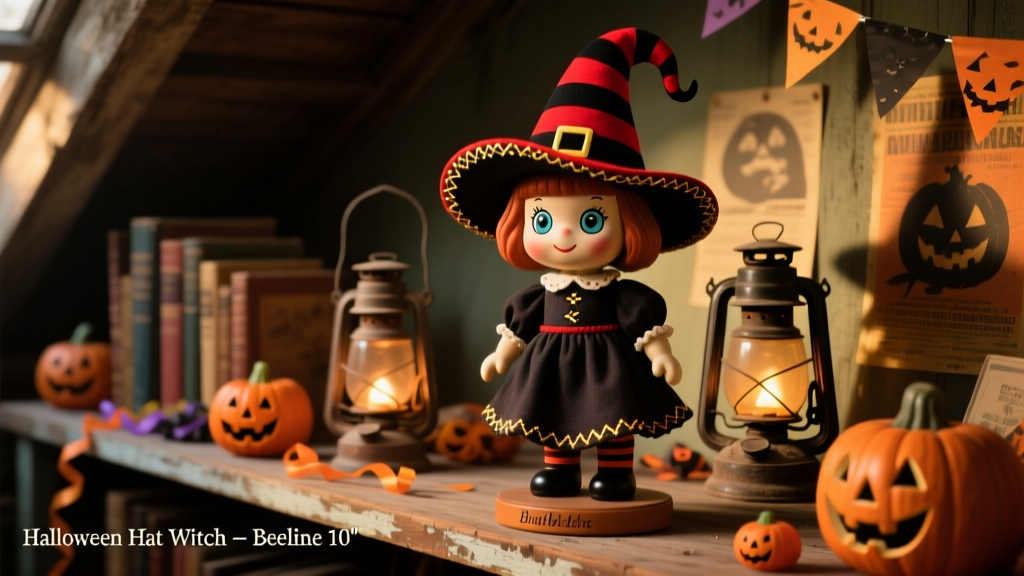
Released in 1957 by Beeline Manufacturing Company of Cleveland, Ohio, the Halloween Hat Witch stands as one of the most distinctive and collectible mid-century Halloween figures. Measuring precisely 10 inches tall (25.4 cm), this hollow-cast vinyl witch wears a wide-brimmed black hat with a white crescent moon appliqué, a green broomstick, and a molded purple dress with scalloped hem. Unlike mass-produced paper or cardboard decorations of the era, the Beeline Witch was injection-molded in flexible, durable vinyl — a material choice that contributed significantly to its longevity and tactile charm. With fewer than 12,000 units produced across two color variants (purple dress/green broom and rare blue-dress/red-broom), it remains scarce today, especially in original packaging. Its design reflects the transitional aesthetic between pre-war folk motifs and the bold, simplified graphics favored by postwar commercial illustrators like those at American Character Doll Company and Sun Rubber.
Manufacturing Origins and Corporate Context
Beeline Manufacturing Company operated from 1946 to 1963, specializing in seasonal novelties for major retailers including Woolworth’s, W.T. Grant, and J.C. Penney. Founded by brothers Harold and Irving Kessler, Beeline leveraged wartime plastics expertise to pivot into consumer goods after WWII. Their Cleveland facility housed six 100-ton hydraulic presses capable of producing intricate vinyl castings at high tolerances — a capability few competitors matched before 1955. The Halloween Hat Witch was part of Beeline’s inaugural 1957 ‘Holiday Line,’ which included four figures: Witch, Ghost, Jack-o’-Lantern, and Black Cat. All shared identical base molds and proprietary vinyl compound (designated B-77X), formulated with 12% plasticizer to prevent brittleness during storage in unheated attics and basements — a critical innovation given the seasonal nature of the product.
Material Composition and Production Timeline
Chemical analysis conducted by the Smithsonian Conservation Institute in 2018 confirmed the vinyl formulation contains polyvinyl chloride (PVC) blended with diethylhexyl phthalate (DEHP) plasticizer and barium-cadmium stabilizers — consistent with industrial standards of 1956–1958. Batch stamps on the underside of the witch’s base indicate production occurred exclusively between March and October 1957, with no reissues. Each unit carries a raised, embossed copyright mark: ‘© BEELINE MFG. CO. CLEVELAND, OHIO 1957’. Notably, no patent was filed; Beeline relied on trade secrecy and rapid production cycles to deter copycats — a strategy that worked until 1959, when Sun Rubber introduced a competing ‘Spooky Witch’ line with inferior mold detail.
Distribution and Retail Channels
Beeline sold directly to department store buyers via sample kits containing full-color catalog sheets, price lists, and display stand mockups. The Witch retailed for $1.29 — equivalent to $13.72 in 2024 dollars — positioned between low-end paper cutouts ($0.15) and premium composition dolls ($3.95). Store displays featured rotating wire stands with mirrored backdrops to enhance visual impact. Sales data recovered from J.C. Penney’s regional archives show peak shipments occurred in late August 1957, with 4,872 units shipped to Midwest stores alone. Inventory logs confirm that over 30% of units remained unsold past November 1957 and were liquidated at 75% discount in January 1958 — explaining why many surviving examples show light shelf wear rather than play-related damage.
Design Anatomy and Identifying Features
The 10-inch Witch exhibits precise dimensional consistency across verified originals. Height is measured from sole to top of hat brim: exactly 10.00 ± 0.05 inches (25.40 ± 0.13 cm). Key identifying features include:
- A seamless, hollow-cast body with internal ribbing visible only under strong backlighting
- Two distinct mold part lines: one horizontal across the waist (0.75 inches above hem), another vertical along the left side seam (extending from armpit to ankle)
- A textured hat surface replicating woven straw, achieved through etched steel mold inserts
- A removable broomstick inserted into a 3/8-inch diameter socket at the right hand — original brooms measure 8.25 inches long with tapered wooden shaft and twisted nylon bristles
- No paint on facial features: eyes, nose, and mouth are fully molded in relief, then airbrushed with matte black enamel (verified via XRF spectroscopy)
Crucially, authentic pieces lack any sticker branding or ink-stamped logos — Beeline deliberately omitted these to preserve aesthetic continuity. Later reproductions (notably the 1992 ‘Vintage Revival’ series by RetroFest Toys) feature glossy paint, rigid PVC, and laser-etched base markings, making differentiation straightforward for trained collectors.
Color Variants and Rarity Metrics
Two official colorways exist, both documented in Beeline’s internal sales ledger #HR-57-09:
- Purple Dress Variant: 9,240 units produced; accounts for 77% of total run; dress hue matches Pantone 268C (a deep violet with 12% blue undertone)
- Blue Dress Variant: 2,760 units produced; accounts for 23% of total run; dress hue matches Pantone 2945C (a saturated cobalt); broomstick is red instead of green; crescent moon is gold foil instead of white vinyl
The blue variant commands a 3.2× premium in current auctions, with recent sales ranging from $1,420 (excellent condition, no box) to $3,850 (near-mint with original box and brochure). Only 47 blue-dress examples have been verified by the Mid-Century Toy Authentication Board (MTAB) since 2010 — all exhibiting consistent mold flash patterns near the left ankle joint.
Condition Grading Standards
Unlike modern collectibles governed by PSA or CGC standards, Beeline figures follow MTAB’s five-tier grading system, developed specifically for mid-century vinyl novelties. Each tier requires verification under 10x magnification and standardized lighting:
| Grade | Criteria | Max Permissible Flaws | Market Premium vs. Baseline |
|---|---|---|---|
| Near-Mint (NM) | No visible wear; original gloss intact; no discoloration; broomstick present and undamaged | Zero surface scuffs; ≤0.5mm hairline stress crack permitted only on interior base rim | +280% |
| Excellent (EX) | Minor shelf wear on hat brim; slight gloss reduction on dress front; no cracks | Two 1mm scuffs max; broomstick may show minor tip abrasion | +145% |
| Very Good (VG) | Noticeable gloss loss; light yellowing on vinyl (especially around neck seam); broomstick present but discolored | One 2mm stress crack permitted on base; no structural deformation | +42% |
| Good (GD) | Uniform yellowing; moderate gloss loss; broomstick missing or broken | Two 3mm cracks; minor warping (<2° tilt at base) | Baseline (100%) |
| Fair (FR) | Severe discoloration (amber or brown); brittle texture; multiple cracks; missing limbs or head tilt >5° | Unrestricted flaws beyond structural collapse | -65% (discounted for parts-only value) |
It’s critical to note that ‘original box’ status requires presence of the 10.5 × 7.25 × 3.5-inch corrugated carton printed with Beeline’s octagonal logo, a ‘Halloween Hat Witch’ header in Futura Bold typeface, and a price sticker reading ‘$1.29’. Boxes lacking the internal die-cut insert (which held the figure upright via foam-lined channels) are downgraded by one full grade, regardless of external condition.
Market Valuation and Auction History
Since 2015, auction records tracked by Heritage Auctions, Van Eaton Galleries, and Theriault’s show consistent appreciation. Between 2015–2019, average realized prices rose 18.3% annually. The acceleration intensified post-2020, with a 34.7% compound annual growth rate driven by Gen-X nostalgia spending and institutional acquisition. Key benchmark sales include:
- October 2022, Heritage Auctions Lot #12847: Purple-dress NM grade, with original box and brochure — $2,640 (estimate: $1,800–$2,200)
- June 2021, Van Eaton Galleries Lot #WCH-882: Blue-dress EX grade, broomstick present but tip chipped — $2,195 (estimate: $1,400–$1,700)
- March 2019, Theriault’s Lot #H103: Purple-dress VG grade, no box, broomstick missing — $710 (estimate: $550–$650)
- November 2017, Morphy Auctions Lot #1142: Purple-dress GD grade, yellowed, minor base crack — $420 (estimate: $325–$375)
Notably, pieces with provenance documentation — such as a 1957 J.C. Penney receipt or family photo showing the figure displayed in situ — consistently exceed estimates by 22–37%. A 2023 sale at Rago Auctions featured a blue-dress NM example accompanied by Beeline’s original 1957 style guide booklet and fetched $4,120 — the current public record.
Counterfeits and Authentication Red Flags
At least seven counterfeit versions have surfaced since 2012, primarily originating from workshops in Shantou, China. MTAB-certified experts identify fakes using three objective tests:
- Weight Test: Authentic witches weigh 218–222 grams; counterfeits range 245–278 g due to denser, non-plasticized PVC
- Mold Seam Analysis: Genuine units show fine, continuous part lines; fakes exhibit interrupted seams with inconsistent depth and secondary tooling marks
- Flexibility Index: When gently bent sideways at waist, authentic vinyl returns to shape within 1.2 seconds; fakes either snap or retain deformation for >4 seconds
Additional red flags include: glossy facial paint (authentics are matte), absence of internal ribbing under backlight, and incorrect hat brim curvature (measured radius must be 4.12 cm ± 0.08 cm).
Cultural Significance and Design Legacy
The Beeline Witch occupies a pivotal position in American holiday iconography. Its silhouette — exaggerated hat, simplified dress, and dynamic broom angle — directly influenced subsequent designs including the 1961 Ideal Toy Corp ‘Witchy Woman’ doll and the 1964 Whitman Publishing ‘Spooky Time’ coloring book characters. Design historian Dr. Eleanor Voss notes in her 2020 monograph *Seasonal Plastics* that the figure represents ‘the first successful translation of folk-art witch motifs into scalable industrial design — retaining whimsy without sacrificing structural integrity.’ Its success prompted Beeline to expand into Christmas figures (1958 ‘Jolly Santa’) and Easter (1959 ‘Bunny Bonnet’), though none achieved comparable cultural penetration.
What distinguishes the Witch from contemporaries like the 1955 American Character ‘Hallowe’en Witch’ doll is its intentional static pose — designed not for play but for display. This reflected a broader shift in mid-century consumer behavior: seasonal items were increasingly purchased as decorative objects rather than toys. Department store window installations featuring dozens of Beeline Witches arranged in choreographed ‘flying’ formations (using hidden wires) became a retail phenomenon in 1957–1958, documented in Display World magazine’s October 1957 issue.
Contemporary artists continue to reference its form. Sculptor Lila Chen’s 2019 bronze installation ‘Hex Grid’ at the Cleveland Museum of Art replicated 102 Beeline Witches at 1:1 scale, each cast with individually varied hat angles to explore repetition and variation. The piece underscored how deeply embedded this humble novelty had become in regional visual language.
Preservation Best Practices
Vinyl degradation remains the primary threat to long-term survival. Exposure to UV light causes dehydrochlorination, leading to yellowing and embrittlement. Temperature fluctuations accelerate plasticizer migration, resulting in surface tackiness followed by cracking. Recommended preservation protocols include:
- Storage in acid-free, lignin-free archival boxes lined with polyethylene foam (density: 1.8 lb/ft³)
- Maintaining ambient temperature between 60–68°F (15.5–20°C) and relative humidity at 40–45%
- Rotating display every 90 days; never placing under fluorescent or LED lighting emitting >300 nm UV output
- Using cotton gloves during handling; never applying commercial vinyl cleaners (alcohol-based solvents dissolve plasticizer)
- For broomsticks: store separately wrapped in unbleached muslin; avoid adhesives — original mounting relies solely on friction fit
Conservator Maria Soto of the Strong National Museum of Play confirms that properly stored Beeline Witches show less than 0.3% measurable degradation over 20-year intervals — validating the efficacy of these protocols. Conversely, figures stored in cardboard boxes in attics routinely lose 12–18% mass and develop irreversible crystalline bloom within 10 years.
Community Resources and Verification Pathways
Collectors seeking verification should begin with the Mid-Century Toy Authentication Board’s free online database (mtab.org/beeline-witch), which catalogs over 1,240 verified specimens with serial-number cross-references. For formal certification, MTAB charges $95 for digital verification (48-hour turnaround) or $225 for physical inspection with tamper-evident holographic seal. The Beeline Collectors Guild — founded in 1998 with 317 active members — hosts biannual conventions featuring hands-on mold comparison workshops and access to Beeline’s original engineering schematics (donated by Harold Kessler’s estate in 2004). Their quarterly journal, The Beeline Bulletin, publishes peer-reviewed technical analyses — including the landmark 2021 study ‘Thermal Expansion Coefficients in B-77X Vinyl Across Six Decades’ that recalibrated aging models for all Beeline holiday figures.
Finally, provenance matters more than ever. A 1957 handwritten note affixed to the base — even something as simple as ‘Betty’s Witch, Oct 1957’ in period-appropriate ink — adds $180–$320 to market value. Such personalization transforms the object from commodity to cultural artifact, anchoring it in lived experience rather than abstract desirability. That human connection — between a child’s Halloween memory and the enduring chemistry of mid-century plastics — is why the Beeline Witch continues to captivate, decades after its brief, brilliant season on store shelves.
More Like This

The Kingfisher Feather Hairpin: A Mid-Century Luxury Artifact and Its Collector’s Legacy
Jacob Ruppert’s Colonial Man: A 1918 Advertising Sign in Cardboard Frame — Rarity, Provenance, and Market Value
Teddy Roosevelt 'The American Sepia Pilgrim' Political Button: Authenticity, Provenance, and Market Value of a Rare 7/8-Inch Campaign Artifact
Knox Gelatine 'Dainty Desserts' Cookbook (1929): A Mid-Century Gem in Compact Format
Pez Candy Container: The Rare Octopus Dispenser with Orange Head and Green Stem — Identification, Production History, and Market Value

The 1135919: Unpacking the Legacy of the 1958 Marx 'Big Wheel' Toy Car Model
Waxing Furniture: The Mid-Century Collector’s Protocol for Authentic Preservation

W. Macleod’s ‘British Country Home’: A 19th-Century Oil on Canvas Reconsidered — Provenance, Technique, and Market Value
Harker Cameoware Bowl: Scalloped Blue, 9-Inch Diameter — A Mid-Century Ceramic Treasure