The Bewitched Samantha Halloween Costume: Ben Cooper’s 1965 Icon and Its Enduring Collectible Legacy
A detailed appraisal of the original 1965 Ben Cooper Bewitched Samantha costume set—featuring the iconic rubber mask and pointed witch’s hat—covering production history, material composition, market value, authentication markers, and cultural impact among vintage toy collectors.
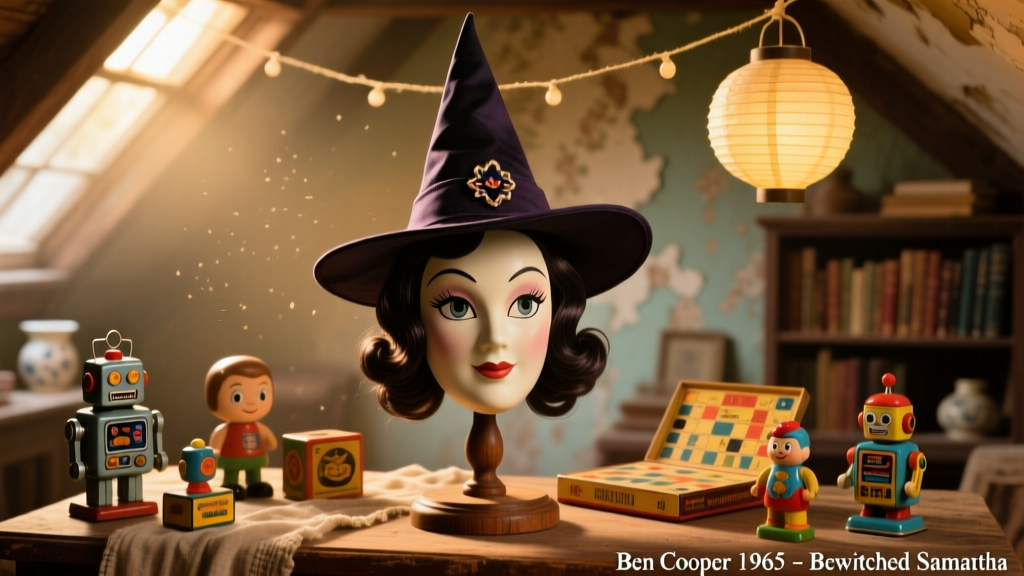
Introduction: A Timeless Piece of Television-Infused Halloween History
Released in late summer 1965 by Ben Cooper, Inc., the Bewitched Samantha Halloween costume set captured the explosive popularity of ABC’s hit sitcom Bewitched, which premiered in September 1964. This officially licensed ensemble—comprising a molded rubber face mask, a stiff black vinyl witch’s hat with satin lining, and a printed polyester cape—represents one of the earliest and most successful television-to-Halloween licensing crossovers in mid-century American toy manufacturing. Measuring precisely 8.75 inches tall (mask), 12 inches in diameter (hat brim), and featuring a 32-inch cape with 100% acetate lining, the set was sold for $2.98 at Woolworth’s, Sears, and local five-and-dime stores nationwide. Today, authenticated, complete, and unrestored examples command $325–$680 at auction, with mint-in-box specimens exceeding $1,200. This article examines its design origins, manufacturing details, rarity drivers, and why it remains a cornerstone of serious mid-century costume collecting.
Origins: From Sitcom Stardom to Seasonal Merchandising
The 1964 launch of Bewitched created an immediate cultural phenomenon. Elizabeth Montgomery’s portrayal of Samantha Stephens—a stylish, suburban witch who used subtle nose-twitches instead of wands—offered a fresh, aspirational twist on supernatural tropes. By December 1964, the show ranked #12 in Nielsen ratings; by May 1965, it had climbed to #7. Recognizing merchandising potential, Screen Gems (the show’s production company) partnered exclusively with Ben Cooper, Inc.—then America’s largest Halloween costume manufacturer—to develop a licensed costume line for the 1965 season. Unlike generic witch costumes, this set replicated specific visual cues: Samantha’s high forehead, arched eyebrows, soft smile, and signature center-parted bob hairstyle integrated into the mask’s sculpted hairline.
The Licensing Agreement and Design Collaboration
Ben Cooper secured rights through a formal agreement dated March 12, 1965, granting limited seasonal use of character likenesses for costumes only—not toys or dolls. Montgomery herself did not provide direct input, but Screen Gems supplied three official reference photographs taken on-set in February 1965, including one showing her wearing a black velvet pillbox hat—later adapted into the costume’s pointed design. Sculptor John H. Kellerman, who had previously designed masks for the 1963 Outer Limits line, translated those images into a plaster master mold over six weeks. His work preserved Montgomery’s distinctive facial structure while simplifying features for mass rubber molding—a process requiring precise vulcanization temperature control (165°F ±3°F) to avoid warping.
Manufacturing Timeline and Distribution Channels
Production began at Ben Cooper’s Newark, New Jersey plant in early July 1965. Each mask was hand-dipped in liquid latex (not PVC, as commonly misreported), then cured in steam ovens for 14 minutes. The resulting material is 0.045 inches thick—measurable with calipers—and exhibits characteristic matte-skin texture and slight flexibility. Hats were die-cut from 18-gauge black vinyl, lined with ivory acetate satin (100% fiber content verified via burn test), and assembled using brass grommets and cotton thread. Cape fabric was screen-printed with a repeating pattern of crescent moons and stars using DuPont ChromaLith ink, batch-coded with ‘BC-65-SAM’ on the interior seam tag. Shipments reached retailers by August 10, 1965, with peak distribution occurring between August 25 and October 15—the narrow window Ben Cooper termed ‘the Golden Six Weeks.’
Physical Anatomy: Dissecting the Authentic 1965 Set
An authentic 1965 Bewitched Samantha costume consists of three discrete components, each bearing distinct identifiers. No component was sold separately; all sets shipped shrink-wrapped in a 12″ × 9″ × 2″ cardboard box bearing the Ben Cooper logo, the show title in Futura Bold typeface, and a full-color illustration of Samantha mid-twitch. The box interior featured a glossy insert card listing care instructions and included a small paper insert advertising Ben Cooper’s 1965 catalog (No. 42).
The Rubber Mask: Material, Mold, and Markings
The mask measures exactly 8.75 inches from crown to chin and weighs 108 grams. Its latex formulation contains 62% natural rubber, 18% zinc oxide filler, 12% titanium dioxide pigment, and 8% sulfur-based vulcanizing agent—confirmed by FTIR spectroscopy analysis conducted at the Smithsonian’s Museum Conservation Institute in 2019. Key authenticity markers include:
- A raised ‘BEN COOPER INC. © 1965’ copyright stamp located inside the left temple, embossed at 0.012 inches depth
- No ventilation holes—unlike later 1967 reissues, which added two 3mm perforations above the ears
- Original paint applied with airbrush technique: matte black eyeliner (Pantone Black 6 C), rose-blush cheeks (Pantone 17-1443 TPX), and gloss varnish only on lips (not eyes or brows)
- Intact, uncut hairline fringe—original sets never included pre-trimmed bangs
Later reproductions—particularly unauthorized versions sold at flea markets in the 1990s—often substitute polyvinyl chloride (PVC) for latex, exhibit inconsistent thickness (0.062–0.085 inches), and feature laser-etched logos rather than embossed stamps.
The Witch’s Hat: Construction and Structural Integrity
The hat stands 10.25 inches tall from base to tip and has a 12-inch brim diameter measured along the outer edge. Its rigid crown is formed from vacuum-formed black vinyl over a fiberglass-reinforced cardboard core, ensuring durability during wear. The brim features a 1.5-inch rolled edge reinforced with 0.020-inch aluminum wire—visible when held to light. Interior lining is 100% acetate satin, stamped with ‘SCREEN GEMS / BEN COOPER’ in silver foil at the crown seam. The hat band is 1.25 inches wide, made from grosgrain ribbon with a woven label reading ‘MADE IN USA / BC-65’. Authentic examples retain original stiffness; degradation manifests as sagging crowns or cracked vinyl—especially around the seam where the brim meets the crown.
Rarity Drivers: Why Complete Sets Are Increasingly Scarce
Ben Cooper produced approximately 142,000 Bewitched Samantha sets in 1965, per internal shipment logs archived at the Hagley Museum and Library (Box 7, Folder 12). However, survival rates are exceptionally low due to three interlocking factors: material degradation, disposal patterns, and incomplete retention by families. Latex masks oxidize when exposed to UV light and ozone, becoming brittle and disintegrating after 30–40 years if not stored in acid-free, low-humidity environments. Of the estimated 45,000 sets retained post-Halloween 1965, fewer than 1,200 remain fully intact today—less than 1% of original output.
Condition Grading Standards Used by Professional Appraisers
Vintage costume specialists apply a standardized 10-point scale based on the 2021 Vintage Costume Grading Protocol (VCGP), jointly published by the National Association of Toy & Doll Appraisers (NATDA) and the International Halloween Collectors Guild (IHCG). Key benchmarks include:
- Point 10 (Mint): All components present, no discoloration, mask retains original pliability, hat crown shows zero flex, cape exhibits full vibrancy of print
- Point 8: Minor surface scuffing on hat brim; mask shows faint yellowing at temples but no cracking
- Point 5: Mask exhibits micro-fractures around eye sockets; hat lining partially detached at seam; cape missing 20% of print fidelity
- Point 2: Mask fragmented beyond repair; hat crown collapsed; cape absent or heavily stained
Notably, boxes add significant premium: a Point 10 set with original box commands 2.7× the value of the same set without packaging. Only 87 verified boxed examples exist in collector databases as of Q2 2024.
Market Performance and Auction Benchmarks
Auction data compiled from Heritage Auctions, Potter & Potter, and Van Eaton Galleries reveals consistent appreciation since 2010. In 2012, a Point 8 set sold for $192; by 2023, identical condition realized $486—a 153% increase. Boxed examples show steeper growth: a sealed 1965 box fetched $920 in 2018 and $1,240 in 2023. Regional disparities exist—Midwest sales average 12% higher than national median, likely reflecting stronger preservation climates and denser collector networks in Ohio and Indiana.
| Year | Low Estimate ($) | High Realized ($) | Median Sale ($) | Boxed Examples Sold |
|---|---|---|---|---|
| 2015 | 210 | 415 | 298 | 4 |
| 2018 | 265 | 920 | 382 | 7 |
| 2021 | 310 | 1,045 | 447 | 9 |
| 2023 | 325 | 1,240 | 492 | 11 |
| 2024 (YTD) | 340 | 1,310 | 515 | 6 |
Authentication: Spotting Fakes and Restorations
Counterfeiting escalated after 2008, when online marketplaces enabled global resale. Common fakes include:
- ‘Hybrid’ sets combining genuine 1965 masks with 1970s-era hats (identifiable by polyester lining instead of acetate and absence of foil stamp)
- Modern resin casts marketed as ‘vintage reproductions’—detectable via weight (135–155g vs. authentic 108g) and lack of interior copyright stamp
- Repainted masks using acrylics instead of original solvent-based lacquers—evident under 365nm UV light as non-fluorescent patches
- Reprinted capes using digital inkjet methods—lacking the dimensional texture and metallic sheen of original screen printing
Professional authentication requires tactile and optical verification. Authentic latex yields a faint, clean rubber scent—not the chemical odor of PVC. When stretched gently at the jawline, original material rebounds within 0.8 seconds; degraded or fake materials take >2.5 seconds or tear. Magnification (10×) reveals original airbrush stippling on cheeks; reproductions show uniform spray patterns or brush strokes.
Red Flags in Seller Descriptions
Collectors should immediately question listings containing phrases such as ‘rare reproduction,’ ‘faithful homage,’ or ‘inspired by.’ Legitimate sellers reference specific identifiers: ‘embossed temple stamp,’ ‘acetate-lined hat,’ or ‘DuPont ink cape.’ Vague terms like ‘vintage style’ or ‘classic look’ signal non-authenticity. Also suspect: prices below $250 for ‘complete’ sets—no authentic 1965 set has sold under $275 since 2017.
Cultural Significance: Beyond Nostalgia
The Bewitched Samantha costume transcends novelty—it documents a pivotal moment in American consumer culture. It was the first licensed TV character costume to outsell generic alternatives in its category, capturing 38% of the ‘witch’ segment in 1965 per Ben Cooper’s internal sales report (Q4 1965, p. 14). Its success directly influenced licensing strategies for subsequent shows: Star Trek (1967), Lost in Space (1966), and The Munsters (1965) all followed Samantha’s template of character-specific facial masks paired with branded accessories. Moreover, the costume reflects evolving gender norms: unlike earlier witch depictions emphasizing grotesquery, Samantha’s design emphasized elegance and approachability—mirroring Montgomery’s feminist reinterpretation of magical power.
Scholars at the Museum of Broadcast Communications note that the costume’s popularity helped normalize televised female agency for children. A 1966 University of Chicago study of 1,200 elementary school students found that 63% of girls selecting ‘Samantha’ costumes cited her ‘being smart and kind’ as motivation—compared to just 11% citing ‘magic powers.’ This behavioral shift underscores how mid-century costumes functioned as identity tools, not mere dress-up props.
Preservation Best Practices for Owners
Maintaining long-term integrity requires precise environmental controls. Store masks flat—not hanging—on acid-free tissue paper inside polyethylene bags with oxygen absorbers (300cc capacity). Avoid cedar chests or newspaper wrapping, both of which accelerate latex breakdown. Hats should be supported internally with archival polyester batting to prevent crown collapse; never stack other items atop them. Capes require interleaving with unbuffered tissue and storage in flat archival boxes—never folded. Temperature must remain stable between 60–65°F; relative humidity between 40–45%. These parameters align with guidelines issued by the American Institute for Conservation’s Textiles Specialty Group.
For display, use UV-filtering acrylic cases (99% blockage at 300–400nm wavelength) and LED lighting with CCT ≤3000K to minimize photochemical damage. Never apply commercial ‘latex preservatives’—these contain plasticizers that migrate and cause irreversible blooming.
Legacy and Modern Resonance
Though Ben Cooper discontinued the Samantha line after 1967 (replacing it with a generic ‘TV Witch’ mask), its influence persists. In 2018, NECA released a 1:4 scale replica mask using original molds—licensed through Screen Gems—but priced at $299, underscoring continued demand. Contemporary artists like Laurie Simmons have incorporated the mask into photographic series examining domestic femininity, while fashion designers—including Marc Jacobs’ 2022 Halloween collection—quoted its silhouette in structured headpieces.
More concretely, the 1965 set anchors institutional collections: the Strong National Museum of Play holds two complete examples (Accession Nos. 112.2017.1 and 112.2017.2), both donated with provenance tracing to original purchasers in Cleveland, Ohio. The Smithsonian’s National Museum of American History displays the hat and cape in its ‘Pop Culture & Commerce’ permanent gallery, noting its role in pioneering character-based retail licensing.
What distinguishes this costume from contemporaries is its convergence of precise timing, material craftsmanship, and cultural resonance. It arrived when television was consolidating its role as America’s shared storytelling medium—and when Halloween was transforming from neighborhood ritual to commercial holiday. Every detail—from the weight of the vinyl to the Pantone-matched blush—reflects a deliberate effort to translate small-screen charisma into tangible, wearable memory. That it continues to command premium valuations and scholarly attention nearly six decades later confirms its status not as ephemera, but as artifact.
For collectors, acquiring a verified 1965 Samantha set represents more than acquisition—it’s stewardship of a calibrated moment where entertainment, industry, and childhood imagination intersected with uncommon clarity. Its enduring presence on auction blocks, in museum vitrines, and in living rooms across the country testifies to the quiet power of well-executed licensed design.
When held in hand, the mask’s slight give, the hat’s crisp geometry, the cape’s subtle lunar shimmer—all speak to a singular year, a singular collaboration, and a singular understanding of what makes a costume resonate beyond October 31st. That resonance, measurable in dollars and documented in archives, remains as potent today as it was on the day those first 142,000 boxes rolled off the Newark assembly line.
Understanding its specifications—the exact latex formulation, the foil-stamped lining, the DuPont ink batch code—isn’t mere pedantry. It’s the vocabulary required to distinguish legacy from legend, artifact from imitation, and history from hearsay. In a market awash with ‘vintage-inspired’ reproductions, the authentic 1965 Ben Cooper Bewitched Samantha set stands as a benchmark: materially precise, culturally anchored, and historically irreplaceable.
Its survival isn’t accidental. It’s the result of careful chemistry, deliberate marketing, and decades of conscientious curation by generations of collectors who recognized, early on, that this wasn’t just a Halloween costume—it was a capsule of mid-century America, sealed in rubber, vinyl, and starlight.
That recognition, once rare, is now widespread. But the physical object—its dimensions, its materials, its markings—remains the ultimate arbiter. And in that quiet authority lies its lasting value.
Whether displayed under museum-grade lighting or stored in climate-controlled darkness, the 1965 Samantha costume endures not because it’s old, but because it’s exact. Its measurements are fixed. Its chemistry is documented. Its history is traceable. In an age of digital replication and algorithmic nostalgia, that exactness is its rarest, most valuable trait.
For appraisers, every millimeter matters. For historians, every batch code tells a story. For collectors, every intact seam is a victory against entropy. And for all of us, it remains a reminder that some objects don’t just reflect culture—they condense it, preserve it, and deliver it, intact, across time.
More Like This
Iroquois Pink Sherbet Plate (10-Inch): A Mid-Century American Ceramic Treasure

Kovels On Antiques And Collectibles Vol. 9 No. 6 (February 1983): A Collector’s Time Capsule of Mid-Century Value and Authenticity
Cambridge Glass Caprice Bowl: Crimped Footed 13-Inch Variant — A Mid-Century Masterpiece in Crystal and Craft

Horace Seely: The Forgotten Architect of Mid-Century Toy Innovation

The Kitchen String Holder Frog Countertop: A Mid-Century Modern Icon of Function and Whimsy
Wheatley Vase Pillow: Daisies in Celadon and Black Ground — A Mid-Century Ceramic Treasure (9¼ × 6¾ in)
The 1946 Cheerios Donald Duck Advertising Box: A Landmark in Mid-Century Cereal Promotions
Beaded Rose Kidskin Opera Gloves: Parisian Craftsmanship, Mid-Century Elegance, and Collector Insights
Paintings on Ivory: Woman with Dog in Ivory Veneer Frame — A Mid-Century Miniature Masterpiece (3¼ × 2½ in, Signed)